
Ad Creative Testing in Dubai 2026: Half Your Budget Funds Your Worst Ads
Research on 1,934 ads found ~half of Meta and DV360 spend went to weaker creative. Real AED production costs, UAE CPMs and the refresh triggers to set before launch.
- PUBLISHED
- 04 NOV 2026
- READ TIME
- 10 MIN
- AUTHOR
- AQUARIUS · DUBAI
- UNIT
- REV 2026.09
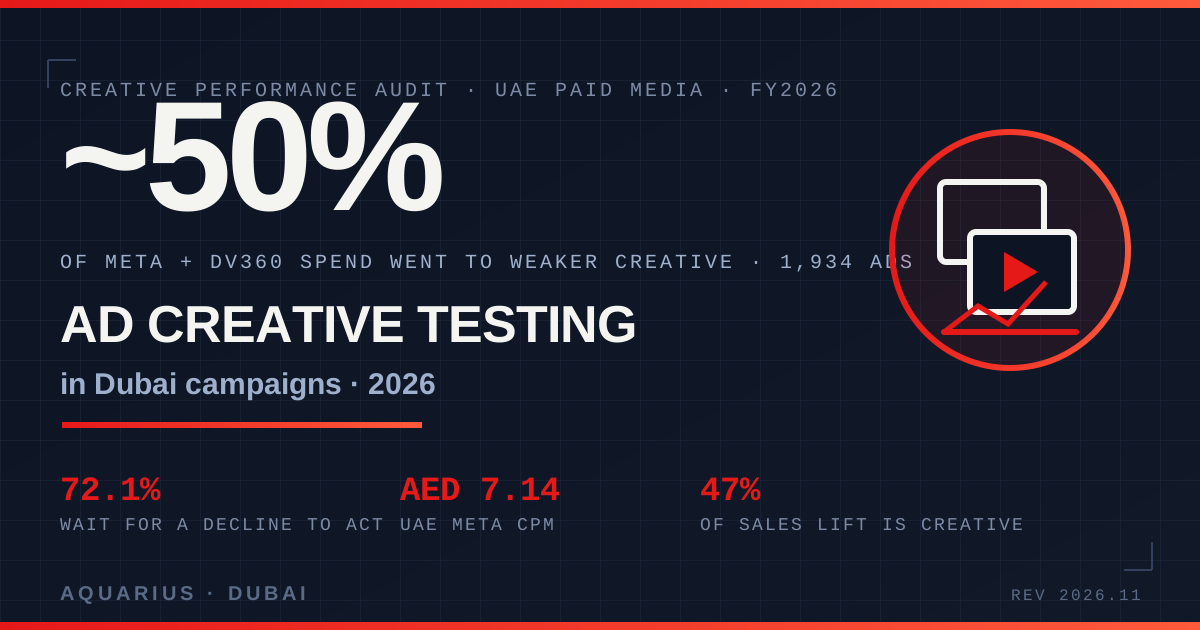
Short answer: A Dubai campaign in 2026 needs a creative pipeline, not a creative project. Research across 1,934 ads by Kroger, Vidmob and MMA Global found that roughly half of historical Meta and DV360 spend went to the weaker half of the creative — and an EMARKETER/Perion survey of 111 marketers each managing over US$5 million in media found 72.1% only change creative after performance has already dropped. Budget AED 4,000–18,000 a month for a working creative pipeline in the UAE, against media CPMs of roughly AED 5.78–7.14. The creative, not the targeting, is where the money is won.
Key takeaways
- Creative is ~47% of sales lift; targeting is 9%. Nielsen's 500-campaign study found marketers guess creative contributes 17%. They are off by a factor of nearly three.
- Half your spend is probably funding your losers. The Vidmob/Kroger/MMA model classified high- versus low-converting ads with 81% accuracy on ads it had never seen.
- Meta deleted the "six creatives per ad set" rule in July 2025. The guidance now is asset diversity, not a magic number. Anyone still quoting six is reading 2024 documentation.
- Meta will tell you when creative dies — for free. The Creative Fatigue label fires when cost per result is at least double what it used to be. Creative Limited fires earlier.
- UAE impressions are cheap; UAE attention is not. With 12.5 million social identities against 11.4 million residents, the same person sees your ad on three platforms. Frequency builds faster here than the dashboard suggests.
The UAE market makes creative the deciding variable
Start with the reach numbers, because they explain why Dubai advertisers burn through creative faster than their global benchmarks predict. DataReportal's Digital 2026 report puts the UAE at 11.4 million residents and 11.3 million internet users — 99% penetration, with 12.5 million social media user identities, about 110% of the population. Platform ad reach: TikTok 12.5 million adults, LinkedIn 10.0 million members, Facebook 9.70 million, YouTube 8.37 million, Instagram 8.05 million, Snapchat 5.13 million.
Read that as an advertiser, not a statistician. There is no untapped audience to expand into. A UAE-wide campaign is effectively addressing the same 11 million people on every platform you buy, which means your effective frequency is higher than any single platform reports. You cannot escape fatigue by widening the audience, because the audience is already everyone.
Meanwhile the money keeps arriving. UAE digital ad spend is forecast at US$2.64 billion in 2026, up 15.2% year on year. More spend chasing a fixed population means rising frequency across the board. The lever that still moves is what the ad actually says.
And that lever is bigger than most Dubai marketing managers think. Nielsen's study of 500 campaigns across TV, digital, print and radio attributed 47% of a campaign's sales contribution to the creative itself, 15% to brand, and just 9% to targeting — while marketers and agencies surveyed estimated creative at only 17%. Every hour your team spends re-cutting audiences is an hour spent on the 9% lever.
What the data says about how creative actually decays
Here is the part worth paying for. In July 2025 Meta removed its long-standing recommendation of six creatives per ad set from its help documentation; the article now simply advises keeping assets diverse. At the same time it shipped tooling that makes decay visible: the Creative breakdown report, introduced 11 July 2025, reports cost per result for each individual image or video inside a flexible-format ad.
Meta also labels the problem directly. In practice the two labels work like this: Creative Fatigue appears when cost per result is at least twice what it has been historically, and Creative Limited appears when cost per result is higher than before but less than double. Meta does not publish a frequency threshold behind either label, which is exactly why you still need your own trigger.
Most advertisers do not have one. The EMARKETER and Perion survey fielded in February 2026 among 111 US marketers each managing more than US$5 million in media found that 72.1% wait for a performance decline before changing creative and only 11.7% use AI-driven performance signals to trigger a refresh. By the time cost per result has doubled, you have already paid for the decline.
The cost of that passivity has been measured. The Kroger, Vidmob and MMA Global study of 1,934 ads found that roughly half of historical Meta and DV360 spend went to lower-performing creatives, and their classification model identified high- versus low-converting ads with 81% accuracy on ads it had not seen before. The waste is not subtle, and it is predictable in advance.
One more myth to retire while we are here: platform creative scores are not performance scores. Google's internal data claims lifting Ad Strength from Poor to Excellent delivers 15% more conversions on average — but Optmyzr's September 2024 analysis of over one million ads across 22,000 accounts found responsive search ads rated merely Average beat Excellent-rated ads on cost per acquisition, conversion rate and ROAS, with no clear correlation between Ad Strength and performance. Optimise for results, not for a green label.
What creative actually costs in Dubai
Real 2026 AED ranges for creative production in the UAE market, from single assets to a running pipeline:
| Asset type | Typical Dubai cost (AED) | Realistic output |
|---|---|---|
| Static image / carousel variant | AED 150–600 per asset | Same-day; best for message and offer tests |
| UGC-style short vertical clip | AED 1,500–8,000 each | 3–7 days; the workhorse of UAE social |
| Studio-produced brand video | AED 10,000–30,000 | 2–4 weeks, crew and permits included |
| AI-generated variant set (from existing footage) | AED 400–2,500 per batch | 24–72 hours; volume, not originality |
| Monthly creative pipeline retainer | AED 4,000–18,000/month | 8–25 new assets, testing plan, weekly reporting |
Put that next to the media side. Typical UAE benchmarks put YouTube at about AED 5.78 CPM, TikTok AED 6.46 and Meta AED 7.14. An advertiser spending AED 40,000 a month on Meta is buying roughly 5.6 million impressions into a country of 11.4 million people. You will exhaust creative novelty long before you exhaust reach — which is the entire argument for spending 10–20% of media on creative supply instead of 2%.
How to run creative testing in a UAE account
In order of return on effort, this is what works in Dubai accounts:
- Set the refresh trigger before you launch. Write the number down: when cost per result rises 40% above the trailing 14-day average, the asset is retired — not when it doubles, and not when someone notices. You are trying to be in the 27.9%, not the 72.1%.
- Test one variable per asset. Hook, offer, format, language. A test that changes the voiceover, the first frame and the CTA tells you nothing you can reuse.
- Treat Arabic as a creative variant, not a translation. In a bilingual market the Arabic cut regularly outperforms the English original at the same CPM. Run both from day one and let the data allocate.
- Keep a bench. Two or three approved assets sitting ready means a fatigue signal triggers a swap the same day instead of a three-week production cycle. This is the single biggest structural advantage of a retainer over project work.
- Use AI for volume, humans for the hook. Nearly 10 million advertisers used at least one of Meta's generative AI creative tools in Q3 2026, and adoption of its video-generation features grew 25% quarter over quarter. That is excellent for producing 20 variants of a concept that already works, and useless for finding the concept.
- Plan around the UAE calendar. Ramadan, the Dubai Shopping Festival and GITEX all compress CPM and attention at once. Creative built in week three of a peak is creative that arrives late — our Dubai Meta Ads cost guide and TikTok Ads cost breakdown cover the seasonal bid pattern.
What this is worth in AED
The honest BOFU maths. Meta ran randomised controlled experiments across more than one million ad campaigns from 13–20 April 2026 and reported that every US$1 spent on Meta generated US$4.13 in downstream revenue, a 25% improvement since 2022. It is an average across wildly different industries, so treat it as a ceiling, not a promise.
Now apply the waste figure. An advertiser spending AED 40,000 a month in media — AED 480,000 a year — with roughly half flowing to the weaker half of the creative set, is misallocating on the order of AED 240,000 a year. A creative pipeline at AED 10,000 a month costs AED 120,000. You do not need to eliminate the waste; recovering a third of it pays for the pipeline and leaves change.
If your traffic is fine and the drop-off is after the click, the bottleneck is not creative — start with CRO instead. If you need the assets themselves rather than the testing system, our Dubai video production cost guide prices the shoot. And if your reporting looks healthy but the leads are not real, read the UAE invalid-traffic numbers first — no creative fixes bot clicks.
FAQ
How many ad creatives does a Dubai campaign need per month?
There is no official number any more — Meta removed its six-creatives-per-ad-set recommendation in July 2025 and now advises asset diversity instead. In practice, scale to spend: a UAE advertiser under AED 20,000 a month can sustain on 4–8 new assets, while AED 75,000+ accounts need weekly additions to stay ahead of frequency in an 11-million-person market.
How do I know my creative has fatigued?
Meta labels it for you: Creative Fatigue appears when cost per result is at least twice its historical level, and Creative Limited when it is higher but less than double. Do not wait for either. Use the Creative breakdown report, live since 11 July 2025, to see cost per result per asset and retire assets at a 40% rise, not a 100% one.
Is AI-generated ad creative good enough for UAE campaigns?
For volume, yes — nearly 10 million advertisers used Meta's generative AI creative tools in Q3 2026 and video-generation adoption grew 25% quarter over quarter. For the concept and the first three seconds, no. Use AI to multiply a winner into 20 variants and localise it into Arabic, and keep a human on the hook and the offer.
Should I trust Ad Strength or creative scores?
Treat them as hygiene checks, not performance predictions. Google reports a 15% average conversion lift moving Poor to Excellent, but Optmyzr's analysis of over a million ads across 22,000 accounts found Average-rated responsive search ads beating Excellent-rated ones on CPA, conversion rate and ROAS, with no clear correlation overall.
Does creative or targeting matter more in the UAE?
Creative, and not by a small margin. Nielsen's 500-campaign study attributed 47% of sales contribution to creative against 9% to targeting. In the UAE the gap is wider still, because at 99% internet penetration and 110% social-identity saturation there is almost no incremental audience left to target into.
The bottom line for Dubai advertisers
In a market where everyone is already reachable and media prices only go up, creative supply is the last real variable. The advertisers who win in 2026 are not the ones with better audiences — they are the ones who decided their refresh trigger in advance, kept a bench of approved assets, and stopped funding the half of their creative set that was quietly losing.
Aquarius builds and runs that pipeline for UAE accounts: the testing plan, the assets, the weekly fatigue review, and the honest call on when a concept is finished. See pricing, browse what we build, or send us your ad account and we will tell you which half of your creative is paying for itself.