
Affiliate and Referral Program Software in Dubai (2026): Real AED Costs, Tracking That Survives Safari, and the Permit Trap
Partners drive about 23% of revenue for brands that run programs properly. Real AED costs to build affiliate and referral software in Dubai in 2026, plus the Advertiser Permit rule now on your side.
- PUBLISHED
- 08 OCT 2026
- READ TIME
- 12 MIN
- AUTHOR
- AQUARIUS · DUBAI
- UNIT
- REV 2026.09
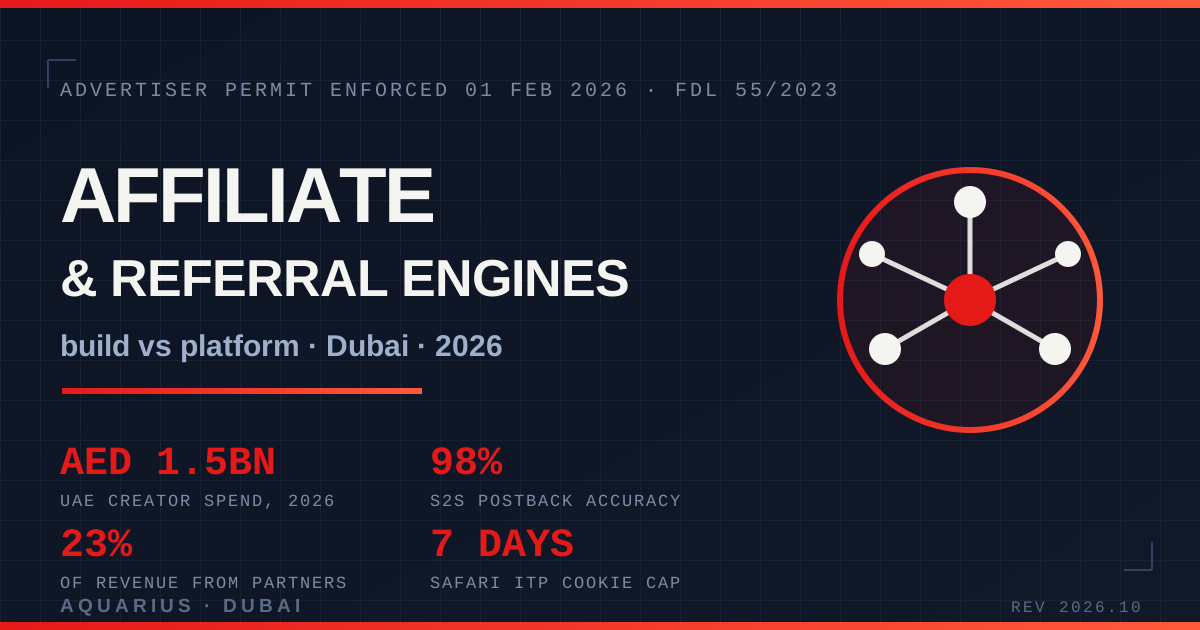
Short answer: A referral or affiliate program bolted onto an existing Dubai store using an off-the-shelf platform costs roughly AED 4,000–25,000 a year in subscription plus a percentage of every affiliate sale. A custom-built, server-side tracked affiliate engine wired into your own checkout, VAT invoicing and payouts costs AED 45,000–180,000 to build in Dubai in 2026 and nothing per transaction after that. The break-even is simple: once your affiliate channel clears roughly AED 1.5–2 million a year in tracked sales, percentage fees on a hosted platform cost more than owning the system. The expensive mistake is not the software though — it is paying partners who publish promotional content without an Advertiser Permit, a rule enforced since 1 February 2026.
Key takeaways
- The channel is proven, not experimental: 81% of brands worldwide now run some form of affiliate program and advertisers report partners contributing around 23% of revenue on average. Affiliate marketing drives 16% of all US e-commerce sales.
- The UAE slice is small but compounding: the UAE affiliate market was about USD 244 million in 2025, heading for USD 503 million by 2033 at a 9.5% CAGR — roughly 1.3% of the global affiliate market against an e-commerce base of USD 12.3 billion in 2026.
- Percentage fees are the real price: Refersion charges 3% of affiliate sales on its entry plan, Impact.com 2.5% on Starter. On AED 2 million of tracked sales that is AED 50,000–60,000 a year on top of subscription.
- Browsers break naive tracking: Safari ITP caps JavaScript-set first-party cookies at 7 days, and at one day on a flagged cross-site landing carrying a query string. Server-to-server postbacks hold above 98% accuracy regardless of browser or ad blocker.
- Compliance sits on your side too: under Federal Decree-Law No. 55 of 2023, anyone publishing promotional content from inside the UAE needs an Advertiser Permit — and the obligation is triggered by commercial intent, which explicitly includes referral links and affiliate deals.
Dubai brands pay creators like media buyers and track them like nobody
Three numbers frame the opportunity, and they do not point in the same direction.
- UAE creator spend is now institutional. The UAE influencer marketing market is valued at roughly AED 1.5 billion entering 2026, growing around 20% year on year, with 59% of UAE brands allocating up to AED 250,000 a year to it and an estimated 38% of digital marketing budgets going to creator partnerships in 2025.
- Social is already the storefront. 69% of UAE shoppers have purchased directly through social media and 67% used mobile for their most recent retail purchase. The traffic is arriving through other people’s audiences whether or not you have a program to measure it.
- But the affiliate infrastructure is thin. The UAE accounts for about 1.3% of the global affiliate market while global affiliate spend has passed USD 18.5 billion and US spend alone is forecast at USD 13.81 billion in 2026, up 11.3% from USD 12.42 billion. The gap is not demand. It is tooling.
Here is what most Dubai businesses get wrong. They treat a creator deal as a campaign — a flat fee, a discount code, a screenshot of reach — instead of a measured channel. A flat fee has no feedback loop. A bare discount code tells you a coupon was used, not who sent the customer, whether the sale survived the return window, or which of your fourteen partners is actually profitable. UAE influencer campaigns averaged a 5.8:1 ROI in e-commerce during 2025, while brands running structured affiliate programs globally report averages in the range of USD 6.50 to USD 15 returned per USD 1 spent. The distance between those two bands is almost entirely attribution quality and the ability to pay for outcomes instead of impressions.
The rule that moved onto your side of the contract on 1 February 2026
Under Federal Decree-Law No. 55 of 2023 on media regulation, anyone publishing advertising content from inside the UAE needs a valid Advertiser Permit from the UAE Media Council. The compliance deadline was extended to 31 January 2026 and the framework has been enforced since 1 February 2026. Three details matter to a program owner:
- It is triggered by commercial intent, not by payment. Referral links, affiliate links, gifted product, barter and hosted stays all count. “We never paid them cash” is not a defence.
- Follower count is irrelevant. A nano-creator with 3,000 followers posting your affiliate link is in scope — which matters because over 60% of UAE brands are increasing nano and micro-influencer budgets in 2026, precisely the tier least likely to be licensed.
- Permit costs sit with the partner; reputational exposure does not stay there. Individual permit issuance runs around AED 1,000, on top of a trade or freelance licence commonly AED 5,000–15,000. First-offence fines for publishing without one typically run AED 3,000–10,000, with exposure climbing toward AED 1 million for serious non-compliance.
The software consequence is unglamorous but concrete: your partner record needs a permit-number field, a licence-expiry date, and a rule that suspends link generation and payouts when it lapses. Platforms built for the US market have no such field, and you cannot bolt a compliance gate onto a system that will not let you add one.
Platform or build? The honest comparison
Hosted affiliate platforms are the right answer below roughly AED 1.5 million in annual tracked sales. Above that, the percentage fee quietly becomes the largest line in your martech budget. Current published pricing, converted at AED 3.67 to the dollar:
| Option | Subscription | Transaction fee | Annual cost at AED 2m tracked sales |
|---|---|---|---|
| Refersion Launch | USD 39/mo | 3% of affiliate sales | ~AED 61,700 |
| Refersion Growth | USD 199/mo | 2% of affiliate sales | ~AED 48,800 |
| Impact.com Starter | USD 30/mo | 2.5% of tracked actions | ~AED 51,300 |
| Impact.com Essentials / Pro | USD 500–2,500/mo | Plan-dependent | AED 22,000–110,000 |
| Tapfiliate Launch / Scale | USD 89–179/mo | None | AED 3,900–7,900 |
| Post Affiliate Pro Starter / Pro | USD 89–139/mo | None | AED 3,900–6,100 |
| PartnerStack Launch / Growth | USD 1,000–1,520/mo (annual) | Custom | AED 44,000–67,000+ |
| Custom build (owned) | Hosting ~AED 300–900/mo | None | AED 3,600–10,800 after build |
Read that table as a decision, not a ranking. A flat-fee platform like Tapfiliate or Post Affiliate Pro is genuinely hard to beat on cost alone. What it cannot do is enforce an Advertiser Permit gate, issue UAE-compliant commission documentation, run a properly bilingual Arabic partner portal, or post commissions into your own ledger with a TRN attached. Those are the reasons Dubai businesses end up building — reasons about fit, not price.
Tracking that survives real browsers
Google confirmed in April 2025 that it would not deprecate third-party cookies, and retired Privacy Sandbox on 17 October 2025. That sounds like a reprieve and is not one. Safari ITP and Firefox ETP still strip roughly 30–35% of trackable traffic, and Safari is heavily over-represented in exactly the high-income iPhone audience Dubai e-commerce sells to. ITP caps every persistent cookie written through document.cookie at 7 days, dropping to one day when the visitor arrives from a domain classified as having cross-site tracking capability and the landing URL carries a query string — which is what an affiliate link is.
So a 30-day cookie window is fiction on Safari unless the cookie is set server-side. What holds up is a server-to-server postback architecture: click IDs persisted server-side, first-party cookies set by HTTP response rather than JavaScript, and conversions confirmed from your backend rather than the browser. That approach measures above 98% accuracy independent of browser, ad blocker or consent state. Our guide to server-side tracking costs in Dubai covers the infrastructure side.
The three leaks that eat affiliate margin
- Coupon and cashback last-click theft. A coupon site that intercepts checkout gets credited for a sale your creator produced. Fix it with commission tiers by partner type and a rule that demotes coupon-sourced last clicks when an earlier content click exists in the same session chain.
- Returns paid out as commissions. Dubai fashion and electronics return rates make this material. Commissions must lock only after the return window closes, not at order confirmation.
- Self-referral and fake accounts. Referral programs offering store credit attract exactly the behaviour you would expect. Device, payment-instrument and address fingerprinting at approval time costs days of engineering and saves a per-sale percentage forever.
What it costs to build in Dubai, and what the money buys
Our build ranges for 2026, assuming an existing e-commerce store or SaaS product to wire into:
| Scope | What you get | Timeline | AED |
|---|---|---|---|
| Referral engine (customer-get-customer) | Unique codes and links, double-sided reward, fraud screens, store-credit ledger, email and WhatsApp share flow | 3–5 weeks | 45,000 – 85,000 |
| Affiliate program, core | Partner portal (EN/AR), server-side click tracking, commission rules, return-window holds, permit and licence fields, payout export | 6–9 weeks | 85,000 – 150,000 |
| Partner platform, full | Multi-tier commissions, coupon-leak rules, creative library, self-billed VAT invoicing, automated payouts, partner analytics, network API | 10–16 weeks | 150,000 – 320,000 |
| Tracking and attribution layer only | S2S postbacks, click-ID persistence, server-side GTM, dedupe against paid channels | 2–4 weeks | 30,000 – 65,000 |
| Migration off a hosted platform | Partner and historical-conversion import, link preservation with redirects, parallel-run reconciliation | 2–3 weeks | 25,000 – 55,000 |
Two tax points decide how the payout module must be built, and both get missed routinely:
- VAT at 5% cuts both ways. A UAE-resident, VAT-registered affiliate must invoice you 5% VAT on commission, and you need a valid tax invoice carrying their TRN to recover it. A non-resident affiliate charges nothing, and you self-account for 5% under the reverse charge mechanism on your own return. Most affiliate platforms produce a commission statement, not a document the FTA accepts — so self-billing with correct TRN capture belongs in the system, not in a spreadsheet at quarter end.
- Withholding tax is 0%, corporate tax is not. The UAE applies a 0% withholding tax on service fees paid to non-residents, so paying overseas affiliates carries no deduction obligation. But commissions are only deductible against the 9% corporate tax on taxable income above AED 375,000 if they are documented against a real supply. A payout log is not documentation.
Worth planning for now: UAE e-invoicing Phase 1 goes live 1 January 2027 for businesses with revenue of AED 50 million or more, with an accredited service provider appointed by 30 October 2026, and Phase 2 follows on 1 July 2027. Self-billed affiliate commission documents are in scope. Building the payout module with no XML export path means rebuilding it within a year.
How Aquarius builds it
We build the tracking layer first and the dashboard last, because an affiliate program with beautiful reporting over broken attribution is worse than no program — it produces confident decisions from wrong numbers. In practice: click IDs resolved server-side before anything renders, conversions confirmed from your backend, commissions held until the return window closes, and a partner record that carries the Advertiser Permit number and expiry as a payout precondition. Consent and tracking disclosure follow the UAE PDPL requirements from day one rather than being retrofitted after a complaint. If you are weighing this against a loyalty play, our breakdown of loyalty and rewards app builds in Dubai covers where the two overlap, and our pricing page lists current engagement rates.
On the cost of inaction: if partners contribute roughly 23% of revenue for brands that run programs properly, an AED 10 million Dubai store with no measured partner channel is not missing a marketing experiment. It is leaving a channel-sized hole in the top line while paying creators flat fees it cannot attribute.
FAQ
Do I need an Advertiser Permit if affiliates promote my products but I never post promotional content myself?
Your affiliates do, and that is the exposure to manage. Under Federal Decree-Law No. 55 of 2023 the permit obligation attaches to whoever publishes promotional content from inside the UAE, and it is triggered by commercial intent — affiliate links and referral deals included. A business promoting only its own services through its own licensed channels generally sits outside the individual permit requirement, but the moment a third party publishes on your behalf, your program terms should require their permit number and your system should enforce it. Confirm your specific position with a licensed advisor.
Is 5% VAT charged on affiliate commissions in the UAE?
Yes, where the affiliate is a UAE-resident VAT-registered person supplying marketing services to you: they invoice commission plus 5% VAT and you need the tax invoice with their TRN to recover input tax. Where the affiliate is outside the UAE, the reverse charge mechanism applies and you self-account for the 5% on your own return. Build the distinction into the partner record, because it changes which document you must produce.
Should I use discount codes or tracked links for Dubai creators?
Both, together. Codes survive Instagram and TikTok environments where links are awkward and parameters get stripped; tracked links give you session-level attribution and new-versus-returning customer data that codes cannot. Issue a unique code and a unique server-side-tracked link per partner, then deduplicate so one sale pays one commission.
What is a realistic commission rate for a UAE e-commerce program?
It depends almost entirely on gross margin, and the honest method is to work backwards: decide what you can pay per acquired customer, then express it as a percentage. What the data gives you is the benchmark to beat — structured affiliate programs globally report returns in the USD 6.50 to USD 15 per USD 1 range, against 5.8:1 for UAE influencer campaigns in 2025. If your program cannot clear the flat-fee creator deals it replaces, the rate is rarely the problem; the attribution is.
How long before an affiliate program pays for itself?
For a referral engine at AED 45,000–85,000, the trigger is usually the size of your existing happy-customer base rather than elapsed time — programs recoup inside one to two quarters when there is an active base to activate. For a full affiliate platform, the subscription-versus-build break-even sits near AED 1.5–2 million a year in tracked affiliate sales, where 2–3% transaction fees start to exceed the amortised build cost.
Where to start
If you are running creator deals on flat fees and screenshots, start with the attribution layer — AED 30,000–65,000, two to four weeks — and let real numbers tell you whether the full program is worth building. If you already have partners and a hosted platform taking 2–3% of every sale, the migration maths is probably already in your favour. Either way, add the permit field before you add the dashboard.
Tell us your channel mix and tracked sales volume and we will tell you in one call whether you should build this or stay on a platform. We will say stay if staying is right.