
AI Crawler Rules on .ae Sites: We Scanned 510 Live robots.txt Files (2027)
First-hand scan of 787 Tranco .ae hosts: 86.9% of 510 live robots.txt files leave AI training crawlers fully open, only 35 carry a Content-Signal line, and 134 ship an llms.txt with no crawler policy behind it.
- PUBLISHED
- 25 NOV 2026
- READ TIME
- 12 MIN
- AUTHOR
- AQUARIUS · DUBAI
- UNIT
- REV 2026.09
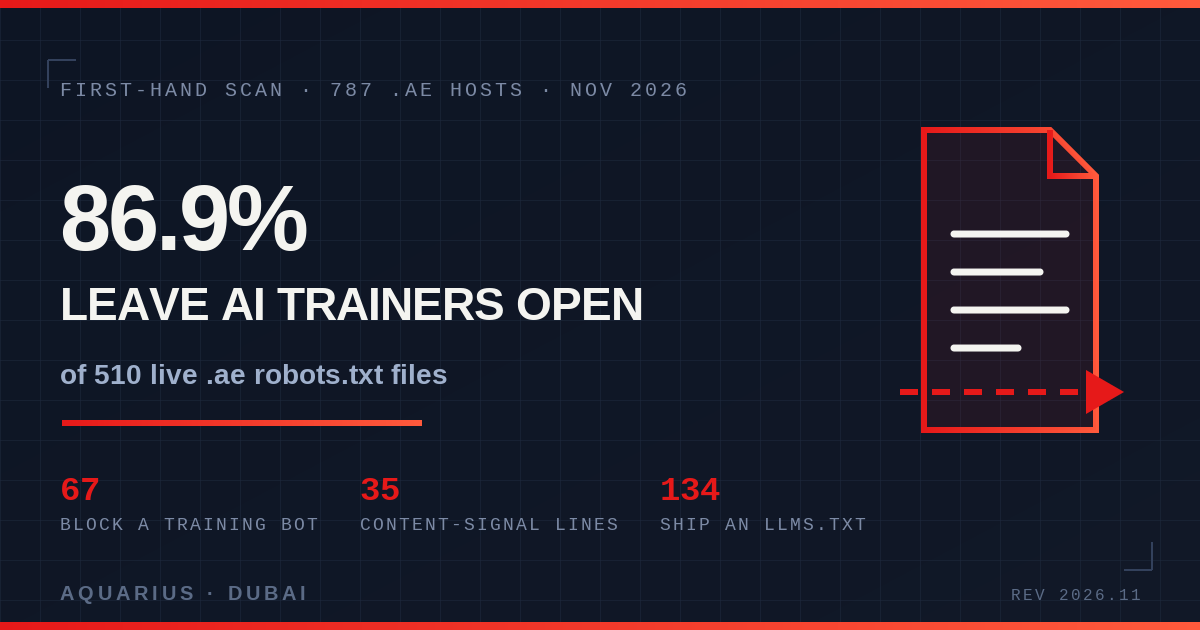
We fetched robots.txt from 787 Tranco-ranked .ae hosts on 25 November 2026. 510 served a valid file — and 443 of them (86.9%) leave every AI training crawler completely unblocked. Only 67 .ae sites fully disallow a single training bot, only 35 carry a Content-Signal line, and not one host in the sample publishes an ai-catalog.json. The UAE web has effectively opted in to AI training by silence.
That silence is a choice, not a default anyone chose. Below is the full first-hand dataset, what the numbers mean for a Dubai business, and the one legal detail that makes the standard Cloudflare advice land differently in the UAE than in Europe.
What we measured, and what the numbers cannot tell you
We took the Tranco top-ranked .ae domains (787 hosts), requested /robots.txt over HTTPS with an HTTP fallback, and discarded anything that returned an HTML error page dressed up as a text file. 687 hosts answered at all; 510 returned a real robots.txt; 177 answered but had no robots.txt to give. We parsed every User-agent block, every Disallow, and every Content-Signal comment, then separately probed /llms.txt and /ai-catalog.json.
Two honest limits. First, requests came from a single European vantage point on one day, so a site using geo-specific edge rules might serve Dubai visitors something different. Second — and this matters more — robots.txt is a request, not a fence. We measured what .ae sites ask AI crawlers to do. We did not measure obedience, and several crawlers in this list have a documented habit of ignoring the ask.
The .ae AI-access picture: 140 sites have an opinion, 370 do not
Of the 510 live robots.txt files, 140 (27.5%) name at least one AI crawler. That is already well ahead of the open web: the 2025 Web Almanac found GPTBot named in roughly 4.5% of desktop robots.txt files, and Ahrefs' crawl of ~140 million sites put explicit GPTBot directives near 5.9%. UAE sites are five times more likely than average to have thought about this at all — which fits a market where Microsoft's 2026 AI Diffusion Report put UAE AI usage at 73.3% of the population against an 18.8% global average.
Naming a bot is not the same as blocking it. Here is the gap, bot by bot, across the 510 files:
| Crawler | Purpose | Named in robots.txt | Fully disallowed |
|---|---|---|---|
Bytespider | ByteDance training | 101 | 49 |
CCBot | Common Crawl corpus | 93 | 40 |
GPTBot | OpenAI training | 70 | 39 |
ClaudeBot | Anthropic training | 67 | 39 |
Google-Extended | Gemini training | 55 | 32 |
meta-externalagent | Meta training | 51 | 38 |
Amazonbot | Alexa / training | 46 | 35 |
Applebot-Extended | Apple training | 44 | 34 |
PerplexityBot | AI answers | 34 | 2 |
OAI-SearchBot | ChatGPT search index | 30 | 1 |
Read the bottom two rows twice. OAI-SearchBot is named by 30 .ae sites and fully blocked by exactly one. PerplexityBot is named by 34 and blocked by two. Meanwhile 67 sites slam the door on at least one training crawler, and 62 of those 67 deliberately leave the answer engines open. Only five .ae sites block both.
That 62-to-5 split is the most encouraging number in the whole scan, because it is the configuration that actually makes commercial sense: refuse to donate your content to a model, keep the door open to the crawler that can send a buyer to your checkout. The sites getting this wrong are not the ones blocking too much — they are the 370 that said nothing at all.
Content-Signal: 35 sites, and 34 of them did not type it themselves
Cloudflare's Content Signals Policy adds machine-readable intent on top of a plain allow/deny: a comment line declaring whether you permit search, ai-input (retrieval for an AI answer) and ai-train. When Cloudflare switched it on in late September 2025, roughly 3.8 million domains inherited the default search=yes, ai-input=yes, ai-train=no overnight.
The .ae footprint is thin and almost entirely inherited. 35 hosts (6.9%) carry at least one Content-Signal line; 34 of those 35 are served through Cloudflare. Across 48 declarations in total:
| Declared value | Lines | What it says |
|---|---|---|
search=yes, ai-train=no, use=reference | 27 | Index me, cite me, don't train on me |
ai-train=yes, search=yes, ai-input=yes | 16 | Everything permitted, including training |
ai-train=no + other combinations | 5 | Training refused, phrasing varies |
One in three Content-Signal declarations on .ae actively grants training rights. In most cases that is an untouched platform default rather than a negotiated position — which is precisely the problem. Cloudflare reported in September 2026 that fewer than 1% of its sites block search crawlers while about 17% restrict AI training, and that 36.6% of crawler traffic now comes from mixed-use bots that index and train from the same fetch. If you never declare an intent, a mixed-use crawler gets to assume one.
The .gov.ae subset is the starkest cut in the dataset: 37 government hosts served a robots.txt, and only two name any AI crawler at all. One blocks a trainer. One carries a Content-Signal line, inherited from Cloudflare.
The UAE legal twist nobody copies into the Cloudflare tutorial
Cloudflare's own framing leans on European law: Article 4 of the EU Copyright Directive lets anyone text-and-data-mine lawfully accessible content unless rights are reserved in a machine-readable way. In the EU, your robots.txt line is that reservation. It has legal weight.
The UAE has no equivalent. Federal Decree-Law No. 38 of 2021 on Copyright and Neighbouring Rights contains no general text-and-data-mining exception and no statutory machine-readable opt-out mechanism. Reproducing a protected work to train a commercial model is, by default, prima facie infringement that needs a licence or a narrow statutory exception — you are not required to post a sign to keep the right.
For a Dubai business, the robots.txt AI block is not what preserves your rights. It is what preserves your evidence, your search visibility, and your bandwidth bill. Your copyright already exists without it.
That reframes the decision usefully. Because the legal downside of staying silent is lower in the UAE than in Berlin, the only honest reason to configure this is the commercial one: controlling which machines get to resell your expertise, and making sure the ones that send traffic are explicitly welcome. We go deeper on the economics, including pay-per-crawl, in AI crawler control and pay-per-crawl for Dubai websites.
llms.txt: 134 .ae sites publish one, 113 of them contradict it
The surprise of the scan: 134 of the 510 hosts (26.3%) publish an /llms.txt. We did not trust that number, so we re-probed every one of the 134 with a nonsense control path — a site that returns 200 for everything would fake a hit. All 134 returned a proper 404 for the control path, so all 134 files are real. Only five were plugin-generated by an SEO tool.
Then the contradiction: just 21 of those 134 sites also block a single AI training crawler. The remaining 113 are hand-feeding models a curated map of their best content while declining to state any terms for its use. An llms.txt without a crawler policy is a menu with no prices.
Two more findings worth noting. ai-catalog.json — the emerging agent-discovery manifest — appeared on zero of 787 hosts. And 397 files (77.8%) still declare a sitemap, so the basic hygiene is there; it is only the AI layer that is missing. Fifty-eight hosts, oddly, send Disallow: / to all user agents. If the underlying delivery stack is the thing you want to fix first, our scan of speed headers on 506 .ae homepages covers that layer.
What to ship, and what it costs in Dubai
This is a half-day job, not a project. The sequence we use:
- Decide per bot, not per category. Block the pure trainers (
GPTBot,ClaudeBot,CCBot,Bytespider,Google-Extended,Applebot-Extended,meta-externalagent,Amazonbot). Keep the answer crawlers (OAI-SearchBot,ChatGPT-User,PerplexityBot) allowed — they cite and refer. - Declare intent. Add an explicit
Content-Signal: search=yes, ai-input=yes, ai-train=norather than inheriting whatever your CDN decided. Edit the string if you actually want training licensing conversations. - Make the allowed crawlers' job easy. A real llms.txt pointing at your service, pricing and contact pages, clean headings, and prices stated as text rather than baked into images.
- Verify from the UAE. Fetch your own robots.txt from a Dubai IP, then check server logs for which agents actually changed behaviour.
| Scope | Indicative Dubai cost (AED) | Timeline |
|---|---|---|
| robots.txt + Content-Signal audit and rewrite | 1,500 – 3,500 | 1 – 2 days |
| llms.txt, structured data and AI-citability pass | 4,000 – 9,000 | 1 week |
| Monthly crawler-log monitoring and policy upkeep | 2,500 – 4,500 / month | Ongoing |
The upside is not hypothetical. Semrush put the value of an AI-referred visitor at up to 4.4× a traditional organic visitor, and while independent measurements are more modest — Siege Media found roughly 1.26× conversion, Adobe reported about 60% higher retail engagement — every credible study points the same direction: AI referrals convert better than average search traffic. In a market where UAE e-commerce is projected to grow from AED 42.2 billion in 2025 to AED 67.2 billion by 2030, being the .ae site an answer engine is allowed to cite is a cheap edge.
How Aquarius does it
We run this scan as a standing benchmark, so when we write your AI-access policy we are comparing you against 510 real .ae competitors rather than a generic template. You get the robots.txt diff, the Content-Signal decision in writing, an llms.txt built from your actual money pages, and a log-based check two weeks later confirming which crawlers changed behaviour. If the directives are not live and verifiable from a UAE vantage point, you do not pay for that stage.
See transparent pricing or send us your domain — we will tell you for free which of the eight training crawlers can currently read your entire site.
FAQ
Does blocking GPTBot hurt my Google rankings?
No. GPTBot and Google-Extended are training crawlers with no role in Google Search ranking, and Googlebot is a separate agent. Blocking trainers while allowing Googlebot, OAI-SearchBot and PerplexityBot keeps every search and answer surface intact. Cloudflare's own data shows under 1% of sites block search crawlers — nobody serious is doing that.
Is robots.txt legally binding in the UAE?
It is not a contract, and the UAE has no machine-readable opt-out statute of the kind the EU created. But Federal Decree-Law No. 38 of 2021 gives you copyright without requiring any notice, and an explicit, dated, published refusal is useful evidence that use was unauthorised. Treat it as documentation plus traffic control, not as a lock.
Should a Dubai business publish an llms.txt?
Yes, if you first decide your crawler policy. 113 of the 134 .ae sites with an llms.txt block no training crawler at all, which is the wrong order of operations. Set the rules, then publish the map.
How do I know the crawlers are obeying my robots.txt?
Server logs. Filter by user agent and compare the fortnight before and after the change. Well-behaved agents disappear within days; anything still fetching after that needs enforcement at the edge, not in a text file.
What is Content-Signal and do I need Cloudflare for it?
It is a comment line in robots.txt stating permitted uses — search, AI input, AI training. Any server can emit it; you do not need Cloudflare. In our scan 34 of the 35 .ae hosts carrying one got it automatically from Cloudflare, which is why so few of them reflect a real decision.
Scan method: /robots.txt, /llms.txt and /ai-catalog.json requested from 787 Tranco-ranked .ae hosts on 25 November 2026; 687 responded, 510 served a parseable robots.txt. llms.txt hits were control-verified against a nonsense path to exclude catch-all 200 responses.