
AI Voice Agents for Dubai Businesses (2026): TDRA Carrier Rules, Arabic Dialect Accuracy and Real AED Costs
UAE businesses answer only 37.8% of inbound calls. Real 2026 per-minute costs in AED, the TDRA carrier rule nobody checks, and what a bilingual voice agent costs to build in Dubai.
- PUBLISHED
- 05 OCT 2026
- READ TIME
- 12 MIN
- AUTHOR
- AQUARIUS · DUBAI
- UNIT
- REV 2026.09
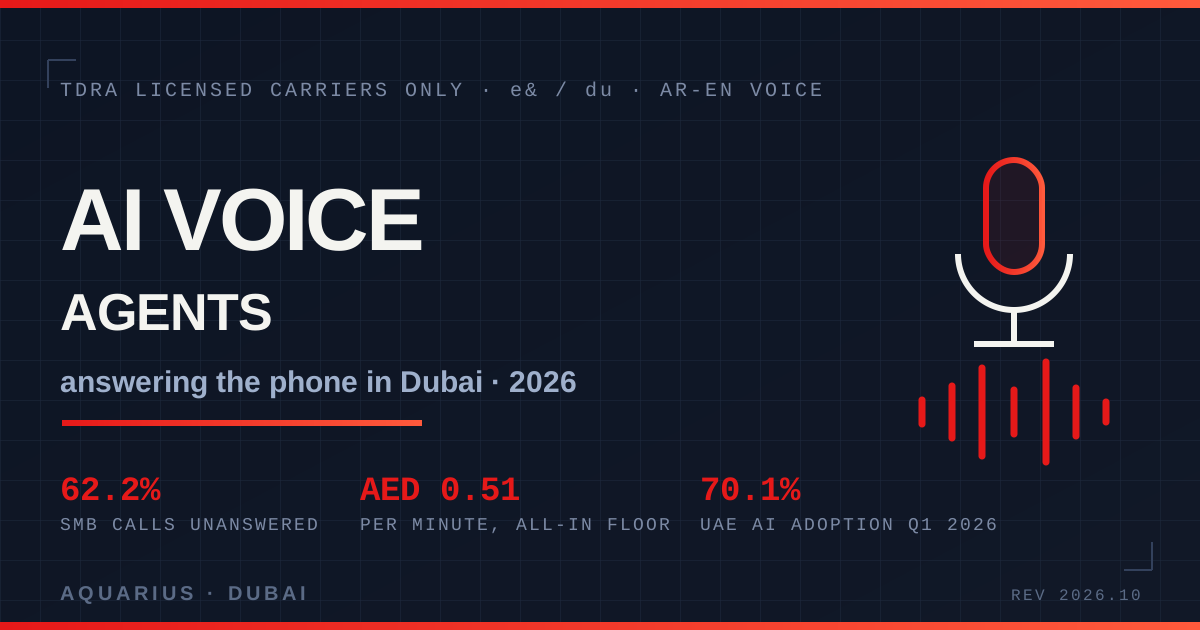
Short answer: an AI voice agent that answers your Dubai phone line costs roughly AED 0.51 to AED 1.21 per minute to run and AED 18,000 to AED 140,000 to build properly, against a Dubai call-centre agent at about AED 3,472 a month who covers one shift and one language well. The economics are not the hard part. The hard parts are that UAE voice traffic must terminate through a TDRA-licensed carrier — e& (Etisalat) or du, and that generic speech models break on Emirati and Khaleeji Arabic at word error rates above 45%.
Most Dubai businesses that piloted a voice agent in 2026 did it in the wrong order: bought a per-minute platform, pointed a foreign number at it, demoed it in English, then discovered the licensing and dialect problems in production. Below are the real 2026 numbers, the regulatory path, and what the build actually costs in AED.
The phone is still where Dubai revenue leaks
Three numbers set the stakes. First, adoption: Microsoft’s Q1 2026 AI Diffusion Report put UAE AI adoption at 70.1% of the 15–64 population — the first economy in the world past 70%, against a global average of 17.8%. Second, the business layer: the Unlocking the UAE’s AI Potential 2026 study from Strand Partners put business AI adoption at 72%, up from 53% a year earlier, while only 31% of adopters run anything that counts as advanced AI. Third, the inbound gap: small and mid-sized businesses answer only 37.8% of incoming calls, leaving 62.2% to voicemail or nothing, and after hours the miss rate climbs past 60%.
That gap is expensive because callers do not wait. 85% of people whose call goes unanswered never call back, 80% hang up rather than leave a voicemail, and 62% immediately dial a competitor. Industry benchmarks put the immediate lost revenue of a single missed call at USD 125 to USD 350. In Dubai property specifically, answering an enquiry inside 5 minutes makes a lead roughly 21× more likely to qualify than a reply at 30 minutes — while average brokerage response time still runs past four hours, and agencies here estimate 60–70% of potential deals are lost to slow follow-up.
The public sector already moved. DEWA converted 16 of its 21 services to agentic AI in under 90 days — about 76% of its service portfolio — and its Rammas assistant has handled more than 13 million customer enquiries since 2017. KPMG’s UAE Tech Report 2026 found 97% of UAE tech leaders embedding AI agents into workflows or products, against an 87% global average. Your customers are being trained on government-grade automation and then calling your landline.
What an AI voice agent is, and what it is not
A 2026 voice agent is four layers stitched together inside a latency budget: speech-to-text, a language model holding the conversation and calling your systems, text-to-speech, and a telephony path onto the public network. It is not an IVR tree, and it is not your website chatbot with a phone number bolted on. The difference that matters commercially is that it can interrupt, be interrupted, read a calendar, write to a CRM, and hand a live caller to a human mid-sentence with context attached.
Where it earns its keep in Dubai is the boring 70% of inbound: opening hours, directions, price ranges, booking and rescheduling, order and delivery status, document checklists, clinic availability, viewing slots, after-hours triage. Gartner expects conversational AI to cut contact-centre agent labour costs by USD 80 billion across 2026, and the per-interaction gap is stark: roughly USD 0.40 for an automated call versus USD 7 to USD 12 handled by a person — a 90–95% reduction. Adoption is still shallow, though: 88% of contact centres use some AI but only 25% have it fully integrated.
Where it does not earn its keep is anything emotionally loaded. The ServiceNow Consumer Voice Report, which surveyed 17,000 adults across 13 EMEA markets including 1,000 in the UAE, found 47% of UAE consumers saying AI customer service fails to meet expectations and at least 68% preferring a human. Trust is task-shaped: around 23–24% will let a bot book a car service or chase a delayed parcel, but only 13% would trust AI to dispute a suspicious bank transaction, where 43% want to be seen in person. Meanwhile 90% expect seamless service, 89% expect speed, 88% expect accuracy and 76% expect a bot to be available at all. Read together, those numbers do not say do not automate. They say automate the queue, not the crisis, and make the escape hatch to a human obvious.
The TDRA rule nobody checks
Most Dubai businesses get this wrong: they spin up a voice agent on an overseas platform, buy a foreign virtual number, and assume that because the demo call connected, the deployment is fine. In the UAE, voice and video calling must be delivered by a TDRA-licensed carrier or in active collaboration with one, and there are exactly two: e& (Etisalat) and du. That applies to UCaaS platforms, cloud IP PBXs, SIP trunks and contact-centre stacks alike — the voice path has to terminate through a licensed operator. TDRA’s approved-service list covers the usual enterprise tools (Microsoft Teams, Zoom, Google Meet, Cisco Webex, 3CX, Botim among them), but an arbitrary offshore SIP provider pointed at a UAE audience is not on it.
Practically, the number your customers dial should be a UAE number from a licensed carrier. An Etisalat 800 toll-free line starts around AED 99 per month on a 12-month contract with a one-time install near AED 600, billing roughly AED 0.24 per minute fixed-to-fixed and AED 0.30 from mobile; the premium tier runs about AED 499 per month with a AED 300 install and AED 0.20 / AED 0.25 per minute. du offers 800 service on a minimum spend of about AED 100 per month with no separate activation fee. Those carrier minutes sit on top of your AI stack cost, and they are the line item most pilots forget to model.
Two more constraints belong in the same conversation. Latency: a voice agent needs round trips under roughly 800 ms to feel human, which argues for in-country or in-region inference rather than a transatlantic hop — the same data-residency logic we walk through for private LLM deployments in Dubai. And disclosure: the UAE Charter for the Development and Use of Artificial Intelligence (issued June 2024, 12 principles, non-binding) puts transparency and human oversight front and centre, including that people should know when AI materially participates. Telling the caller in the first sentence that they are speaking to an automated assistant is not a formality to skip — it is also the single change that most improves completion rates, because callers stop testing the system.
Personal data: voice is in scope
Under Federal Decree-Law No. 45 of 2021 (PDPL), voice is named inside the definition of personal data, so a recorded or transcribed call carries the same consent and processing obligations as any other record: consent must be informed, freely given, specific and shown by clear affirmative action — silence is not consent. The law has no article dealing with call recording as such, which is exactly why a generic “this call may be recorded” beep is not enough once you move past quality assurance and dispute resolution. Voice biometrics, training models on customer audio, or marketing profiling each need their own lawful basis. If your entity sits in DIFC or ADGM, those jurisdictions’ own data-protection regimes apply instead of the federal PDPL.
Arabic is the part that fails in production
English-first demos hide the real risk. Generic multilingual speech models exceed 45% word error rate on Emirati, Khaleeji and Saudi Najdi audio — at that level the agent is guessing, not listening. UAE-built Munsit, trained on more than 30,000 hours of real GCC audio, holds sub-20% WER on those dialects and ranks first on the HuggingFace Open Universal Arabic ASR leaderboard, posting 23.38% WER on Saudi dialect against 40–60% for generic models. On the reasoning side, TII’s Falcon-H1 Arabic, released January 2026, tops the Open Arabic LLM Leaderboard.
So the design rule for Dubai is specific: do not pick one model for both languages. Route Arabic audio to an Arabic-trained recogniser, keep an English path separate, and let the caller code-switch mid-sentence without resetting the conversation — which is how people actually speak here. Names are the other trap. A Dubai agent has to spell back Arabic and South Asian names, Emirates ID numbers and building names correctly, or the booking it writes is worthless.
What a minute actually costs
Voice AI is sold per minute, and the headline numbers in vendor marketing are platform fees only. Stacked honestly, at the pegged rate of USD 1 = AED 3.6725:
| Layer | 2026 market price (USD/min) | AED/min | Note |
|---|---|---|---|
| Speech-to-text | 0.0025 – 0.012 | 0.01 – 0.04 | Arabic-tuned models sit at the top of the band |
| Language model (or realtime bundle) | ~0.06 | ~0.22 | OpenAI gpt-realtime bundles STT + LLM |
| Text-to-speech | 0.015 – 0.040 | 0.06 – 0.15 | Lower for native voices, higher for premium voices |
| Platform / orchestration | 0.050 – 0.055 | 0.18 – 0.20 | Vapi 0.05, Retell voice infra 0.055 |
| PSTN connection | ~0.015 | ~0.06 | Before UAE carrier minutes |
| UAE 800 carrier minutes | — | 0.20 – 0.30 | e& / du tariff, paid by you on toll-free |
| Realistic all-in, bilingual | 0.14 – 0.33 | 0.51 – 1.21 | Platform-only quotes land near AED 0.18 |
For reference, published all-in platform pricing in 2026 is Bland at USD 0.14 per minute with no platform fee, Retell USD 0.07 to 0.31, ElevenLabs Agents USD 0.08 / 0.10 / 0.12 by tier, and Vapi’s basic stack around USD 0.14 to 0.15 rising to USD 0.25 to 0.33 on premium voices and frontier models. Against that, a Dubai call-centre representative averages about AED 3,472 per month — the UAE band runs roughly AED 2,500 to 7,500 — covers one shift, and takes annual leave. A 4,000-minute month of inbound, roughly 130 calls a day at two minutes, costs about AED 2,040 to AED 4,840 on the agent stack and never sleeps. The honest comparison is not agent versus bot; it is three agents and a voicemail versus one agent and an always-on front door.
What it costs to build in Dubai, in AED
Per-minute pricing is the fuel bill. The build is the car. These are the bands we quote in Dubai in 2026 for a voice agent actually wired into a business rather than demoed in a browser tab:
| Scope | Indicative build (AED) | Typical timeline |
|---|---|---|
| Single-purpose inbound agent: FAQs, hours, directions, qualified message capture, human handoff — English only | 18,000 – 35,000 | 2 – 3 weeks |
| Bilingual Arabic / English agent with dialect-tuned recogniser and code-switch handling | 35,000 – 70,000 | 4 – 6 weeks |
| Add live booking: calendar or clinic slots, reschedule and cancel, confirmation by SMS or WhatsApp | 55,000 – 95,000 | 6 – 8 weeks |
| Full CRM-integrated agent: lead qualification, scoring, write-back, follow-up sequencing, escalation rules | 70,000 – 140,000 | 7 – 10 weeks |
| Outbound campaigns plus call-QA analytics (containment rate, drop-off points, sentiment, transcript search) | +30,000 – 75,000 | +3 – 5 weeks |
| Carrier integration through e& or du, SBC configuration, in-region hosting for latency and residency | 15,000 – 45,000 | 2 – 4 weeks |
| Managed run: monitoring, prompt and knowledge updates, monthly QA review | 2,500 – 9,000 / month | Ongoing |
Usage sits on top at the per-minute rates above. Our published pricing bands line up with the first four rows. The honest sequencing advice: buy the first row, prove containment on your real call mix for a month, then extend. A voice agent that handles 40% of inbound cleanly beats one that attempts 100% and hands over badly.
The cost of leaving the phone as it is
Take a mid-sized Dubai clinic or brokerage taking 900 inbound calls a month. At the SMB benchmark it answers about 340 and misses 560, of which 85% never call back and 62% go straight to a competitor. If only 5% of those missed calls would have converted at an average value of AED 1,500, that is roughly AED 42,000 of monthly revenue on the floor — against a bilingual build in the AED 35,000 to 70,000 band and run costs under AED 5,000 a month. Payback is usually measured in weeks, not quarters. The macro version of the same arithmetic: PwC projects AI will add AED 353 billion to UAE GDP by 2030, about 13.6% of output, and the National AI Strategy 2031 targets AED 335 billion in additional economic output.
How Aquarius builds it
We start with your last 50 recorded calls, not a feature list. Those calls tell us the real intent distribution, where Arabic and English interleave, and which 30% of conversations must never touch a bot. Then we build in this order: carrier and number path through a licensed operator, dialect-tuned recognition with a spell-back test suite, a deliberately narrow first release, explicit AI disclosure in the greeting, a one-word human handoff, and a containment dashboard so you can see what it actually absorbed. Voice is usually one channel of a wider setup — most clients run it beside WhatsApp Business API and a text assistant, and we cost the text side in our AI chatbot and agent cost guide. Fixed scope, fixed price, and if containment misses the number we agreed in week one, we keep tuning at our cost until it lands.
FAQ
How much does an AI voice agent cost in Dubai in 2026?
Expect AED 18,000 to AED 35,000 for a single-purpose English inbound agent, AED 35,000 to AED 70,000 bilingual with dialect-tuned Arabic, and AED 70,000 to AED 140,000 fully integrated with your CRM and booking system. Running cost is AED 0.51 to AED 1.21 per minute all-in including UAE carrier minutes, plus AED 2,500 to AED 9,000 a month if you want it managed.
Is it legal to run an AI voice agent on a UAE phone number?
Yes, provided the voice path runs through a TDRA-licensed carrier — e& (Etisalat) or du — or a platform operating in collaboration with one. That requirement covers SIP trunks, cloud PBXs, UCaaS and contact-centre platforms. Pointing an unlicensed offshore SIP provider at a UAE customer base is the part that creates exposure, not the AI itself.
Can an AI voice agent handle Emirati and Khaleeji Arabic?
With the right recogniser, yes. Generic multilingual models exceed 45% word error rate on Gulf dialects, while UAE-built Arabic ASR trained on 30,000+ hours of GCC audio holds under 20%. Specify the Arabic model separately from the English one, and test with a spell-back script covering Arabic names, Emirates ID numbers and Dubai building names before launch.
Do we have to tell callers they are speaking to AI?
You should, in the first sentence. The UAE Charter for the Development and Use of AI (June 2024) sets transparency and human oversight as core principles, including that people should know when AI materially participates. Separately, under PDPL voice counts as personal data, so your recording and processing notice needs a real lawful basis rather than a generic beep.
What should a voice agent never handle?
Anything emotionally or financially loaded without a human in the loop. Only 13% of UAE consumers would trust AI to dispute a suspicious transaction, and 68% prefer a human overall. Route complaints, disputes, medical urgency and high-value negotiation to a person immediately, and measure how fast that handoff happens — time-to-human is a KPI, not an afterthought.
If you are weighing a voice agent for a Dubai clinic, brokerage, dealership, restaurant group or service business, send us a week of call volumes and we will model the containment rate and per-minute cost against your current staffing before anyone writes a line of code. Talk to Aquarius — we will tell you if the phone is not your problem.