
Android Developer Verification in Dubai (2027): When Your APK Link Stops Installing
Android is 80.69% of UAE mobile and Google now needs a verified developer behind every install, APK links included. The 2027 deadline, the free fleet exemption and real AED costs.
- PUBLISHED
- 02 NOV 2026
- READ TIME
- 12 MIN
- AUTHOR
- AQUARIUS · DUBAI
- UNIT
- REV 2026.09
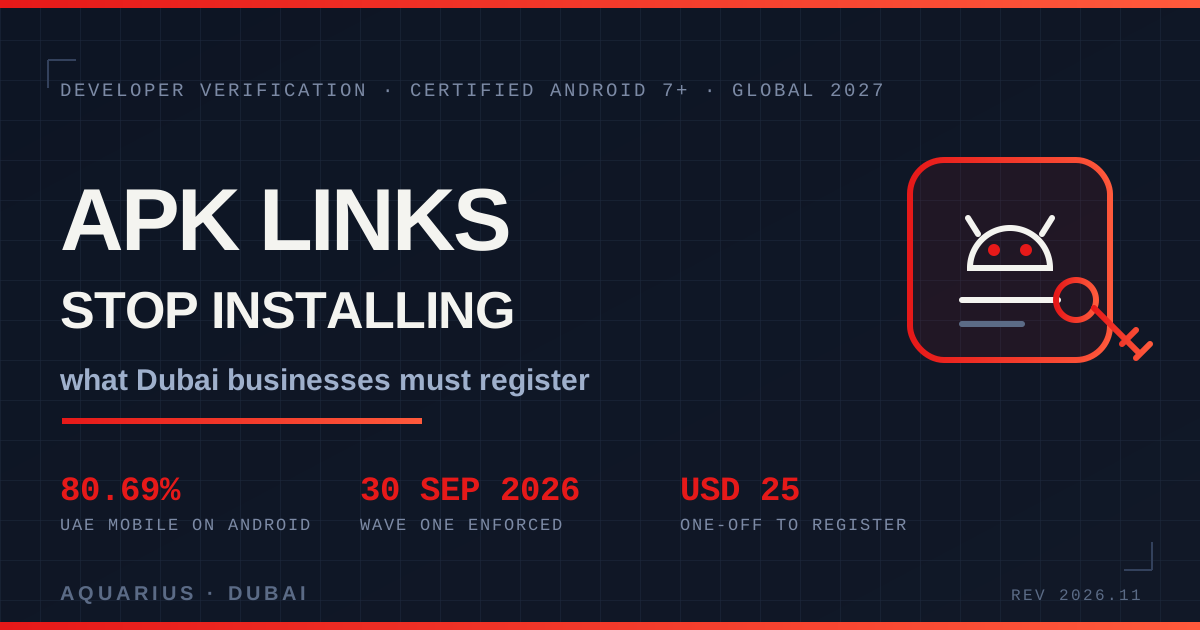
Short answer: Google now requires a verified developer identity behind every Android app that installs on a Google Play Protect certified device — including apps you hand out as an APK file, outside any store. Enforcement began on 30 September 2026 in Brazil, Indonesia, Singapore and Thailand, and Google says the capability expands “globally” across certified devices in 2027 and beyond, which is the UAE’s deadline. With 80.69% of UAE mobile traffic running Android in October 2026, a Dubai business that distributes a driver app, a kiosk build or a client beta by APK link has one job this year: register, or move that app into managed distribution. Registration is a one-off USD 25 (about AED 92) — or free if the app only ever lands on managed devices.
Most Dubai teams read the headlines in 2025, saw “Google Play” in the title, concluded it was a Play Store story and moved on. It is not. This is a change to what the Android operating system will install at all, and the apps most exposed in this market are the ones that never went near a store: the warehouse scanner build, the delivery-rider app shared on WhatsApp, the tablet menu in a Business Bay restaurant, the white-label APK an agency emails to a client in Sharjah.
The numbers that set the stakes for UAE apps
Three figures explain why this matters more here than in a market like the US or Western Europe:
- Android runs 80.69% of UAE mobile traffic (StatCounter, October 2026), against 19.29% for iOS. Whatever Android changes about installation, it changes for four devices in five.
- The first-wave stores are the UAE’s best-selling brands. Enforcement from 30 September 2026 covers installs via Google Play plus the Samsung Galaxy Store, Xiaomi GetApps, HONOR App Market, OPPO App Market, vivo V-Appstore and Palm Store. In the UAE those vendors are Samsung 20.86%, Xiaomi 16.84%, vivo 9.88%, OPPO 9.22% and HONOR 5.58% — 62.4% of devices whose own app channels are already inside the programme.
- The fraud problem Google is answering is loud in the UAE. The UAE Cyber Security Council has warned that more than 85% of fake applications impersonate well-known apps, and Dubai Police’s e-Crimes and Cybersecurity Department has repeatedly warned residents that apps from untrusted sources can carry malware that drains bank accounts. Google’s own justification cites Global Anti-Scam Alliance 2025 data: 57% of surveyed adults hit by a scam in a year, USD 442 billion in global consumer losses.
That is the real context. Unsigned, unattributed APKs circulating by WhatsApp are exactly the delivery mechanism UAE enforcement bodies keep warning about, and Android is closing the channel rather than policing it.
What “developer verification” actually means
Two separate things, and conflating them is where Dubai teams go wrong.
1. Verify who you are. A legal name, address and contact details, usually a government-issued ID, and for an organisation account a D-U-N-S number plus a working website. D-U-N-S is issued free by Dun & Bradstreet against your trade licence; allow up to two weeks, and ignore the resellers who charge for it.
2. Register the app itself. Verification of a human or company is not enough — each package name (for example ae.yourcompany.riderapp) must be registered and tied to your signing key by completing a cryptographic challenge with the private key, matched on the SHA-256 certificate fingerprint. This is the step that catches agencies: if the signing keystore for a 2019 app lives on a laptop that left the company, you cannot prove ownership and you cannot register the package. Finding that out in 2027 is a rebuild. Finding it out this quarter is an afternoon.
If you publish on Google Play, relax slightly: when verification opened to all developers in March 2026, Google auto-registered roughly 99% of apps already on Play. The gap is everything distributed outside Play.
The timeline, with the date that applies to the UAE
| When | What happens | Who it hits |
|---|---|---|
| March 2026 | Verification opens to all developers via Play Console and the new Android Developer Console | Everyone; ~99% of Play apps auto-registered |
| June 2026 | Verification system service ships silently via Google System Updates | No install impact yet |
| August 2026 | Developer APIs, free limited-distribution accounts and the advanced (power-user) install flow go live | Hobbyists, testers, internal tools |
| 30 September 2026 | Unregistered apps can no longer be installed or updated from participating stores on certified Android 7+ devices | Brazil, Indonesia, Singapore, Thailand |
| 2027 and beyond | Verification capability expands globally across certified Android devices | UAE and the rest of the GCC |
| September 2027 | End of the grace period for public Play apps installed on fully managed devices and work profiles | Enterprise fleets |
The UAE is not in wave one. That is a head start, not an exemption — and the useful way to read it is that Brazil, Indonesia, Singapore and Thailand are running the pilot that tells you exactly what will break here.
Which account do you need, and what it costs
Google split the console in two. Choose by where the app goes, not by company size.
| Option | Fee | Install limit | Requirements |
|---|---|---|---|
| Play Console (organisation) | USD 25 one-off (approx. AED 92) | Unlimited | Covers distribution on and outside Play; ID verification |
| Android Developer Console — full distribution | USD 25 one-off (approx. AED 92) | Unlimited | For apps distributed only outside Play; organisation accounts need D-U-N-S + website |
| Android Developer Console — limited distribution | Free | 20 devices | Personal accounts only; no government ID required |
| Managed Google Play private app | Free | Your managed fleet | Exempt from verification indefinitely; needs an EMM |
| D-U-N-S number | Free | — | Issued against the trade licence; allow up to 2 weeks |
Note the trap in row three. Limited distribution is free and needs no ID, but it is capped at 20 devices and personal accounts only. It is right for a hobby project or a 12-person internal pilot. It is wrong for 60 riders, and it is wrong for anything billed to a client.
Most Dubai businesses get this wrong: the fleet escape hatch is free
Here is the part almost nobody in this market has read, and it quietly removes the whole problem for internal apps. Google’s Android Enterprise documentation states that apps installed by an EMM Device Policy Controller are exempt from verification indefinitely, and that private apps distributed only to EMM-managed devices or work profiles do not require developer verification registration. Public Play apps on fully managed devices and work profiles get a longer runway still, to September 2027.
Translated into a Dubai operations reality: if your 80 delivery riders carry company-owned Androids, the compliant path is not to pay a fee and register a public package. It is to enrol those handsets as fully managed devices and publish the rider app as a private app in managed Google Play. Verification stops applying, the APK-by-WhatsApp habit disappears, updates become centrally pushed, and a lost handset can be wiped. Our guide to BYOD and device management for Dubai SMEs covers how that enrolment looks for a small fleet.
The three options for an app on unmanaged devices are narrower: register it with a verified developer account, bring the devices under management, or ask every user to run the advanced flow by hand. Only the first two are a business process.
The advanced flow is not a distribution strategy
Google did leave a door open for experienced users. In the advanced flow, a person enables developer mode in system settings, waits roughly a day, confirms with biometrics or a device PIN, and then permits unverified installs for seven days or indefinitely. Installing through ADB from a computer also still works.
Read that as a developer and hobbyist accommodation, not a customer journey. Nobody is asking a Dubai Marina customer, a new rider on day one, or a client’s procurement officer to toggle developer options and wait 24 hours before they can open your app. Any onboarding funnel that depends on it has a conversion rate close to zero.
Five Dubai distribution patterns that break
- The rider or driver app shared as an APK link. Extremely common in UAE last-mile and logistics. Breaks on unmanaged personal handsets; fixed free by managed Google Play private apps.
- The tablet in the restaurant or clinic. Menu, queue and check-in builds flashed by hand, never enrolled, often on a 2020 Android. Fix: dedicated-device enrolment, which also stops staff installing games on it.
- The closed beta on a free-zone startup’s website. “Download the Android app” buttons that serve a raw APK. Either register the package for full distribution, or use a Play closed test track.
- The white-label APK an agency hands a client. Whoever signed it must be the verified registrant — so settle signing-key custody in the contract before the deadline, not after.
- The abandoned 2018 app nobody can rebuild. No keystore, no registration, no updates. Budget for a re-sign and re-release, or a replacement.
If a store listing is in your future anyway, our walkthrough of publishing a Dubai app on the App Store and Google Play covers the licence, TDRA and submission side.
What this costs in Dirhams — and what ignoring it costs
The compliance line items are trivial. The remediation line items are not, and they scale with how much key hygiene your past developers skipped.
| Work | Typical AED cost | Notes |
|---|---|---|
| Developer registration | approx. AED 92 one-off | USD 25 at the 3.6725 peg |
| D-U-N-S number | Free | Up to 2 weeks against the trade licence |
| Package registration + signing-key audit | AED 2,500 – 7,500 | Per app; higher if the keystore must be reconstructed |
| Private-app packaging and managed Google Play setup | AED 6,000 – 18,000 | One-off; covers enterprise enrolment, app upload, policy |
| EMM/UEM licensing | approx. AED 29 per user per month | Microsoft Intune Plan 1 at USD 8/user/month; core Android Enterprise policy and managed Google Play APIs carry no Google per-device fee |
| Re-sign and re-release an orphaned app | AED 12,000 – 45,000 | Depends on build reproducibility and target API level |
Against that, the downside. An unregistered app stops installing and stops updating — so the failure is not just onboarding, it is your inability to patch a live app on devices that already have it. For a regulated UAE operator that is a security finding, and the reputational maths is already priced in locally: in BioCatch’s April 2026 UAE survey, 58% of bank fraud and compliance leaders reported rising fraud losses, 62% put annual losses above AED 18.3 million, and 75% ranked reputational risk above the financial hit. In October 2026 the UAE led a global operation that disrupted roughly USD 39 billion in digital fraud with more than 900 arrests. In that climate, “download our APK from WhatsApp” is not a neutral instruction to give a customer — it is a trust liability, and it is about to become a technical dead end.
How Aquarius handles it
We treat this as an inventory problem first, because that is what it is. We list every Android artefact your company distributes, trace who signed each one and where the keystore lives, then route each app down the cheapest compliant path — managed private app where the devices are yours, registered full distribution where they are not, Play closed testing where it is a beta. Keys get moved into Play App Signing or a controlled vault so the next person who inherits your app is not stuck. You own every account and key at the end; we are a team member on them, not the owner. Clear scope, fixed milestones — see our pricing, or compare against typical mobile app build costs in Dubai.
FAQ
Does Android developer verification apply in the UAE yet?
Not as enforcement. The 30 September 2026 wave covers Brazil, Indonesia, Singapore and Thailand. Google states the capability expands globally across certified Android devices in 2027 and beyond, which is when UAE users are affected. Registration itself has been open worldwide since March 2026, so there is no reason to wait.
I only publish on Google Play. Do I have to do anything?
Almost certainly not. Google auto-registered about 99% of apps already on Play when verification opened in March 2026. Check Play Console for an unregistered package warning and confirm your organisation details are current.
Can we still give staff an APK file directly?
Yes, if it is registered to a verified developer account, or if it is delivered to managed devices. Apps installed by an EMM Device Policy Controller and private apps distributed only to EMM-managed devices or work profiles are exempt from verification indefinitely. An unregistered APK on an unmanaged personal phone is what stops working.
What if we lost the signing key for an old app?
Then you cannot complete package registration, because ownership is proven with the private key against the SHA-256 certificate fingerprint. The app must be re-signed and re-released under a new key, which existing users install as a fresh app. Audit your keystores now — this is the single most expensive surprise in the whole change.
Is the free limited-distribution account enough for a small company?
Only for a very small, informal case. It is capped at 20 devices and restricted to personal accounts, so it does not suit a company app, a client deliverable or a fleet. Pay the USD 25 for full distribution, or use managed Google Play.
Does this change our PDPL obligations?
It does not replace them, but it overlaps. Verified identity and centrally managed installs make it far easier to evidence who controls an app processing personal data — see our UAE PDPL compliance checklist for websites and apps.
The practical next step
Two deadlines are already fixed: a global expansion in 2027, and September 2027 for public apps on managed fleets. The work in between is unglamorous — find the APKs, find the keys, pick a channel per app. It takes days if you start now and becomes a rebuild if you start when installs begin failing.
Send us the list of Android apps your business hands out and we will tell you which ones are already safe, which need a USD 25 registration, and which have a key problem you do not know about yet. Book an Android distribution audit.