
App Store Optimization in Dubai (2026): Why 65% of Installs Start With a Search You Are Not Ranking For
Dubai firms spend six figures building apps, then rent every install. Real 2026 ASO data, Arabic keyword strategy and what store optimisation actually costs in AED.
- PUBLISHED
- 13 SEPT 2026
- READ TIME
- 09 MIN
- AUTHOR
- AQUARIUS · DUBAI
- UNIT
- REV 2026.09
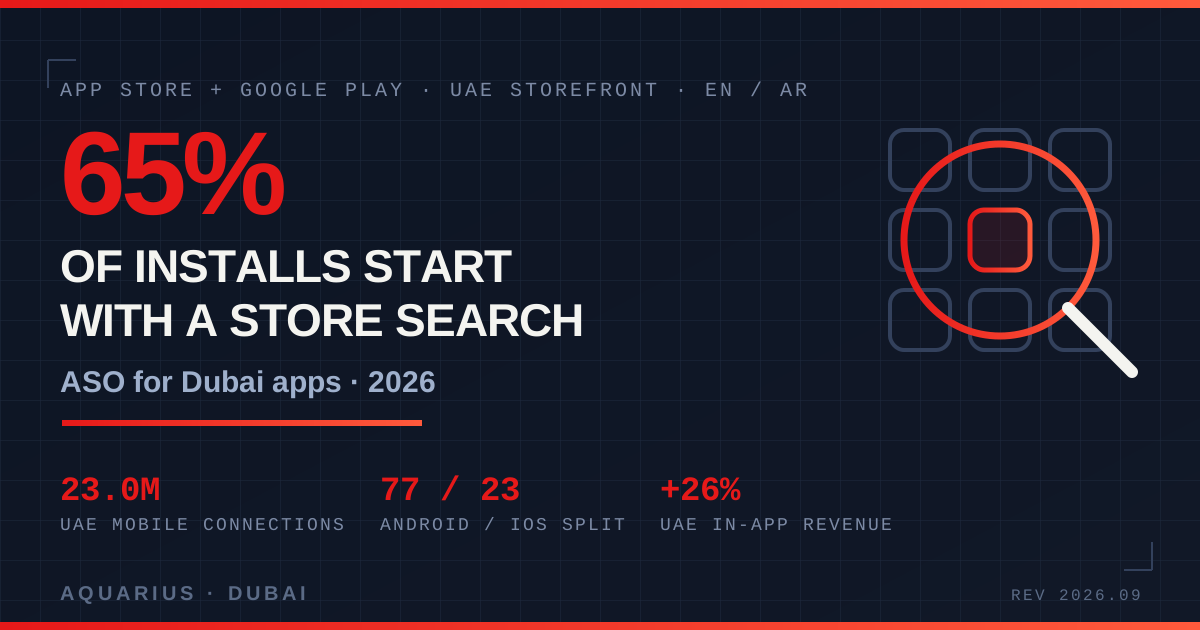
Short answer: App Store Optimization (ASO) is how your app gets found inside the App Store and Google Play instead of being paid for one install at a time. It matters in the UAE because roughly 65% of iOS installs and 58% of Google Play installs come from in-store search, and because a UAE storefront is genuinely bilingual — English and Arabic queries are two separate keyword markets, and most Dubai apps compete in only one. Budget AED 4,000-15,000 per month for an ongoing ASO programme, versus AED 4.40-13.20 per paid install if you skip it and rent traffic forever.
Key takeaways
- The UAE is one of the most app-saturated markets on earth. DataReportal's Digital 2026: UAE counted 23.0 million active cellular mobile connections — 202% of the population, up 1.7 million (+8.1%) in a year — against 11.3 million internet users at 99.0% penetration.
- Money is moving, not just downloads. Sensor Tower's 2025 Middle East App Growth Report put GCC downloads up 2.6% year-on-year (versus 0.5% globally) and GCC in-app purchase revenue up 20% YoY to USD 700 million in H1 2025 — with the UAE leading the region at +26% IAP growth.
- Your storefront is 77% Android. StatCounter put the UAE mobile OS split at Android 77.53% / iOS 22.46% in August 2026 — so Play-first for reach, App Store for revenue, not the other way round.
- Ranking is not a vanity metric. A top-3 keyword rank drives roughly 4.6x the daily installs of ranks 8-15, and rank 1 about 6.2x.
- Arabic is the cheapest growth lever nobody pulls. Description-only localisation delivers a 17% average install lift in non-English markets, and localised screenshot text alone captures about 60% of the lift from a fully localised listing.
TOFU: Dubai has an app problem, and it is not the build
Most Dubai businesses treat launch day as the finish line. It is the start of the hard part. The UAE has 23.0 million active cellular connections against a population of roughly 11.4 million — 202% penetration, per DataReportal's Digital 2026 UAE report — with 11.3 million internet users at 99.0% penetration and 12.5 million social media identities (110% of population) as of October 2025. Every one of those handsets already carries dozens of apps. Yours is asking for the last free slot.
The market is growing, which is the good news. Sensor Tower's 2025 Middle East App Growth Report found GCC downloads climbing 2.6% year-on-year while the global figure was 0.5%, and GCC in-app purchase revenue rising 20% YoY to USD 700 million in the first half of 2025 alone — about AED 2.57 billion. The UAE led that surge at +26%. Regional users spent 200 billion cumulative hours in apps over the same six months.
The bad news is that everyone else noticed. In the same report, 52% of Middle East app marketers named market saturation as their single biggest obstacle, and nearly 80% now refresh ad creative weekly or more often just to hold position. That is an arms race you lose on budget. ASO is the part of the funnel where a smaller Dubai brand can still beat a funded competitor, because it is earned rather than bought.
One structural fact should change how every UAE app is optimised: StatCounter recorded the UAE mobile OS split at Android 77.53% / iOS 22.46% in August 2026. Dubai teams routinely design, test and market iPhone-first because that is what the boardroom carries. Their customers are on Android by more than three to one, while iOS still skews to the higher-spending segment. Optimise Play for volume and the App Store for revenue — and stop guessing which one matters.
MOFU: what ASO actually is, and the four levers that move it
ASO is search optimisation for the two stores. It splits into visibility (do you appear for the query) and conversion (does the person who sees you tap install). Both are measurable, and both are where most Dubai apps leak.
Search is the dominant discovery path. Roughly 65% of iOS installs originate from store search and 58% on Google Play, per AppTweak and Sensor Tower benchmarks; Apple has long cited that over 70% of App Store visitors use search to find apps. If you do not rank for "food delivery Dubai", "clinic booking UAE", the Arabic equivalents, or your own category term, that demand goes to a competitor — or you rent it back from Meta.
Lever 1 — Keywords and metadata
On iOS that means title, subtitle and the 100-character keyword field; on Play it means title, short description and long description (Play indexes the full description, iOS does not). Position compounds hard: a top-3 keyword rank produces roughly 4.6x the daily installs of ranks 8-15, and rank 1 about 6.2x, while ranks 16-30 sit near 0.4x — effectively invisible. There is no page-two consolation prize in an app store.
Lever 2 — Arabic, treated as a real market
This is the Dubai-specific edge. The UAE storefront serves a population where a large share searches in Arabic, and almost nobody optimises for it properly. Machine-translating the English listing does not work: Arabic app-store phrasing does not mirror a literal rendering of English keywords, and Gulf usage differs from Modern Standard Arabic. Benchmarks show description-only localisation lifts installs 17% on average in non-English markets, and localised text on your screenshots alone delivers roughly 60% of the benefit of a fully localised listing — which makes it the highest return-per-dirham task on this page. Treat it the way you would treat Arabic and RTL on your website: native copy, written by a person.
Lever 3 — The creative set, where installs are actually won
Visibility earns the impression; the screenshots close it. Median tap-through-to-install sits at 33.4% on iOS and 27.7% on Google Play, while the top quartile reaches 45.6% and 39.1%. That gap is pure margin — same traffic, about a third more installs. Screenshot A/B testing produces a median 11.8% conversion lift, with top-decile winners at 32.4%, and in 54% of tests the first screenshot was the deciding variable. On iOS, Custom Product Pages tied to specific campaigns add a further 18-26% lift on paid traffic.
Lever 4 — Ratings and review velocity
Apps rated 4.5 and above install at 1.7x the rate of apps below 4.0. Store algorithms reward a steady drip rather than a one-off burst — a working rule of thumb is around 12 reviews per 1,000 installs to keep keyword rankings stable. Prompt after a success moment (order delivered, booking confirmed), never on first launch, and reply to Arabic reviews in Arabic.
MOFU: what "good" looks like by category in the UAE
Conversion benchmarks vary enormously by vertical, so judge yourself against your own category rather than a headline average. Games convert at 41-48% tap-through-to-install on iOS, Photo & Video at 38-44%, and Finance at just 18-24% — the lowest of the major categories, because a finance install asks for far more trust. A Dubai fintech converting at 20% is on benchmark; a delivery app converting at 20% has a creative problem.
The second number to hold yourself to is retention, because ASO that attracts the wrong users is worse than no ASO. Industry benchmarks put iOS day-1 retention at 25.4%, falling to 5.3% by day 30, and Android at 20.2% falling to 3.8%, with a 30-day uninstall rate of 46.1% in 2024 (down marginally from 46.9% in 2023). Roughly half of everyone who installs your Dubai app deletes it inside a month. Honest, keyword-matched listings are the cheapest retention tool you own — a listing that oversells manufactures churn by day three.
BOFU: what ASO costs in Dubai, and what skipping it costs more
Here is the arithmetic that decides the question. Paid installs are a rented asset. Published CPI benchmarks put EMEA at around USD 1.04 per install on average, with iOS near USD 3.60 and Android near USD 1.20; by network, Google App campaigns run USD 1.50-4.50, Meta USD 2.00-5.50 and TikTok USD 0.70-4.50. Regulated verticals are brutal — fintech and insurance apps frequently pay USD 10-25 per install.
Convert at the pegged rate of AED 3.6725 to the dollar and the cost of inaction becomes concrete: every 1,000 organic iOS installs you fail to earn is roughly AED 13,200 handed to an ad network, and about AED 4,400 per 1,000 on Android. Repeat that monthly for a year and a mid-sized Dubai app has spent more on rented installs than the app cost to build. Meanwhile, the market rate for the work that would have earned those installs organically looks like this:
| Engagement | Typical Dubai price (2026) | What it covers | Best for |
|---|---|---|---|
| One-off ASO audit | AED 3,500-8,000 | EN/AR keyword research, metadata rewrite, competitor gap analysis, creative critique | Live apps never properly optimised |
| Launch ASO package | AED 8,000-20,000 | Pre-launch bilingual metadata, screenshot set, store listing build, tracking setup | Apps 4-6 weeks from submission |
| Monthly ASO retainer | AED 4,000-15,000/mo | Keyword tracking, monthly metadata iteration, A/B tests, EN/AR review management | Any app that depends on organic installs |
| Full app-marketing retainer | AED 15,000-40,000/mo | ASO plus paid user acquisition, creative production, attribution and reporting | Funded scale-ups pushing volume |
| Year-one ASO + marketing programme | 30-50% of build cost | The realistic first-year number most Dubai app owners never budget | Planning a launch properly |
All figures exclude 5% UAE VAT, which applies to agency fees. For the other side of that ratio, see our breakdown of mobile app development costs in Dubai and the ongoing yearly app maintenance costs. If you are quoted a flat "AED 35,000-50,000 for app optimisation" with no keyword report attached, ask precisely which of the five rows above you are buying.
Most Dubai app owners get this wrong
They approve a six-figure build, launch with a one-line English description the developer wrote at 2am, then spend two years buying installs to compensate. The store listing — the highest-leverage asset in the funnel, seen by every prospective user, free to change — gets less attention than the splash screen. Meanwhile a competitor with a weaker app ranks top-three for the Arabic query and takes the market.
You cannot out-spend a saturated market forever. You can out-rank it once, and keep the ranking.
How Aquarius does it
We build apps and we ship the listing that sells them: bilingual EN/AR keyword research against the live UAE storefront, metadata written natively in both languages, a tested screenshot set with localised overlay text, review prompts placed at success moments, and monthly iteration against ranking data you can actually see. Visibility movement typically shows within 4-6 weeks, depending on category competition. If we cannot find a realistic keyword opportunity in your category, we say so before you sign, not after. See our pricing, browse what we build, or book a 20-minute teardown of your current listing.
FAQ
What is App Store Optimization, and does it work in the UAE?
ASO is the practice of ranking and converting inside the App Store and Google Play. It works in the UAE specifically because store search drives around 65% of iOS installs and 58% of Play installs, and because the UAE storefront's Arabic search demand is far less contested than its English equivalent. Visibility improvements generally appear within 4-6 weeks.
How much does ASO cost in Dubai in 2026?
A one-off audit runs roughly AED 3,500-8,000, a launch package AED 8,000-20,000, and an ongoing retainer AED 4,000-15,000 per month, plus 5% VAT. Full app-marketing retainers that bundle paid user acquisition run AED 15,000-40,000 monthly. As a planning rule, year-one marketing and ASO typically consume 30-50% of what the app cost to build.
Should I optimise for iOS or Android first in the UAE?
Android, for reach. StatCounter recorded the UAE mobile OS split at Android 77.53% / iOS 22.46% in August 2026. iOS still over-indexes on in-app spending, so subscription and high-ticket models should run both — but do not let a boardroom full of iPhones convince you the UAE market is iOS-first. It is not.
Do I really need an Arabic app store listing?
If you serve UAE consumers, yes — and it is the cheapest win available. Description-only localisation lifts installs by 17% on average in non-English markets, and localised screenshot text alone captures about 60% of the benefit of a full localisation. Write it natively rather than machine-translating, because Arabic app-store search phrasing does not mirror English keywords.
How long does ASO take to show results?
Metadata changes are typically reindexed within days, with measurable ranking movement in 4-6 weeks. Conversion changes — a new screenshot set, a new first frame — show in store analytics almost immediately, since tap-through-to-install is measured per impression. Competitive categories such as food delivery and fintech take longer than niche B2B tools.
Is ASO better than running paid app install ads in Dubai?
They are complementary, but the economics differ sharply. Paid installs stop the day the budget stops, at roughly AED 4.40 per Android install and AED 13.20 per iOS install at benchmark CPI rates — far higher in fintech. ASO compounds: a keyword you rank for keeps delivering. Most successful Dubai apps run paid acquisition for launch velocity while ASO builds the organic base underneath, exactly as they would pair ads with SEO on the web side.
My app has decent downloads but terrible retention. Will ASO help?
Partly — and a bad listing is often the cause. Benchmarks show 46.1% of installs are removed within 30 days, with day-30 retention of just 5.3% on iOS and 3.8% on Android. A listing that promises more than the product delivers manufactures churn. Honest, keyword-matched metadata and screenshots showing the real interface bring in users who actually wanted your app. Everything beyond that is a product and onboarding problem, not a store problem.