
Capital Work in Progress and IAS 23 in Dubai 2026: The Interest Hiding Inside Your CWIP Balance
Dubai completed AED 111 billion of projects in H1 2026, and the interest capitalised inside those CWIP balances is not deductible when you pay it. What IAS 23 and Article 30 actually do to your asset register.
- PUBLISHED
- 13 NOV 2026
- READ TIME
- 13 MIN
- AUTHOR
- AQUARIUS · DUBAI
- UNIT
- REV 2026.09
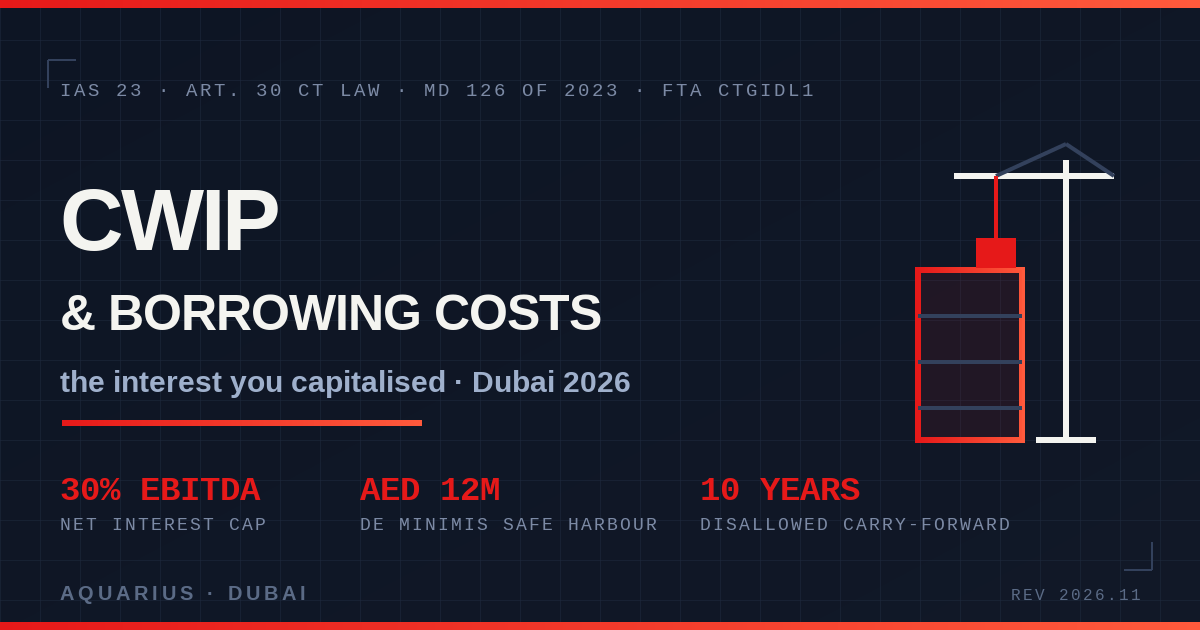
Short answer: Interest you capitalise into capital work in progress under IAS 23 is not a deduction in the year you pay the bank. Under the UAE Corporate Tax Law it is capital in nature, so the Federal Tax Authority's Interest Deduction Limitation Rules guide (CTGIDL1, published 7 April 2025) requires that capitalised interest be released into Net Interest Expenditure on a straight-line basis over the useful life of the finished asset — and that your depreciation add-back in adjusted EBITDA be reduced by the same amount so you do not count it twice. A capitalisation decision you make on a Dubai site in 2026 therefore sets a line in your Article 30 calculation every year until roughly 2056.
Almost no UAE finance team tracks that number. CWIP is the quietest account in a Dubai balance sheet: it does not depreciate, it does not hit the profit and loss, and it usually sits in a spreadsheet maintained by whoever is closest to the project manager. Then it transfers to the fixed asset register as one clean figure — and the interest component inside it disappears forever.
Dubai is building more than it can account for
The scale is the first problem. Dubai completed 104 real estate projects worth roughly AED 111 billion in the first half of 2026, delivering 24,537 units, and started construction on 228 new projects worth about AED 66.99 billion between January and July 2026. The UAE construction market is valued at around USD 127.1 billion in 2026, with Dubai holding roughly 47% of it — the largest single geography in the country.
Off-plan is where the cash sits. Off-plan transactions made up 71% of all Dubai real estate deals in H1 2026, worth AED 139.75 billion across 58,840 transactions. Every one of those projects runs through a DLD-supervised escrow account under Law No. 8 of 2007, released against verified construction milestones — as of 12 June 2026, 864 of 865 active projects in the DLD register had an escrow bank on record.
And money is no longer cheap. The CBUAE base rate has stood at 3.90% since 17 September 2026, with 3-month EIBOR around 4.32% on 9 November 2026 — up from roughly 3.66% at the end of March. Developer and contractor facilities typically price at 1.00–2.25% over 3-month EIBOR. On a 24-month build financed at AED 120 million, that is real nine-figure-adjacent interest flowing into a CWIP account that nobody audits line by line.
Most Dubai businesses get this wrong in the same way: they treat capitalised interest as an accounting entry, when it is a tax asset with a 25-year tail.
What IAS 23 actually requires
IAS 23 says you capitalise borrowing costs that are directly attributable to the acquisition, construction or production of a qualifying asset — an asset that necessarily takes a substantial period of time to get ready for its intended use or sale. An asset that is ready for use when you buy it is not a qualifying asset, and its finance cost goes straight to the P&L.
Three dates control the whole calculation, and each one is a field your system either has or does not.
1. The commencement date
Capitalisation starts when all three conditions are met together: you incur expenditure on the asset, you incur borrowing costs, and you undertake activities necessary to prepare the asset for its intended use. In Dubai that last condition often precedes the first shovel — technical and administrative work such as obtaining the building permit counts, but simply holding a plot with no development activity does not.
2. Suspension
You suspend capitalisation during extended periods in which active development is interrupted. This is the clause that catches UAE projects — a contractor dispute, a variation order standoff, or a stalled handover can pause a site for months. A temporary delay that is a necessary part of the process (waiting for a concrete pour to cure, or for a seasonal restriction) does not trigger suspension. A commercial standstill does.
3. Cessation
You stop capitalising when substantially all the activities necessary to prepare the asset for its intended use or sale are complete. IAS 23 is explicit that an asset is normally ready when physical construction is complete, even though routine administrative work might still continue. And when an asset is completed in parts, each part that is capable of being used while the rest continues stops capitalising on its own.
That last sentence is worth a Dubai-specific warning. Finance teams here routinely use the Dubai Municipality Building Completion Certificate as the cessation trigger. The BCC is issued 3–7 working days after a successful final inspection, and requires Civil Defence sign-off, DEWA connection approval and as-built drawings in DBC 2026 format. It is a clean, dated, auditable document — which is exactly why people reach for it. But it is an administrative milestone that lands weeks after physical completion. Capitalising interest up to the BCC date over-capitalises, and on a phased tower with partial handover it over-capitalises on every phase.
The capitalisation rate
Where you borrow specifically for the asset, you capitalise the actual borrowing costs incurred less any investment income earned on temporary investment of those funds — relevant in Dubai, because escrow balances often earn a return while sitting between milestone releases. Where you fund from a general pool, you apply a weighted average capitalisation rate to the expenditure on the asset, capped at total borrowing costs for the period.
The Article 30 twist that changes everything
Here is where UAE corporate tax stops behaving like the accounting. Article 30 of Federal Decree-Law No. 47 of 2022 caps deductible Net Interest Expenditure at the higher of 30% of adjusted EBITDA or a de minimis of AED 12,000,000, with disallowed amounts carried forward for up to 10 tax periods on a first-in, first-out basis. Ministerial Decision No. 126 of 2023 fills in the mechanics.
Three provisions in that decision and the FTA guide combine into something most Dubai finance teams have never modelled:
- Capitalised interest is interest. Article 7 of MD 126/2023 confirms that income and expenditure attributable to the capitalised interest amount is subject to the General Interest Deduction Limitation Rule. It does not escape the cap by being parked in an asset.
- But not yet. Because it is capital in nature, it is not deductible in the tax period it is incurred. The FTA guide requires the capitalised interest to be spread on a straight-line basis over the useful life of the underlying asset, with only the relevant portion for each tax period entering Net Interest Expenditure.
- And your EBITDA add-back shrinks. When computing adjusted EBITDA, the depreciation and amortisation add-back must be reduced by the capitalised interest element, precisely to stop the same amount inflating both sides of the 30% test.
Read those together and the consequence is concrete. A building completed in 2026 with AED 9 million of capitalised interest and a 30-year useful life adds AED 300,000 to Net Interest Expenditure every year to 2056 — and simultaneously reduces the depreciation add-back by AED 300,000, so adjusted EBITDA falls and the 30% ceiling falls with it. The capitalisation decision is not a presentation choice. It is a three-decade commitment with a tax number attached.
| Interest treatment | IFRS effect (year incurred) | UAE CT effect (year incurred) | Later years |
|---|---|---|---|
| Expensed — non-qualifying asset | Hits P&L in full | Enters Net Interest Expenditure in full, tested against the cap now | Nothing further |
| Capitalised into CWIP — qualifying asset | No P&L impact; sits in CWIP, no depreciation | Not deductible; excluded from Net Interest Expenditure this period | Released straight-line into Net Interest Expenditure over the asset's useful life; depreciation add-back reduced by the same slice |
| Capitalisation suspended (stalled site) | Expensed for the suspension window | Enters Net Interest Expenditure in that period | Capitalisation resumes when activity resumes |
| Pre-9 December 2022 debt | Normal IAS 23 treatment | Grandfathered out of the rule under Article 11 of MD 126/2023 | Excluded from Net Interest Expenditure and from the EBITDA adjustment |
| Qualifying long-term infrastructure | Normal IAS 23 treatment | Excluded, where the project is for public benefit and the assets last not less than 10 years (Article 14) | Excluded |
Where the data layer breaks
None of this is hard arithmetic. It is a data problem, and it is the same data problem we see in almost every Dubai finance stack: the system records the total, not the composition.
A CWIP account in a standard UAE ERP holds a running balance per project. When the asset is capitalised, the balance transfers to the fixed asset register as a single cost figure, and depreciation runs off that cost. Nothing in the chain remembers that AED 9 million of the AED 140 million was interest. Yet Article 30 needs exactly that split, every year, for thirty years, and the FTA can request supporting records for at least seven years after each tax period. The penalty for failing to maintain required records is AED 10,000, rising to AED 20,000 for a repeat within 24 months — small money next to a disallowed deduction, but the disallowance is the real cost.
The fields that need to exist, and usually do not:
- Interest sub-ledger per CWIP project — capitalised interest separated from construction cost, with the capitalisation rate, the borrowing it came from, and the period it relates to.
- Commencement, suspension and cessation dates per asset and per phase — with evidence attached, not a single project-level date.
- A surviving interest tag on the capitalised asset — so the straight-line release and the EBITDA add-back reduction can be computed automatically after transfer to the register.
- Grandfathering flags — which facilities had terms agreed before 9 December 2022, carried through every drawdown and refinancing.
- Specific-versus-general borrowing allocation — including investment income earned on temporarily invested specific borrowings, which in an escrow-funded Dubai project is a real, recurring number.
- A 10-year disallowed-interest carry-forward register on FIFO — tracked by origin period, because the FIFO ordering determines what you can actually use.
Why spreadsheets fail this specific test
Project accountants are not careless; the tooling is simply pointed the wrong way. A construction cost spreadsheet is built to answer "what have we spent and what is left in the budget". Article 30 asks a different question — "of everything ever capitalised, how much was interest, from which facility, starting when, over what life" — and that answer has to stay correct through staff turnover, phase handovers, refinancing and disposals.
The same structural gap shows up next door. Contractors hit it in revenue recognition, where the percentage-of-completion measure needs cost composition rather than cost totals — we covered that in construction WIP and percentage of completion. Asset owners hit it again at the register itself, in fixed asset register and depreciation software. And anyone with a long lease hits a close cousin of the capitalisation rate question in IFRS 16 lease accounting. One missing dimension, three different compliance failures.
There is also a reporting trigger worth noting. Ministerial Decision No. 84 of 2025 requires audited financial statements from taxable persons with revenue above AED 50 million, from every Qualifying Free Zone Person, and from every tax group — the tax group requirement applies regardless of revenue. If your CWIP and capitalised interest numbers are going to be audited anyway, they may as well come out of a system rather than a reconciliation.
What it costs to build in Dubai
These are the bands we quote for a CWIP and capitalised-interest data layer in 2026, assuming an existing ERP or accounting system that stays in place.
| Scope | AED range | Typical timeline | Fits |
|---|---|---|---|
| CWIP interest sub-ledger + capitalisation-rate engine bolted onto existing ERP | 45,000 – 95,000 | 4–7 weeks | Single-entity contractor or owner, one or two active projects |
| Full IAS 23 lifecycle module: commencement / suspension / cessation per phase, evidence vault, auto-transfer to asset register | 95,000 – 210,000 | 8–14 weeks | Developers with phased handovers and multiple facilities |
| Article 30 calculation layer: Net Interest Expenditure build-up, adjusted EBITDA with reduced depreciation add-back, de minimis test, FIFO carry-forward register | 70,000 – 160,000 | 6–10 weeks | Groups near or above the AED 12m de minimis |
| Escrow and milestone integration (DLD-supervised releases, investment income on specific borrowings) | 35,000 – 85,000 | 3–6 weeks | Off-plan developers |
| Group consolidation across entities and tax group reporting pack | 120,000 – 300,000 | 10–18 weeks | Multi-entity groups under MD 84/2025 |
| Care, standards updates and FTA-request support | 4,000 – 15,000 / month | Ongoing | Everyone who ships |
Set that against the exposure. A group running AED 40 million of annual net interest against a thin EBITDA can see several million dirhams of deduction pushed into a 10-year carry-forward queue that may never clear. At the 9% corporate tax rate, a permanently disallowed AED 5 million of interest is AED 450,000 of cash tax — recurring. The build pays for itself on the first correctly computed year, and the cost of inaction compounds annually rather than once.
How Aquarius builds it
We start with your last two capitalisations and reverse-engineer them: what was the interest component, which facility funded it, when did physical completion actually occur, and what would the straight-line release have been. That exercise alone usually surfaces the gap in a week, before anyone writes code.
From there we build the sub-ledger inside your existing system rather than beside it, because a parallel spreadsheet is what created the problem. Every capitalised asset carries its interest tag forward; the Article 30 schedule is generated, not typed; and every trigger date has an evidence document attached to it. Full scope and engagement models are on our services page, and indicative ranges for related finance-data builds are on pricing.
FAQ
Is capitalised interest deductible in the year we pay it under UAE corporate tax?
No. Because it is capital in nature, it is not deductible in the tax period in which it is incurred. The FTA guide requires it to be included in Net Interest Expenditure on a straight-line basis over the useful life of the related asset, so only a slice enters the Article 30 calculation each year.
Does capitalising interest help us stay under the 30% EBITDA cap?
Only in timing, and less than people expect. It keeps the amount out of Net Interest Expenditure now, but it returns in slices for decades — and the depreciation add-back in adjusted EBITDA must be reduced by the same slice, which lowers the cap itself. It defers, it does not eliminate.
When exactly do we stop capitalising on a Dubai building?
When substantially all activities necessary to prepare the asset for its intended use are complete. IAS 23 treats an asset as normally ready when physical construction is complete, even if routine administrative work continues — so the Building Completion Certificate date is usually later than the correct cessation date, and on a phased project each usable part ceases separately.
What is the AED 12 million de minimis and does it apply to us?
Under Article 8 of MD 126/2023 the limitation does not apply where Net Interest Expenditure for the tax period does not exceed AED 12,000,000. It is pro-rated for tax periods longer or shorter than 12 months. Banks, insurance providers and natural persons carrying on a business sit outside the general rule entirely.
Are any projects exempt from the interest cap?
Yes. Debt instruments whose terms were agreed before 9 December 2022 are grandfathered under Article 11, and qualifying long-term infrastructure projects are excluded under Article 14 where the project is exclusively for public benefit and the assets have a life of not less than 10 years. Both exclusions have to be flagged in your data and carried through refinancings, or you will lose them by accident.
How long do we need to keep the supporting records?
At least seven years after the end of the relevant tax period. Failing to maintain the required records carries a penalty of AED 10,000, rising to AED 20,000 for a repeat offence within 24 months — but the larger risk is being unable to evidence a deduction you have already taken.
If your CWIP balance is growing and nobody can tell you how much of it is interest, that is the whole problem in one sentence. Talk to Aquarius — we will take a look at your last capitalisation and tell you in a week whether the number survives a review.