
Chrome's Built-In AI for Dubai Websites (2026): Free On-Device Gemini Nano and the Arabic Catch
Chrome now ships a free AI model inside the browser: zero inference cost, data never leaves the device. It reaches about a quarter of UAE sessions, and it cannot reason in Arabic yet. Here is how to use it anyway.
- PUBLISHED
- 05 NOV 2026
- READ TIME
- 13 MIN
- AUTHOR
- AQUARIUS · DUBAI
- UNIT
- REV 2026.09
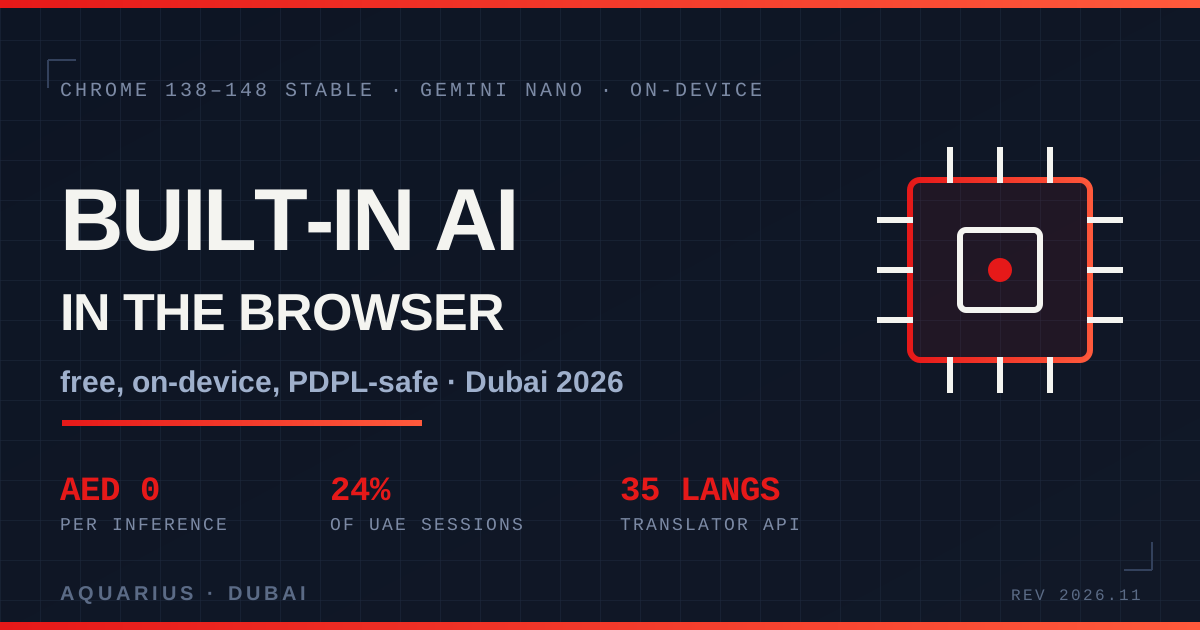
Short answer: Chrome now ships a small Gemini model (Gemini Nano) inside the browser, exposed through standard JavaScript APIs. Translation, language detection and summarisation have been stable since Chrome 138, and the general-purpose Prompt API reached stable on the web in Chrome 148. Inference costs AED 0, the text never leaves the user's laptop, and it works offline — but it only runs on desktop Chrome, which is roughly a quarter of UAE browser sessions, and its reasoning APIs do not support Arabic.
Here is what most Dubai businesses get wrong about this. Agencies are quoting AED 40,000 "AI integration" projects to add a summariser or a translate button that Chrome will now do for free, locally, with four lines of JavaScript. At the same time, the vendors selling free-on-device AI as a replacement for your cloud model are hiding two facts that matter enormously in the UAE: it is desktop-only, and the APIs that reason accept five languages, none of them Arabic.
Why a free in-browser model matters more in the UAE than most markets
Three numbers set the stakes before you write a line of code.
- 99.0% internet penetration, 23.0 million mobile connections. DataReportal's Digital 2026 UAE report counts 11.3 million internet users at 99.0% of the population and 12.5 million social media identities. There is no unconnected audience left to acquire. Every point of growth has to come from converting traffic you already pay for — which is exactly where a faster, cheaper AI feature earns its keep.
- AED 42.2 billion, going to AED 67.2 billion. That is UAE e-commerce turnover in 2025 heading to 2030 at a 9.9% CAGR, per the sixth annual EZDubai study with Euromonitor International published 28 September 2026. Online's share of UAE retail was 15.7% in 2025 and is forecast to pass 20% by 2030. More catalogue, more reviews, more product copy — all of it needing summarising and translating at volume.
- 4,807,185 residents and 200+ nationalities. The Dubai Data and Statistics Establishment put Dubai's population at 4,807,185 on 29 September 2026, up 226,885 since January 2026. Your audience is not one language group. Client-side translation stops being a nice-to-have at that mix.
A free model that runs on the visitor's own machine changes the unit economics of any AI feature you were planning to meter. It does not change the fact that two-thirds of your UAE traffic is on a phone that cannot run it.
What "built-in AI" actually is
Chrome downloads Gemini Nano once, to the user's device, and shares it across every site through web-platform APIs. There is no API key, no account, no per-call billing, no server. Each API is a small purpose-built interface rather than one giant chatbot endpoint.
| API | What it does | Status on the web | In extensions |
|---|---|---|---|
| Translator | Translates text between 35 languages, Arabic included | Stable — Chrome 138 | Stable — Chrome 138 |
| Language Detector | Identifies the language of a text string | Stable — Chrome 138 | Stable — Chrome 138 |
| Summarizer | key-points, tldr, teaser or headline summaries | Stable — Chrome 138 | Stable — Chrome 138 |
| Prompt | General-purpose prompting, plus image and audio input | Stable — Chrome 148 | Stable — Chrome 138 |
| Writer / Rewriter | Drafts and rewrites copy in a given tone | Developer trial | Developer trial |
| Proofreader | Grammar and spelling correction | Developer trial | Developer trial |
Google's Chrome team named its first production adopters in a post dated 26 May 2026: Drupal uses the Summarizer API to generate SEO tags inside CKEditor, Yahoo! Japan uses the Prompt API for community comment moderation, and Trip.com uses it to generate AI overviews that help shoppers compare flight options. These are not demos; they are shipped features on high-traffic properties.
The whole integration, honestly
// Arabic to English, on-device, no API key
const t = await Translator.create({
  sourceLanguage: 'ar',
  targetLanguage: 'en',
});
const english = await t.translate(reviewText);

// Three-bullet summary of a long product page
const s = await Summarizer.create({
  type: 'key-points',
  length: 'short',
  format: 'plain-text',
});
const bullets = await s.summarize(longDescription);
That is it. A short key-points summary returns three bullet points; a short tldr returns one sentence. Translation is managed with language packs downloaded on demand per language pair, and Chrome deliberately reports every pair as downloadable until your site actually creates a translator for it — a privacy measure, so sites cannot fingerprint users by which packs they already have.
The Arabic catch nobody is telling Dubai clients
This is the part that decides your architecture. The two capability sets have different language support:
- Translator API: 35 languages, including Arabic — ar, bg, bn, cs, da, de, el, en, es, fi, fr, he, hi, hr, hu, id, it, ja, kn, ko, lt, mr, nl, no, pl, pt, ro, ru, sk, sl, sv, ta, te, th, tr, uk, vi, zh and zh-Hant.
- Prompt API and Summarizer API: five languages only —
en,ja,es,de,fr. Chrome's documentation states support for additional languages is "in development", and an unsupported input or output can throw aNotSupportedError.
So on-device Chrome can translate your Arabic customer review into English for free — but it cannot summarise it in Arabic, classify its sentiment in Arabic, or draft an Arabic reply. For a bilingual UAE business, that is the whole ballgame. The workable pattern is a hybrid: use the free on-device Translator for the language hop, the on-device Summarizer for English content, and route genuine Arabic reasoning to a cloud model. If you are planning Arabic-first interfaces at the same time, our guide to Arabic and RTL design for UAE brands covers the layout half of the problem, and bilingual AI chat that actually converts covers the conversational half.
Who in your UAE audience actually gets it
Built-in AI runs on Windows 10 or 11, macOS 13 Ventura and later, Linux, and ChromeOS on Chromebook Plus devices only. It is not supported on Chrome for Android, Chrome for iOS, or non-Chromebook Plus ChromeOS. The device also needs real headroom: at least 22 GB of free space on the volume holding the Chrome profile, and either a GPU with strictly more than 4 GB of VRAM or a CPU with 16 GB of RAM and four or more cores. Chrome removes the models if free space later drops below 10 GB, and the first download needs an unmetered connection.
Now apply UAE traffic. Statcounter's October 2026 figures put Chrome at 76.98% of UAE browser sessions (Safari 12.05%, Edge 2.7%, UC 2.67%, Opera 1.97%, Samsung Internet 1.41%), and platforms at mobile 67.8%, desktop 31.37%, tablet 0.84%. Statcounter does not cross-tabulate browser by platform, so treat the product as an order-of-magnitude estimate: desktop Chrome is somewhere around 24% of UAE sessions, before you subtract machines that fail the 22 GB or VRAM test.
| Monthly AI calls | Cloud: Gemini 3.8 Flash | Cloud: Gemini 3.1 Flash-Lite | On-device Gemini Nano |
|---|---|---|---|
| 50,000 | ~AED 310/mo | ~AED 110/mo | AED 0 |
| 1,000,000 | ~AED 6,200/mo | ~AED 2,200/mo | AED 0 |
| 1,000,000 (from 1 Jan 2027) | ~AED 12,400/mo | ~AED 2,200/mo | AED 0 |
Those figures assume 1,500 input and 150 output tokens per call, converted at AED 3.6725 to the dollar, using Google's published paid-tier prices: Gemini 3.8 Flash at USD 0.75 per million input tokens and USD 3.75 per million output through 31 December 2026 — doubling to USD 1.50 and USD 7.50 on 1 January 2027 — and Gemini 3.1 Flash-Lite at USD 0.25 and USD 1.50.
Read that table honestly. At SME volume the cloud bill is a rounding error, so "free" is not the reason to do this. The reasons are the other three: latency (no network round-trip from a Dubai laptop to a US-hosted model), offline (the feature still works in a basement majlis with no signal), and privacy (the text is never transmitted at all). At a million calls a month, though, the January 2027 price step turns a nice-to-have optimisation into a line item worth engineering around.
Three features worth shipping on a Dubai site this quarter
1. Client-side review translation
UAE storefronts collect reviews in Arabic, English, Hindi, Urdu, Tagalog and Russian. Detect the language with the Language Detector API, translate on the fly with the Translator API, and show every shopper every review in their own language — with no translation API bill and no reviews leaving the device. This is the single highest-value use of built-in AI for a Dubai e-commerce site, because review coverage drives conversion and translation cost is usually what stops teams doing it.
2. Summaries on long compliance and spec pages
Law firms, clinics, free-zone consultancies and B2B manufacturers all publish 3,000-word pages nobody reads. A key-points short summary at the top, generated in the browser, gives three bullets without a server. Render it progressively: the page must be complete and useful before the model is ever asked.
3. Private form assistance
Drafting help on an enquiry, complaint or medical intake form is the classic use case teams abandon for data-protection reasons. On-device, the draft never leaves the laptop, so the legal objection disappears.
PDPL: the compliance argument is the strongest one
Under Federal Decree-Law No. 45 of 2021 (the UAE PDPL), the obligations that cost real money attach to processing and to cross-border transfer of personal data. A built-in AI call performs neither: the text is handled by code running on the data subject's own device and is never transmitted to you or to Google. That removes the transfer question, the sub-processor question and the retention question in one step — which is exactly why Chrome's own framing is that "sensitive data never leaves the browser". It does not exempt you from consent or notice duties for everything else on the page; our UAE PDPL checklist for websites and apps covers the rest.
What this costs to build in Dubai
Because there is no model to train, no GPU to rent and no key to manage, the cost is just front-end engineering plus the fallback path. Honest 2026 ranges for the Dubai market:
| Scope | What you get | AED |
|---|---|---|
| Single feature, progressive | One API (translate or summarise), feature-detected, graceful no-op when unsupported | 3,500 – 9,000 |
| Bilingual layer with cloud fallback | Language detection, on-device translation, cloud model for Arabic reasoning, caching, telemetry | 12,000 – 35,000 |
| Chrome Extension for internal teams | Prompt API tooling for your own staff on managed desktops, where the 24% reach problem does not exist | 9,000 – 25,000 |
Aquarius builds these as progressive enhancements, never as the only path: feature-detect, use the free local model where it exists, fall back to a metered cloud call where it does not, and log which branch served each request so you can see what you are actually spending. Our published pricing starts at AED 2,500 for a Business Site with the AI layer included and AED 10,000 for custom app work — AED-first quotes, fixed scope, and you own the code and the accounts at handover. If page speed is the reason you are reading this, pair it with instant page loads via Speculation Rules; both are free browser capabilities most Dubai sites have not switched on.
FAQ
Does Chrome's built-in AI work in Arabic?
Partly. The Translator API supports Arabic as one of 35 languages, so you can translate to and from Arabic on-device for free. The Prompt and Summarizer APIs accept only English, Japanese, Spanish, German and French, so Arabic summarisation, classification or drafting still needs a cloud model. Google says more languages are in development.
Does built-in AI work on mobile in the UAE?
No. It is not supported on Chrome for Android or Chrome for iOS, which matters because Statcounter put UAE mobile traffic at 67.8% in October 2026. Any feature you build on it must degrade cleanly, or two out of three UAE visitors will see a broken control.
Is it really free?
Yes — there is no API key and no per-call charge, because inference runs on the visitor's hardware. The cost shifts to them: a one-time model download and roughly 22 GB of free disk space. You are spending their battery and storage, not your budget, which is a trade worth naming in your own product decisions.
How do I check whether a user can run it?
Call the availability method on the API before you render anything: await Translator.availability({sourceLanguage, targetLanguage}) returns states including available and downloadable. Treat anything other than available as "show the cloud path or hide the feature", and never let a missing model block the page.
Should a Dubai business drop its cloud AI provider for this?
No. Built-in AI is an optimisation on a slice of your desktop Chrome traffic, not a platform. Use it to make the common, low-stakes, privacy-sensitive operations free and instant, and keep a cloud model for Arabic, for long context, and for anything you need identical results from on every device.
The practical takeaway
Dubai's web audience is 99% connected, overwhelmingly mobile, and multilingual by default. Chrome has quietly handed you a free model for the desktop quarter of it — strong at translation across 35 languages including Arabic, limited to five languages when it has to think, and unavailable on phones. Build for that shape honestly and you ship a faster, cheaper, more private feature this month. Build for the marketing version of it and you will ship something two-thirds of your visitors cannot use.
Want to know which of your AI features can move into the browser for free and which cannot? Tell us what you are building — we will map it in one call, in AED, with the fallback path written down.