
Commodity Trading Software in Dubai (2026): Real AED Costs, the eBL Myth and the 1 January 2027 Invoicing Wall
Gold alone moved AED 706.2 billion of UAE trade in H1 2026, yet a single transaction still drags up to 27 documents. Real AED costs to build commodity trading and trade finance software in Dubai.
- PUBLISHED
- 04 OCT 2026
- READ TIME
- 12 MIN
- AUTHOR
- AQUARIUS · DUBAI
- UNIT
- REV 2026.09
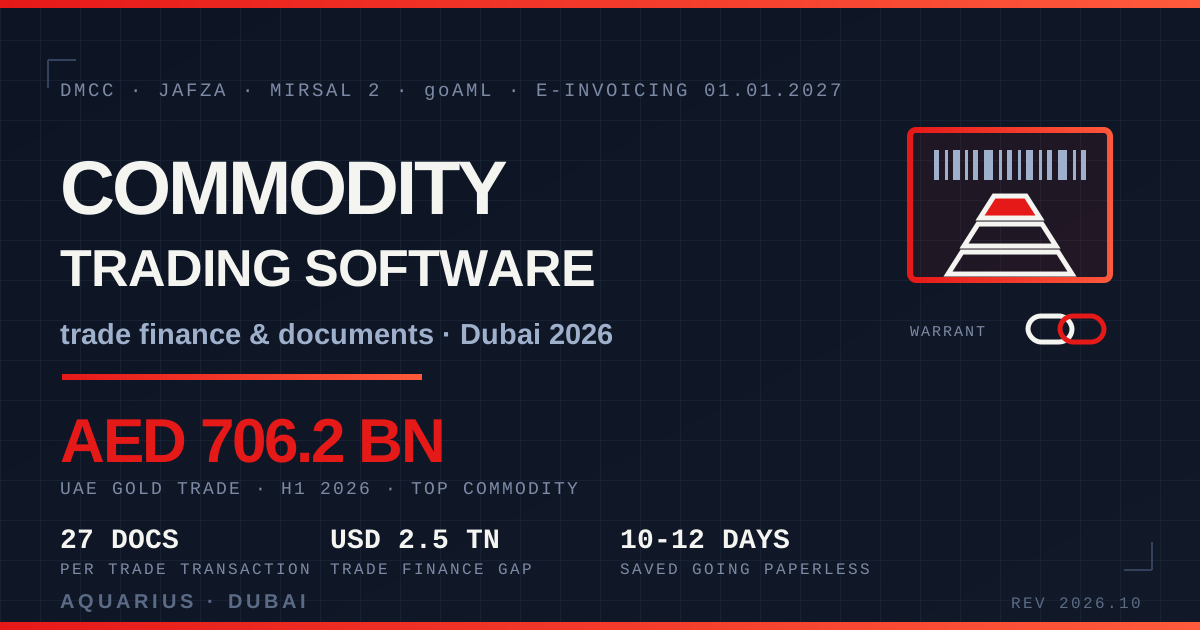
Short answer: in Dubai in 2026, a working commodity trading and trade finance platform costs roughly AED 55,000-130,000 for a single-desk trade and position ledger, AED 160,000-440,000 for a full CTRM-style build covering contracts, inventory, hedging and settlement, and AED 35,000-85,000 to bolt goAML and e-invoicing compliance onto whatever you already run. The expensive part is never the software. It is the 27 documents you still move by email.
Dubai is not short of commodity flow. Gold alone accounted for AED 706.2 billion of UAE trade in the first half of 2026 - the single largest commodity line, ahead of telecoms products at AED 189.7 billion, with gold jewellery, automobiles and diamonds behind it. Yet most of the desks moving that value still run on spreadsheets, WhatsApp confirmations and a courier.
The numbers behind Dubai trade in 2026 (awareness)
Three figures set the stakes for anyone building or buying trading software here.
First, volume. UAE non-oil foreign trade hit AED 1.937 trillion in H1 2026, up 13.1% year on year, with non-oil exports at AED 452.8 billion - a 23.9% jump and now 23.4% of total trade, up from 21.3% a year earlier. Trade with CEPA partner countries alone reached AED 304.3 billion in the same six months. Every one of those transactions needs a contract, a shipping document set, a payment instruction and an audit trail.
Second, density. DMCC passed 26,000 member companies after adding more than 2,300 in 2025, including over 2,500 members in precious metals, stones and diamonds. That is a concentration of mid-sized trading houses - the exact segment too big for a spreadsheet and too small for a half-million-dollar legacy CTRM licence.
Third, fragility. Jebel Ali handled 15.55 million TEU in 2025. Then Strait of Hormuz disruption and a March 2026 fire at the port took Q2 2026 throughput down to 374,000 TEU, a 90.1% year-on-year fall, with H1 2026 at 3.1 million TEU, down 59.5%. DP World group revenue still rose 13.1% to USD 12.7 billion in H1 2026 because volume rerouted elsewhere - but only the traders who could see their own exposure, positions and document status in one place rerouted calmly. The rest spent weeks reconstructing where their cargo and their paperwork actually were.
Most Dubai trading houses get this wrong: they believe the bottleneck is price discovery or hedging. It is almost never that. It is that nobody can answer “which of our 40 open trades is missing a document right now” without three phone calls - and that question is what decides whether a bank funds you.
Where the money actually leaks: documents, not deals (consideration)
The International Chamber of Commerce puts a typical trade transaction at up to 27 separate documents, nine of which relate to transfer of possession. End to end, such a transaction can cost as much as USD 80,000 and take two to three months to process. A paper bill of lading costs around USD 50 to issue, before courier and administrative handling that routinely runs to multiples of that. Going electronic cuts the cost of issuing and administering a bill of lading by roughly 75% and saves an average of 10 to 12 days per transaction.
Ten to twelve days is not an efficiency metric. It is working capital. And working capital is the scarce thing: the Asian Development Bank puts the global trade finance gap at USD 2.5 trillion, about 10% of world trade, essentially unchanged since 2023. Banks are not rejecting SME trade finance applications because the commodity is wrong. They reject them because the applicant cannot evidence the trade cleanly and fast.
The eBL myth every Dubai desk should know
Here is the part that catches people. The UNCITRAL Model Law on Electronic Transferable Records (MLETR) is what makes an electronic bill of lading legally equivalent to paper, by replacing physical “possession” with provable exclusive control in a reliable system. It has been adopted in only about ten jurisdictions - Bahrain (2018), Singapore (2021), Belize, Paraguay, Papua New Guinea, Timor Leste, the UK (2023), France (2024) - and in the UAE it is Abu Dhabi Global Market that enacted the MLETR-aligned framework, in 2021. Onshore UAE runs on Federal Decree-Law No. 46 of 2021 on Electronic Transactions and Trust Services, which gives electronic documents, signatures and seals legal recognition but is not the same instrument as MLETR.
Practical consequence: if your software is going to issue or endorse transferable documents, the governing law and seat of your contracts matters as much as your database schema. We build the document module so the record of control - who held the document, when, and under which jurisdiction - is immutable and exportable, because that is the artefact a bank or a court will ask for.
What the local rails already give you
Dubai has done more of this work than most traders use. Mirsal 2, accessed through the Dubai Trade portal, is mandatory for import, export and free zone transit declarations. Dubai Trade’s digital delivery order cut a release process that previously took up to 48 hours down to under 10 minutes. Dubai Customs launched Phase One of the Digital MAKASA initiative on 25 January 2026, letting direct-import MAKASA procedures be completed online instead of at a service centre. DMCC Tradeflow handles warrant-backed inventory financing, including jewellery and precious metals programmes and Shariah-compliant commodity murabaha.
These are APIs and portals, not magic. The value of a custom build is that your trade ledger, your declarations, your warrants and your invoices stop being four separate systems maintained by four different people.
Two compliance dates that are already priced into your 2027 (consideration)
Commodity desks in the UAE now carry two hard deadlines that change what software must do.
E-invoicing. The Ministry of Finance published its E-Invoicing Guidelines v1.0 on 23 February 2026. Businesses with revenue of AED 50 million or more must appoint an Accredited Service Provider by 30 October 2026 - extended from 31 July - but the go-live date of 1 January 2027 has not moved. Smaller businesses appoint an ASP by 31 March 2027 and go live 1 July 2027; government entities follow on 1 October 2027. Around 32 ASPs are already accredited. If your trading system generates invoices, it needs a validated path into an ASP, not a PDF export.
AML on precious metals and stones. Dealers in precious metals and stones are regulated at an AED 55,000 transaction threshold under Federal Decree-Law No. 10 of 2025 and Cabinet Resolution No. 134 of 2025. Qualifying cash or wire transactions must be filed as a DPMSR on the goAML portal within 15 working days, with a named MLRO and five-year record retention. Penalties run from AED 10,000 to AED 5,000,000, plus licence suspension. Banks now ask for AML registration proof before they will keep a dealer’s account open, and free zone authorities check goAML status at licence renewal. See our AML and KYC compliance software guide for the filing mechanics.
What it costs to build in Dubai (decision)
For context on the alternative: legacy CTRM deployments have historically cost upwards of USD 500,000 in upfront licence fees alone before implementation, which is why the vendor market is now pushing modular subscription tiers. Below is what a purpose-built platform costs with us in Dubai, fixed-scope and in AED.
| Scope | What you get | Timeline | Dubai cost (AED) |
|---|---|---|---|
| Trade & position ledger | Contracts, counterparties, lots, costs, realised and unrealised P&L, one commodity group | 4-6 weeks | 55,000 - 130,000 |
| Document & trade finance module | Document sets per trade, control/custody trail, LC and warrant tracking, bank-ready export packs | 3-5 weeks | 45,000 - 115,000 |
| Full CTRM-style platform | Multi-commodity, inventory and warehouse positions, hedging and mark-to-market, settlement, approvals, roles | 12-20 weeks | 160,000 - 440,000 |
| goAML / DPMSR compliance module | AED 55,000 threshold detection, CDD records, MLRO queue, goAML-format filing export, 5-year retention | 2-4 weeks | 35,000 - 85,000 |
| E-invoicing / ASP integration | Invoice data model, validation, ASP connector, failure handling and audit log | 2-4 weeks | 28,000 - 65,000 |
| Dubai Trade / Mirsal 2 & logistics feeds | Declaration status sync, delivery orders, shipment milestones into the trade record | 2-5 weeks | 30,000 - 90,000 |
| Care plan | Hosting, monitoring, regulatory updates, support, small changes | monthly | 4,000 - 14,000 / mo |
Most Dubai desks do not need row three in month one. The sequence that pays is ledger first, documents second, compliance third - each one live before the next starts. Our pricing page shows how we stage that, and our services cover the build, the integrations and the hosting under one accountable contract.
The return math, in the only units that matter
Take a desk doing 20 trades a month. At 10 to 12 days saved per transaction on document handling, and with a paper bill of lading costing around USD 50 before courier and admin multiples, the hard document saving alone is real - but the cash-cycle effect is larger. Pull 10 days out of 240 transactions a year and you have freed roughly 6,600 days of capital-tied-up across the book. Against a one-time AED 100,000-180,000 build, that is not a software decision. It is a treasury decision. And on the downside: one missed DPMSR filing can cost up to AED 5,000,000, which is more than the entire platform, twice over, with the care plan paid for a decade.
How Aquarius builds trading software in Dubai
We are a Dubai web, app and AI studio, not a commodity software reseller, and that shapes three things. We scope to a fixed price and a fixed date before writing code. We build on stacks you can hire for in the UAE - no proprietary trading DSL that locks you to us. And you own the repository, the database and the domain from day one; see our note on ownership and handover. If a regulator, a bank or an auditor asks for a record, the system produces it without a developer in the loop.
FAQ
Do I need a full CTRM or just a trade ledger?
If you trade one commodity group, under about 50 open positions, and you do not hedge with derivatives, a trade and position ledger at AED 55,000-130,000 covers you. You need full CTRM features when mark-to-market, multi-leg hedging or multi-warehouse inventory enter the picture.
Is an electronic bill of lading legally safe in the UAE?
It depends on the seat. ADGM enacted an MLETR-aligned framework in 2021, which is what gives an eBL functional equivalence to paper through provable exclusive control. Onshore UAE relies on Federal Decree-Law No. 46 of 2021 on Electronic Transactions and Trust Services, which recognises electronic documents and signatures but is a different instrument. Take legal advice on the contract seat, and build the control trail either way.
When exactly does e-invoicing hit my trading company?
Revenue of AED 50 million or more: appoint an Accredited Service Provider by 30 October 2026, live 1 January 2027. Below that: ASP by 31 March 2027, live 1 July 2027. Government entities, 1 October 2027. The ASP extension did not move any go-live date.
What triggers a goAML report for a metals trade?
A cash or wire transaction at or above AED 55,000, reported as a DPMSR within 15 working days under Federal Decree-Law No. 10 of 2025 and Cabinet Resolution No. 134 of 2025. Keep records five years and name an MLRO. Fines reach AED 5,000,000.
Can you integrate with our existing ERP instead of replacing it?
Usually yes, and usually cheaper. Most Dubai desks keep accounting where it is and add the trade ledger, document control and compliance layers on top, syncing invoices and journals. That is the AED 45,000-115,000 and AED 28,000-65,000 rows above rather than a full rebuild.
Next step
If you are a Dubai trading house still reconciling positions in Excel while an ASP deadline sits in October, the useful first move is small: a two-week scoping pass that maps your current document flow, flags the compliance gaps and returns a fixed AED price per module. Talk to Aquarius and we will send the readiness checklist with it, no obligation.