
Cookie Consent for Dubai Websites 2026: PDPL Rules and Real Costs
UAE law needs opt-in consent for analytics and ad cookies, yet the AED 5m PDPL fine everyone quotes is not in the law. What PDPL, DIFC and Consent Mode really require.
- PUBLISHED
- 12 OCT 2026
- READ TIME
- 10 MIN
- AUTHOR
- AQUARIUS · DUBAI
- UNIT
- REV 2026.09
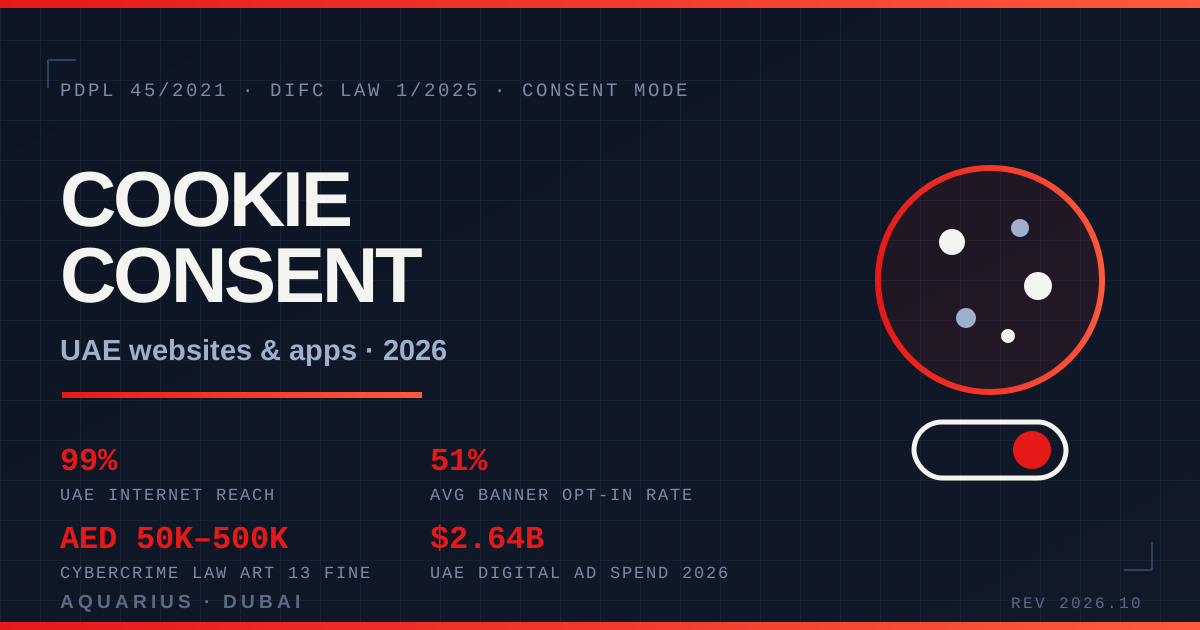
Short answer: yes — if your Dubai website sets analytics, advertising or any other non-essential cookie, UAE law expects you to ask first. The Personal Data Protection Law (Federal Decree-Law No. 45 of 2021) requires consent that is specific, informed, unambiguous and freely given, and as easy to withdraw as it was to give. There is no separate UAE cookie law and the PDPL’s Executive Regulations are still unpublished in 2026, so the safe reading is the one every UAE data-protection practice now gives: treat non-essential cookies as opt-in today rather than waiting for the detail.
That is the compliance half. The commercial half is the part most Dubai businesses get wrong: a banner copy-pasted from a European template usually blocks your own measurement, hands Google Ads and Meta a smaller conversion set than it needs, and still does not satisfy PDPL because nothing is actually wired to the tags. This guide covers what the law requires, which regime applies to you, what a banner costs in money and in lost data, and how to configure one that stays compliant without flying your marketing blind.
Key takeaways
- UAE internet penetration is 99% with about 11.3 million users as of January 2026 — almost every customer you have arrives through a browser you are tracking.
- UAE digital ad spend is forecast at US$2.64 billion in 2026, up 15.2% year on year. Measurement you cannot legally collect is budget you cannot optimise.
- The PDPL itself sets no fines. The much-quoted “AED 5 million PDPL fine” is not in the law — penalties await a Cabinet decision. Your live exposure today runs through the Cybercrime Law instead.
- DIFC and ADGM entities are under separate, already-enforced regimes. DIFC Law No. 1 of 2025 added a private right of action in the DIFC Courts, including claims for distress alone.
- Google Consent Mode v2 is mandatory for EEA, UK and Swiss traffic — not for UAE-only traffic. You still want it, because it is the only clean way to honour a PDPL opt-out and keep modelled conversions.
Why cookie consent became a 2026 problem in the UAE
The UAE is one of the most connected markets on earth. Internet penetration sits at 99.0–99.1% with roughly 11.3 million internet users, there are around 12.5 million social media identities (about 110% of the population, because of multiple accounts) and 23 million mobile connections — roughly 202% of residents. Smartphone penetration is near 95%, and the majority of UAE web traffic is mobile.
Money follows that attention. UAE digital ad spend is projected to grow 15.2% to US$2.64 billion in 2026, heading for about US$4.30 billion by 2029 on a 17.7% compound rate, with Dubai alone accounting for more than US$1.2 billion. Every dirham of that is optimised against events a cookie or an identifier reports back. So the consent banner is no longer a legal checkbox at the bottom of a backlog — it is the valve on your entire measurement stack.
Meanwhile the legal picture stopped being theoretical. The PDPL has been in force since January 2022. Its Executive Regulations, originally due within six months, remain unpublished as of 2026 — and when they do land, organisations get six months to comply. DIFC and ADGM, which many Dubai and Abu Dhabi companies sit inside, already have working regulators, fee schedules and fines.
What the PDPL actually requires from a cookie banner
There is no standalone UAE cookie regulation. Instead, the general personal-data rules apply whenever a cookie or similar technology processes personal data — which analytics, advertising, remarketing and session-replay cookies all do. Where you rely on consent, it has to clear four cumulative tests:
- Specific. Tied to a defined purpose. One bundled “we use cookies to improve your experience” covering analytics, ads and third-party data sharing does not qualify.
- Informed. Given after a clear privacy notice the user can actually reach — which means a working cookie policy, not a dead link.
- Unambiguous. A clear affirmative act. Pre-ticked boxes, silence, scrolling and “by continuing to browse you agree” are not consent.
- Freely given. Not bolted onto a service where consent is not needed to deliver it.
Two more obligations get skipped most often. Consent must be withdrawable at any time, as easily as it was given — so if accepting took one click, withdrawing cannot require an email to your data protection officer. And withdrawal has to actually stop the processing within a reasonable time, meaning the banner must control your tags rather than sit decoratively on top of them. A banner that fires Google Analytics and the Meta pixel before anyone clicks anything is the single most common failure we find on Dubai websites.
The AED 5 million fine you keep reading about is not in the PDPL
Search “PDPL fine” and you will find confident blog posts quoting a schedule from AED 50,000 up to AED 5 million, sometimes AED 20 million with imprisonment. Check the law and that schedule is not there. The PDPL does not specify penalties: the Cabinet is to issue a decision setting out which acts constitute violations and the matching administrative penalties, and that decision has not been published.
That is not a reason to relax — it is a reason to understand your real exposure, which sits in three places today:
- The Cybercrime Law. Federal Decree-Law No. 34 of 2021, Article 13, penalises unlawful collection or processing of personal data with detention and/or a fine of not less than AED 50,000 and not more than AED 500,000. This is live, criminal, and independent of the PDPL regulations.
- Free-zone regimes. If you are in DIFC or ADGM you are already inside an enforced framework with its own commissioner and fines.
- Commercial and contractual risk. Enterprise and government procurement in the UAE now routinely asks for data-protection and consent evidence in the vendor questionnaire. Failing that section costs more, faster, than any regulator will.
Which regime applies: mainland vs DIFC vs ADGM
Dubai businesses often assume one rulebook. There are three, and your registration decides which one binds you.
| Where you are registered | Governing law | Consent standard for non-essential cookies | Enforcement position in 2026 |
|---|---|---|---|
| UAE mainland / most free zones | Federal Decree-Law No. 45 of 2021 (PDPL) | Specific, informed, unambiguous, freely given, withdrawable | Executive Regulations unpublished; penalties pending a Cabinet decision. Cybercrime Law Art. 13 applies: AED 50,000–500,000 |
| DIFC | DIFC Data Protection Law, as amended by DIFC Law No. 1 of 2025 | GDPR-style explicit consent; pre-ticked boxes invalid | Scope now covers all processing in the DIFC regardless of where the controller is incorporated. Private right of action in the DIFC Courts, including distress-only claims. New USD 25,000 fine for missing the annual DPO assessment; DPIA and public-authority data-sharing failures up to USD 50,000 |
| ADGM | ADGM Data Protection Regulations 2021 | Freely given, specific, informed, unambiguous affirmative action | Commissioner of Data Protection enforces. Annual data protection fee of USD 300 plus USD 300 renewal; penalties for non-payment and for substantive breaches |
If you operate across all three — a DIFC holding company, a mainland trading licence and a website serving both — build to the strictest standard once rather than running three banners. That is also the cheapest path, because the DIFC standard already satisfies the PDPL reading. Our UAE PDPL compliance checklist for websites and apps covers the wider programme around the banner, and UAE website legal pages covers the policy documents a banner has to link to.
Essential vs non-essential: what you may still set without asking
Consent is for non-essential cookies. You can set what is strictly necessary to deliver the service the user asked for:
- No consent needed: session and authentication cookies, cart contents, CSRF tokens, load balancing, language or currency choice, the cookie-consent record itself.
- Consent needed: Google Analytics and any product analytics, Google Ads and Meta remarketing, TikTok and Snapchat pixels, heatmaps and session replay, chat widgets that profile, A/B testing tools, embedded video that drops advertising cookies.
The practical test is ruthless: if the feature exists to help you rather than the visitor, it is non-essential. That includes the analytics you personally rely on.
Google Consent Mode: what UAE advertisers actually need
Google Consent Mode v2 is mandatory for advertisers whose users are in the EEA, the UK or Switzerland. Google began enforcing it on 21 July 2025, and non-compliant accounts lose personalised ads, remarketing and conversion tracking for that traffic. The requirement is geographic by user location, not by where your company sits — so a Dubai business serving only UAE customers is not caught by Google’s mandate.
Implement it anyway. Consent Mode is the mechanism that makes a PDPL opt-out real inside Google’s tags instead of just hiding a banner. Two signals do the work:
- analytics_storage. Denied means Google Analytics reads and writes no first-party analytics cookies and sends cookieless pings instead.
- ad_storage. Denied means no advertising cookies are written and no existing first-party advertising cookies are read.
The choice that matters is advanced versus basic mode. Basic mode blocks the tags entirely until consent, so a declining visitor is simply invisible. Advanced mode loads tags in a denied state and sends cookieless pings, which is what feeds Google’s behavioural and conversion modelling — vendors report advanced implementations recovering upwards of 70% of otherwise-lost conversions. If you run Google Ads in the UAE, basic mode is the expensive choice. One caveat for 2026: with Google Signals retired as of 15 June 2026, ad_storage is the sole governing parameter for advertising data in linked GA4 properties, so getting that one signal right now carries more weight than it did last year.
If your analytics already runs through a server container, consent has to be enforced there too — see GA4 server-side tracking setup cost in Dubai. And if you are buying traffic while this is unresolved, our Google Ads cost guide for Dubai explains what thin conversion data does to your cost per acquisition.
What a compliant banner costs you in data, and how to minimise it
A real opt-in choice means some visitors say no. Published 2026 benchmarks put the global average banner opt-in rate near 51%, with real-world results ranging from 4% to 85% driven largely by banner design. Giving “Reject All” equal prominence — which a defensible banner must — typically drops opt-in by 20–30 percentage points. By sector, reported consent rates run roughly:
| Sector | Reported consent rate | What that means for your reporting |
|---|---|---|
| Healthcare and clinics | 60–67% | Usable analytics, but model the gap before trusting conversion counts |
| Finance and insurance | 55–62% | Advanced Consent Mode worth the setup cost immediately |
| Ecommerce and retail | 45–55% | Roughly half your revenue attribution needs modelling or server-side support |
| Ad-supported media | 23–30% | Plan for first-party and contextual measurement, not pixel-led reporting |
You lower that loss honestly, not with dark patterns: a short banner in plain English and Arabic, a clear statement of what each category does, a visible benefit for accepting, fast load so the banner is not the slowest thing on the page, and no second interruption on every visit. Design work beats trickery here, and it is also the only version that survives scrutiny.
What cookie consent costs a Dubai business in 2026
Two line items: the consent platform licence, and the implementation that actually wires it to your tags. Platform prices below are public vendor pricing converted at the fixed 3.6725 AED/USD peg; VAT at 5% may apply.
| Option | Published price | Approx. AED per year | Best for |
|---|---|---|---|
| CookieYes Free | US$0 (5,000 pageviews/month) | AED 0 | Brochure sites with light traffic |
| CookieYes Basic / Pro / Ultimate | US$10 / $25 / $55 per domain per month | ≈ AED 440 / 1,100 / 2,425 | SMEs; priced by pageviews, 100k to unlimited |
| Cookiebot Lite / Small / Medium | €7 / €15 / €30 per month | ≈ AED 300 / 650 / 1,290 | Scanning-led compliance; note base prices doubled in August 2025 |
| Usercentrics | From US$8/month; 3 domains at $34/month, 10 at $56/month, session-metered | ≈ AED 1,500–2,470 | Multi-brand groups needing session-based billing |
| Aquarius implementation | From AED 2,500, fixed scope | One-off | Cookie audit, GTM consent wiring, Consent Mode v2 advanced, bilingual banner, cookie policy, QA evidence |
The licence is the cheap part. The expensive failure is paying for a consent platform for two years and discovering during a procurement review that every tag still fired before consent — so you carried the cost without the compliance, and the data loss without the modelling. Our pricing page lists where this sits alongside the rest of a build.
How Aquarius implements it
- Cookie audit. We crawl the site and list every cookie, pixel and third-party script actually firing — usually including two or three nobody remembers installing.
- Classification. Each one marked essential or non-essential, with the purpose written in the language you will publish, in English and Arabic.
- Blocking before consent. Tags move into Google Tag Manager behind consent triggers, so nothing non-essential fires on first load. This is the step most banners skip.
- Consent Mode v2, advanced. Default denied, region-aware, with cookieless pings preserved so GA4 and Google Ads can model the gap.
- Withdrawal that works. A persistent preferences link, one click to change categories, verified to stop processing.
- Evidence. A dated screenshot and network-log pack showing pre-consent and post-consent behaviour — the artefact that answers a client’s compliance questionnaire in an afternoon instead of a fortnight.
Fixed scope, fixed price, and we hand over the tag container and documentation. If you already have a consent platform, we audit and fix it rather than selling you a replacement.
FAQ
Do UAE websites legally need a cookie banner in 2026?
There is no standalone UAE cookie law, but the PDPL applies whenever cookies process personal data, and it requires consent that is specific, informed, unambiguous and freely given. If your site sets analytics or advertising cookies, you need a consent mechanism. DIFC and ADGM entities are under stricter, already-enforced regimes.
What is the fine for not having cookie consent in the UAE?
The PDPL itself specifies no fines — penalties await a Cabinet decision, and the figures circulating online are not in the law. The live exposure is Article 13 of the Cybercrime Law (Federal Decree-Law No. 34 of 2021), which carries detention and/or a fine of AED 50,000 to AED 500,000 for unlawful collection or processing of personal data. DIFC and ADGM have their own published fines.
Is Google Consent Mode v2 required for a Dubai business?
Google mandates it only for traffic from the EEA, the UK and Switzerland, so a UAE-only advertiser is outside the mandate. Implement it regardless: it is the cleanest way to make a PDPL opt-out take effect inside Google’s tags, and advanced mode preserves modelled conversions you would otherwise lose.
Can I just use the cookie banner that came with my WordPress theme?
Usually not. Most bundled banners display a notice without blocking anything, so analytics and advertising cookies are already set by the time a visitor sees the message. That fails the unambiguous-consent test while still annoying the user — the worst of both outcomes.
Does my banner need to be in Arabic?
Consent must be informed, which means understandable to the person giving it. For a UAE audience that means English and Arabic parity, with the banner mirrored correctly in right-to-left layout. It also measurably improves opt-in rates, because people accept what they can read.
How long does implementation take?
For a typical Dubai business site, a cookie audit, tag-manager consent wiring, Consent Mode v2 and a bilingual banner takes about one to two weeks, most of which is QA proving that nothing fires before consent.
Get it right once
With UAE digital ad spend heading past US$2.64 billion this year and 99% of the population reachable online, the cost of a broken consent setup is not a hypothetical regulator — it is the half of your conversion data you cannot see while you bid against competitors who can. Fix the banner, keep the measurement, and have the evidence pack ready when a client asks.
Want a straight answer on where your site stands? Send us the URL and we will tell you which tags fire before consent, what that is costing your reporting, and the fixed AED price to put it right.