
Custom Packaging and Box Printing in Dubai (2026): Real AED Costs, MOQs and the 1 January 2026 Plastic Ban
Custom boxes cost AED 6-7 per unit at MOQ 100 and AED 1-2 in bulk. Real Dubai print costs, lead times, the single-use plastic phases and the Arabic label rule that stops print runs.
- PUBLISHED
- 24 SEPT 2026
- READ TIME
- 11 MIN
- AUTHOR
- AQUARIUS · DUBAI
- UNIT
- REV 2026.09
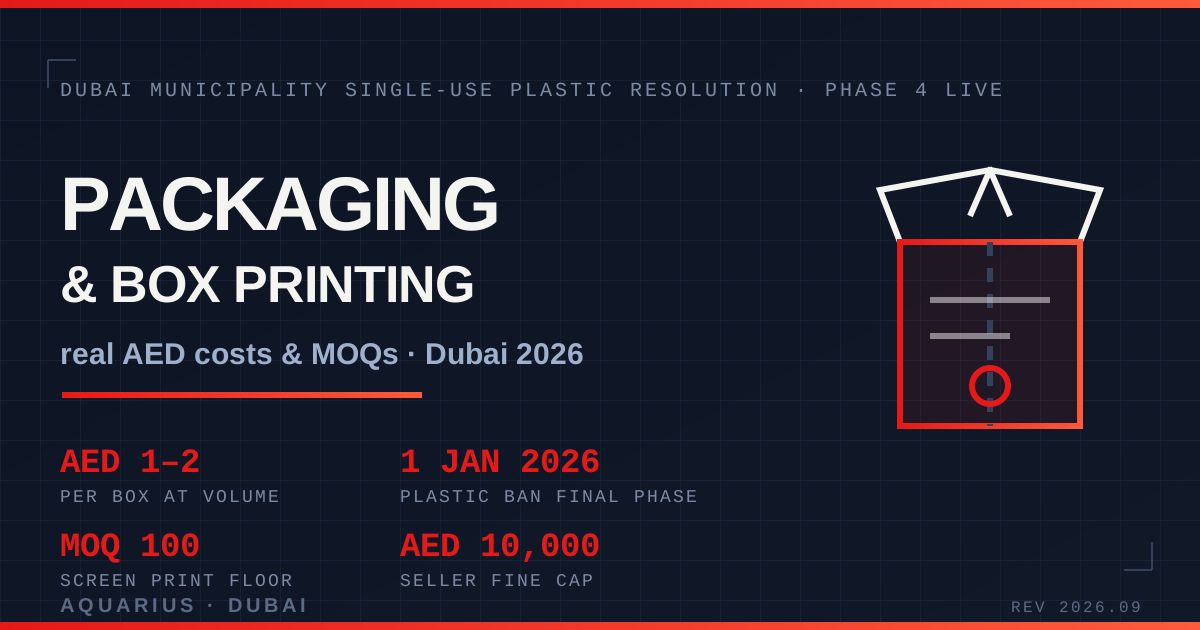
Short answer: A custom-printed corrugated e-commerce box in Dubai costs roughly AED 6–7 per unit at the 100-piece minimum and drops to AED 1–2 per unit once you order in real volume. Rigid gift boxes start at an MOQ of about 100 and cost several times that. Standard production is 7–10 working days from artwork approval, with Dubai delivery inside one working day after that. And since 1 January 2026, the final phase of Dubai Municipality’s single-use plastic resolution has made plastic plates, cutlery, chopsticks, and beverage cups and lids illegal to hand a customer — which is why half the packaging quotes in this city changed shape this year.
Here is what most Dubai businesses get wrong. They shop for packaging on the per-unit price of the box and nothing else. But the box is a component in three separate cost systems: the printer’s setup economics (which is why 100 units costs four times as much per box as 5,000), the courier’s volumetric weight table (which is why an oversized box costs you money on every single order, forever), and the regulator’s label file (which is why a beautiful print run can be legally unsellable). Get the unit price 10% wrong and you lose a rounding error. Get the dieline or the Arabic label wrong and you reprint the entire run.
Why packaging stopped being a back-office purchase in Dubai
The demand side is not subtle. The UAE e-commerce market reached USD 12.3 billion in 2026 — roughly AED 45.1 billion — and is forecast to hit USD 21.01 billion by 2031, an 11.29% CAGR. Dubai carries around 60% of that. The emirate’s wholesale and retail trade sector alone generated about AED 50.9 billion in Q1 2026, near 22% of Dubai’s GDP, growing 2.6% year on year. Every one of those parcels leaves a warehouse inside something.
The supply side has followed. The UAE paper packaging market is at USD 4.16 billion in 2026 and tracks to USD 6.65 billion by 2035 at a 5.35% CAGR, while UAE corrugated board packaging specifically sits at about USD 1.43 billion (2025) heading to USD 1.68 billion by 2030 at 3.23%. Corrugated is the largest single category by size, pulled by e-commerce volume and a hard regulatory push away from plastic.
That regulatory push has a calendar, and it already ran to the end:
| Phase | Effective | What became illegal to supply |
|---|---|---|
| Phase 1 | 1 January 2024 | Single-use plastic bags under 57 microns |
| Phase 2 | 1 June 2024 | All single-use bags — including paper and biodegradable plant-based |
| Phase 3 | 1 January 2025 | Styrofoam cups and food containers, plastic straws, stirrers, cotton buds, plastic table covers |
| Phase 4 (final) | 1 January 2026 | Plastic plates, plastic cutlery including chopsticks, plastic beverage cups and their lids |
Enforcement is per-incident and compounding: AED 200 per violation for a seller, doubled for a repeat inside the same year, capped at AED 10,000 for sellers and AED 2,000 for consumers. The exemptions are narrow and worth knowing precisely, because they are where legitimate savings live: export products, items manufactured inside the UAE from recycled material (a deliberate subsidy to local recycling), medicine and refuse bags, very thin fresh-food wraps, and large shopping bags. Compostable alternatives must meet recognised international standards — “eco-friendly” on a supplier’s invoice is not a compliance document.
Note what Phase 2 caught out: banning all single-use bags, paper included, means the swap most F&B operators made in 2024 was itself non-compliant. If your answer to a regulation is a like-for-like material swap, check the text, not the trend piece.
What actually drives the number on the quote
Six variables set your per-unit price, roughly in order of impact:
- Quantity. The dominant factor by a wide margin. Plates, dies and machine setup are fixed costs amortised across the run.
- Print method. Screen printing typically starts at 100 pieces; flexographic printing at 500 pieces and carries additional block charges per colour; offset and digital sit at different ends of the quality-versus-quantity curve. Quoted prices are commonly for one colour on one panel — extra panels and colours are extra money.
- Board construction. Single-wall versus double-wall corrugated, flute profile, GSM, and whether you need rigid chipboard rather than corrugated at all.
- Finishes. Matte or gloss lamination, spot UV, foil stamping, embossing and debossing, die-cut windows. Each adds a pass.
- Dieline and structure. Mailer, tuck-end carton, rigid two-piece, sleeve, insert trays for fragile items. Inserts are frequently the difference between an 11% damage rate and a 2% one.
- Lead time. Standard is 7–10 working days after artwork approval. Compressing that costs a premium, and during Ramadan and the GITEX and Gulfood run-ups Dubai’s presses genuinely book out.
Real AED numbers, 2026
Published and quoted Dubai figures, before your own negotiation. Treat the per-unit column as the shape of the curve rather than a fixed rate card — every printer prices off your specific dieline.
| What you are buying | AED per unit | Terms |
|---|---|---|
| Plain stock carton, bought retail (50L double-wall) | ~4.50 | From 20 pieces, no branding at all |
| Custom-printed e-commerce box, 15×14×8 cm | ~6.83 | MOQ 100 pcs — AED 682.50 inc. VAT for the run |
| Basic custom printed box, true bulk | 1–2 | Volume orders; 500+ for best per-unit pricing |
| Screen print, one colour one panel | Included in above | MOQ 100 pcs |
| Flexo print | Lower at volume | MOQ 500 pcs + block charges per colour |
| Rigid / luxury gift box with finishes | Multiples of the above | MOQ from 100; 3D mockups and samples on request |
| Add-on insert tray (fragile / premium) | Quoted separately | Priced per cavity design |
Run the arithmetic before you argue about dirhams. A brand shipping 1,000 orders a month that buys at the 100-piece MOQ price of AED 6.83 spends AED 81,960 a year on boxes. The same brand buying the same box in bulk at AED 1.80 spends AED 21,600. That is a AED 60,360 annual difference created entirely by order size and cash-flow planning — not by finding a cheaper supplier. Small MOQs are a launch tool, not an operating model.
Add VAT at 5%, and if you are importing rather than printing locally, add 5% customs duty on CIF plus clearance. Local printing in Al Quoz or Dubai Investments Park frequently wins on landed cost alone once you price the freight of shipping air.
The cost nobody puts in the packaging budget: volumetric weight
This is where Dubai brands quietly lose the most money. Couriers bill large-but-light parcels on volumetric weight, not actual weight. So an oversized box is not a one-time AED 2 mistake — it is a per-order tax on every shipment for the life of the SKU.
The delivered numbers, 2026: standard next-day delivery in Dubai runs AED 17–30 per parcel and AED 22–38 to the Northern Emirates; same-day is AED 35–60 in Dubai and AED 45–75 up north. Flat-rate operators quote around AED 17.31 per shipment up to 5 kg across all seven emirates. But once failed delivery attempts, retries and amortised return-to-origin are included, true delivered cost lands at AED 32–38 per order — 8.5–10% of average order value.
Against that, the box is the cheap variable. Right-sizing your dieline so the carton matches the product and drops into a lower volumetric band pays back more than any per-unit haggle. So does cutting the damage rate: 11% of e-commerce parcels arrive damaged, at an average cost of USD 18 (about AED 66) each in replacements, return freight and support time. E-commerce return rates already sit at 20–30% against about 9% for traditional retail. A protective insert that costs cents is competing against a failure that costs AED 66 plus a lost customer.
The label file that stops a print run
If your product is food, cosmetics, or a health or personal-care item, the packaging artwork is a regulatory submission, not a design deliverable. Arabic labelling is mandatory under UAE law — all required information must appear in Arabic. Food products register through Dubai Municipality’s FIRS / ZAD system; cosmetics, health and personal-care products through Montaji. You will need the label in Arabic and English, the ingredient list in descending order, country of origin, manufacturer details, a barcode, plus a Certificate of Analysis, nutritional analysis, a Certificate of Conformity, and a Halal certificate where applicable.
Timelines: registration commonly takes one to three weeks, and advisors report three to six weeks for FIRS with complete documentation, with lab testing adding 2–5 working days per shipment. The single most common rejection reason is the dullest one: missing or incorrect Arabic translation on the label. Barcodes come from GS1 UAE, whose fees are tiered by annual turnover and require annual renewal — let the membership lapse and your GTINs stop being valid.
Sequence matters more than speed here. Approve the label file before the print run, not in parallel with it. A 5,000-unit run reprinted because the Arabic ingredient order was wrong costs the full unit price twice, plus the lead time twice, plus whatever the stockout costs you.
What the spend actually returns
Packaging is one of the few brand expenses with a measurable retention effect. Custom packaging is associated with a 26% increase in repeat purchases, a 15% drop in returns and a 40% rise in social mentions. 72% of consumers say packaging design influences their purchase decision, 61% say premium packaging makes them more likely to buy from the same brand again, and 57% of people who had a memorable packaging experience bought again. The distribution channel is free and enormous: the #unboxing hashtag has passed 85 billion views on TikTok alone.
Put that beside the delivered-cost math. At AED 32–38 per order to get a parcel to a Dubai doorstep and 8.5–10% of AOV gone on logistics, the marginal dirham on the box is the cheapest retention spend on the P&L — and the only one the customer photographs.
How Aquarius approaches it
We treat packaging as a system with three deliverables, not one: a structural dieline right-sized to the product and the courier’s volumetric bands, a print-ready artwork file with the bilingual label fields the regulator requires already placed and proofed, and a print specification (board, ply, colours, panels, finishes, MOQ tier) you can send to three Dubai printers and get genuinely comparable quotes back. We build the same discipline into the storefront and the fulfilment data behind it — see our Dubai e-commerce build guide — and for branded client-gift programmes the economics run parallel to our 2026 Dubai corporate gifting cost breakdown.
Physical proof before volume, always: a 3D mockup and a physical sample, drop-tested with the real product inside, before a 5,000-unit run is committed. Transparent bands and scope are on our pricing page.
FAQ
What is the minimum order for custom printed boxes in Dubai?
Screen-printed custom boxes start at about 100 pieces, and rigid gift boxes from roughly 100 units. Flexographic printing generally needs 500 pieces. Best per-unit pricing typically starts at 500 units and above.
How much does a custom box cost per unit?
At the 100-piece minimum, expect around AED 6–7 for a small corrugated e-commerce box — one published Dubai price is AED 682.50 inc. VAT for 100 pieces of a 15×14×8 cm box. In bulk, basic custom boxes fall to AED 1–2 per unit. Rigid and foiled luxury boxes cost several times more.
How long does production take?
Standard lead time is 7–10 working days from order and artwork approval, with delivery within Dubai often next working day. Add regulatory label registration time separately — one to three weeks, and up to three to six weeks for food products through FIRS.
Which plastic packaging is banned in Dubai in 2026?
Since 1 January 2026, the final phase bans plastic plates, plastic cutlery including chopsticks, and plastic beverage cups and their lids. Earlier phases already banned single-use bags (all types, from 1 June 2024), Styrofoam cups and food containers, straws, stirrers, cotton buds and plastic table covers. Fines are AED 200 per violation, doubled for repeats within a year, capped at AED 10,000 for sellers.
Does my packaging need Arabic text?
Yes, for regulated products. Arabic labelling is mandatory under UAE law and mandatory information must appear in Arabic. Food registers via Dubai Municipality’s FIRS/ZAD system, cosmetics and health products via Montaji, and missing Arabic translation is the most common cause of label rejection.
Where to start
Before you request a single quote, settle three things: the exact internal dimensions of your product plus protection, whether your category triggers Arabic label registration, and the realistic annual volume you can commit to and store. Those three answers move your per-unit cost more than any supplier conversation will.
Want the dieline, the bilingual label file and a print spec you can shop to any Dubai printer? Talk to Aquarius — we will size it against your actual courier bands and order volume, not a generic rate card.