
The EU Forced Labour Ban and UAE Exporters (2026): No Re-Export, and You Pay for the Destruction
Regulation (EU) 2024/3015 applies from 14 December 2027. A banned consignment cannot be re-exported, the operator funds disposal, and the Commission risk database went live in June 2026.
- PUBLISHED
- 30 OCT 2026
- READ TIME
- 12 MIN
- AUTHOR
- AQUARIUS · DUBAI
- UNIT
- REV 2026.09
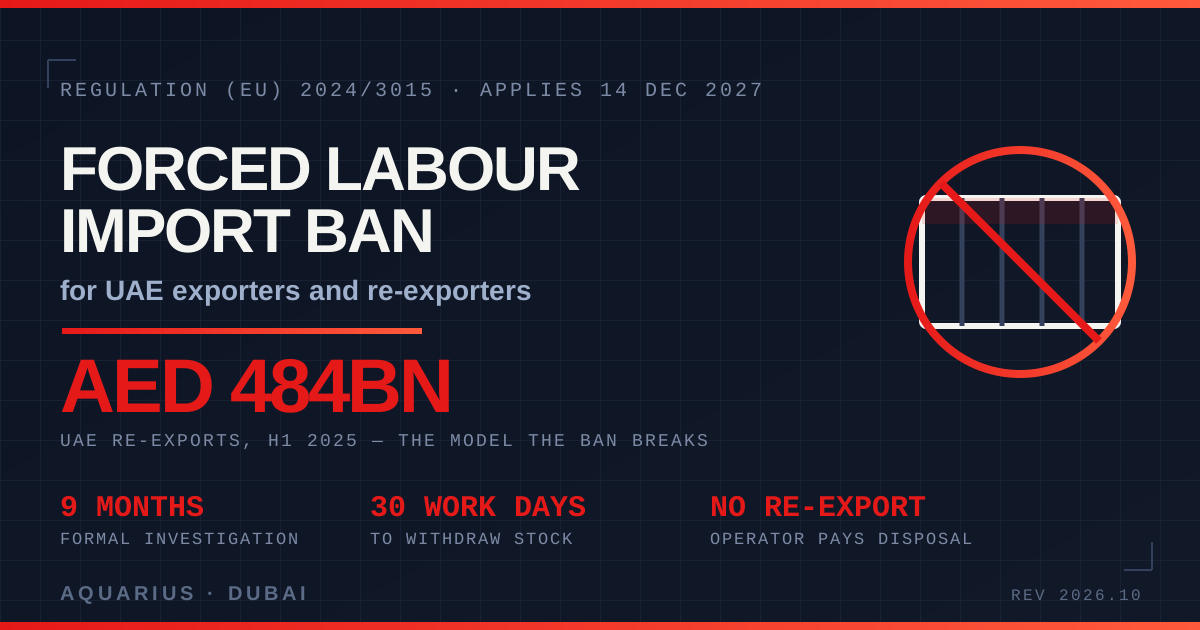
Short answer: from 14 December 2027, Regulation (EU) 2024/3015 bans any product made wholly or partly with forced labour at any stage of its supply chain from being placed on, or exported from, the EU market — with no sectoral carve-out, no de minimis value and no SME exemption. The clause that should worry a Dubai trading company is not the ban itself but the remedy: once a ban decision is issued, customs must refuse release, re-export is not available, and the economic operator bears the cost of disposal. The Commission published its implementation guidelines, opened the Forced Labour Single Portal and switched on the public forced-labour risk database on 26 June 2026, which means the risk assessment that will be used against your goods is already running.
Why UAE goods are inside the blast radius
The UAE has never had more exposure to this rule than it does right now. Non-oil foreign trade passed AED 3.8 trillion in 2025, up 26.8% year on year, with non-oil exports alone exceeding AED 813 billion on 45.5% growth. In the first half of 2025, imports ran at AED 874.1 billion, direct non-oil exports at AED 369.5 billion and re-exports at AED 484.4 billion — that last number is the one the forced-labour regime collides with, and we will come back to it.
Europe is not a marginal destination. The EU is the UAE's second-largest trading partner, accounting for about 8.3% of total non-oil trade, with UAE–EU non-oil trade at USD 67.6 billion in 2024 (roughly AED 248 billion), up 3.6% on the prior year. The two sides formally launched Comprehensive Economic Partnership Agreement negotiations in April 2025, with a second round held in December 2025. Tariff lines are about to get easier. Admissibility is about to get harder, and the second one is not negotiable in a trade deal.
The scale of the underlying problem explains why the EU reached for a product ban rather than a reporting duty. The ILO estimates 27.6 million people in forced labour worldwide, generating USD 236 billion in illegal profits a year — about AED 867 billion, and up USD 64 billion, or 37%, since 2014, at close to USD 10,000 per victim. The Arab States account for USD 18 billion of those profits, and rank second-highest in the world on illegal profit per victim. Walk Free's Global Slavery Index puts G20 imports of at-risk products at USD 468 billion annually (about AED 1.72 trillion), led by electronics at USD 243.6 billion, garments at USD 147.9 billion, palm oil at USD 19.7 billion, solar panels at USD 14.8 billion and textiles at USD 12.7 billion. Those five categories are a fair description of what moves through Jebel Ali.
Being realistic about the regional picture matters too, because competent authorities will consult the risk database rather than your brochure. The same index estimates a UAE prevalence of 13.4 people per 1,000 and around 132,000 people in modern slavery on any given day in 2021 — second-highest of eleven countries in the Arab States region and seventh-highest of 160 countries assessed. You do not have to agree with the methodology. You do have to expect an EU investigator to have read it.
What the regulation bans, and what it pointedly does not require
Regulation (EU) 2024/3015 was published in the Official Journal on 12 December 2024, entered into force on 13 December 2024 and applies from 14 December 2027. Member States must have their penalty rules in place by 14 December 2026 — a date most UAE exporters have not registered at all.
Read the structure carefully, because it is unusual. The Commission's June 2026 guidelines state plainly that the regulation does not create a standalone due diligence obligation. There is no filing, no annual statement, no certificate to buy. What exists instead is an outcome ban: if a product was made with forced labour anywhere in its chain, it is prohibited, full stop. The guidelines then note that effective due diligence is central to demonstrating compliance and managing enforcement risk. In practice that is a harder standard than a reporting duty, not a softer one — there is no safe harbour you can reach by filing a form, and the only defence is evidence.
Scope is deliberately wide. The ban covers products made wholly or partly with forced labour at any stage of the supply chain, regardless of product type, sector or origin; it applies to goods placed on the EU market and to goods exported from it; and the published text contains no de minimis threshold and no small-business exemption. Authorities are told to prioritise cases on three criteria: the severity and extent of the alleged forced labour, the quantity or value of the product on the EU market, and the share the suspect input represents in the finished product.
Enforcement is also crowdsourced. Any natural or legal person or association can submit information about a suspected violation through the Single Portal, in any official EU language. NGOs and trade unions have had that channel since June 2026. The first authority to hear about your tier-three supplier will probably not be you.
The clause that breaks the Dubai re-export model
Here is the part most Dubai businesses get wrong. The commercial assumption built into a re-export operation is optionality: if a consignment is refused at one border, you redirect it. Under this regulation that option is removed. Where customs identify a product covered by a ban decision, they must refuse its release, and the guidance is explicit that re-export will not be possible and that the operator bears the disposal cost. A container does not come home, does not get flipped to another market and does not sit in bond while you argue. It is destroyed, at your expense, plus freight, plus demurrage, plus the penalty for non-compliance with the decision.
A ban decision converts inventory into a disposal liability. For a business whose margin model assumes goods can always be redirected, that is a balance-sheet event, not a compliance cost.
Note the asymmetry in penalties as well: under the regulation, fines attach to failure to comply with a decision, not to the underlying forced labour. The guidelines set out a five-step calculation logic for national authorities rather than one EU-wide tariff, with illustrative severity bands running from 0–10% of product value for very low severity up to 30–60% for significant severity. Twenty-seven Member States will set their own numbers by December 2026.
How an investigation actually runs, in days
The timetable is the real design constraint on your systems, because the deadlines are short and they start without warning.
| Stage | Clock | What you must produce |
|---|---|---|
| Notification of formal investigation | Within 3 working days of opening | Nothing yet — but the response window starts |
| Reply to a request for information | Generally 30 working days, extendable to 60 in complex cases | Due diligence records, supplier mapping, traceability evidence |
| Preliminary assessment by the authority | About 30 working days after your reply | Decision whether to open a formal investigation |
| Formal investigation | In principle completed within 9 months | Rolling evidence, remediation and corrective action plans |
| Compliance with a ban decision, non-perishable goods | At least 30 working days | Withdrawal from market and disposal, operator-funded |
| Compliance with a ban decision, perishable goods | At least 10 working days | Same, on a third of the timeline |
Thirty working days is roughly six calendar weeks. If answering "which smelter supplied the copper in the units we shipped to Rotterdam in March" currently means emailing four purchasing managers and hoping, you do not have six weeks of slack. You have a data model problem that reveals itself at the worst possible moment.
The evidence they ask for is a database question
The guidelines list the evidence competent authorities may request, and it reads like a schema rather than a policy: bills of materials, purchase orders, shipping and customs records, production capacity evidence, traceability documentation, audit reports, worker interview transcripts — and, where origin is disputed, satellite imagery and isotopic test results. Alongside that: internal policies, supplier codes of conduct, contract clauses, training materials, due diligence reports, corrective action plans and chain-of-custody records.
Separate those into two piles. The policy pile is a document exercise a law firm can do in a fortnight. The other pile — BOM-to-shipment lineage, production capacity cross-checks, chain of custody per lot, per-supplier audit status with expiry dates — cannot be produced retrospectively, because it has to be captured as the transactions happen. That is the whole build. The guidelines expect alignment with the six-step OECD due diligence framework: embed policy, identify risk, prevent and mitigate, monitor, communicate, and provide remedy. Steps two, four and six are software; the rest is governance.
The production capacity cross-check deserves a flag of its own, because it is the test that catches transshipment. If a supplier invoices you for more finished units in a quarter than its declared plant can physically produce, the inference is undeclared subcontracting, and undeclared subcontracting is where forced labour hides. A field for stated capacity next to rolling purchased volume per supplier is about a day of work and it is one of the highest-yield controls in the whole regime.
What UAE law already gives you, and the gap it leaves
UAE employers start from a better position than many assume for their own workforce. Article 6 of Federal Decree-Law No. 33 of 2021 prohibits an employer from charging a worker for recruitment or employment costs, directly or indirectly — the employer-pays principle that sits at the centre of every international forced-labour indicator — carrying a MOHRE fine of AED 20,000 per worker. Article 60, as amended by Federal Decree-Law No. 9 of 2024, sets fines of AED 100,000 to AED 1,000,000 for the most serious employer violations, multiplied by the number of affected workers up to a ceiling of AED 10 million. The Wage Protection System already produces a monthly, machine-readable record that wages were paid, in full, on time, to named individuals.
That is a genuinely strong evidence base, and most UAE exporters have never thought to use it as such. The gap is scope. All of it ends at your own establishment card. The EU regulation looks at any stage of the supply chain, which means the fabric mill, the cable assembler, the mica mine and the labour agency three steps upstream — entities that have never heard of WPS and will not appear in any MOHRE file of yours. Compliance here is not about proving your own payroll. It is about being able to show, per shipment, where every input came from and what you did when a risk signal appeared.
What it costs, and what we build
Off-the-shelf first, because for some companies that is the right answer. Published 2026 pricing: EcoVadis runs at a median of about USD 29,082 a year (roughly AED 107,000), with per-assessment pricing of USD 200–600 (about AED 735–2,200) below 100 suppliers and blended rates under USD 150 per supplier at 500-plus. IntegrityNext starts around EUR 9,800 a year (roughly AED 42,000), with typical enterprise deployments near USD 60,000 (about AED 220,000). Sedex memberships start at about GBP 6,471 a year (roughly AED 32,000). For 50 suppliers, the practical entry band across these platforms is USD 12,000–40,000 a year, about AED 44,000–147,000.
What those platforms do well is supplier questionnaires, scorecards and a shared assessment library. What they do not do is sit inside your ERP and tie a specific container to a specific lot to a specific mill with a capacity cross-check and a 30-working-day document retrieval path. That integration layer is what an investigation actually asks for, and it is where we work.
| Module | Aquarius 2026 band (AED) | What it answers |
|---|---|---|
| Supplier master and tier mapping | 40,000–70,000 | Who supplies whom, to what tier depth, with risk flags from the EU database |
| BOM-to-shipment traceability | 55,000–95,000 | Per-lot chain of custody from input to the container that left Jebel Ali |
| Evidence vault and RFI pack generator | 35,000–60,000 | One-click dossier against the guidelines' evidence list, inside 30 working days |
| Capacity and anomaly monitoring | 30,000–50,000 | Declared plant capacity versus purchased volume; undeclared subcontracting alerts |
| Grievance and remediation workflow | 25,000–45,000 | OECD step six: intake, case handling, corrective actions, closure evidence |
All five lands at AED 185,000–320,000, with 15–20% a year for maintenance. Weigh that against the only enforcement record we can actually measure. Under the comparable US regime, customs had detained more than 16,700 shipments with a declared value of about USD 3.7 billion (roughly AED 13.6 billion) as of 1 August 2025, and denied entry to more than 10,000 consignments worth about USD 900 million (about AED 3.3 billion). In fiscal 2025 roughly 7,325 shipments were stopped for review, more than 50% above the prior year, and only about 6.5% were ultimately released. Between fiscal 2025 and April of fiscal 2026 the running totals reached 17,651 detained and 10,959 denied. A stopped container is not a 6.5% problem. It is a 93.5% problem.
Risk reversal, plainly: we scope this in a fixed-price discovery sprint so the range becomes a number before you commit, you own the code and the data outright, and the database sits in a UAE region. See our pricing for how the phases break down. If you already read our work on the EU Digital Product Passport for UAE exporters or the EUDR deforestation rules, this is the same supplier master and the same traceability spine — build it once, answer three regimes. The halal traceability build uses it too.
FAQ
Does the EU Forced Labour Regulation apply to a UAE company with no EU subsidiary?
Functionally, yes. The obligation falls on the economic operator placing the product on the EU market, so the legal target may be your importer or distributor. But a ban decision stops your goods, the evidence requests land on your desk through that importer's contract, and the disposal cost is argued out between you. Expect your European customers to push the requirement down to you contractually well before December 2027.
Is there a minimum order value or an SME exemption?
No. The published regulation contains no de minimis threshold and no small-business carve-out, and it covers all product types, sectors and origins. What does vary is enforcement priority: authorities are directed to weigh severity and extent of the alleged violation, the quantity or value on the EU market, and the share the suspect input represents in the final product. Small shipments are lower priority, not out of scope.
Can a banned consignment be re-exported to another market?
No, and this is the single most important operational fact in the regulation. Customs must refuse release, re-export is not available, and the operator bears the disposal cost. For a Dubai re-export business whose model assumes a refused container can be redirected, that removes the fallback entirely.
Do I have to run supply chain due diligence to comply?
There is no standalone due diligence obligation in the regulation, and no form to file. There is a ban on an outcome. The Commission's June 2026 guidelines nonetheless treat documented due diligence aligned to the six-step OECD framework as the central way to demonstrate compliance, because evidence is the only defence available. No due diligence means no evidence, and no evidence is how a preliminary assessment becomes a formal investigation.
What should a UAE exporter do first, before December 2027?
Two things, in this order. Check your product categories and sourcing regions against the Commission risk database that went live on 26 June 2026, because that is the same list an investigator will open. Then time-trial one request for information: pick a shipment from last quarter and see how long it takes to assemble its bill of materials, purchase orders, customs records and supplier audit status. If that takes more than a week, the gap is in your systems, and six calendar weeks under investigation will not be enough.
The short version
The EU did not write a reporting rule you can satisfy with a PDF. It wrote a product ban with a destruction remedy, a nine-month investigation, a 30-working-day evidence window and no re-export escape hatch — applying from 14 December 2027, with national penalty regimes due a year earlier. The UAE's AED 484 billion half-year re-export business is built on exactly the flexibility this regulation removes. The companies that come through it cleanly will be the ones who treated supplier identity, lot traceability and capacity cross-checks as data infrastructure in 2026, not as a legal memo in 2027.
If you export to Europe and cannot currently trace a finished shipment back to its inputs in under a week, send us one product line and one quarter of shipments and we will map it against the June 2026 evidence list before the national penalty rules land.