
EU Machinery Regulation 2023/1230: What UAE Exporters Must Fix Before 20 January 2027
Directive 2006/42/EC is repealed on 20 January 2027 with no grace period. Software becomes a safety component, self-evolving ML safety functions force a notified body, and digital manuals carry a 10-year uptime duty.
- PUBLISHED
- 29 OCT 2026
- READ TIME
- 13 MIN
- AUTHOR
- AQUARIUS · DUBAI
- UNIT
- REV 2026.09
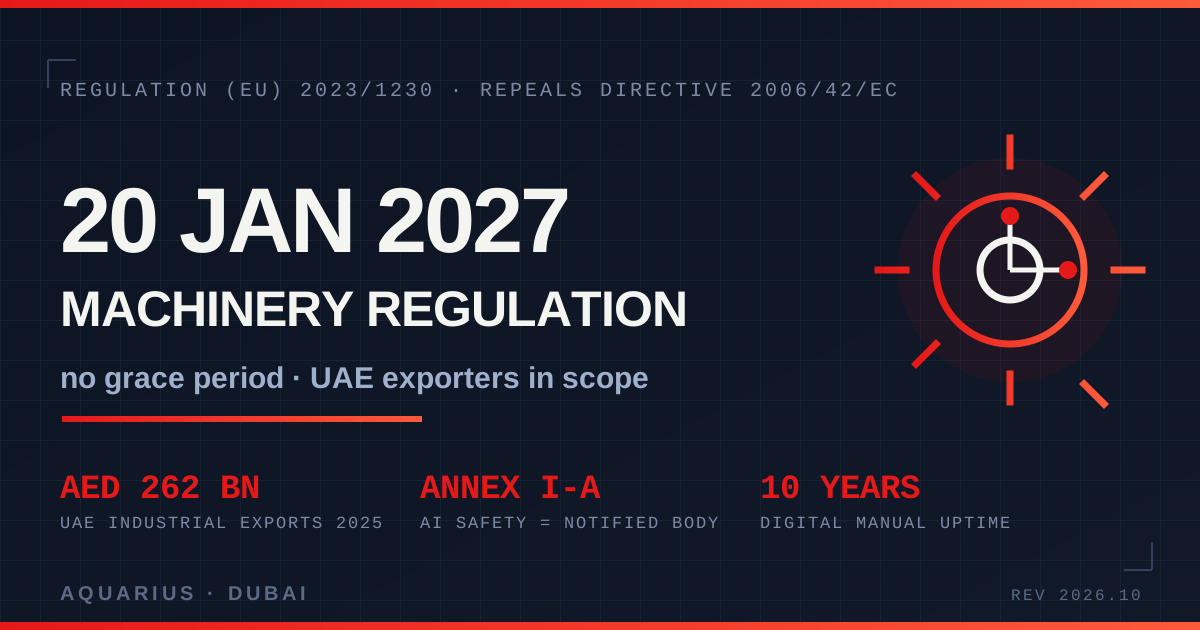
On 20 January 2027 Regulation (EU) 2023/1230 replaces the Machinery Directive 2006/42/EC outright, with no transition window and no grace period for stock already built. If your Dubai or Sharjah factory ships machinery, safety components or industrial equipment into the European Union, every unit placed on the EU market from that date needs a new technical file, a new conformity route, and — this is the part UAE manufacturers keep missing — software and cybersecurity evidence that the old Directive never asked for.
Most Dubai exporters we speak to assume this is a paperwork refresh their European importer will absorb. It is not. The Regulation turns software into a regulated safety component, puts machine-learning safety functions into the category that forces a third-party notified body, and obliges you to keep a digital manual online for at least ten years. Those are engineering and IT commitments, not a certificate you buy once.
Why a UAE manufacturer should care in 2026, not 2027
The stakes are set by how fast UAE industry has grown into export markets. UAE industrial exports hit a record AED 262 billion in 2025, up 25% year on year, of which roughly AED 92 billion came from advanced manufacturing categories such as electronics and precision components. The industrial sector contributed about AED 200 billion to GDP in 2026 — close to 70% growth since Operation 300bn launched in 2021, against an AED 300 billion target for 2031. Make it in the Emirates 2026 alone closed AED 171 billion in industrial deals.
Europe is a real slice of that demand. UAE–EU non-oil trade ran at USD 67.6 billion in 2024, up 3.6%, with the EU absorbing 8.3% of all UAE non-oil trade. Machinery, metals and transport equipment are named priority sectors in Operation 300bn, which is precisely the product scope Regulation (EU) 2023/1230 governs. Put plainly: the national strategy is pushing UAE factories toward exactly the market that is rewriting its machinery rulebook in fourteen months.
And the clock is genuinely tight for an unusual reason. Roughly 800 harmonised standards sit under the old Directive and must be reviewed, revised and cited under the new Regulation. The first batch of citations was expected only in Q3 2026, and the list was still unfinalised with about three months to go. Manufacturers face a fixed deadline against a standards framework that is still moving. There is no exception clause for that, which means the risk sits with you, not with Brussels.
The Digital Omnibus twist: your machine's AI just left the AI Act
Here is the change almost nobody in the region has priced in. The Digital Omnibus on AI — adopted as Regulation (EU) 2026/1744, published 24 July 2026 and in force from 27 July 2026 — moved the Machinery Regulation from Section A to Section B of Annex I of the EU AI Act. Every other Section A product family, medical devices and toys included, stayed where it was. Machinery was singled out.
The practical effect: AI embedded in a machine no longer falls directly under the AI Act's high-risk chapter. Only Article 6(1), the new Article 60a, and Articles 102–112 of the AI Act apply directly to high-risk AI systems inside machines. The substantive requirements of Chapter III, Section 2 get folded into the Machinery Regulation itself through delegated acts the Commission must adopt by 2 August 2028 at the latest. Until then, manufacturers can still lean on harmonised standards or common specifications adopted under the AI Act for presumption of conformity.
Most Dubai machine builders get this backwards. They budget for an AI Act high-risk audit that will not apply to their product, and skip the Machinery Regulation notified body that will. The duty did not disappear — it changed address, and the new address has an earlier deadline.
This was a deliberate de-duplication: it stops a machine with an AI safety function being assessed twice under two overlapping regimes. It does not reduce the engineering burden by one line of code. If anything it concentrates it, because the Machinery Regulation route bites on 20 January 2027 while the delegated acts that spell out the AI detail may not land until 2028. You design to the Regulation's essential requirements in the meantime.
Annex I: when self-certification stops being an option
Under the old Directive, most machinery was self-certified, with a short Annex IV list carved out for third-party involvement. The Regulation restructures that list into Annex I with two parts, and the split decides your cost and your lead time.
| Category | Conformity route | What it covers | Indicative cost (AED) |
|---|---|---|---|
| Not in Annex I | Self-assessment, internal production control | The large majority of machinery | 8,300 – 16,600 documentation refresh |
| Annex I Part B | Self-certification permitted only if harmonised standards are applied in full | High-risk machinery with mature standards coverage | 33,000 – 62,000 where a notified body is needed |
| Annex I Part A | Third-party notified body assessment, mandatory | Safety components and embedded systems with fully or partially self-evolving behaviour using machine learning to ensure safety functions | 50,000 – 75,000 per model, first EU entry |
Two categories in Part A were created specifically for AI: safety components with fully or partially self-evolving behaviour using machine learning approaches ensuring safety functions, and machinery with embedded systems of the same description. The Regulation's reasoning is explicit — data dependency, opacity, autonomy and connectivity raise both the probability and the severity of harm.
Read the scope carefully, because it is narrower than the panic suggests. The third-party requirement for safety software applies only to systems with fully or partially self-evolving behaviour using machine learning. A fixed-logic safety PLC, a deterministic light-curtain controller, or a vision system whose model weights are frozen at shipment is not self-evolving. A model that retrains on site data is. If you are not sure which side of that line your controller sits on, that question is now a commercial one worth answering before you quote a European buyer.
Note also that the Part A duty attaches to the component whether or not it was placed on the market independently. Embedding a third-party self-evolving safety module inside your machine does not let you inherit its paperwork and self-certify the whole assembly.
Software is now a safety component, and it has to prove it
Safety components explicitly include software under the Regulation. That single change pulls your firmware team into a compliance scope it has never been in. Section 1.1.9 of the essential health and safety requirements adds protection against corruption: machinery must be designed so that connecting another device cannot create a hazardous situation, hardware transmitting signals or data relevant to safety-critical software must be protected against accidental or intentional corruption, and — the demanding part — the machine must collect evidence of legitimate or illegitimate intervention in that component.
Evidence collection is a logging and integrity architecture, not a clause you tick. In practice it means signed firmware, tamper-evident audit trails, a secure update channel, and a way to read that evidence back years after the machine left Jebel Ali. If you also ship a manufacturer-operated cloud that the machine depends on to function, you are simultaneously inside the EU Cyber Resilience Act's Article 14 reporting regime, live since 11 September 2026 with a 24-hour early-warning clock. We covered that overlap in our guide to the EU Cyber Resilience Act for UAE software and IoT firms. The sensible build is one evidence pipeline serving both regimes rather than two that disagree.
Digital instructions: a ten-year uptime obligation
The Regulation lets you ship instructions for use digitally for the first time, and the conditions are specific. The machine must state how to access them. The format must allow printing and saving. They must stay accessible online for the expected lifetime of the machine and at least 10 years after it is placed on the market. And if a buyer asks for paper at the time of purchase, you supply it free of charge within one month.
That is a hosting and versioning commitment with a decade-long floor, per serial number, in the right language, surviving every website redesign and CMS migration you will do between now and 2037. A PDF on a marketing site that gets rebuilt in 2029 fails it. What works is a versioned documentation service keyed to serial or model number, with immutable URLs, an archive of superseded revisions, and uptime monitoring — the same discipline a Digital Product Passport implementation needs, and very often the same system.
Substantial modification: the trap for UAE integrators
This clause catches more Gulf businesses than the AI clauses do, because so much regional activity is integration and retrofit rather than original manufacture. A modification is substantial when four conditions hold together: it is made after the machine was placed on the market or put into service, by physical or digital means; it was not foreseen or planned by the original manufacturer; it affects safety by creating a new hazard or increasing an existing risk; and it requires adding guards or protective devices, modifying the existing safety control system, or extra measures for stability or mechanical strength.
If all four apply, the party making the modification becomes the manufacturer and assumes every obligation that goes with it — risk assessment, technical file, declaration of conformity, CE marking, the lot. "By digital means" is the phrase to re-read. A firmware update that unlocks a faster cycle time, or a retrofitted AI vision module bolted onto a line in Dubai Industrial City, can transfer manufacturer status to the integrator who installed it.
For UAE firms who retrofit European machines and re-export them, or who supply software that changes machine behaviour on an installed base, this is the single highest-value clause to get legal eyes on before January 2027.
What it costs, and where the money actually goes
Rates quoted by CE-marking consultancies in 2026 give a usable planning range. A documentation update for a machine already CE-marked runs EUR 2,000–4,000 (AED 8,300–16,600). A full notified body conformity assessment runs EUR 8,000–15,000 (AED 33,000–62,000) depending on complexity and body, and first-time EU market entry is better budgeted at EUR 12,000–18,000 per model (AED 50,000–75,000). Notified body hourly rates average around EUR 325 (AED 1,345) for quality-system audits and EUR 317 (AED 1,312) for technical file review. An EU type-examination has no published flat rate at all; budgets run from several thousand euros to north of twenty thousand. Converted at EUR/AED 4.14.
Those are the certification line items, and they are the smaller half. The larger half is engineering: the secure update channel, the tamper-evidence logging, the serial-keyed documentation platform with a ten-year service life, and the data model that lets you answer a market surveillance authority in a day rather than a quarter. Those are software builds, and they are what actually slips.
Penalties sit with each Member State under Article 50 rather than a single EU-wide ceiling, with national rules due to be notified to the Commission by 20 October 2026. So the real exposure is not one predictable fine but 27 regimes, plus removal from the market until you are compliant. Against AED 262 billion of industrial exports growing at 25% a year, that is the number that should move the budget: a machine that cannot be placed on the EU market on 21 January 2027 is inventory, not revenue — and the European importer who refuses it is acting on their own legal duty to verify your compliance, not being difficult.
How Aquarius builds the digital half
We do not issue certificates — a notified body does that, and you should engage one in 2026 rather than Q4 of next year. What we build is the software the Regulation now demands and a certificate cannot supply: versioned digital instruction platforms with immutable per-serial URLs and a decade-plus retention design; tamper-evidence and audit logging that satisfies the Section 1.1.9 evidence-collection duty; signed over-the-air update pipelines; declaration-of-conformity and technical-file systems that survive a surveillance request; and traceability that threads through your existing MRP and shop-floor systems instead of sitting beside them in a spreadsheet.
If you want the shape of an engagement and a budget before committing, our services and pricing pages lay out the ranges, and a short call is usually enough to tell whether your product lands in Annex I Part A, Part B, or neither.
Frequently asked questions
Does the EU Machinery Regulation apply to a UAE manufacturer with no EU office?
Yes. The obligations attach to placing machinery on the EU market, not to where you are established. You will need an EU importer who verifies your compliance and can refuse the shipment, and in practice an authorised representative is worth appointing to hold documentation inside the Union. Importers and distributors must verify CE marking and documentation and cooperate with market surveillance authorities — which makes your paperwork their legal problem, and therefore a condition of the sale.
Is there a transition period after 20 January 2027?
No. Directive 2006/42/EC is repealed on that date and the Regulation applies in full across all 27 Member States without national transposition. There is no grandfathering for machinery placed on the market afterwards, even if it was built earlier.
My machine uses AI but not for safety functions. Do I need a notified body?
Not on that basis. Annex I Part A targets self-evolving machine-learning systems that ensure safety functions. An AI module doing quality inspection, predictive maintenance or yield optimisation, with no safety role, does not trigger the mandatory third-party route. Document that boundary clearly in your risk assessment, because you will be asked to defend it.
Can I just publish the manual as a PDF on our website?
Only if it meets the conditions: discoverable from the machine itself, printable and saveable, and online for the machine's expected lifetime and at least ten years after it was placed on the market, with paper supplied free within one month on request at purchase. A marketing-site PDF that moves or disappears in the next redesign does not meet them.
Does the Digital Omnibus mean I can ignore the EU AI Act entirely?
No. It moves machinery from Section A to Section B of Annex I, so the AI Act's high-risk chapter no longer applies directly to AI embedded in machines; Article 6(1), Article 60a and Articles 102–112 still do. The substantive requirements arrive through delegated acts under the Machinery Regulation by 2 August 2028, and AI Act harmonised standards remain usable for presumption of conformity in the meantime. Your AI-in-machinery duty moved address; it did not vanish.
The short version
20 January 2027 is a hard date with no grace period. Eight hundred-odd harmonised standards are still settling. Software is a safety component now. Self-evolving machine-learning safety functions force a notified body. And your digital manual carries a ten-year uptime obligation. Fourteen months is enough time to do this calmly, and not enough to do it late.
If you export machinery or industrial equipment from the UAE into Europe, start with the Annex I classification and the documentation platform — those two decisions set everything downstream. Talk to Aquarius and we will map your product against the Regulation and scope the software side in one session.