
E-Wallet & Neobank App Development in Dubai (2026): Build Cost, the CBUAE SVF Licence & the Full Payments Stack
What an e-wallet or neobank app in Dubai costs in 2026 — real AED build tiers (white-label vs custom), the KYC and payment-rail stack, and the CBUAE Stored Value Facility licence and capital you need to go live.
- PUBLISHED
- 12 SEPT 2026
- READ TIME
- 12 MIN
- AUTHOR
- AQUARIUS · DUBAI
- UNIT
- REV 2026.09
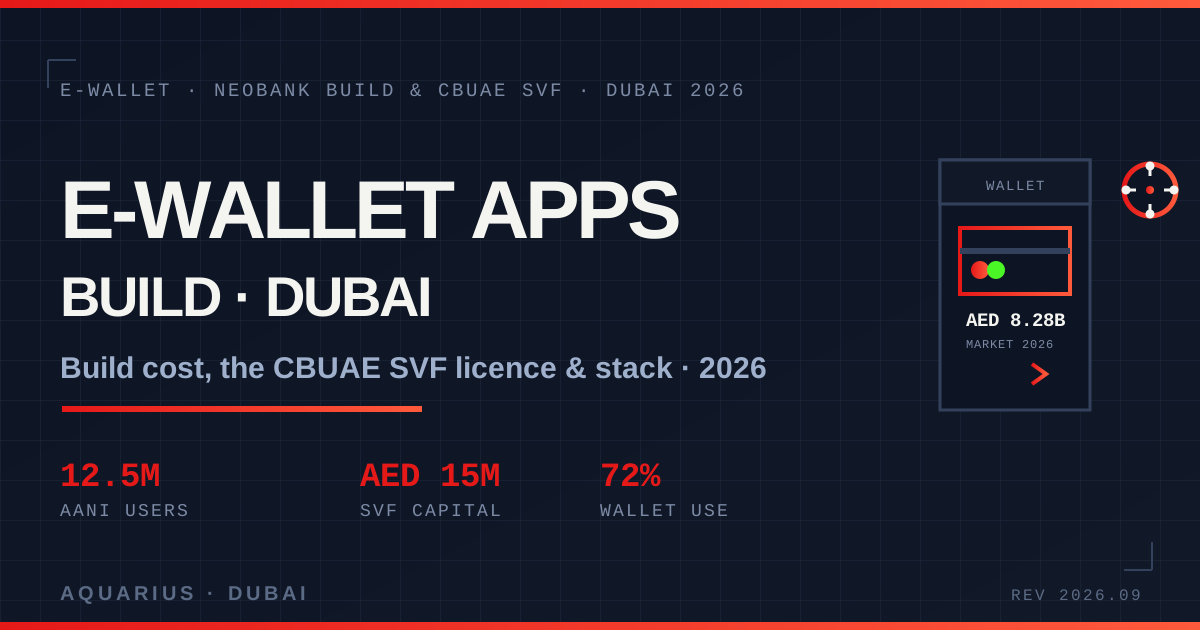
Short answer: A white-label e-wallet in Dubai runs roughly AED 55,000–150,000 and ships in 4–8 weeks; a custom, bank-grade neobank app runs AED 700,000 to AED 7M+ over 6–24 months. The build is the easy part — the gate is regulation. To hold customer balances you need a CBUAE Stored Value Facility (SVF) licence, which carries a AED 15,000,000 minimum paid-up capital plus capital funds of at least 5% of the float you hold. Get the licensing route right first, then scope the app to it.
Key takeaways
- Two very different price tags. White-label wallet: AED 55K–150K, live in weeks. Custom neobank: AED 700K–7M+, 6–24 months. Most first movers should launch white-label and rebuild later.
- The licence is the real cost. A CBUAE SVF licence needs AED 15M paid-up capital and aggregate capital funds ≥ 5% of customer float — that dwarfs the app build.
- The market is real, not hype. The UAE prepaid-card & digital-wallet market is worth about USD 8.28B in 2026, heading for USD 12.43B by 2030, with digital-wallet penetration at 72% of banked consumers.
- Rails are ready. Aani, the CBUAE instant-payment platform, already has 12.5M+ users, 74 connected institutions and 3-second transfers — you plug in, you don't build a network.
The opportunity: why 2026 is the year for a UAE wallet
Digital payments in the UAE stopped being a trend and became the default. Digital-wallet penetration among banked consumers hit 72% in early 2025, up from 53% a year earlier — one of the fastest adoption curves anywhere. The prepaid-card and digital-wallet market is worth roughly USD 8.28 billion in 2026 and is forecast to reach USD 12.43 billion by 2030.
The infrastructure caught up too. Aani, the Central Bank's instant-payment platform run by Al Etihad Payments, crossed 12.5 million registered users and connects 74 licensed financial institutions, settling transfers in about 3 seconds. The domestic card scheme Jaywan gives you a low-cost local rail as an alternative to Visa/Mastercard. For a wallet builder, that means the hard parts — the network, instant settlement, a domestic scheme — already exist. Your job is the app and the licence.
What you're actually building: the e-wallet stack
"An e-wallet app" hides a lot of moving parts. Whether you buy or build, these layers have to exist and interlock:
- Onboarding & KYC/AML — Emirates ID scan + UAE PASS, liveness check, sanctions/PEP screening, ongoing transaction monitoring. Non-negotiable under CBUAE rules.
- The ledger — a double-entry core that tracks every dirham of stored value. This is the part cheap builds get wrong; it must be auditable and reconcilable to the last fils.
- Wallet & stored value — top-up, hold, send, request, split, in-app cards (virtual/physical via a BIN sponsor).
- Payment rails — Aani for instant P2P, a card processor for spend, a top-up path (card, bank transfer, cash-in agent).
- Apps + admin — iOS & Android, plus a back-office for compliance, reconciliation, disputes and reporting to the regulator.
See our web & app development services for how these layers map to a delivery plan. The related build economics for accepting card payments are broken down in our guide to payment gateway integration cost in Dubai.
Build cost in Dubai: white-label vs custom (real AED tiers)
The single biggest cost decision is buy vs build. White-label platforms give you a proven core to rebrand; custom gives you control and IP. Here's what each tier costs and delivers in 2026:
| Build tier | AED cost | Timeline | Best for |
|---|---|---|---|
| White-label wallet (rebrand + config) | AED 55,000–150,000 | 4–8 weeks | Fast market entry, closed-loop wallets, testing demand |
| Custom MVP (core wallet, KYC, top-up, P2P) | AED 180,000–450,000 | 3–6 months | A focused neobank feature set you own |
| Full custom neobank (cards, lending, multi-currency) | AED 700,000–2,000,000 | 6–12 months | Differentiated product, own IP, scale plans |
| Bank-grade platform (full compliance, high volume) | AED 2,000,000–7,000,000+ | 12–24 months | Licensed institutions, regional expansion |
Two numbers people forget: ongoing run cost adds 20–30% of build per year (cloud, security monitoring, compliance, support), and a white-label save of "40–70% versus custom" is real but comes with a ceiling — you'll eventually rebuild if you want to differentiate. The lazy-but-correct path for most founders: launch white-label, validate, then invest in custom once the licence and traction are proven.
The licence: CBUAE Stored Value Facility (SVF), capital & compliance
This is where most e-wallet plans in Dubai live or die. The moment you store customer value — a balance a user can spend later — you're operating a Stored Value Facility, regulated by the Central Bank of the UAE. The headline requirements:
- Minimum paid-up capital: AED 15,000,000, fully paid, unencumbered, held with a UAE-regulated bank.
- Aggregate capital funds ≥ 5% of total float — as customer balances grow, your capital obligation grows with them.
- Float safeguarding — customer money segregated and protected, not mixed with operating funds.
- Governance & risk — fit-and-proper directors, an AML/CFT programme, a UAE-incorporated entity, and ongoing CBUAE reporting.
If you're not holding balances — say you only initiate payments or aggregate merchant transactions — you may fall under the Retail Payment Services and Card Schemes (RPSCS) Regulation instead, which covers nine service categories (payment account issuance, instrument issuance, merchant acquiring, aggregation, fund transfer, payment token, initiation and account-information services) with its own, lower capital tiers. And if a licensed bank sponsors you, an agent / programme-manager model can let you launch on someone else's licence — far cheaper, at the cost of control. Picking the right one of these three is the highest-leverage decision in the whole project.
Bottom line: what it costs to launch, and the cost of getting it wrong
Add it up honestly. A realistic first-year budget for a licensed UAE wallet is the AED 15M SVF capital + AED 180K–700K build + ~25% annual run cost + legal/licensing fees. Under a bank-sponsored agent model, you can strip the capital requirement out and launch a branded wallet for well under AED 300,000 all-in — which is why most 2026 launches start there. Related reading: crypto exchange development and VARA licensing.
The expensive mistake is building the app first and discovering the licence later: a beautiful wallet you legally cannot switch on. Every month of delay in a market growing double digits a year is market share handed to a competitor. How Aquarius does it: we scope the licence route with you before a line of product code is written, then build to that route — white-label to validate, custom once you're licensed and proven. Fixed AED pricing, full code handover, no lock-in. See our pricing or book a scoping call.
FAQ
Do I need a CBUAE licence to launch an e-wallet in Dubai?
If you store customer balances, yes — that's a Stored Value Facility and requires an SVF licence (AED 15M capital). If you only initiate or aggregate payments, RPSCS may apply. If a licensed bank sponsors you as an agent, you can launch on their licence without holding your own.
How much does an e-wallet app cost to build in Dubai?
White-label: AED 55,000–150,000 in 4–8 weeks. Custom MVP: AED 180,000–450,000 in 3–6 months. Full custom neobank: AED 700,000–7M+ over 6–24 months. Budget another 20–30% of build per year to run it.
What's the minimum capital for an SVF licence?
AED 15,000,000 in paid-up capital, plus aggregate capital funds of at least 5% of the customer float you hold — so your capital requirement rises as balances grow.
Can my wallet plug into Aani and instant payments?
Yes. Aani is the CBUAE instant-payment platform with 12.5M+ users and 74 connected institutions, settling in ~3 seconds. You connect through a sponsoring institution rather than building a payment network yourself.
Should I go white-label or custom?
Start white-label to validate demand fast and cheap, then move to custom once the licence and traction are proven. Building custom first is the most common — and most expensive — way to burn runway.
The bottom line: the UAE wallet opportunity is real and the rails are ready, but the licence — not the app — is the gate. Decide SVF vs RPSCS vs agent model first, build to it second, and you turn a AED 15M question into a shippable product. Talk to Aquarius and we'll map your route.