
Facility Management & CAFM Software Development in Dubai (2026): Law No. (3) Just Made Your Spreadsheet a Liability
Dubai Law No. (3) of 2026 fines repeat building-safety violations up to AED 2,000,000. What a CAFM platform that can actually prove compliance costs in AED.
- PUBLISHED
- 15 SEPT 2026
- READ TIME
- 11 MIN
- AUTHOR
- AQUARIUS · DUBAI
- UNIT
- REV 2026.09
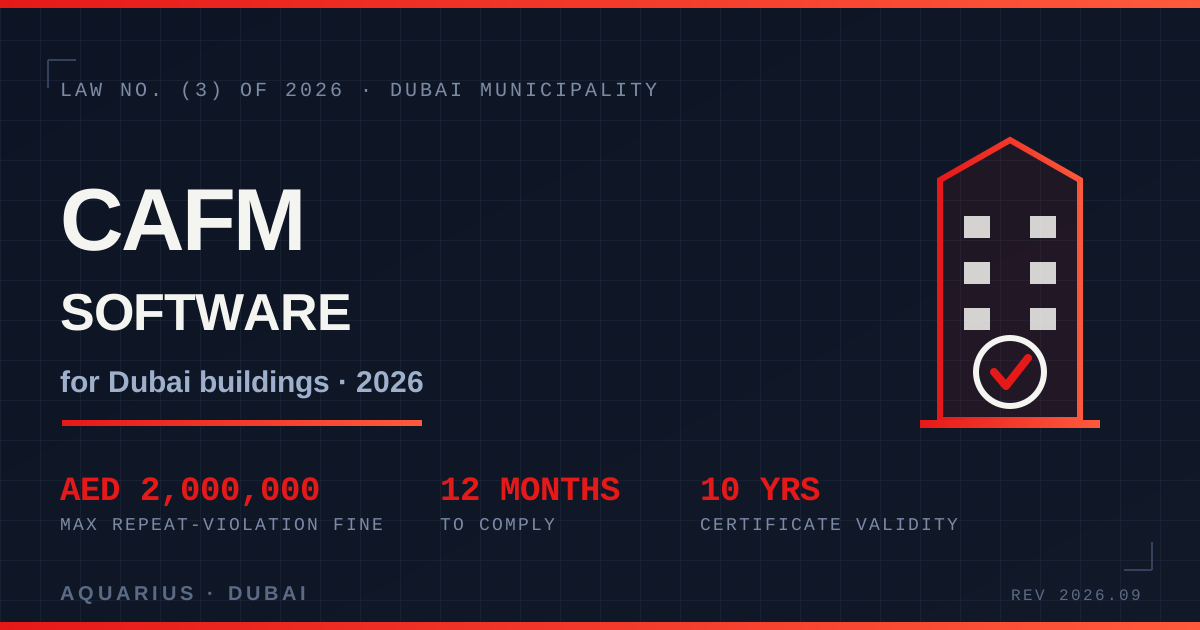
Short answer: A facility management platform in Dubai costs AED 35,000–70,000 for a single-building PPM scheduler and work-order tracker, AED 110,000–260,000 for a proper multi-building CAFM system with an asset register, technician mobile app and a compliance evidence vault, and AED 300,000–650,000+ for an integrated FM suite with owners’ association portals, Mollak-ready budget exports, BMS/IoT telemetry and BI dashboards. The reason 2026 is the year this stopped being optional: Dubai Law No. (3) of 2026 makes building quality and safety a certified, inspected, continuously-evidenced obligation — with administrative fines running from AED 100 to AED 1,000,000, rising to AED 2,000,000 for repeat violations within two years.
Key takeaways
- Dubai rewrote the rulebook. Law No. (3) of 2026 on the Quality and Safety of Buildings introduces a mandatory Quality and Safety Certificate, issued after technical inspection by a licensed engineering office, and it applies retroactively to existing buildings — including those in free zones, not just new projects.
- The clock is short. The law takes effect 60 days after publication in the Official Gazette, and owners, contractors and engineering offices get one year from that effective date to comply, extendable only by the Chairman of the Executive Council of Dubai.
- Certification is not a one-off. The certificate runs 10 years for buildings under 40 years old and 5 years for buildings 40 years or older — but owners must keep maintaining, keep records, and keep reporting to Dubai Municipality through its digital building systems in between.
- Non-compliance has teeth. Fines of AED 100 to AED 1,000,000, up to AED 2,000,000 on repeat violations within two years, plus permit suspension and transaction freezes.
- The asset base keeps growing. Dubai Municipality processed more than 30,000 building permit applications in H1 2025, a 20% year-on-year increase covering over 5.5 million square metres of licensed built-up area, with more than 24,000 buildings under construction.
The maintenance spreadsheet is now a legal liability
This is the 2026 guide for Dubai facility management companies, owners’ associations, developers, master community operators, hotel groups and asset owners working out what a CAFM or FM platform needs to contain after Law No. (3) of 2026, what it must be able to prove to Dubai Municipality, and what it costs in dirhams. Updated September 2026.
Start with the market. The UAE facility management sector was valued at roughly USD 7.62 billion in 2024 and is forecast to reach USD 10.53 billion by 2029 — a 6.68% CAGR, per Mordor Intelligence. Dubai is the centre of gravity, expected to account for around 52% of the national market in 2026. And the stock those firms have to maintain is compounding: Dubai Municipality approved over 30,000 building permit applications in the first half of 2025 alone, up 20% year on year, with 24,000+ buildings under construction.
Now the part that changes the software requirement. Law No. (3) of 2026 is the biggest overhaul of Dubai construction and building regulation in over a decade. It places continuing responsibility on building owners, developers, unit owners in jointly owned properties, building management entities, licensed engineering offices and contractors to keep assets safe and operational across their whole lifecycle — and it makes Dubai Municipality the authority running the digital systems, databases, inspections and compliance monitoring behind it.
Here is the myth worth busting, because it is about to cost Dubai FM companies real money: most Dubai buildings are not under-maintained. They are under-evidenced. The chiller did get serviced. The fire pump was tested. The lift had its inspection. But the proof lives in a technician’s WhatsApp photo, a PDF in someone’s inbox, a signature on a paper job card in a site office, and three versions of an Excel PPM planner that stopped matching reality in March. Under the old regime that was survivable. Under a certification regime with scheduled inspections and a AED 2,000,000 ceiling, an unprovable maintenance history is functionally the same as no maintenance history.
What Law No. (3) of 2026 actually asks your systems to do
Strip the legal language out and the compliance burden resolves into four things software has to produce on demand:
- A live asset register. Every chiller, AHU, pump, panel, lift, fire system, tank and pressure vessel, with make, model, serial, location, install date, warranty and condition — per building, per owner entity.
- A planned preventive maintenance (PPM) schedule that is actually followed. Not a plan document: a scheduler that generates the work orders, tracks completion, and flags overdue tasks before an inspector does.
- Immutable evidence. Timestamped, geotagged completion records with photos, technician ID, readings taken, parts replaced and a signature — retained and retrievable years later.
- Defect rectification tracking. The law requires owners to rectify identified defects. That means a closed loop from inspection finding to work order to verification to sign-off, with dates you can show.
Overlay the rules that were already there and the case gets stronger. Fire systems in every commercial, residential and industrial building in Dubai require an active annual maintenance contract with a Dubai Civil Defence-licensed company under Ministerial Resolution No. 505 of 2012, verified at Istifa certificate renewal. Jointly owned property budgets have to pass through Mollak, RERA’s centralised platform, before a single service-charge invoice can be issued — and the submission needs at least three competitive tenders for each major service category, supporting contracts, utility bills and insurance records, verified by a licensed audit firm. Every one of those is a data-collection problem masquerading as a paperwork problem.
What a Dubai CAFM platform should contain
Off-the-shelf CAFM exists and is often the right first step. It stops being the right answer when your process is Dubai-specific: Mollak budget structures, DCD AMC evidence, multi-entity owners’ associations, Arabic and English technician interfaces, and the new Municipality reporting flow. The build-versus-buy line usually falls where licence costs per user, per building, per year start to exceed the amortised cost of owning the thing.
| Module | What it does in a Dubai context | Indicative cost (AED) |
|---|---|---|
| Asset register & QR tagging | Every asset scannable on site; full history opens on the technician’s phone, offline-capable for basements and plant rooms | 18,000–40,000 |
| PPM scheduler | Statutory and manufacturer frequencies, auto-generated work orders, overdue escalation, annual compliance calendar per building | 25,000–55,000 |
| Technician mobile app (EN/AR) | Job cards, checklists, photo capture, geotag, digital signature, parts used — works offline and syncs | 30,000–70,000 |
| Compliance evidence vault | Certificates, DCD AMC records, inspection reports, defect closure trail, retention and one-click audit export | 20,000–45,000 |
| Helpdesk & tenant portal | Complaint logging with SLA clocks, WhatsApp intake, unit-level history, satisfaction capture | 25,000–60,000 |
| Owners’ association & Mollak-ready budgeting | Budget line items mapped to service categories, tender attachments, audit pack assembly, service-charge reporting | 40,000–95,000 |
| BMS / IoT integration | Chiller, energy, water and air-quality telemetry pulled in; condition-based triggers instead of calendar-only PPM | 45,000–120,000 |
| BI dashboards | Planned-vs-reactive ratio, SLA breach rate, cost per sq ft, asset failure hotspots, compliance status by building | 25,000–60,000 |
The economics are not subtle. Preventive maintenance programmes run roughly 25–30% cheaper than reactive ones once emergency labour premiums, after-hours surcharges and rush parts pricing are counted, and they cut operating expenses by 12–18%. The industry benchmark for a well-run facility is 70–80% planned versus 20–30% reactive work. Most Dubai portfolios running on spreadsheets cannot even tell you which side of that line they are on — which is the real finding, because you cannot cut a ratio you do not measure.
Budget pressure makes this urgent rather than aspirational. The SFG20 State of Facilities Management Report 2025 found 75% of facility managers name budget constraints as their single biggest challenge, and 40% saw their budget fall between 2024 and 2025. More compliance obligation, flat or shrinking budget: the gap closes with software or it does not close.
What it costs to build, and what it costs not to
Three realistic tiers, before 5% VAT:
| Scope | Who it fits | Cost (AED) | Timeline |
|---|---|---|---|
| Single-building PPM & work orders | One tower or community; asset register, PPM scheduler, technician app, evidence storage | 35,000–70,000 | 5–8 weeks |
| Multi-building CAFM | FM company or OA manager with a portfolio; adds helpdesk, resident portal, compliance vault, SLA reporting, roles per client entity | 110,000–260,000 | 3–5 months |
| Integrated FM / IWMS suite | Master community or large operator; adds Mollak-ready budgeting, BMS and IoT telemetry, procurement, BI, client-facing dashboards | 300,000–650,000+ | 5–9 months |
Budget 15–22% of build cost per year for hosting, support, regulatory updates and enhancements — the regulatory line matters more than usual here, because the executive decisions and implementing resolutions under a brand-new law will keep arriving.
Now the cost of inaction, which is the only number that should decide this. A single repeat violation under Law No. (3) of 2026 can reach AED 2,000,000 — enough to fund the largest tier on this page three times over. And the fine is rarely the worst part: the law also allows permit suspension and freezing of transactions, which in a Dubai context means units that cannot be sold or transferred until the file is clean. Set that against a mid-tier CAFM build at AED 110,000–260,000 and the risk-adjusted arithmetic is not close.
How Aquarius builds it
We start with a compliance map, not a feature list: every statutory obligation attached to your buildings — Municipality, Civil Defence, RERA and Mollak, DEWA, lift and pressure-vessel regimes — and the evidence each one demands. That map becomes the data model, so compliance is a by-product of daily work rather than a quarterly fire drill. We ship the technician app first, because a CAFM system with no field adoption is an expensive database. Arabic and English from day one. Phased delivery with a working module every few weeks, fixed-scope pricing per phase, source code and data yours outright. If you want to see how we scope and price engagements, our pricing page sets out the tiers, and services covers the wider build capability.
FAQ
Does Law No. (3) of 2026 apply to my existing building, or only new ones?
Both. The regime applies retroactively to existing buildings across Dubai, including free zones, not only to new projects — which is precisely why it created an immediate workload for owners and FM teams rather than a future one.
How long do I have to comply?
The law enters force 60 days after publication in the Official Gazette, and building owners, contractors and engineering offices have one year from that effective date to achieve compliance. An extension is possible, but only by decision of the Chairman of the Executive Council of Dubai — not something to plan around.
How long is the Quality and Safety Certificate valid?
Ten years for buildings less than 40 years old, and five years for buildings aged 40 years or older, renewable under specified conditions. Certification does not pause the maintenance obligation — owners must keep maintaining the building and allow inspections by the competent authorities throughout.
Should I buy off-the-shelf CAFM or build custom?
Buy if you manage a handful of buildings with standard processes and can live inside a vendor’s data model. Build when per-user, per-building licence fees compound across a growing portfolio, when you need Mollak budget structures and DCD AMC evidence handled natively, or when the system is client-facing and needs to carry your brand rather than a vendor’s.
Can a CAFM system connect to Dubai Municipality’s digital systems?
Dubai Municipality operates the digital systems, databases and compliance monitoring behind the new regime, and FM teams are expected to maintain records and report through them. Build with an integration-ready export layer — structured, mapped, versioned — so that when the submission specification is published you are reformatting data, not collecting it from scratch.
What does ongoing support cost?
Plan on 15–22% of the build cost annually for hosting, monitoring, support and regulatory updates. See our Dubai maintenance cost breakdown for how those line items behave over a full year.
The short version
Dubai just converted building maintenance from an operational habit into a certified, inspected, evidence-backed legal duty, with a AED 2,000,000 ceiling on getting it wrong twice. FM companies and owners’ associations running on spreadsheets and WhatsApp threads are not behind on technology — they are exposed. A CAFM platform that captures evidence as a by-product of normal work costs less than a single repeat fine, and pays for itself in the 25–30% gap between planned and reactive maintenance long before the first inspector arrives.
If you manage buildings in Dubai and want to know exactly what your current setup can and cannot prove, talk to Aquarius. We will map your compliance obligations against your systems and tell you the gap in one session — whether or not you build with us.