
Google Scaled Content Abuse in 2026: Why Dubai Websites Get Deindexed
Google does not penalise AI content, it penalises scaled content abuse. The four site reputation factors, the 2026 update dates, six patterns on Dubai sites, and AED recovery costs.
- PUBLISHED
- 07 NOV 2026
- READ TIME
- 12 MIN
- AUTHOR
- AQUARIUS · DUBAI
- UNIT
- REV 2026.09
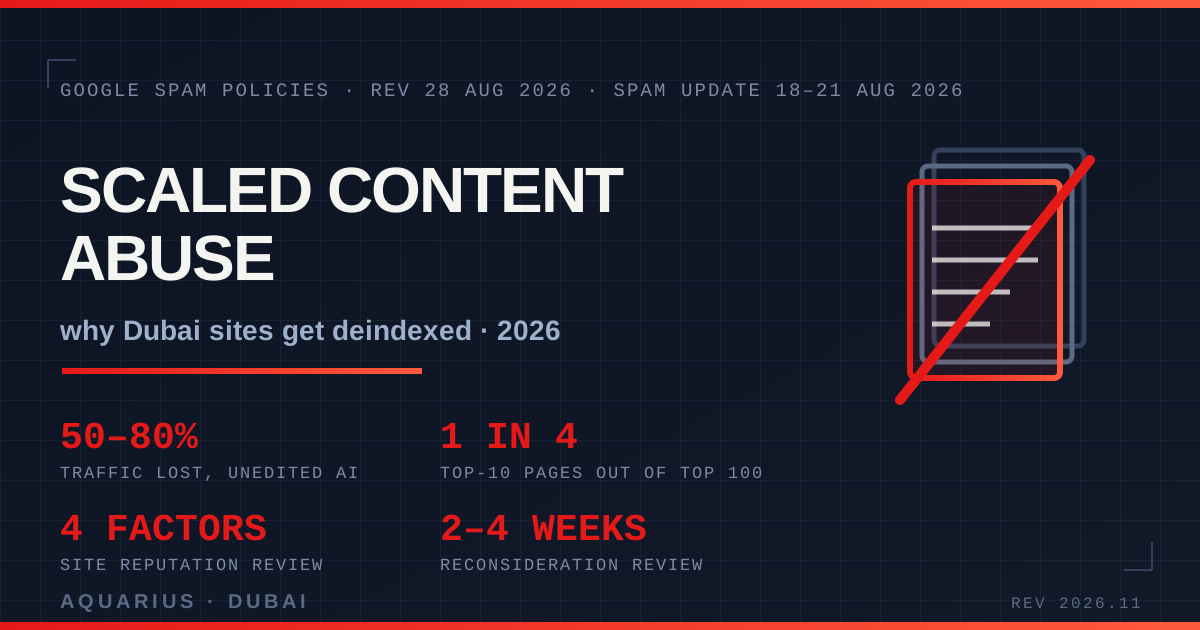
Short answer: Google does not penalise AI-written content. It penalises scaled content abuse — publishing many pages whose main purpose is to rank rather than to help a reader — and it enforces that both algorithmically and by human manual action, up to full removal from Search. Google’s own wording is blunt: using generative AI tools to produce many pages without adding value for users may violate the scaled content abuse policy. The dividing line is editorial value per page, not the tool that typed it.
Three numbers explain why this has become a Dubai problem specifically. UAE marketing teams are among the heaviest AI users on earth — 73% use at least one AI tool in daily workflow against 41% globally, and 68% use it to draft content, while 82% admit the output needs significant human editing before publication. Microsoft’s 2026 AI Diffusion Report puts 70.1% of the UAE’s working-age population using AI regularly, against a 17.8% global average — the highest adoption rate measured anywhere. And the channel all those pages are aimed at is brutally concentrated: Statcounter had Google at 93.47% of UAE search in September 2026, with Bing a distant 3.96%. High AI adoption, thin editing, one gatekeeper. That is the exact combination the August 2026 spam update was built to find.
What Google actually banned — and what it did not
Read the policy, not the headlines. Google’s spam policies page, last revised 28 August 2026, defines scaled content abuse as creating many pages primarily to manipulate rankings rather than help users. The listed examples are what matter for a Dubai marketing team:
- Generating numerous pages with AI tools without adding value for users.
- Scraping feeds or search results and running automated transformations such as synonymising.
- Stitching content together from multiple sources without adding value.
- Creating multiple sites to disguise the scaled nature of the content.
- Publishing pages with little coherence that nonetheless carry the target keywords.
Nothing there bans AI. Three things do get you hit: volume without oversight, derivative text, and pages that exist for a query rather than for a customer. A 400-page “web design in [every Dubai community]” set written in one afternoon is the archetype — and in our experience auditing UAE sites, it is also the single most common structure sold to Dubai SMEs as an SEO package. The defensible version of the same ambition is covered in our guide to ranking on Google UAE.
Independent post-update analyses — agency data, not Google’s — put the damage at 50–80% organic traffic loss within roughly two weeks for sites running hundreds or thousands of unedited AI pages, and 60–80% for niche sites carrying 500+ unedited pages. The same analyses report edited, first-party AI-assisted content gaining 30–80%. Treat the exact percentages as directional; treat the direction as settled.
Site reputation abuse: the four factors Google reviews
The sibling policy catches a different Dubai habit: renting out your domain’s trust. Site reputation abuse is third-party content published on a host site mainly to exploit that host’s ranking signals. Think a Dubai news portal with a “best online casinos” subfolder, a corporate blog section handed wholesale to an offshore link vendor, or an institutional domain hosting a coupon directory. The policy was announced in March 2024, enforced from May 2024, expanded in November 2024, and has been manual-action-only since launch — there is no algorithm quietly handling it, a human reviews your site.
The August 2026 revision replaced the old example list with the four factors Google says it weighs. Audit your own subfolders against them:
| Factor | What a reviewer looks for | How Dubai sites fail it |
|---|---|---|
| Presentation | Design, formatting and UX consistent with the main domain | A partner subfolder on a different template, no header, no Arabic toggle, no brand type |
| Content quality | Whether quality differs from the standard set by the rest of the domain | Editorial newsroom standard on /news, spun affiliate listicles on /offers |
| Authorship | Explicit acknowledgement of who owns and is responsible for the content | No byline, no paid-partnership label, no named author with a real bio |
| Multi-site presence | Whether identical or near-identical content appears across other sites | The same vendor-written page live on five GCC domains with the city swapped |
One 2026 wrinkle matters if you also publish for European audiences. After discussions with the European Commission, Google announced on 28 August 2026 that from 30 August 2026 a site reputation abuse manual action no longer takes effect for users inside the European Economic Area — affected pages are instead treated as separate from the main domain and rank on their own merits. Outside the EEA, including the UAE, the policy works exactly as before and manual actions still suppress visibility. Do not read European coverage of that change as an all-clear for a Dubai domain.
The 2026 enforcement timeline Dubai teams missed
If traffic fell this year and nobody could explain it, check these dates against your analytics before blaming the agency:
| Date | Event | What moved |
|---|---|---|
| March 2026 | March 2026 spam update | Scaled content abuse named as a primary target |
| 27 March 2026 · 12 days 4 hrs | March 2026 core update | Per SE Ranking data reported by Search Engine Land: nearly 80% of top-three results shifted and almost one in four top-10 pages fell out of the top 100 — more volatile than December 2025 |
| 18–21 August 2026 · 2 days 16 hrs | August 2026 spam update | Global, every language; third spam update of 2026, aimed at scaled content abuse |
| 28 August 2026 | Spam policies page revised | Four site reputation factors published; examples rewritten |
| 30 August 2026 | EEA manual-action change live | No effect for UAE-targeted sites — enforcement unchanged here |
There is a second reason to care that has nothing to do with blue links. AI Overviews now appear on roughly 48% of Google queries, and Ahrefs measured a 58% click-through reduction for top-ranking pages when an AI Overview is present. A page that trips a spam policy is not merely demoted — it stops being a candidate for the citation slots that increasingly carry the click. Our breakdowns of getting cited by AI search and how AI Mode fans out a query cover the mechanics.
Six patterns we keep finding on Dubai websites
- The community sprawl. One service page cloned across JLT, Marina, Business Bay, Deira and forty more, with only the area name changed. Doorway pages by Google’s own definition, and scaled content abuse by volume.
- The GCC copy-paste. The identical page running on the .ae, .sa and .qa domains with the city swapped. Fails the multi-site presence factor, and wastes the one asset a Dubai business genuinely owns — local specificity.
- The rented subfolder. A link vendor given write access to /blog for a monthly fee. You are the host site in a site reputation abuse review, and the manual action lands on your domain, not theirs.
- The press-release mill. Forty near-duplicate releases a quarter pushed through distribution and mirrored onto your own newsroom. Unoriginal content at scale, by any reading of the policy.
- The expired-domain flip. Buying a lapsed UAE domain for its backlinks and repurposing it for unrelated commercial content. Named explicitly as expired domain abuse.
- The unedited FAQ farm. Hundreds of auto-generated question pages at 90 words each, with nothing on them a reader could not get from the snippet.
The honest test, and the one we apply in audits: pick three pages at random and ask whether a real Dubai customer would be worse off if that page vanished. If the answer is no for all three, you do not have a ranking problem, you have an inventory problem.
What cleaning this up costs in Dubai, in AED
For market context, Dubai SEO retainers run roughly AED 3,000–8,000 a month for SMEs and AED 10,000–50,000 for enterprise programmes — see our Dubai SEO cost breakdown. Remediation is a separate, finite project. Our quoting bands:
| Scope | What you get | AED range |
|---|---|---|
| Spam-risk content audit | Full page inventory, thin-page scoring, duplicate and cross-domain scan, manual-action check, written kill-or-keep list | AED 6,000 – 14,000 |
| Remediation sprint | Pruning, consolidation, redirect map, noindex decisions, author and disclosure fixes on up to 300 pages | AED 15,000 – 38,000 |
| Manual-action recovery | Documented remediation log, reconsideration request drafting and resubmission, post-approval monitoring | AED 18,000 – 45,000 |
| Rebuild on editorial content | Smaller page count, first-party data, named authors, Arabic and English parity, schema and internal-link architecture | AED 24,000 – 90,000 |
Now the cost of waiting. Take a Dubai services business where organic brings 60 qualified enquiries a month, closing at 20% on an average first contract of AED 18,000 — AED 216,000 of monthly pipeline. A 60% organic loss removes about AED 130,000 of pipeline every month. Set that against a recovery timeline that is not negotiable: industry reporting puts the reconsideration review at 2–4 weeks, stretching to about 6 for complex cases, with full ranking restoration 60–90 days from the point remediation is complete — not from the day you file. Four months of exposure at those numbers is roughly half a million dirhams of lost pipeline, which is why the AED 6,000 audit is the cheapest line on this page.
How to recover, in order
- Confirm what you are dealing with. Search Console → Manual actions. A notice there means a human decision and a reconsideration request. An empty report plus a traffic cliff on an update date means algorithmic suppression — nothing to appeal, and the fix is the site itself.
- Screenshot everything first. Page counts, impressions by template, top landing pages. Remediation destroys the evidence you will later need to prove improvement.
- Inventory by template, not by page. Scaled problems are template-shaped. Score each template on originality, first-hand input, and whether it answers a question a customer actually asks.
- Prune and consolidate hard. Merge the twelve near-identical area pages into one genuinely useful page with real data. Redirect rather than delete silently; noindex only what must stay live for users.
- Fix accountability signals. Named authors with real credentials, review dates, sponsorship and partnership disclosure, and clear ownership on anything third-party.
- File once, with evidence. A reconsideration request that lists what was removed, what was rewritten, what changed in your process, and who now signs off. One strong submission beats three hopeful ones.
How Aquarius handles it
We start by asking what each template is for, then we delete. Most Dubai sites we inherit rank better with 40% fewer pages, because the survivors stop competing with their own clones. From there: first-party data (your real project numbers, your real AED ranges), named authors, Arabic and English parity instead of machine-translated mirrors, and schema plus internal links so the pages that remain are easy to cite — by Google and by AI assistants. We use AI in production every day; the rule is that a human owns every page that ships and can defend why it exists. Build and retainer bands are on our pricing page, and if you only want the diagnosis, the audit is a standalone deliverable with no retainer attached — send us the domain and we will tell you which templates are the liability.
FAQ
Will Google penalise my Dubai website for using AI to write blog posts?
No. Google penalises scaled content abuse — many pages created mainly to rank rather than to help users — regardless of whether a human, AI, or a mix produced them. AI-assisted content with genuine editorial oversight, original data and a named author is not a policy violation. Volume without oversight is.
How do I know whether I was hit by an algorithm or a manual action?
Open the Manual actions report in Search Console. A notice there is a human decision and can be appealed with a reconsideration request. Nothing there, combined with a drop aligned to the 18–21 August 2026 spam update or the 27 March 2026 core update, points to algorithmic suppression — which has no appeal path, only remediation.
Does the August 2026 EEA change mean site reputation abuse no longer matters in the UAE?
It does not. From 30 August 2026 a manual action under that policy stops taking effect for users inside the European Economic Area only. For a UAE-targeted site serving UAE searchers, enforcement is unchanged and a manual action still suppresses visibility.
How long does recovery take?
Reconsideration reviews are generally reported at 2–4 weeks, stretching to about 6 for complex cases, and full ranking restoration typically runs 60–90 days from the completion of remediation rather than from submission. Plan on a quarter, and fix the cause before filing.
Is deleting pages risky for a site that has already lost traffic?
Pruning without a plan is risky; pruning with an inventory is not. Score templates before touching them, redirect consolidated pages to the surviving best version, keep anything with real traffic, links or conversions, and change one template at a time so the result is attributable.
How many pages is “too many”?
There is no threshold, and anyone quoting one is guessing. A 5,000-page site built on real inventory data is fine; a 200-page site of spun service-area clones is not. The test is value per page, not page count.