
Hotel Direct Booking Engine in Dubai (2026): Stop Handing 15-30% to Booking.com & Expedia
Dubai hotels and holiday homes hand 15-30% of every OTA booking to Booking.com and Expedia. Here is how a direct booking engine wins that margin back — with real 2026 AED costs.
- PUBLISHED
- 10 SEPT 2026
- READ TIME
- 09 MIN
- AUTHOR
- AQUARIUS · DUBAI
- UNIT
- REV 2026.09
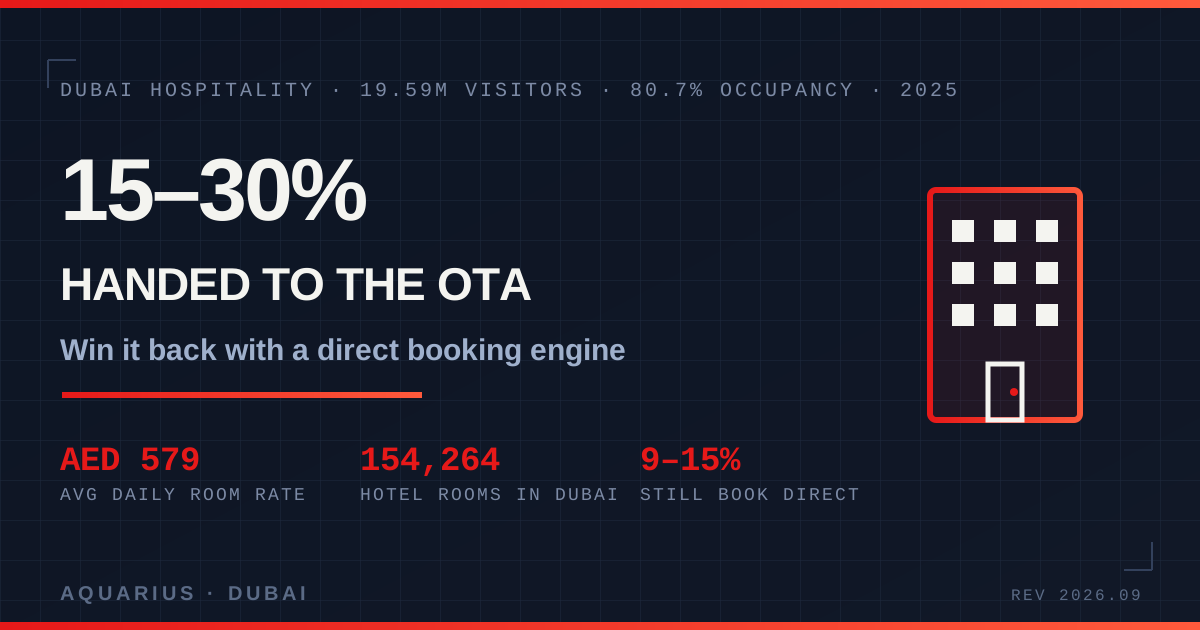
Short answer: a Dubai hotel or holiday-home operator loses 15-30% of revenue on every OTA reservation — Booking.com takes 10-25%, Expedia and Agoda 18-22%, and "preferred partner" placement adds another 3-5 points on top. A direct booking engine on your own website — real-time availability, secure payment, PMS and channel-manager sync — takes that reservation at near-zero commission. In a city that drew 19.59 million international overnight visitors in 2025 at 80.7% hotel occupancy and an average daily rate of AED 579, shifting even a fifth of your bookings direct is usually worth more than the entire build cost in year one.
Key takeaways
- OTAs cost 15-30% per booking. On AED 2M of OTA revenue at 18%, that is AED 360,000 a year handed to a middleman.
- The "billboard effect" is fading. Only 9-15% of travellers who find you on an OTA now book direct afterwards — down from 20-25% five years ago. If you do not own the booking, the OTA does.
- A direct booking engine pays for itself fast. Build ranges run AED 12,000-30,000 (widget), AED 35,000-90,000 (full engine + channel manager), to AED 90,000-250,000+ (custom multi-property platform).
- Dubai's demand is record-breaking. 154,264 hotel rooms, 45 million occupied room-nights, and 22,000+ licensed holiday homes all competing for the same guest — direct channel control is now a survival skill, not a luxury.
TOFU: Dubai's hospitality boom is real — but the OTAs are eating the margin
The demand is not in question. Dubai closed 2025 with 19.59 million international overnight visitors, up 5% year on year — a third consecutive record. Average hotel occupancy climbed to 80.7% (from 78.2% in 2024), occupied room-nights hit 45 million, and the average daily rate rose 8% to AED 579, with RevPAR up 11% to AED 467. Room inventory now stands at 154,264 keys across 827 establishments, and on top of that sit 22,000+ licensed holiday homes — a segment that grew roughly 35% year on year.
Here is the problem hidden inside those numbers: most of that occupancy is booked through an OTA, and each of those reservations leaves 15-30% of its value on the table. On a single AED 579 room-night at an 18% commission, that is roughly AED 104 gone before you have paid a cleaner or a receptionist. Multiply it across a year of near-full occupancy and the OTA becomes your single largest "supplier" — one you have no contract leverage over.
Worse, the old justification for paying it — the "billboard effect", where an OTA listing supposedly drives guests to book with you directly later — is collapsing. In 2025 only 9-15% of travellers who discovered a property on an OTA went on to book direct, down from 20-25% five years earlier. The OTA is no longer a shop window that sends people to your door; increasingly, it is the door. Dubai restaurants learned the same lesson with Talabat and Deliveroo — the platform that owns the transaction owns the customer.
MOFU: what a direct booking engine actually is (and the four parts that matter)
A booking engine is not "a contact form". It is the real-time reservation system embedded in your own website that lets a guest check live availability, see your rates, and pay — instantly, without a third party — while keeping your inventory perfectly in sync everywhere else you sell. A proper Dubai build has four connected parts, and any quote that ignores one of them is a red flag:
- The booking engine itself — live room/unit availability, dynamic rates, add-ons and upsells, and a mobile-first checkout. Most Dubai bookings now happen on a phone, so a clunky mobile flow silently pushes guests back to the OTA app.
- Payment gateway — local rails (Network International, Telr, PayTabs, Stripe UAE) with multi-currency display so a guest from Moscow, Mumbai or Manchester pays in a currency they trust. Dubai's guest mix is roughly 21% Western Europe, 15% South Asia and 14% CIS/Eastern Europe, so Arabic, English and Russian UX plus multi-currency are not optional.
- Channel manager — two-way sync of rates and availability across Booking.com, Expedia, Agoda and Airbnb so you never double-sell a room. This is what lets you push guests toward the direct channel without abandoning the OTAs you still need for discovery.
- PMS integration — real-time connection to your property management system so reservations, housekeeping and reporting stay clean with no manual re-keying. Skimp here and staff spend their day reconciling spreadsheets instead of serving guests.
The commercial logic is simple: the OTAs remain your billboard for discovery, but a rate-parity-smart direct engine — think member rates, free breakfast, or a late-checkout perk available only on your site — steadily migrates repeat and high-intent guests onto the channel you own. Here is what the middlemen actually charge:
| Channel | Typical commission (2025-26) | Notes |
|---|---|---|
| Booking.com | 10 - 25% | +3-5% for "Preferred Partner" visibility |
| Expedia Group | 18 - 22% | Includes Hotels.com, Vrbo, Orbitz |
| Agoda | 18 - 22% | Often bundled with marketing fees |
| Airbnb (holiday homes) | ~15% (host-only) or split | Plus DTCM permit AED 1,890-2,790/yr |
| Your own booking engine | ~0% commission | Only the payment-gateway fee (~2-3%) |
MOFU: what it costs to build in Dubai (real AED ranges)
There is no single price because there is no single scope. A five-room guesthouse and a 200-key hotel group need very different systems. Realistic 2026 Dubai build bands:
| Build tier | Dubai cost (2026) | Best for |
|---|---|---|
| Booking widget on existing site | AED 12,000 - 30,000 | Single small hotel or one holiday home, fast launch |
| Full booking-engine website + channel manager + PMS sync | AED 35,000 - 90,000 | Independent hotels & boutique properties wanting real direct-channel control |
| Custom multi-property / holiday-home platform | AED 90,000 - 250,000+ | Groups, operators managing 20+ units, dynamic pricing, owner portals |
Budget another 15-20% of build cost per year for hosting, security patching, channel-connection upkeep and rate-plan changes — a booking engine that drifts out of sync with your OTAs is worse than none at all. A UAE-region host or CDN also matters: your guest is often on hotel Wi-Fi in Deira, and a checkout that lags loses the sale.
BOFU: the break-even math, and how Aquarius builds it
The numbers make the decision for you. Take a mid-size Dubai hotel doing AED 2 million a year in OTA revenue at an 18% blended commission — that is AED 360,000 handed over annually. Migrate just 20% of those bookings to your own site and you keep roughly AED 72,000 every year, minus a ~2.5% payment fee. A AED 60,000 booking-engine build pays for itself in well under a year, and everything after is margin you used to give away. For a holiday-home operator running 15 units, the same 20% shift often covers the entire platform inside the first peak season.
How Aquarius builds it: (1) a fast, mobile-first booking engine in Arabic, English and Russian with multi-currency checkout on local gateways; (2) a channel manager wired to Booking.com, Expedia, Agoda and Airbnb so inventory never clashes; (3) two-way PMS integration so operations stay clean; (4) member-rate and perk logic that legitimately pulls guests to the direct channel; and (5) a conversion-tuned site — because a booking engine on a slow, untrusted website just sends people back to the app. Fixed-scope quotes in AED, source code and data you own, and PDPL-aware handling of guest data. See our pricing, review the UAE payment-gateway options, or tell us your property size and we will size it.
FAQ
How much commission do OTAs charge hotels in Dubai?
Typically 15-30% per booking: Booking.com 10-25%, Expedia and Agoda 18-22%, with "preferred" or "sponsored" placement adding 3-5 points. A direct booking engine on your own website charges no commission — only the payment-gateway fee of roughly 2-3%.
How much does a hotel booking engine cost in Dubai in 2026?
A booking widget on an existing site runs AED 12,000-30,000; a full booking-engine website with channel manager and PMS integration AED 35,000-90,000; and a custom multi-property or holiday-home platform AED 90,000-250,000+. Budget 15-20% of build cost a year for upkeep.
Will a direct booking engine hurt my OTA rankings?
No — keep listing on the OTAs for discovery. The engine simply gives high-intent and repeat guests a commission-free way to book with you, often sweetened with a member rate or perk you cannot legally show on the OTA. Use a channel manager to keep availability in sync.
Do holiday homes and Airbnb hosts in Dubai need one too?
Increasingly, yes. With 22,000+ licensed holiday homes competing, owning a direct booking channel — alongside your DTCM permit (AED 1,890-2,790/yr) — is how operators escape platform fees and build repeat guests instead of renting them from Airbnb each time.
What about payments from international guests?
Use a UAE gateway (Network International, Telr, PayTabs or Stripe UAE) with multi-currency display. Dubai's guest mix is heavily Western European, South Asian and CIS/Russian, so Arabic, English and Russian UX with local-currency pricing measurably lifts direct-booking conversion.
Bottom line: in a Dubai market of 19.59 million visitors, 80.7% occupancy and AED 579 room rates, the OTAs are quietly taking 15-30% of your best channel — and the billboard effect that once justified it is fading fast. A direct booking engine turns that recurring tax into margin you keep, usually paying for itself inside a single year. Talk to Aquarius about a booking engine sized to your property.