
HR & Payroll Software Development in Dubai (2026): WPS-Compliant Payroll, Attendance & Gratuity Done Right
The 15-day WPS grace period is gone. Here is how Dubai businesses build WPS-compliant HR & payroll software — with SIF files, gratuity and leave — plus real 2026 AED build costs.
- PUBLISHED
- 10 SEPT 2026
- READ TIME
- 09 MIN
- AUTHOR
- AQUARIUS · DUBAI
- UNIT
- REV 2026.09
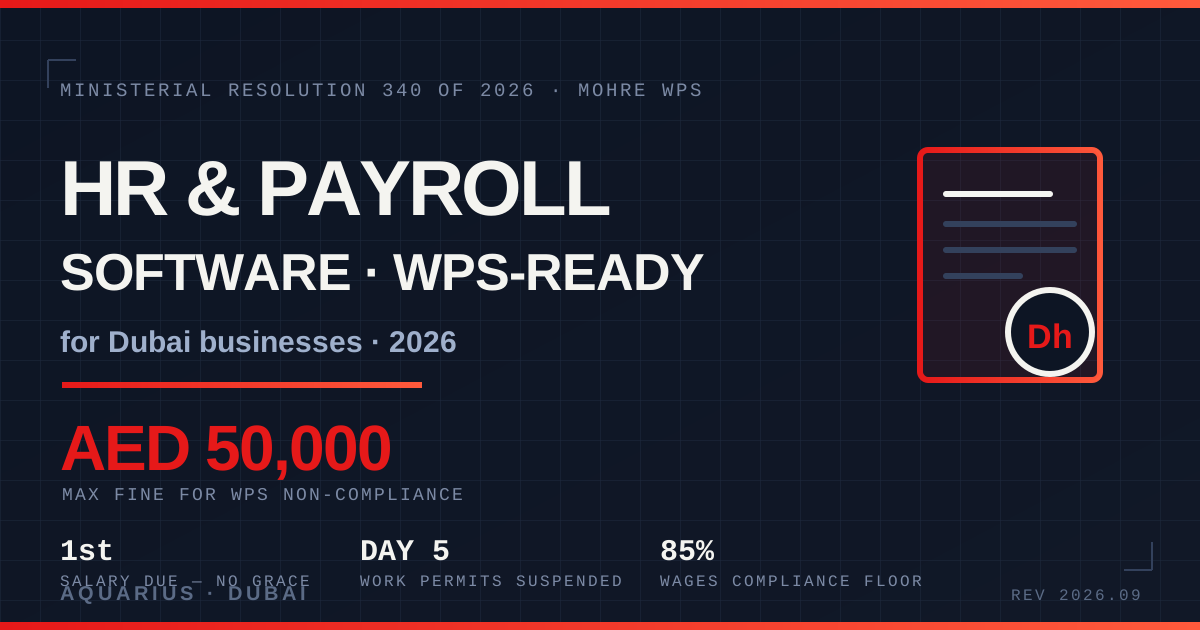
Short answer: As of Ministerial Resolution No. 340 of 2026 (effective 1 June 2026), UAE private-sector salaries are due on the 1st of every month — the old 15-day grace period is abolished, and enforcement is automatic: new work permits are frozen from Day 5, administrative fines start from Day 11, and travel bans and prosecution can follow by Day 21. Fines run from AED 1,000 per employee up to AED 50,000 for repeat violations. Off-the-shelf WPS payroll software starts around AED 12 per employee per month; a custom HR & payroll platform built for a Dubai business typically costs AED 80,000 for a focused MVP to AED 600,000+ for a mid-to-enterprise system. If payroll is still a spreadsheet plus a bank upload, you are one rejected SIF file away from a compliance problem.
Key takeaways
- The deadline moved and the buffer vanished. Salaries must clear by the 1st — there is no contractual flexibility and no 15-day grace under Resolution 340 of 2026.
- The compliance floor rose from 80% to 85% of total wages due, transferred on time, across every worker on your MOHRE establishment.
- A malformed SIF file is a late payment. One formatting error rejects the whole file and can trigger penalties even when you fully intended to pay.
- Build cost is scope-driven: AED 80,000 (MVP) to AED 600,000+ (mid/enterprise), or AED 12/employee/month for SaaS — the right answer depends on headcount and how much you integrate.
Why HR & payroll compliance just got serious in Dubai (awareness)
The Wage Protection System (WPS) has been the backbone of UAE payroll since it launched in July 2009 under Ministerial Decree 788, run by MOHRE together with the UAE Central Bank. By 2015 the ILO already counted more than three million workers protected under it, and coverage has grown every year since. For a decade it was a routine bank task. In 2026 it became a board-level risk.
Ministerial Resolution No. 340 of 2026, effective 1 June 2026, rewrote the rules. Salaries are now due on the 1st of the following month with no grace period, the 30-day new-hire exemption is gone, and the compliance threshold rose from 80% to 85% of total wages transferred on time. Every employee on your establishment record — full-time, part-time, flexible and remote — must appear in the monthly SIF file. Miss the mark and MOHRE's response is now automatic and fast, not a warning letter weeks later.
Layer on the wider 2026 compliance stack — 9% corporate tax on taxable income above AED 375,000, mandatory ILOE unemployment insurance, and end-of-service gratuity that must be paid within 14 days of exit — and the manual spreadsheet-plus-bank-portal workflow most Dubai SMEs still run simply does not hold up. The software you use to run payroll is now the software that keeps you out of trouble.
What "WPS-compliant" actually means in your software (consideration)
Vendors throw "WPS-compliant" on every landing page, but only a few things make software genuinely safe to run payroll on in the UAE. A build that ignores any of these is a liability:
- Correct SIF generation. The Salary Information File must be machine-perfect — routing codes, employee IDs, committed wage vs paid wage, and totals all validated before submission, because a single malformed field rejects the entire file and counts as non-payment.
- The 1st-of-month deadline, enforced in-app. The system should calculate, approve and queue the transfer to clear by the 1st, with escalating reminders — not rely on someone remembering.
- 85% coverage tracking. Dashboards that show, in real time, what percentage of total wages due are cleared, so you never slip under the compliance floor.
- Gratuity done by the book. End-of-service = 21 days of basic salary per year for the first five years, then 30 days per year after, capped at two years' wages, on basic pay only. Since Federal Decree-Law No. 33 of 2021, resignation no longer cuts the rate.
- ILOE, leave, attendance and payslips — the everyday HR layer that feeds clean data into payroll so the numbers are right in the first place.
The enforcement timeline is what turns a small process gap into a real cost. Here is exactly what happens in 2026 when the 1st passes unpaid:
| Timeline after due date | MOHRE action |
|---|---|
| Day 2 | Automated warnings and notifications issued |
| Day 5 | New work-permit applications suspended |
| Day 11 | Administrative fines begin + "Third Category" reclassification |
| Day 16 | Automatic labour-dispute registration; extended permit suspension |
| Day 21 | Asset attachment, travel bans, referral to Public Prosecution |
The fines themselves scale quickly: from AED 1,000 per affected employee for late payment, up to AED 5,000 for an intentionally inaccurate SIF, and up to AED 50,000 where violations stack up. For a 40-person company, a single missed cycle is not a rounding error — it is a five-figure exposure plus a hiring freeze. Software that removes the human deadline is cheaper than one bad month.
Deciding between building and buying? Our custom software vs off-the-shelf guide and ERP implementation guide for Dubai SMEs cover the trade-offs — most companies land on SaaS for standard payroll and custom for anything tied to their own operations.
What HR & payroll software costs to build in Dubai (decision)
There are two honest paths, and the right one depends on headcount and how much your payroll ties into the rest of your business.
| Option | 2026 cost (AED) | Best for |
|---|---|---|
| Off-the-shelf WPS SaaS | from ~AED 12 / employee / month | Standard payroll, small–mid headcount, fast start |
| Custom HR & payroll MVP | AED 80,000+ | A focused platform with WPS, gratuity, leave |
| Mid-tier custom platform | AED 146,000–600,000 | Multi-entity, integrations, attendance, self-service |
| ERP with payroll module | AED 40,000–220,000 | Payroll bolted onto finance/operations |
| Enterprise HRMS | AED 1,800,000+ | Large workforce, complex approvals, deep integrations |
For most Dubai SMEs, a good SaaS at AED 12–40 per employee per month covers WPS and gratuity out of the box — the smart, lazy answer if your payroll is standard. You move to custom when payroll must integrate with a bespoke system: your own booking or POS platform, project-based cost allocation, multi-free-zone entities, or an app your team already lives in. Budget the way you would for any UAE software build — plan on 15–20% of build cost per year for maintenance, updates and compliance changes, because rules like Resolution 340 land regularly.
How Aquarius does it: we build WPS as a first-class feature, not an afterthought — validated SIF generation, a 1st-of-month deadline engine with escalating reminders, live 85% coverage dashboards, and gratuity/ILOE/leave logic checked against current UAE labour law. We integrate payroll with the systems you already run so data is entered once and correct everywhere, and we hand over full source code and your own cloud accounts — no lock-in. See our services and pricing, or compare approaches in our Dubai build-cost guide.
The cost of inaction is concrete: one missed cycle can mean AED 50,000 in fines plus a work-permit freeze that stalls hiring — far more than a year of good software. In 2026, payroll software is a compliance control, not a convenience.
Frequently asked questions
What changed for WPS in the UAE in 2026?
Ministerial Resolution No. 340 of 2026 (effective 1 June 2026) abolished the 15-day grace period and the 30-day new-hire exemption. Salaries are now due on the 1st of each month, and the on-time compliance threshold rose from 80% to 85% of total wages due.
What are the penalties for late salary payment in Dubai now?
Enforcement is automatic: warnings from Day 2, new work-permit suspension from Day 5, administrative fines from Day 11, and travel bans plus referral to Public Prosecution by Day 21. Fines run from AED 1,000 per employee up to AED 50,000 for repeated violations.
How much does custom HR & payroll software cost in Dubai?
A focused custom MVP starts around AED 80,000; a mid-tier platform runs AED 146,000–600,000; enterprise HRMS builds exceed AED 1,800,000. Off-the-shelf WPS SaaS starts near AED 12 per employee per month. Budget 15–20% of build cost yearly for maintenance.
Does the software need to calculate gratuity and ILOE too?
Yes. End-of-service gratuity (21 days' basic pay per year for the first five years, 30 days after, capped at two years' wages) must be paid within 14 days of exit, and ILOE unemployment insurance is mandatory. Payroll software that ignores these leaves you doing the risky parts by hand.
Should a Dubai SME build or buy payroll software?
Buy if your payroll is standard — SaaS handles WPS and gratuity cheaply. Build when payroll must integrate with your own systems, multiple entities, or bespoke workflows. Many companies run a hybrid: SaaS payroll plus custom modules where they differ.
The bottom line: the 2026 rules turned UAE payroll from an admin chore into a compliance control with real teeth — a 1st-of-month deadline, an 85% floor, and a fine schedule that starts at AED 1,000 per head and reaches AED 50,000. Whether you buy WPS SaaS at AED 12/employee/month or commission a custom platform from AED 80,000, the goal is the same: take the human deadline out of payroll. Talk to Aquarius and we will map your headcount and systems to the right build.