
IAS 24 Related Party Disclosures in Dubai 2026: One Transaction, Three Registers, No ERP That Tracks Them
Your audited accounts, your tax return and your board minutes each define a related party differently. Most Dubai ERPs carry one counterparty flag and satisfy none of the three.
- PUBLISHED
- 14 NOV 2026
- READ TIME
- 14 MIN
- AUTHOR
- AQUARIUS · DUBAI
- UNIT
- REV 2026.09
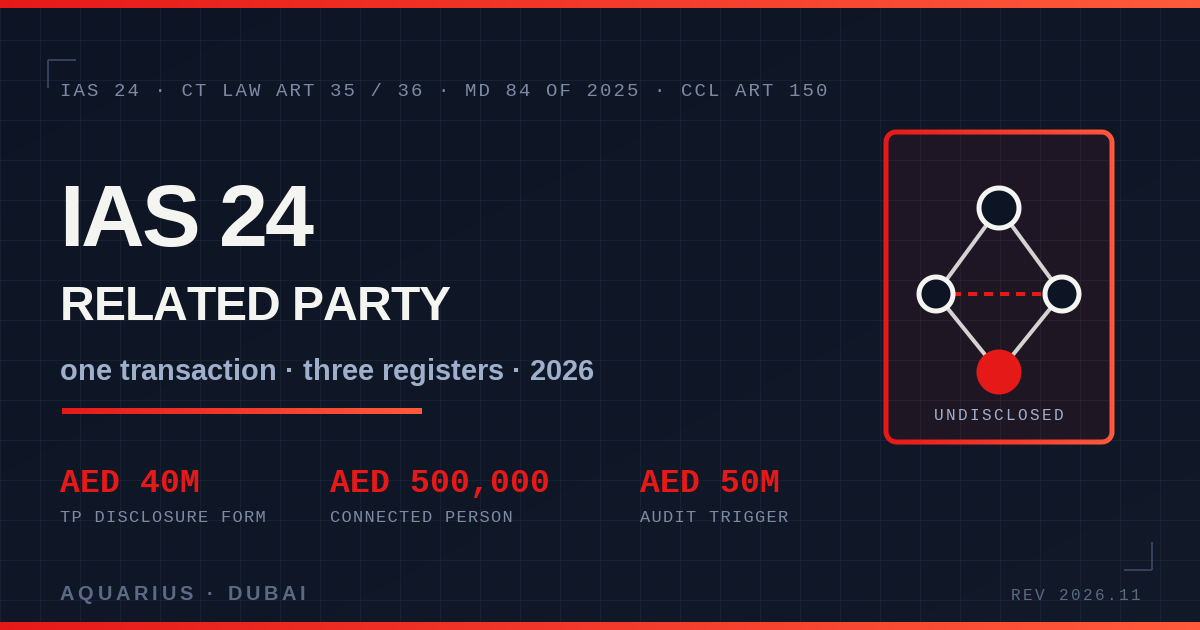
Short answer: A related party transaction in Dubai is now disclosed three separate times, against three different definitions, to three different audiences. IAS 24 asks who controls you and what you paid your key management. The UAE Corporate Tax Law asks who is related to you within the fourth degree of kinship and whether the price was market value. The amended Commercial Companies Law asks which director had an interest and whether the board wrote it down. The same warehouse rent paid to the owner’s brother sits in all three registers — and the counterparty master in most Dubai ERPs carries one flag that satisfies none of them.
This is not a disclosure-note problem. It is a data problem that only looks like a disclosure-note problem in March, when the auditor asks for a related-party schedule and the finance team starts reconstructing it from memory, WhatsApp and the owner’s personal bank statements. The relationships existed all year. Nothing in the ledger recorded them.
Why related parties became a 2026 problem in the UAE
Until recently, a privately held Dubai group could run on unaudited management accounts and nobody outside the family ever read a related-party note. Three things closed that door inside eighteen months.
First, the audit requirement. Ministerial Decision No. 84 of 2025, effective 1 January 2025, requires audited financial statements from three populations: any taxable person with revenue above AED 50 million in the tax period, every Qualifying Free Zone Person regardless of size, and every tax group (which must maintain audited special purpose financial statements). An audit signed under IFRS is an audit that includes the IAS 24 note. There is no de minimis inside IAS 24 and no materiality escape for the parent-and-ultimate-controlling-party disclosure.
Second, the scale of the registered population. More than 651,000 businesses have registered for UAE Corporate Tax according to FTA figures published in 2025. A large share of them had never prepared a statutory related-party disclosure in their lives.
Third, who those businesses are. Family enterprises contribute roughly 60% of UAE GDP, employ about 80% of the workforce and account for close to 90% of all private companies in the country, per the Ministry of Economy and Tourism. Dubai alone hosts nearly 60% of the UAE’s family businesses. Dubai Chamber of Commerce registered 53,838 new member companies in January to September 2025, up 4% year on year. A family group is, structurally, a related-party machine: shared premises, shared staff, shareholder current accounts, cross-guarantees, and a cousin who owns the logistics company.
Most Dubai groups do not fail the related-party note because they priced something wrongly. They fail it because no system ever recorded that the counterparty was family.
Enforcement has caught up. In a 9 September 2026 analysis, Gulf News reported that FTA corporate tax audits are putting arm’s length pricing, related-party and connected-person arrangements, head-office management fees and profit allocation between free zone, mainland and offshore entities under direct examination — including at mid-sized groups. Saad Maniar, CEO of Baker Tilly UAE, summarised the shift bluntly: tax and transfer pricing positions “now sit much closer to the audit file than many businesses realise.” The FTA position is that documentation must be concurrent — the policy existed and operated during the year, with approvals and ledger reconciliation — not assembled after the profit landed.
And company law moved in the same direction. Federal Decree-Law No. 20 of 2025, issued 1 October 2025 and in force from 15 October 2025, amended the Commercial Companies Law to expand directors’ duties to include disclosing related-party transactions above statutory thresholds, maintaining board minutes and a conflicts-of-interest register, and making prescribed governance disclosures. Under Article 150, a joint stock company director with a conflicting interest in a board transaction must disclose it, have it minuted, and abstain from the vote. Failure can let the company or a shareholder seek judicial relief — including invalidation of the transaction or recovery of the benefit obtained.
Register one: IAS 24, inside the audited accounts
IAS 24 is a disclosure standard, not a measurement standard. It never tells you to reprice anything. It tells you to make the relationship visible, on the logic that parties who are close can agree terms that strangers would not.
What it actually demands:
- Parent and ultimate controlling party (para 13) — named, even if there were no transactions at all. For a Dubai group whose ultimate owner is a natural person holding through two offshore vehicles, that is the single most commonly missed line in the file.
- Key management personnel compensation (para 17), split into five categories: short-term employee benefits, post-employment benefits, other long-term benefits, termination benefits and share-based payment. Housing allowances, school fees, cars and end-of-service accruals for directors belong here, not buried in general payroll.
- Per-category transaction detail (paras 18 and 19) — for the parent, entities with joint control or significant influence, subsidiaries, associates, joint ventures, key management personnel and other related parties: the amount of the transactions, the outstanding balances and their terms and conditions, whether they are secured, guarantees given and received, provisions for doubtful related-party debts, and the bad-debt expense recognised in the period.
- The arm’s length claim (para 23) — you may state that terms were equivalent to those in an arm’s length transaction only if you can substantiate it. A sentence in the notes is not substantiation. A dated quote, a comparable market rate or a valuation is.
IAS 24’s family definition is narrow and judgement-based: close members of the family means a spouse or domestic partner, children, the spouse’s children and dependants. Anyone else counts only if they may be expected to influence, or be influenced by, the person. Remember that sentence — the tax law does the opposite.
One UAE-specific relief is worth knowing. Paragraphs 25 to 27 exempt an entity controlled, jointly controlled or significantly influenced by a government from the full paragraph-18 detail for transactions with that government and with other entities under the same government’s control or influence. That exemption matters across Dubai and Abu Dhabi, where very large numbers of companies sit under state-linked holding structures and would otherwise be related to each other by definition. It is a relief, not a pass: paragraph 26 still requires you to name the government, state the nature of the relationship, disclose each individually significant transaction, and give a qualitative or quantitative indication of the transactions that are significant only when taken together.
Register two: Articles 35 and 36, inside the tax return
The Corporate Tax Law runs on an entirely different test, and it is mechanical rather than judgemental.
Article 35 Related Parties reaches natural persons related within the fourth degree of kinship or affiliation. That is automatic and wide: brothers, in-laws, nephews, cousins. No assessment of influence is required. A transaction with your wife’s cousin’s company is a related-party transaction for tax whether or not anyone influences anyone.
Article 36 Connected Persons is the one that catches owner-managed Dubai businesses hardest. A connected person includes any natural person who directly or indirectly owns an ownership interest in or controls the taxable person, any director or officer, partners in the same unincorporated partnership, and the related parties of each of those people. Payments and benefits to connected persons are deductible only if they are at market value and wholly for the business — and that market-value test applies regardless of any threshold.
Then the reporting thresholds, which are where the data work bites:
| Filing | Trigger | What it needs |
|---|---|---|
| Transfer Pricing Disclosure Form (with the return) | Aggregate related-party transactions above AED 40 million in the tax period | Itemisation of each category whose value exceeds AED 4 million |
| Connected Persons schedule (with the return) | Aggregate payments and benefits above AED 500,000 per connected person, counting their related parties together | Salaries, dividends, rent, benefits in kind, per person |
| Local File (MD 97 of 2023) | Entity revenue of AED 200 million or more | Functional analysis and benchmarking of material related-party dealings |
| Master File (MD 97 of 2023) | Multinational group consolidated revenue of AED 3.15 billion or more | Group-level structure, intangibles and financing picture |
Note the asymmetry in that table. A UAE-only group that crosses AED 200 million of entity revenue prepares a Local File but no Master File, because the Master File obligation is tied to operating across jurisdictions. And the AED 500,000 connected-person line is far lower than people assume: a founder drawing AED 50,000 a month takes AED 600,000 a year and is over the threshold on their own payroll alone, before rent, dividends or the car.
All of it is filed with the Corporate Tax return, due within nine months of the tax period end — so a 31 December 2026 year end files by 30 September 2027. The data has to be captured from January 2026 to be captured at all.
Register three: the board minute
The third register is the one finance teams forget because it does not live in the finance system. Under the amended Commercial Companies Law, conflicted transactions must be disclosed by the interested director, minuted, and voted without them. In the governance code applying to listed companies, a related-party transaction whose value exceeds 5% of issued capital requires an explicit general assembly resolution, and must be valued by an evaluator accredited by the securities regulator. The related-party definition there also reaches parent companies and any shareholder holding 5% or more of capital or voting rights.
So the same lease to an affiliate can need a board minute with an abstention, a general assembly resolution with an accredited valuation, an IAS 24 note with terms and security disclosed, a transfer pricing disclosure line, and a connected-person entry — from one contract that an accounts payable clerk coded to “Rent — Warehouse 3”.
The myth: “our prices are arm’s length, so there is nothing to disclose”
This is the single most expensive misunderstanding in UAE related-party compliance, and it gets repeated in boardrooms every quarter.
Arm’s length pricing and related-party disclosure are different obligations. IAS 24 disclosure is triggered by the relationship, not by mispricing. A perfectly market-rate loan from the shareholder is still disclosed, with its amount, balance, terms, security and any guarantee. Correct pricing removes the tax adjustment; it does not remove the note. And under paragraph 23 you cannot even assert that the pricing was arm’s length unless you hold evidence that it was.
The reverse error is just as common. Because the tax definitions are wider on family and narrower on judgement, the two populations genuinely differ:
- A transaction with the owner’s cousin’s trading company is a related party for tax (fourth degree) and may well fall outside IAS 24 if no influence runs either way.
- A transaction with an associate you hold 30% of is squarely inside IAS 24 and inside the tax definition, but needs different attributes captured for each.
- Intra-group transactions eliminated on consolidation are not disclosed in the consolidated statements — yet they still appear in each entity’s standalone statutory accounts, and the tax group audited special purpose statements are their own separate exercise.
One boolean is_related_party column cannot represent that. It will either over-disclose, which invites questions you cannot answer, or under-disclose, which is the finding.
What the data layer actually has to do
When we build this for UAE finance functions, the design is consistently the same six pieces:
- A counterparty master with three independent flag sets, not one — IAS 24 category (para 19), Article 35 status, Article 36 status — each with its own effective-from and effective-to dates, because relationships start and stop mid-year.
- An ownership and kinship graph that can compute degree of kinship and indirect ownership, so “fourth degree” is a query result rather than a family argument.
- A key management personnel register wired to payroll, tagging every component into the five IAS 24 buckets — including benefits in kind and end-of-service accrual, which almost always sit outside the salary line.
- A threshold aggregation engine that runs continuously against AED 40m, AED 4m per category, AED 500,000 per connected person, AED 200m and AED 3.15bn, and tells you in month four that you are going to cross a line, not in month fifteen.
- An evidence locker holding the concurrent documentation per transaction type: the dated quote or comparable, the approval, the policy version in force, and the ledger reconciliation.
- Two outputs from one dataset — the IAS 24 disclosure note and the tax disclosure schedules — generated from the same source so they cannot silently disagree.
Most of this is not new software. It is usually a thin layer over the ERP and payroll you already run, which is the same pattern as the transfer pricing data layer and the QFZP qualifying income tagging problem. If you have already done either of those, you have most of the counterparty spine.
What it costs, and what getting it wrong costs
Transfer pricing documentation in the UAE market generally runs AED 15,000 to AED 80,000 depending on complexity and the number of related parties. Standalone benchmarking studies typically start around AED 15,000 to AED 35,000; a Local File is commonly quoted at AED 35,000 to AED 65,000, with benchmarking at AED 25,000 to AED 45,000 per transaction type. Those are annual, recurring, advisory fees — and they are quoted on the assumption that someone hands the adviser clean data. When the data has to be reconstructed first, the invoice is at the top of the range every year.
| Failure | Exposure |
|---|---|
| Required records not maintained | AED 10,000, rising to AED 20,000 on a repeat within 24 months |
| Records not provided in Arabic when the FTA asks | AED 5,000 |
| Incorrect tax return submitted | AED 500, unless corrected before the filing deadline |
| Late return | AED 500 per month for months 1 to 12, then AED 1,000 per month |
| Late payment | 14% per annum, applied monthly |
| Deduction disallowed for want of substantiation | Tax at 9% on the add-back — an unsupported AED 5 million management fee is AED 450,000 of tax before penalties and interest |
The fixed penalties are not the real number. The real number is the add-back, plus the audit itself: once the FTA opens a related-party line, it tends to walk the whole intercompany structure, and the cost becomes months of senior finance time defending positions that were never documented when they were cheap to document.
FAQ
Does IAS 24 apply to a private Dubai LLC with no listing?
If you prepare IFRS financial statements, yes — IAS 24 has no public-market scope limit, unlike IAS 33. And under Ministerial Decision No. 84 of 2025 you are required to have those statements audited if your revenue exceeds AED 50 million in the tax period, if you are a Qualifying Free Zone Person of any size, or if you are part of a tax group.
Our related-party prices are at market rate. Do we still have to disclose them?
Yes. IAS 24 disclosure is triggered by the relationship, not by mispricing. Correct pricing protects your tax deduction; it does not remove the note. Paragraph 23 goes further: you may only state that terms were equivalent to arm’s length if you can substantiate that claim with evidence.
Does the owner’s own salary have to be disclosed?
In two places. It is key management personnel compensation under IAS 24 paragraph 17, categorised as a short-term employee benefit with the post-employment element shown separately. It is also a payment to a connected person under Article 36, disclosable in the return once aggregate payments and benefits to that person and their related parties exceed AED 500,000 in the tax period — which a salary of AED 50,000 a month does on its own.
Do intra-group transactions need disclosing?
Not in consolidated financial statements, where they have been eliminated. They remain disclosable in each entity’s own statutory accounts, and the audited special purpose financial statements a tax group must maintain are a separate exercise again. Practically, the group needs the transactions captured at entity level regardless, because that is the only level at which the tax thresholds can be measured.
We are owned through a government-linked holding company. Are we exempt?
Partially. IAS 24 paragraphs 25 to 27 relieve you of the full paragraph-18 detail for transactions with the controlling government and with fellow state-influenced entities, but you must still name the government, describe the relationship, disclose each individually significant transaction, and indicate the extent of transactions that are significant collectively. The exemption also does nothing for your Article 35 and Article 36 tax obligations.
Where to start
Do not start with a software decision. Start with a reconstruction: take the last filed tax period, pull every counterparty you transacted with, and try to assign each one an IAS 24 category, an Article 35 status and an Article 36 status, with dates. Most Dubai finance teams get a few hundred rows in and find the same three things — a shareholder current account with no agreement, a property rented from a relative with no comparable rate on file, and director benefits that were never tagged as compensation.
That exercise is also the specification. Once you know which attributes you could not answer, you know exactly what the data layer has to capture, and the build is small and boring. We do this work for UAE finance functions — the counterparty spine, the kinship graph, the threshold engine and the disclosure outputs, wired into the ERP and payroll you already run. Start with the diagnostic: talk to Aquarius, and we will map one filed tax period against all three registers before anyone writes a line of production code. If you want the wider picture first, see our finance and compliance engineering work.