
Insurance Comparison Website Development in Dubai (2026): Build a CBUAE-Compliant Aggregator That Converts
What it costs to build an insurance comparison platform in Dubai in 2026 — real AED tiers, insurer API integration, and the CBUAE broker licence (AED 3M capital) that decides whether you can legally sell.
- PUBLISHED
- 11 SEPT 2026
- READ TIME
- 10 MIN
- AUTHOR
- AQUARIUS · DUBAI
- UNIT
- REV 2026.09
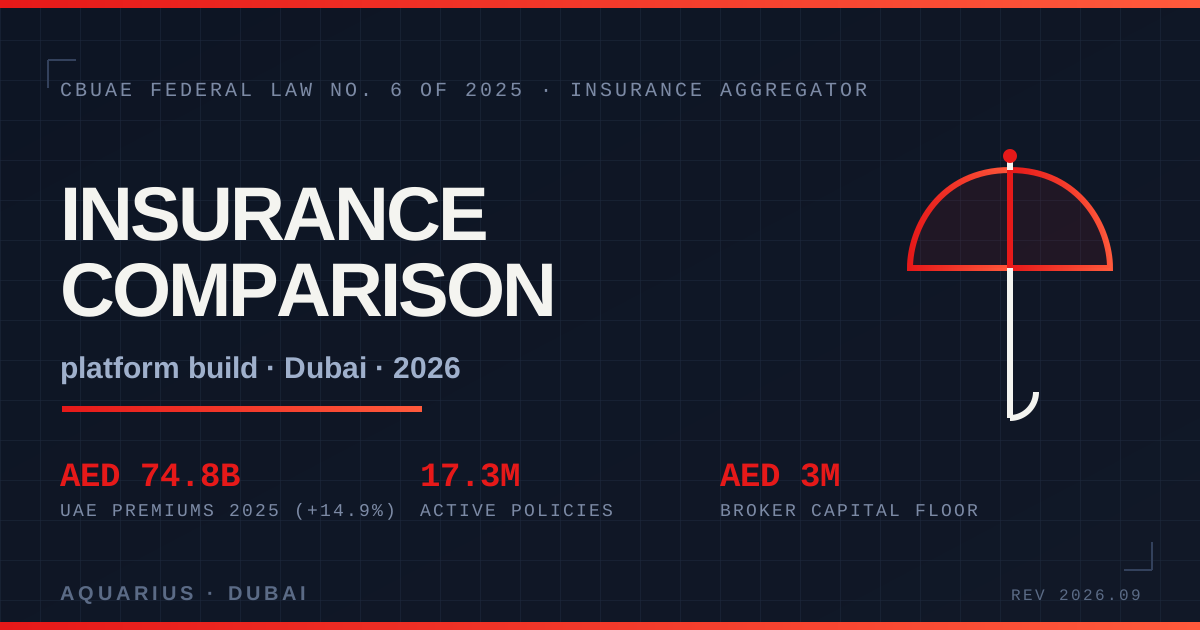
Short answer: an insurance comparison platform in Dubai costs roughly AED 90,000–180,000 for a single-line comparison MVP (motor or health), AED 180,000–420,000 for a multi-line aggregator with live insurer APIs, payments and policy issuance, and AED 420,000–800,000+ for an enterprise insurtech suite with CRM, claims and embedded insurance (before 5% VAT). But the software is only half the job — to legally quote, sell and earn commission on policies you must operate as, or partner with, a CBUAE-licensed insurance broker, which carries a AED 3 million paid-capital floor and a separate AED 3 million bank guarantee.
This is the 2026 build guide for founders and brokers launching a Policybazaar- or Souqalmal-style aggregator in the UAE: what the platform actually costs, how insurer integration works, and the licensing rules that decide whether you can switch it on. Updated September 2026.
Key takeaways
- Three real build tiers: single-line MVP AED 90k–180k, multi-line aggregator AED 180k–420k, enterprise insurtech suite AED 420k–800k+ (add 5% VAT).
- A market at scale: UAE gross written premiums hit AED 74.8 billion in 2025 (+14.9%) across 17.3 million active policies, and grew a further 15.1% in Q1 2026.
- The myth that sinks new entrants: motor and basic-health prices are regulated — you cannot win on price alone. You win on UX, bundling and speed-to-quote.
- Licensing gates launch: selling insurance requires a CBUAE broker licence — AED 3M capital, AED 3M bank guarantee, AED 2M professional-indemnity cover.
- Revenue is commission + leads: aggregators distribute rather than underwrite, so integration depth and conversion, not inventory, decide the margin.
Why 2026 is the year UAE insurance goes online-first (TOFU)
The demand is already here. The UAE insurance sector wrote AED 74.8 billion in gross premiums in 2025, up 14.9% year on year, spread across 17.3 million active policies — and momentum carried into 2026 with premiums up a further 15.1% in Q1. Health is now the largest line at AED 35.5 billion, with health policies alone jumping 26.1% after mandatory basic health insurance was extended nationwide to every private-sector employee and domestic worker from 1 January 2025.
That regulation created millions of new must-buy customers overnight — and they are shopping online. With UAE internet penetration near 99%, the aggregator layer has become a real market in its own right, valued at roughly USD 1.2 billion, inside a UAE insurtech sector worth USD 8.5 billion in 2025 and forecast to reach USD 18.1 billion by 2031 at a 15.8% CAGR. Established players — Policybazaar UAE, Souqalmal, Yallacompare, InsuranceMarket.ae, Shory and Aqeed — already own the head terms, which is exactly why a new entrant has to be sharper on niche, experience and conversion rather than trying to out-shout them.
The behavioural shift is the opportunity: a buyer renewing motor cover or a HR manager insuring 40 staff no longer wants a phone call and a PDF the next day. They want an instant, comparable quote on their phone. Whoever answers that intent first — in Arabic or English, with a price they can act on — takes the sale.
What an insurance comparison platform costs to build in Dubai (MOFU)
Pricing tracks scope: how many insurers you integrate, how many lines you compare, and whether you stop at lead capture or go all the way to bindable policies and payment. Below are the working 2026 AED ranges for a Dubai build (indicative bands — a fixed quote follows a scoping call).
| Tier | AED build cost | What it includes |
|---|---|---|
| Single-line comparison MVP | AED 90,000–180,000 | One vertical (motor or health), quote form, comparison grid, lead capture + CRM handoff, 2–4 insurer integrations, payment gateway, Arabic/English |
| Multi-line aggregator | AED 180,000–420,000 | Motor, health, travel, home & life; live insurer APIs, real-time binding & policy issuance, document upload/KYC, VAT invoicing, renewals engine, admin dashboard |
| Enterprise insurtech suite | AED 420,000–800,000+ | Embedded/white-label distribution, corporate group-health portals, claims & endorsements, commission reconciliation, analytics, mobile apps, fraud checks |
Insurer integration — the plumbing. The hard engineering is not the comparison grid; it is connecting to insurers so quotes are live and policies bind without a human rekeying data. Some UAE insurers expose modern REST APIs; many still work over rating spreadsheets, portals or email, so a real aggregator ships an integration abstraction layer that normalises every insurer to one internal quote schema. Motor is the usual first line because it is high-frequency and renews annually; health follows because the mandatory-cover mandate created guaranteed demand.
The pricing myth that sinks new entrants. Here is what most people building a UAE aggregator get wrong: for motor and basic health, prices are regulated. A four-cylinder private saloon's third-party liability sits inside a published band of AED 750–1,300; comprehensive minimums are AED 1,300 for a saloon and AED 2,000 for a 4WD, capped at 5% and 7% of vehicle value respectively — and the policy wording is identical across insurers because it is issued under one regulation. So you cannot win by being cheapest. You win on experience: fewer form fields, an instant quote, transparent add-on bundling, WhatsApp follow-up, and one-tap renewals. That reframing is the whole product strategy.
Pricing, licensing and the cost of getting it wrong (BOFU)
Budget the software at AED 90k–180k for a single-line MVP, AED 180k–420k for a multi-line aggregator, and AED 420k+ for an enterprise suite — then licence in the right order, because in the UAE the regulator decides who may sell. Under Federal Law No. 6 of 2025, the Central Bank of the UAE (CBUAE) now supervises all insurance activity, and the Insurance Brokerage Regulation issued 25 July 2024 (in force 15 February 2025) sets the bar: a UAE-incorporated broker needs paid capital of at least AED 3 million, a separate AED 3 million bank guarantee (these are additive, not alternatives), and a professional-indemnity policy of at least AED 2 million. The same rules ban brokers from collecting premiums directly and from discounting their own commission to win a deal, and require the insurer to pay the broker within 10 business days.
That shapes the revenue model. An aggregator earns through commission on bound policies and qualified-lead fees — it distributes, it does not underwrite — so margin comes from conversion and integration depth, not from holding risk. If you would rather not carry a broker licence yourself, the pragmatic route is to build the technology and partner with an existing CBUAE-licensed broker or insurers directly, which keeps the compliance burden with the licensed party while you own the funnel.
The cost of getting it wrong is concrete. On the demand side, employers who fail to provide the now-mandatory health cover face fines running to AED 150,000 per month — which is precisely why HR-led group-health comparison is one of the fastest-converting entry niches for a new platform. On the supply side, transacting insurance without the right licence is not a grey area with the CBUAE; the licence is the product's licence to operate.
How Aquarius approaches it: we scope to your commercial model first — pure lead-gen, licensed broker, or embedded partner — then build the insurer-integration layer that matches your actual carrier list, and ship the single line that converts before widening to a full multi-line aggregator. See indicative bands on our pricing page, review our development services, and tell us your carrier and licensing position via contact.
Frequently asked questions
Do I need a licence to run an insurance comparison website in Dubai?
To simply publish information you do not; to quote, sell, bind or earn commission on policies you must be — or partner with — a CBUAE-licensed insurance broker. A UAE-incorporated broker needs AED 3M paid capital, an AED 3M bank guarantee and AED 2M professional-indemnity cover under the 2024 Insurance Brokerage Regulation.
How much does an insurance aggregator cost to build in the UAE?
Roughly AED 90,000–180,000 for a single-line comparison MVP, AED 180,000–420,000 for a multi-line aggregator with live insurer APIs and policy issuance, and AED 420,000+ for an enterprise insurtech suite — before 5% VAT.
Why can't I just compete on the cheapest price?
Motor and basic-health prices are regulated in the UAE, and the policy wording is identical across insurers, so price is largely fixed. Winning platforms compete on user experience, speed-to-quote, bundling, bilingual service and renewals — not on undercutting.
How do insurance comparison platforms make money?
Through commission on bound policies and fees for qualified leads passed to insurers or brokers. Aggregators distribute rather than underwrite, so revenue scales with conversion and the number of carriers integrated, not with holding risk.
Which insurance line should I launch first?
Motor is the common starting point — high frequency, annual renewals, well-understood rating — followed by health, where the nationwide mandatory-cover mandate (effective 1 January 2025) created guaranteed, recurring demand, especially for SME group cover.
The bottom line
Budget AED 90k–180k for a single-line MVP, AED 180k–420k for a multi-line aggregator, and AED 420k+ for an enterprise suite — then decide your licensing posture early, because a CBUAE broker licence (AED 3M capital plus a AED 3M guarantee) is what turns a comparison site into a business that can legally earn. Build the experience, not a price war. If you are weighing the regulated-fintech side of this, see our fintech app development guide and payment gateway integration costs. When you're ready to scope, talk to Aquarius.