
IoT and M2M SIM Connectivity in Dubai (2026): Real AED Costs, TDRA Rules and the Permanent Roaming Trap
Dubai runs on 2.3 million smart meters and 2G died in 2022. Real AED per-SIM costs for IoT and M2M connectivity in 2026, plus TDRA registration and the permanent roaming trap.
- PUBLISHED
- 28 OCT 2026
- READ TIME
- 12 MIN
- AUTHOR
- AQUARIUS · DUBAI
- UNIT
- REV 2026.09
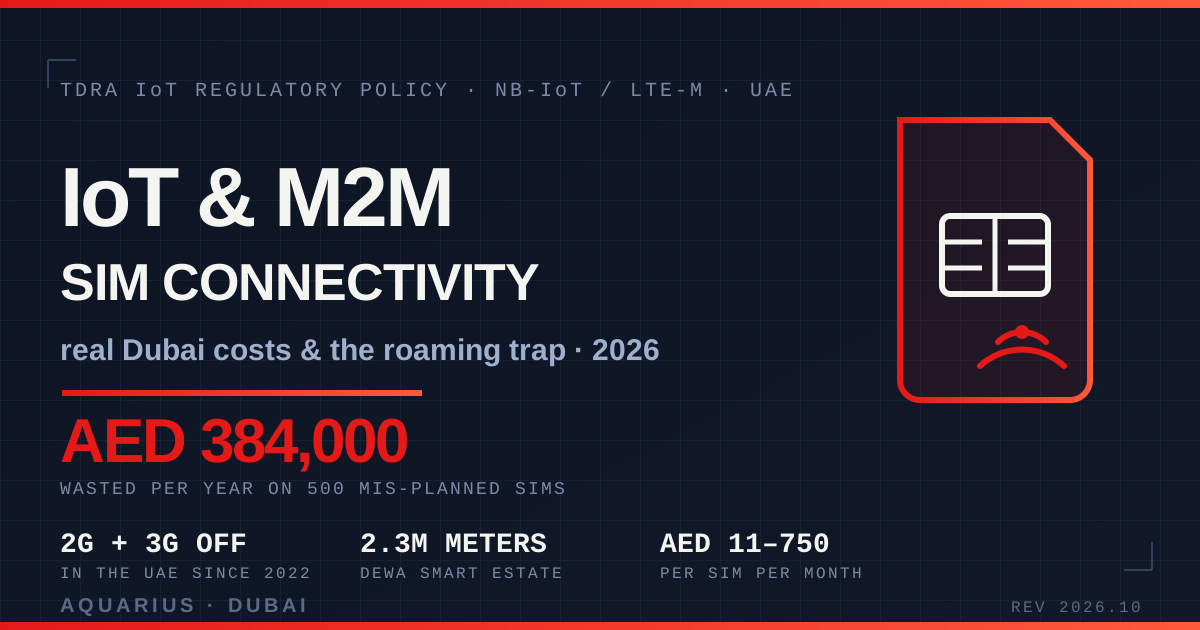
Short answer: an IoT or M2M SIM in Dubai costs roughly AED 11 to AED 64 per device per month on a proper machine-to-machine plan, versus AED 35 to AED 750 per month if you put your devices on a business data SIM meant for laptops and routers. On a 500-device fleet that single procurement decision is a AED 384,000 a year difference — and because the UAE switched off 2G and 3G back in 2022, half the cheap modules still being quoted into Dubai projects cannot connect at all.
Key takeaways
- 2G and 3G have been off in the UAE since 2022. Etisalat shut 3G in December 2022 and the TDRA-directed 2G phase-out completed in the same window. Anything you deploy must speak 4G, 5G, LTE-M or NB-IoT.
- The TDRA restricts permanent roaming. A multi-network roaming SIM is fine for a pilot or an asset transiting the Gulf; a permanent Dubai deployment belongs on a local operator profile.
- Every IoT service provider must register with the TDRA and hold a registration certificate — and that requires local presence or an appointed representative physically in the UAE.
- DEWA alone runs 1,202,411 smart electricity meters and 1,103,901 smart water meters at 100% coverage, analysing 15 million data points a day. Connected infrastructure is not a pilot in Dubai, it is the default.
- 30% of IoT projects die at proof-of-concept (Microsoft IoT Signals, 3,000+ IoT decision-makers), and Cisco put completed-successfully at just 26%. Connectivity and unit economics are the usual cause of death.
Three numbers that make connectivity a board-level line item in Dubai
Start with the market. The UAE IoT market is valued at USD 2.69 billion in 2025 and is projected to reach USD 4.15 billion by 2030 (MarketsandMarkets) — roughly AED 9.9 billion growing to AED 15.2 billion at the AED 3.6725 peg. Globally, cellular IoT subscribers are forecast to hit 6.5 billion by 2030, an increase of about 2.3 billion connections on 2025 at a 9.3% compound rate. Module prices keep falling; the recurring per-SIM cost does not.
Second, Dubai is already saturated with connected hardware. DEWA has deployed 1,202,411 smart electricity meters and 1,103,901 smart water meters — 100% smart-meter coverage of a customer base that reached 1,292,487 accounts by mid-2025 and is growing 4.81% a year. Its smart grid programme analyses 15 million data points daily and is backed by AED 7 billion of investment to 2035. If you sell chillers, generators, tanks, trucks or cold rooms in this market, your customers already treat telemetry as standard equipment.
Third, the thing almost nobody prices in: the UAE's 2G and 3G networks have been shut down since 2022. Etisalat retired 3G in December 2022 and the 2G GSM phase-out, directed by the TDRA, closed out in the same period. Globally, 313 completed, planned or ongoing 2G and 3G switch-offs had been identified across 89 countries as of June 2026. Dubai is simply several years ahead of the suppliers still shipping 2G trackers.
The AED 384,000 mistake most Dubai fleets make
Here is the arithmetic that most Dubai businesses get wrong. A business data-only SIM from Etisalat starts at AED 35 a month for 750 MB and runs up through AED 75 (2 GB), AED 130 (6 GB), AED 180 (12 GB), AED 260 (30 GB), AED 370 (60 GB) to AED 750 for 200 GB, on a 12-month contract and excluding 5% VAT. Those plans are designed for tablets, hotspots, routers and POS terminals. They are what a procurement team orders when the brief says "we need SIMs".
A telematics unit or a water-level sensor does not need 2 GB. It needs tens of megabytes. UAE M2M SIM plans are priced for exactly that: a local provider lists EUR 2.50 a month for 50 MB, EUR 8 for 500 MB and EUR 15 for 1 GB — about AED 11, AED 34 and AED 64 respectively — with an AED 11 one-off per SIM, dual-operator failover across Etisalat and du, and static IP plus private APN at the top tier. Volume discounts start at 2% for 10 or more SIMs, 3% at 50 and 5% at 100.
Put 500 devices on the AED 75 business plan and connectivity costs AED 450,000 a year before VAT. Put the same 500 devices on a correctly sized 50 MB M2M plan and it costs AED 66,000 a year. That is AED 384,000 of pure waste annually, created by a decision made in a single purchase order, usually before anyone has measured one real payload.
| Connectivity option | AED per SIM per month | Data | Fits |
|---|---|---|---|
| M2M starter | ~11 | 50 MB | Trackers, meters, sensors, low-rate telemetry |
| M2M standard | ~34 | 500 MB | Gateways, multi-sensor nodes, image snapshots |
| M2M professional | ~64 | 1 GB + static IP, private APN | Industrial gateways, remote access, SCADA edge |
| Business data SIM (750 MB) | 35 | 750 MB | Routers, POS, tablets — not sensor fleets |
| Business data SIM (30 GB) | 260 | 30 GB | Site CCTV, video edge, mobile offices |
| Business data SIM (200 GB) | 750 | 200 GB | Backhaul and failover links |
All figures exclude 5% VAT and assume a 12-month term. The lesson is not "always buy the cheapest tier" — it is measure the payload in a two-week pilot, then size the plan. In our experience the measurement pays for itself inside the first quarter of a fleet rollout.
What you can actually connect on in the UAE in 2026
Four radio options are commercially live, and the differences matter more than most vendors admit.
NB-IoT is the low-power workhorse. Etisalat was the first UAE operator to launch it commercially, back in 2017, and now runs nationwide NB-IoT on 800 MHz spectrum — the low band that gets you through basement car parks, meter cupboards and plant rooms. du offers NB-IoT across key urban centres and industrial zones. It is the right choice for metering, parking, waste bins, level sensors and anything battery-powered that reports a few times an hour.
LTE-M adds mobility and low-latency messaging, which makes it the better fit for asset tracking that has to hand over between cells. Etisalat appears alongside du in the GSMA's Mobile IoT commercial launch data, with LTE-M still rolling out rather than blanket. Treat per-site validation as mandatory: both operators' LPWA footprints vary by area, and the honest answer at design stage is "we will confirm your postcodes during the pilot".
4G LTE remains the safe default for anything that moves, streams or needs firmware pushed over the air. 5G matters for video analytics at the edge and private-network campuses, not for a flow meter.
One hardware note specific to this region: for outdoor and vehicle deployments, specify the MFF2 solderable form factor rather than a plastic SIM in a tray. Dubai summers, coastal humidity and dust kill SIM-socket contacts long before they kill the modem. A cheap socket failure that needs a technician to open 400 enclosures in Al Quoz is the most expensive few dirhams you will ever save.
The permanent roaming trap
This is the part that quietly blows up deployments after month six. Many global IoT SIM vendors sell a single "works everywhere" roaming SIM. It does work — until a regulator notices.
The TDRA restricts permanent roaming in the UAE. A multi-network roaming SIM is appropriate for pilots, temporary projects and assets transiting the Gulf. A permanent Dubai deployment is expected to sit on a local operator profile, which in practice means an eUICC that downloads an Etisalat or du profile once it lands. The UAE sits on the list of markets where permanent roaming is treated as effectively off-limits, alongside Saudi Arabia, India, China, Singapore and Egypt — often through licensing practice rather than one explicit ban, which is exactly why it catches teams out.
There is a second, sharper edge for anyone shipping hardware. Selling an IoT device in the UAE with a non-UAE eSIM profile is a regulated activity. Devices with embedded SIMs are expected to carry the SIM of a UAE licensee — Etisalat or du — or to have the licensees' consent. The framework recognises both traditional UICC SIMs and eUICC eSIMs, while soft SIMs require prior TDRA approval. If your product roadmap includes a built-in eSIM, that is a commercial conversation with a licensee, not a firmware setting. We cover the consumer-side mechanics in our eSIM app development guide.
The practical rule we apply on every build: roaming profile for the pilot, local profile for production, with remote provisioning designed in from day one so the switch is an over-the-air operation rather than a truck roll. GSMA's SGP.32 IoT remote-provisioning architecture exists precisely so a sealed, screen-less device can change operator without a human touching it.
TDRA registration: the step integrators forget
The UAE's IoT regulatory framework sets out a mandatory registration process for all IoT service providers. The definition is broad: any person providing an IoT service or solution to individuals, businesses or government — which expressly captures systems integrators, telecom equipment manufacturers and machine-to-machine connectivity providers, regardless of where they are located.
Three consequences for a Dubai project plan:
- You need a registration certificate, and to get one you need local presence or an appointed representative physically in the UAE, responsible for communicating with the TDRA and law enforcement agencies. An offshore vendor with no UAE entity cannot satisfy this alone.
- Mission-critical IoT services carry extra duties — maintaining subscriber information including the subscriber's name, address and ID along with the device's model and registration number, plus heightened safety and security requirements.
- Government data has residency rules. Data classified Secret, Sensitive or Confidential must stay within UAE borders; other categories may be transferred abroad only where the minimum criteria are met. If your pilot customer is a government entity, your hosting decision is already made.
Build the registration pack into the timeline rather than discovering it during procurement. It is cheap when planned and project-stopping when it is not.
What a connected-device platform costs to build in Dubai
Connectivity is the recurring cost; the platform is the capital cost. These are the bands we quote in Dubai in 2026 for custom work, excluding SIM subscriptions and hardware.
| Workstream | AED | What it covers |
|---|---|---|
| Device and SIM fleet dashboard | 45,000 – 90,000 | Inventory, activation state, per-SIM usage, cost alerts, bulk actions |
| Telemetry ingestion and time-series store | 55,000 – 120,000 | MQTT/HTTP ingest, payload decoding, retention policy, downsampling, APIs |
| Full IoT platform | 140,000 – 320,000 | Ingest, rules engine, alerting, bilingual Arabic/English portal, roles, audit trail |
| Firmware and OTA update pipeline | 35,000 – 85,000 | Signed images, staged rollout, rollback, remote profile switching |
| ERP, fleet or SCADA integration | 20,000 – 65,000 | Two-way sync with your existing systems of record |
| TDRA registration and documentation pack | 12,000 – 30,000 | Service description, data-flow mapping, security annexes, representative setup |
| Managed care and connectivity cost control | 3,500 – 12,000 / month | Monitoring, monthly SIM spend review, firmware releases, incident response |
The cost of getting this wrong is well documented. 30% of IoT projects fail at the proof-of-concept stage because implementation proves expensive or the bottom-line benefit stays unclear, per Microsoft's IoT Signals survey of more than 3,000 IoT decision-makers. Cisco's widely cited research found only 26% of IoT projects completed successfully. Complexity was a dealbreaker for 38% of decision-makers and 47% said there were not enough skilled people available to build or maintain a network of connected devices. Notice what those answers have in common: not one of them is about the sensor.
How Aquarius does it
We put the connectivity economics in the first two weeks, not the last two. A typical engagement runs a metered pilot on 10 to 20 devices across your real sites, measures actual payload and signal per postcode, confirms NB-IoT or LTE-M availability with the operator before anyone signs a volume order, then sizes the plan and designs the production platform around the measured numbers. Remote provisioning and a local-profile path are in the architecture from day one, so production never depends on a roaming grace period.
Then we publish the unit cost: AED per device per month, all in, on a dashboard your finance team can read. See our pricing for engagement shapes and our cold chain monitoring guide for a worked example of the same approach in a regulated vertical. If the platform will be supplied by a vendor rather than built, read our guide to what Dubai SLAs really cover before you sign anything.
FAQ
Can I use a foreign IoT SIM on permanent roaming in the UAE?
For a pilot, a temporary project or assets transiting the Gulf, yes. For a permanent deployment, no — the TDRA restricts permanent roaming and production fleets are expected to run on a local Etisalat or du profile. Design remote provisioning in early so the switch is over-the-air.
Does NB-IoT work everywhere in Dubai?
Etisalat runs nationwide NB-IoT on 800 MHz and du covers key urban and industrial areas, but LPWA coverage genuinely varies building by building and basement by basement. Validate your actual postcodes and enclosure positions during the pilot; never accept a coverage map as a design input.
Do I need TDRA registration if I only write the software?
Probably yes. The IoT service provider definition covers anyone providing an IoT service or solution, explicitly including systems integrators and machine-to-machine connectivity providers, regardless of location — and the certificate requires UAE presence or an appointed local representative.
Can I still buy cheap 2G modules for a Dubai project?
You can buy them. They will not connect. The UAE's 2G and 3G networks have been off since 2022, so your bill of materials needs LTE Cat-1 or Cat-4, LTE-M or NB-IoT.
How much data should I budget per device?
Low-rate telemetry — meters, trackers, level and temperature sensors reporting every few minutes — is usually sized on the 50 MB tier at roughly AED 11 a month. Gateways aggregating several sensors sit on 500 MB. Anything carrying images or video belongs on a business data plan and should be modelled separately so it does not inflate your fleet average.
Most Dubai businesses find out their connectivity bill is wrong in month seven, when the first annual renewal lands and nobody can explain the number. It is a two-week measurement problem that becomes a six-figure annual problem if you skip it. Tell us what you are connecting and we will size the plan and the platform against real payloads before you commit to a single purchase order.