
ISO 9001:2026 and QMS Software in Dubai: The 30 September 2029 Deadline and Real AED Costs
ISO 9001:2026 published on 16 September 2026 and every UAE certificate expires after 30 September 2029. What changed clause by clause, plus real AED costs for QMS software in Dubai.
- PUBLISHED
- 31 OCT 2026
- READ TIME
- 13 MIN
- AUTHOR
- AQUARIUS · DUBAI
- UNIT
- REV 2026.09
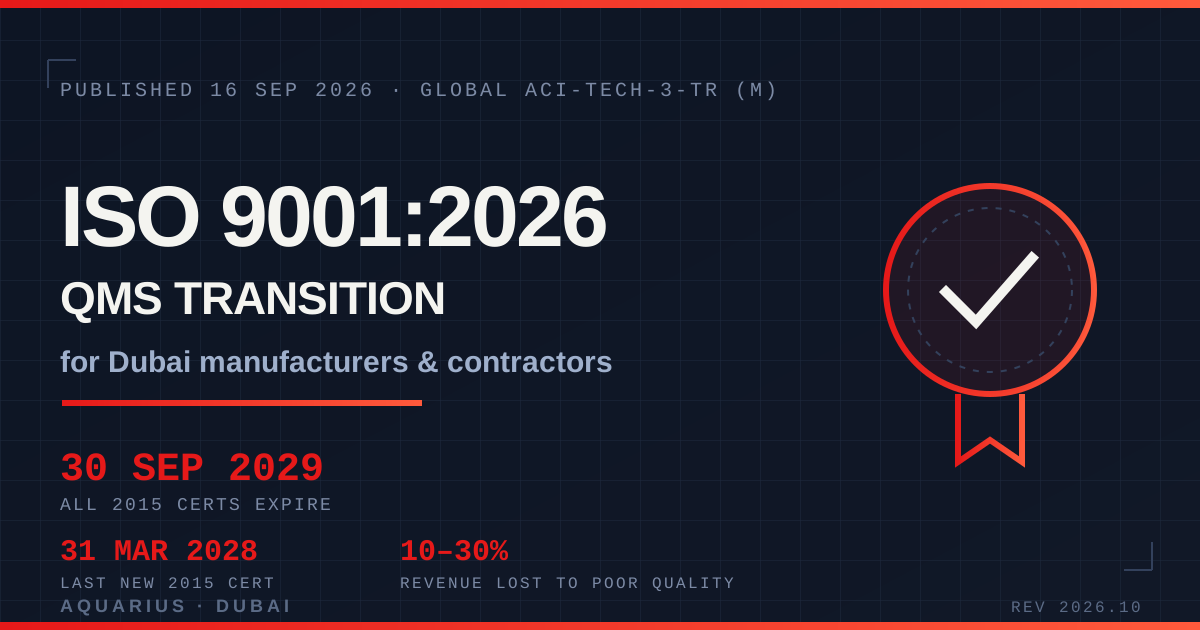
Short answer: ISO 9001:2026 was published on 16 September 2026, and under the mandatory transition document Global ACI-TECH-3-TR 2029-09-30 (M) every existing ISO 9001:2015 certificate in the UAE stops being valid after 30 September 2029. The last date a certification body can issue a brand-new 2015 certificate is 31 March 2028. The revision adds quality culture, ethical behaviour, climate change in organisational context and a cleaner split between risk and opportunity — and it deliberately adds no artificial-intelligence requirements, whatever a software vendor told you. Budget AED 5,000 to 15,000 for the certification itself and AED 55,000 to 320,000 for a QMS platform that actually runs your nonconformances, CAPAs, document control and audit programme instead of a shared drive.
Three numbers Dubai quality managers should have on the wall
First, the clock. ISO 9001:2026 landed on 16 September 2026, the first substantive rewrite since 2015, and the transition arrangements are not advisory. The governing document, Global ACI-TECH-3-TR 2029-09-30 (M), was published the same day; the (M) marks it mandatory, so accreditation bodies and certification bodies apply the dates rather than interpret them. Four milestones sit between now and the end: accreditation bodies ready by 31 March 2027, certification-body transition declarations by 30 June 2027, accreditation decisions complete by 30 September 2027, and 31 March 2028 as the cut-off for issuing any new 2015 certificate. Then 30 September 2029, and anything still on 2015 is simply expired.
Second, the scale. The ISO Survey 2024, released in September 2025 and built from IAF CertSearch data covering 77 accreditation bodies and 2,431 certification bodies, counts 1,474,118 valid ISO 9001 certificates worldwide across 2,321,640 certified sites. Every one of them has to move within the same three-year window, using the same finite pool of auditors. Dubai firms that book their transition audit in 2029 will be queueing behind the planet.
Third, why it matters commercially here. UAE manufacturing reached 12.8% of non-oil GDP in 2025, the industrial sector hit AED 205 billion against the Operation 300bn target of AED 300 billion by 2031, the country attracted more than AED 180 billion in industrial investment between 2021 and 2024, and industrial exports reached USD 71 billion in 2025. That growth runs through tenders, and tenders run on certificates. ISO 9001 is the entry ticket; the National In-Country Value programme is the scoring system layered on top of it — over AED 200 billion redirected into the local economy since 2018, more than 7,000 suppliers holding ICV certificates, AED 67 billion of local procurement and roughly 19,000 Emiratis employed inside ICV-certified companies.
Most Dubai businesses get this backwards. They treat the 2029 deadline as a documentation exercise for the quality department. Two of the four headline changes — quality culture and ethical behaviour — cannot be written into a procedure and handed to an auditor. They have to be evidenced in how the organisation actually behaves.
What actually changed, clause by clause
The architecture is intact: the process approach, Plan-Do-Check-Act and risk-based thinking all remain central, and the clause numbering you already know survives. What changed sits inside those clauses.
- Clause 4.1 — context of the organisation. Climate change is now formally integrated. You must determine whether climate change is a relevant external issue and, if it is, address it inside the QMS. This continues the amendment work that arrived in 2024.
- Clause 5.1 — leadership. The biggest conceptual addition. Top management must promote and demonstrate quality culture and ethical behaviour, actively, through communication, training and their own conduct.
- Clause 5.2 — quality policy. The policy must now take the organisation’s context into account and support its strategic direction, tightening the link between the QMS and the business plan.
- Clause 6.1 — risk and opportunity. Restructured into sub-clauses 6.1.1 to 6.1.3 so that addressing risk and pursuing opportunity are separate obligations rather than one blended paragraph.
- Clause 6.3 — change management. Strengthened requirements for planning, communicating, monitoring and reviewing changes to the QMS.
- Clause 7.3 — awareness. Expanded: employees must be aware of quality culture and ethical behaviour, not only the policy and objectives.
- Terminology and Annex A. Core definitions move from ISO 9000 into the standard itself, and Annex A grows considerably as informative guidance on structure, terms and intent — guidance, not new obligations.
The myth: ISO 9001:2026 does not require AI
Despite two years of expectation, the published revision excludes specific requirements for artificial intelligence, digital transformation, expanded sustainability provisions and supply-chain resilience clauses. If a vendor is quoting you for an “AI module required by ISO 9001:2026”, the requirement does not exist. AI governance is a real obligation, but it lives in a different standard — see our breakdown of ISO 42001 AI management system certification in Dubai. Buy software because it removes work, not because someone invented a clause.
Where paper QMS systems fail the audit
The transition is the trigger, but the reason to build anything is the cost of the current system. ASQ estimates the cost of poor quality consumes 10% to 30% of annual revenue in typical manufacturing organisations, falling below 5% in world-class operations with mature quality systems; at many manufacturers quality-related costs run 15% to 20% of annual sales, and the hidden portion commonly exceeds the visible portion by a factor of four. Scrap and rework alone range from 0.6% of revenue at top-performing plants to 2.2% at underperformers. ASQ’s 2025 benchmarking also found only 31% of respondents felt they fully understood how quality costs hit financial performance — which is what happens when the data lives in spreadsheets.
Audit findings tell the same story from the other side. Clause 7.5, documented information, is the single most-flagged finding in smaller ISO 9001 audits: superseded documents still in circulation, uncontrolled copies, records that cannot be retrieved on request. Close behind sit incomplete calibration records for monitoring and measuring equipment (7.1.5), competence record gaps (7.2) and incomplete management review inputs (9.3). One analysis of audit data put Chapter 7 at 12.6% of all nonconformities, Chapter 9 at 7.5% and Chapter 8 at 7.4%. Internal audits are mandatory, yet overdue audits, unfinished reports and findings left open are routine.
Every one of those findings is a software problem wearing a quality hat. Document control with forced versioning and acknowledgement. Calibration due-date scheduling with an owner and an escalation. A competence matrix tied to the training record. A management review pack generated from live data rather than assembled the night before. None of it is exotic; it is the difference between a system and a folder.
What certification and software actually cost in the UAE
| Line item | What it covers | UAE 2026 market range (AED) |
|---|---|---|
| ISO 9001 certification, small firm | Under 30 staff: consultancy preparation plus certification-body Stage 1 and Stage 2 audit | 5,000 – 10,000 |
| ISO 9001 certification, mid-size | 30 to 150 staff, moderate operational complexity | 10,000 – 15,000 |
| Annual surveillance audit | Per standard, per year, scaling with size and certification body | 3,000 – 8,000 |
| Renewal cycle for an SME | Consultancy preparation plus recertification audit fees | 5,500 – 8,000 |
| Off-the-shelf QMS subscription | Per-user SaaS, generic workflows, limited Arabic and local-forms support | Cheap to start, expensive to bend |
The certification fee is the small number. The expensive part is the labour your team burns feeding the audit, and that is the part software removes.
How Aquarius builds a QMS that survives a 2029 transition audit
We do not sell a QMS product. We build the parts of one that your spreadsheets cannot do, sequenced so the first phase pays for itself before the second starts. The bands below are our own 2026 quote ranges for UAE clients.
| Phase | What it covers | Aquarius 2026 range (AED) | Typical duration |
|---|---|---|---|
| 1. Document and record control | Versioned document register with review dates, forced read-and-acknowledge per role, retention rules, controlled-copy tracking, instant retrieval for clause 7.5, full audit trail | 55,000 – 95,000 | 5 – 8 weeks |
| 2. Nonconformance, CAPA and audit programme | NCR capture from the floor on mobile with photo evidence, root-cause workflow, CAPA owners and due dates, effectiveness checks, internal audit calendar with findings closed out on the record, management review pack generated from live data | 75,000 – 140,000 | 7 – 11 weeks |
| 3. Calibration, competence and supplier quality | Equipment register with calibration intervals and escalation, competence and training matrix tied to job roles, supplier scorecards and incoming inspection, dashboards for cost-of-quality tracking | 65,000 – 120,000 | 6 – 10 weeks |
| 4. Transition overlay | Clause 4.1 climate-relevance assessment record, quality-culture and ethics evidence capture, 6.1.1 to 6.1.3 risk and opportunity registers held separately, 6.3 change log | 25,000 – 45,000 | 2 – 4 weeks |
If your production data already lives in an MRP or shop-floor system, phases 2 and 3 get cheaper because the equipment and job data is already modelled — see manufacturing MRP and shop-floor software in Dubai. If your obligations arrive through customer contracts, the same document-control spine serves both; our note on contract lifecycle management software covers that overlap. Indicative platform rates sit on our pricing page.
The decision number is the tender one. Where buyers such as ADNOC or federal entities evaluate In-Country Value, the ICV score can carry 30% to 40% of the total bid evaluation, ADNOC applies up to a 5% price preference for certified suppliers, and a bidder without a certificate scores zero on that component. Pair that with a cost of poor quality running at 10% to 30% of revenue and the arithmetic stops being about software licences. A lapsed certificate on 1 October 2029 does not cost you an audit fee; it costs you the bid.
Risk reversal, plainly: we scope phase 1 as a fixed-price deliverable with your own clause 7.5 findings as the acceptance test. If it does not close them, we fix it before you pay the final milestone.
FAQ
When exactly do I lose my ISO 9001:2015 certificate?
After 30 September 2029. That is the final deadline in Global ACI-TECH-3-TR 2029-09-30 (M), published 16 September 2026. The practical deadline is earlier: your certification body needs a transition audit slot, and after 31 March 2028 no new 2015 certificates can be issued at all.
Does ISO 9001:2026 require AI or digital tooling?
No. The published revision excludes specific AI, digital transformation, expanded sustainability and supply-chain resilience requirements. You can transition on paper if you want to. Software is a cost and audit-time decision, not a compliance one.
What does ISO 9001 certification cost in Dubai in 2026?
For a firm under 30 staff, roughly AED 5,000 to 10,000 all-in for consultancy plus the certification-body audit; AED 10,000 to 15,000 for 30 to 150 staff. Annual surveillance runs AED 3,000 to 8,000 per standard, and an SME renewal cycle AED 5,500 to 8,000.
Which clause fails most often in audits?
Clause 7.5, documented information, is the most-flagged finding in smaller audits — outdated documents, uncontrolled copies, records that cannot be produced. Calibration records (7.1.5), competence records (7.2) and management review inputs (9.3) follow closely.
Can I transition without hiring a consultant?
Yes, if you have an internal auditor who can read the new 6.1.1 to 6.1.3 structure and build the quality-culture evidence trail. The part teams underestimate is clause 5.1: an auditor will ask leadership what they personally did to promote quality culture, and “we published a policy” is not an answer.
If your QMS currently lives in a folder structure and one very patient person’s head, the three-year window is the cheapest time you will ever have to fix it. Tell us what your last audit flagged and we will map it clause by clause.