
IT Asset Disposal and E-Waste Compliance in Dubai (2026): EPR Moves the Cost, Not the Data Liability
Dubai Resolution 34/2026 turned IT disposal into a records duty with fines to AED 500,000, and EPR does not transfer your data liability. Real registers, NIST 800-88 certificates and AED build costs.
- PUBLISHED
- 29 OCT 2026
- READ TIME
- 12 MIN
- AUTHOR
- AQUARIUS · DUBAI
- UNIT
- REV 2026.09
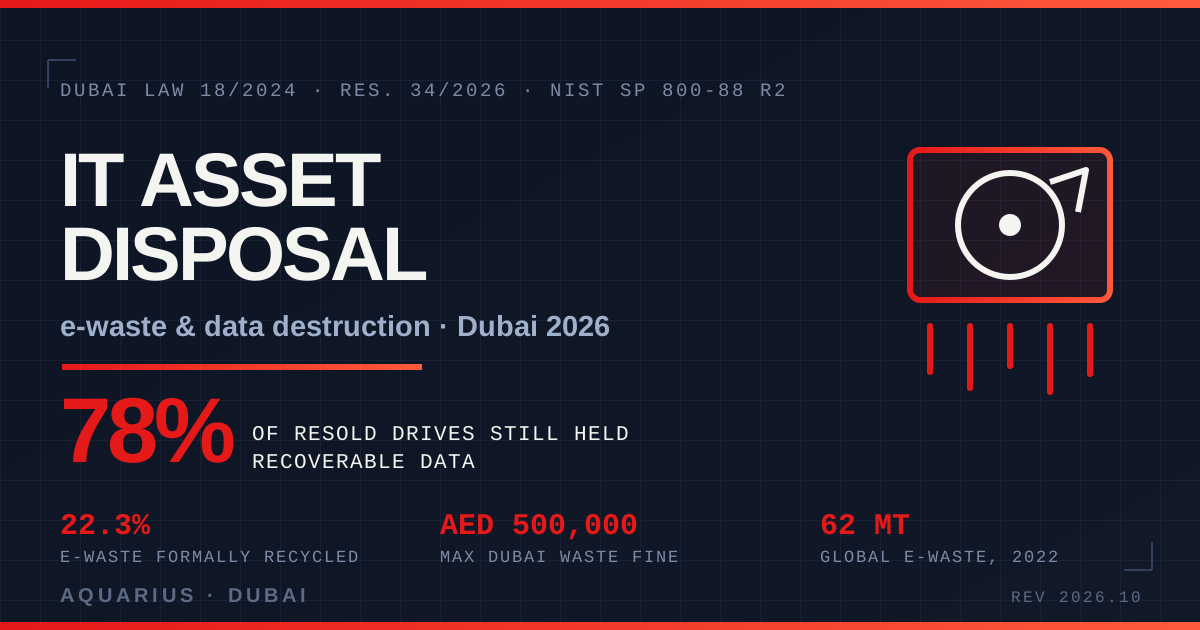
Short answer: in Dubai in 2026, retiring IT hardware is two separate obligations that most companies accidentally merge into one. The waste side is now written down — Law No. (18) of 2024 and its bylaw, Administrative Resolution No. (34) of 2026, require a documented waste register, a licensed carrier and a Municipality-approved destination, with violations reaching AED 500,000. The data side never leaves you: the UAE Extended Producer Responsibility scheme moves the recycling cost onto producers, but nothing in it transfers your liability for the personal data sitting on a retired laptop. The artefact that satisfies both is the same one almost nobody keeps — a per-serial asset record ending in a sanitisation certificate.
The hardware is leaving faster than the records are being made
Start with the scale, because it explains why regulators stopped treating this as housekeeping. The UN-backed Global E-waste Monitor 2024 (UNITAR/ITU) recorded 62 million tonnes of electronic waste generated in 2022 — up 82% on 2010, growing by 2.6 million tonnes a year, and on track for 82 million tonnes by 2030. Only 22.3% of that 2022 mass was documented as properly collected and recycled. The metals inside it were worth USD 91 billion, of which USD 62 billion went unaccounted for. Asian countries produced roughly half the total, about 30 million tonnes.
The UAE sits at the wrong end of the per-capita table and the wrong end of the collection table at once. The same 2024 monitor puts UAE generation at around 12 kg per person per year against a global average near 7.8 kg, while the Regional E-waste Monitor for the Arab States reported a formally documented UAE collection rate of just 0.4%. That is the gap in one line: high-income consumption volumes, almost no paper trail.
Capacity is not the bottleneck. Enviroserve’s plant in Dubai Industrial Park — about AED 120 million invested, Swiss process technology, roughly 39,000 tonnes of electronics a year inside a facility rated at 100,000 tonnes across all its streams — has been running since 2019 and handles everything from handsets to chillers to avionics. The UAE e-waste management market itself is estimated at USD 171.3 million in 2025, reaching USD 240.9 million by 2030 (about 7.1% CAGR). There is somewhere for the hardware to go. What is missing is the record proving yours went there.
What the federal rules already require
Federal Law No. 12 of 2018 on Integrated Waste Management is the spine. Its Article 5 places responsibility — explicitly including the financial cost — on the waste producer and the supplier for products and waste remaining after use. The executive regulations announced in July 2021, with Cabinet Resolution No. 39 of 2021 alongside, already oblige suppliers of electronics and batteries to accept them back from consumers free of charge through collection points at retail outlets. That duty has been live for five years.
Extended Producer Responsibility is the part still being built. MOCCAE announced the national EPR framework in December 2024 and, on 3 July 2025, signed a six-month pilot with Tadweer Group as national Producer Responsibility Organisation, covering Abu Dhabi and Dubai across three streams — packaging, electrical and electronic equipment, and batteries. 26 companies signed the EPR pledge at launch. The pilot was designed to feed national rollout under the UAE Integrated Waste Management Agenda 2023–2026.
Be precise about what is not yet published, because vendors are selling certainty that does not exist. As of late 2026 there is no producer registration portal, no per-unit or per-tonne fee schedule, and no published collection or recovery targets for electrical and electronic equipment. If you import, assemble or brand EEE in the UAE, the sensible position is registration-ready rather than registered: a product catalogue with weights and categories, units placed on the UAE market per period, and return volumes already recorded. When the fee schedule lands, your levy gets calculated from exactly those numbers.
Dubai made the register the product
Law No. (18) of 2024 Regulating Waste Management in the Emirate of Dubai was issued on 4 September 2024, and its implementing bylaw — Administrative Resolution No. (34) of 2026, issued by the Director General of Dubai Municipality on 10 February 2026 — sets out the operational duties. Three things in it matter for IT hardware, which counts as hazardous waste once it contains batteries, screens or circuit boards:
- Article 2(c): keep a register. Hazardous waste producers, and any person with operational control over residential and commercial complexes, hotels and industrial establishments, must maintain records of waste type (hazardous or non-hazardous), daily quantity, the production, segregation, sorting and recycling processes applied, and the approved carrier and disposal site used.
- Article 3: daily removal. Waste must be transported to Municipality-approved disposal sites via licensed carriers or authorised vehicles meeting the Technical Manual standards.
- Articles 4–6: permits. Filed through the Unified Digital Window, valid one year and renewable, with shorter terms available on request; refusals come with written reasons.
Read Article 2(c) as a data schema, not a policy. Type, quantity, process, carrier, destination — per movement, per day. A quarterly PDF from your recycler does not satisfy it, and neither does an email thread. We covered the hauler-side build in our Dubai waste management software guide; this is the generator-side mirror of it, and it is the half most offices skip.
The myth that costs the most: EPR does not move the data liability
Here is where most Dubai businesses get this wrong. EPR shifts who pays for recycling. It does not transfer data destruction responsibility, it does not guarantee that a take-back scheme will accept every category of corporate equipment, and it does not value your retired assets. Your obligation over the personal data on a decommissioned drive ends when that data is genuinely irrecoverable and you can prove it — not when the courier collects the pallet.
Retiring the device does not retire the obligation. The only thing that discharges it is evidence of sanitisation, tied to a serial number.
The evidence that this routinely fails is old but has never been bettered: Blancco and Kroll Ontrack bought 200 used drives from eBay and Craigslist and found 78% still held recoverable residual data — 67% carrying personal files, 11% carrying company data including emails, spreadsheets and customer records. Only 10% had been securely wiped. An earlier study of 122 second-hand devices found residual data on 48% of drives and 35% of mobiles. Sellers in both studies believed they had erased them.
On the UAE legal side, be accurate rather than dramatic. The PDPL — Federal Decree-Law No. 45 of 2021, in force since 2 January 2022 — requires appropriate technical and organisational measures across the data lifecycle, disposal included, and requires processors to delete data at the end of a processing period and be able to show it. But its executive regulations are still unpublished as of late 2026, and no Cabinet decision defining violations and administrative penalties has been issued, so anyone quoting you a fixed PDPL fine for a mishandled laptop is inventing it. Note also that on 14 June 2026 the Cabinet established the Federal Authority for Artificial Intelligence and Data, consolidating the AI Office, the TDRA digital government sector and the Emirates Data Office — the enforcement address is changing. Our PDPL compliance checklist covers the wider obligations.
Two nearer-term pressures bite harder than a hypothetical fine. First, DESC ISR v3, in effect since August 2026, requires Dubai government and semi-government entities — and increasingly their suppliers, as a contract condition — to maintain a living asset register with named owners and custodians, and classification that drives retention and disposal controls. Lose the register, lose the tender. Second, cost of failure: IBM’s Cost of a Data Breach 2026 puts the Middle East average at USD 8 million, about AED 29.4 million, with lost business alone at USD 3.57 million. A pallet of unwiped drives is a cheap way to buy an expensive incident.
Clear, Purge, Destroy: the only three words in the standard
NIST SP 800-88 Revision 2, released in September 2025, is the reference everyone cites and few read. It frames sanitisation as a programme (Section 4.4) built on three methods, chosen by data sensitivity and whether the device will be reused, and it defers to IEEE 2883-2022 for media-specific techniques across HDDs, SSDs, NVMe, flash, optical and tape. The distinction is commercial as well as legal: a reusable laptop that is purged is worth money, and a drilled drive is worth scrap.
| Method | What it defeats | Typical technique by media | Device reusable after? |
|---|---|---|---|
| Clear | Keyboard-level and simple software recovery | Logical overwrite of all addressable locations | Yes — lowest assurance, fine for low-sensitivity reuse |
| Purge | Laboratory recovery attempts | HDD: ATA Secure Erase or overwrite plus verification. SSD/NVMe: Sanitize block erase or cryptographic erase | Yes — the right default for resale and redeployment |
| Destroy | Any recovery, by making the media unusable | Shred, disintegrate, pulverise, incinerate | No — value recovery drops to materials |
Two traps specific to the hardware now reaching end of life in Dubai offices. Multi-pass overwrites designed for magnetic platters are pointless on flash and can miss over-provisioned and remapped blocks entirely — SSDs and NVMe need the drive’s own sanitise or cryptographic-erase command, verified. And self-encrypting drives only make cryptographic erase trustworthy if encryption was actually enabled and the key is confirmed destroyed; an unencrypted SED is just a drive.
What a defensible disposal record actually contains
NIST SP 800-88 Rev. 2 Section 4.6 specifies the fields a certificate of sanitisation should carry, and it is a short list you can build into a form today: asset identifier and media serial number, media type, the sanitisation method used (clear, purge or destroy), the tool and version, the verification result, the operator and the validator, the date, and the standard relied on. Pair it with chain of custody — who collected, which vehicle, which permit, which approved destination — and one record answers Dubai Municipality, your PDPL file and a DESC ISR auditor at the same time.
When you pick a vendor, the certifications are shorthand for which of those claims get independently checked. R2v3 and e-Stewards cover responsible recycling with data security requirements; NAID AAA audits destruction operations; ADISA, approved under UK GDPR, runs a research centre that forensically attempts recovery from sanitised media against NIST 800-88 and IEEE 2883. Ask for the certificate scope, not the logo — and ask whose serial numbers appear on the certificates you receive, because a certificate without your serials on it proves nothing about your drives.
What it costs in Dubai, in AED
The global IT asset disposition market is forecast to grow from about USD 23 billion in 2026 to USD 34.97 billion by 2030 (roughly 11% CAGR), so the tooling market is crowded and the pricing models differ wildly. At FX of AED 3.6725 to the dollar, the realistic 2026 options:
| Option | Listed 2026 price | Approx. AED | Best fit |
|---|---|---|---|
| Snipe-IT, self-hosted | Free, open source | Hosting only | Asset register under ~300 devices; no disposal workflow |
| Snipe-IT hosted, small business | USD 99.99/mo or USD 999.99/yr | About AED 367/mo or AED 3,673/yr | Same, without running the server |
| Freshservice Starter / Growth / Pro | USD 19 / 49 / 99 per agent/mo, billed annually | About AED 70 / 180 / 364 per agent/mo | ITAM is a separate SKU metered in Asset Units; 100 bundled from Growth upward |
| ServiceNow HAM/SAM | Quote only, priced on assets under management | Enterprise-tier | Large estates already on ServiceNow |
| BitRaser erasure | From USD 99 perpetual; around USD 20 per drive at volume | About AED 364; about AED 73 per drive | In-house wiping with auditable certificates |
| Blancco Drive Eraser | Quote only; typically 3–5x BitRaser per drive | Quote-dependent | Regulated estates needing the most recognised certificate |
Buying a licence is not the same as being compliant, which is where a build comes in. Our 2026 bands for custom work: AED 45,000–75,000 for a serialised asset register with lifecycle states, owners and custodians; AED 35,000–60,000 for the disposal workflow — chain of custody, carrier and permit capture, certificate generation against the Section 4.6 fields; AED 30,000–55,000 for the Resolution 34/2026 register and daily-movement reporting; and AED 25,000–45,000 for EPR readiness reporting on units placed on the UAE market. All four together lands at AED 135,000–235,000, with 15–20% a year for maintenance. Against an average Middle East breach of AED 29.4 million, the register is the cheapest line in the risk column.
Risk reversal, plainly: we scope in a fixed-price discovery sprint so that range becomes a number before you commit, you own the code and the data outright, and the database sits in a UAE region. See our pricing for how the phases break down, or the device-side companion to this work in our Dubai BYOD and device management guide — same asset identity, earlier in its life.
FAQ
Does a Dubai office need a permit to dispose of old computers?
You need to use a licensed carrier and a Dubai Municipality-approved destination, and the carrier and site hold the permits — filed through the Unified Digital Window, valid one year and renewable under Articles 4 to 6 of Administrative Resolution No. (34) of 2026. As a hazardous waste producer you carry the Article 2(c) register duty yourself: type, daily quantity, processes applied, carrier and disposal site, per movement.
Is UAE EPR for electronics mandatory in 2026?
Not yet as a registration-and-fee regime. MOCCAE announced the framework in December 2024 and ran a six-month pilot from 3 July 2025 with Tadweer Group as national Producer Responsibility Organisation across Abu Dhabi and Dubai, covering packaging, EEE and batteries, with 26 companies signed up. No producer portal, fee schedule or recovery targets have been published. Separately, the duty on suppliers to take back electronics and batteries from consumers free of charge has been in force since the 2021 executive regulations.
Does deleting files or formatting a drive satisfy UAE data protection rules?
No. Formatting is not sanitisation. NIST SP 800-88 Rev. 2 recognises only Clear, Purge and Destroy, and for SSDs and NVMe that means the drive’s own sanitise or cryptographic-erase command with verification, not an overwrite pass. The PDPL expects appropriate technical measures through disposal and expects you to be able to demonstrate them — which in practice means a certificate carrying the media serial number.
What should a certificate of data destruction include?
Per Section 4.6 of NIST SP 800-88 Rev. 2: asset identifier and media serial number, media type, method used, tool and version, verification result, operator and validator identities, date, and the standard applied. If your provider’s certificate lists a pallet count instead of your serial numbers, it will not survive an audit.
Can we resell retired laptops in the UAE instead of recycling them?
Yes, and purge-level sanitisation is specifically designed to keep a device reusable, which is where the residual value sits — destroy-level treatment drops it to materials value. The condition is that sanitisation is verified and certificated per serial before the asset leaves your control. The Blancco and Kroll Ontrack study of 200 resold drives, where 78% still held recoverable data and only 10% had been securely wiped, is what happens when that step is assumed rather than evidenced.
The short version
Dubai turned IT disposal into a records problem in February 2026, and the records it wants look almost exactly like the records your data obligations want. One serialised asset register, one chain of custody per movement, one sanitisation certificate per drive naming the method and the verification — and Resolution 34/2026, the PDPL file, the DESC ISR audit and your future EPR return all get answered from the same table. Skip it and you are relying on a recycler’s PDF to prove something about drives it never listed.
If you are a Dubai business with a hardware refresh coming and no defensible disposal trail behind the last one, tell us how many assets you hold and we will map your register against Article 2(c) and Section 4.6 in a week.