
Live Shopping in Dubai (2026): Real AED Streaming Costs and Why No Platform Takes Your Payment
UAE live commerce hits USD 2.7bn in 2026, but no GCC market has TikTok Shop and Meta killed live checkout in 2023. Real AED streaming and build costs for Dubai.
- PUBLISHED
- 26 OCT 2026
- READ TIME
- 13 MIN
- AUTHOR
- AQUARIUS · DUBAI
- UNIT
- REV 2026.09
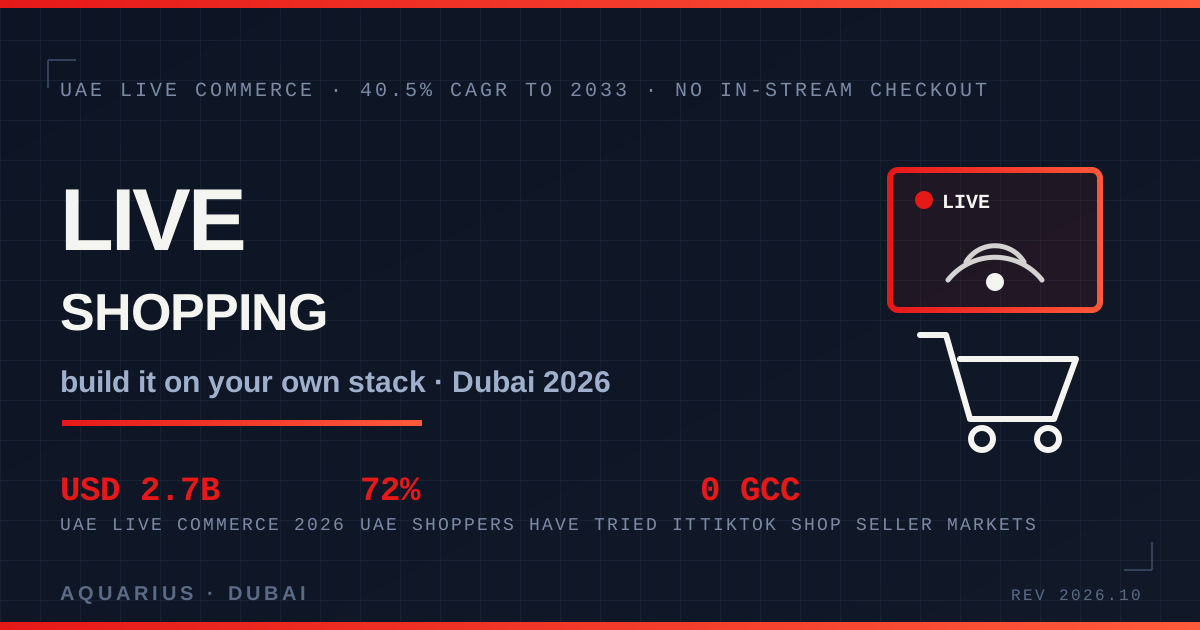
Short answer: Live shopping works in the UAE, but no major platform will take the money for you. The UAE live commerce market is estimated at USD 2.7 billion in 2026 and forecast to compound at 40.5% a year to roughly USD 29 billion by 2033, yet Meta switched off live checkout in 2023 and TikTok Shop still has no Seller Center in any GCC market. In Dubai the broadcast runs on a platform you do not own and the transaction runs on a stack you do. Budget for both.
That split is the whole story, and it is the part most Dubai brands discover three weeks before their first show. They book the creator, build the set, run the lights, and then realise the viewer has to leave the stream, open a browser, find the product and pay on a site that was never built to absorb 800 people in ninety seconds. The money leaks in the handoff.
Aquarius is an AI-native web and app development studio in Dubai. We build the half of live shopping nobody films: the stream infrastructure, the real-time catalogue, and the checkout that survives the spike. Here are the 2026 numbers.
Key Takeaways
- The market is real. UAE live commerce was USD 2.0 billion in 2025 and is estimated at USD 2.7 billion in 2026, growing 40.5% annually through 2033.
- The checkout is not. Instagram retired live shopping on 16 March 2023, Facebook Live Shopping closed in October 2022, and TikTok Shop supports local sellers in 24 markets as of August 2026 — none in the GCC.
- Bandwidth is cheap. A 90-minute show with 800 concurrent viewers costs roughly AED 265 to 650 in streaming delivery. The build, not the stream, is the budget line.
- Conversion is the reason to bother. McKinsey puts live commerce conversion up to ten times standard e-commerce, with return rates 40 to 50 percent lower.
- Compliance is non-optional since 1 February 2026. The UAE Media Council Advertiser Permit is mandatory for promotional content, with fines reported up to AED 1 million.
How big is live shopping in the UAE, really?
Big enough that the growth rate is the headline. Grand View Research puts UAE live commerce revenue at USD 2.0 billion in 2025, an estimated USD 2.7 billion in 2026, and roughly USD 29.0 billion by 2033 on a 40.5% CAGR from 2026. For scale, that is still only about 1.2% of the global live commerce market in 2025 — this is an early market in a country that adopts early.
Adoption backs that up. A Wunderman Thompson study found 72% of UAE shoppers had already used livestream shopping — a figure from 2023, so treat it as a measure of familiarity rather than current frequency, but it tells you the format needs no explaining to a Dubai audience. Fashion and apparel took the largest slice at 45.0% of UAE live commerce revenue in 2025, with health and wellness the fastest-growing category.
Set that against the wider picture: UAE e-commerce sits around USD 12.3 billion in 2026, heading toward roughly USD 21 billion by 2031. Live commerce at USD 2.7 billion is therefore already a meaningful fraction of online retail here, not a novelty channel. The question is not whether Dubai shoppers buy from a livestream. It is where they are standing when they pay.
Why no platform will take the payment for you
This is the part that breaks plans. Two things happened, and neither was reversed.
First, Meta retreated. Facebook Live Shopping closed in October 2022 and Instagram stopped letting creators tag products in live broadcasts on 16 March 2023. You can still go live on Instagram in Dubai and you can still sell — through comment-to-DM, a link in bio, a story swipe — but the purchase happens off-platform, on your site.
Second, TikTok never arrived. TikTok Shop supports local seller access in 24 markets as of August 2026 — three in the Americas, seven in Asia, fourteen in Europe — and the Gulf is not among them. There is a steady drip of “coming soon” posts, but as of this writing there is no native Seller Center for UAE merchants, and Fulfilled by TikTok, the logistics arm behind TikTok Shop in the US and UK, does not operate in the UAE. TikTok Live is available to UAE creators; TikTok Shop checkout is not.
So the UAE operating model is fixed: the platform owns discovery, you own the transaction. That is the same structural truth we covered in our guide to social commerce in Dubai and why you still cannot take payment inside Instagram, and live shopping makes it sharper, because a live audience is a time-boxed audience. A checkout that is merely adequate on a Tuesday afternoon will fail at minute 14 of a show.
The three ways to run live shopping in Dubai
There are only three honest architectures, and the right one depends on whether you need the audience or the control.
| Model | How it works | Best for | Main weakness |
|---|---|---|---|
| Platform-led (Instagram / TikTok Live) | Broadcast on social, drive to your site for checkout | Reach and cold-audience discovery | You lose the viewer at the handoff; no in-stream cart |
| Embedded on-site player | Live video player on your own product or landing page, cart in the same tab | Conversion, repeat buyers, owned data | You must bring the audience yourself |
| Simulcast (both) | Social for reach, on-site player as the destination, one catalogue behind both | Serious programmes running monthly shows | Highest build cost and operational load |
Nearly every Dubai brand that sticks with live shopping ends at simulcast, but almost none should start there. Start with the embedded on-site player, because that is the asset you keep, and because it is the only one of the three where the add-to-cart happens without a context switch. The reason that matters is the conversion gap: McKinsey research puts live commerce conversion at up to ten times standard e-commerce, with return rates 40 to 50 percent lower than standard online purchases. Those gains come from the demonstration and the live Q&A. Every tab switch between the demo and the payment gives one of them back.
What the streaming actually costs in AED
Here is where the budget surprises people in the good direction. Live video delivery is a commodity in 2026, and Dubai shows are not Super Bowls. The table below uses October 2026 list rates, converted at AED 3.6725 to the US dollar, normalised to 1,000 viewer-hours — which is 1,000 people watching for one hour, or about 670 people watching a 90-minute show.
| Service | Mode | Rate (USD) | Per 1,000 viewer-hours (AED) |
|---|---|---|---|
| Mux | Managed HLS delivery | ~$0.060 / viewer-hour | ~AED 220 |
| Agora | HD interactive | $0.99–$3.99 / 1,000 min | ~AED 218–879 |
| Amazon IVS Real-Time (Middle East & Africa) | Sub-second, interactive | $0.0920 / participant-hour, first 10,000 | ~AED 338 |
| Amazon IVS Low-Latency | Full HD output | ~$0.144 / viewer-hour | ~AED 529 |
Add the channel input charge on top for Amazon IVS: USD 0.20 per channel-hour on Basic, 0.50 on Advanced SD, 0.85 on Advanced HD and 2.00 on Standard, dropping to 0.50 with Multitrack Video. At Advanced HD that is about AED 3.12 for every hour you are live, regardless of audience size.
Run the realistic case. A 90-minute Dubai show holding 800 concurrent viewers is 1,200 viewer-hours. On Mux that is roughly AED 265. On Amazon IVS Low-Latency at Full HD it is roughly AED 636 plus about AED 5 of channel input. Even a breakout show that triples your audience lands under AED 2,000 in bandwidth. The stream is never the expensive part. Anyone quoting you a five-figure monthly “streaming fee” is selling you a platform licence, not bandwidth.
The one technical choice that does cost real money is latency. If your show is a presenter talking over a product, HLS at 5 to 15 seconds of delay is fine and cheap. If you want live Q&A, call-ins, or a visible countdown tied to stock, you need sub-second WebRTC — Amazon IVS Real-Time or Agora — and you pay per participant rather than per viewer, which changes the maths at scale. Decide this before you design the show, not after. We cover the same latency-versus-cost trade-off for on-demand platforms in our Dubai OTT and video streaming app build guide.
What a Dubai live shopping build costs
Streaming is cheap; the commerce layer around it is the project. These are the fixed-scope AED ranges we quote in Dubai in 2026, and they assume real catalogue integration rather than a video embed.
| Scope | What you get | Fixed AED range | Typical timeline |
|---|---|---|---|
| Live module on an existing store | Embedded player, live product pinning, cart sync, spike-tested checkout | AED 28,000–65,000 | 3–5 weeks |
| Live-first storefront | New store built around scheduled shows, replay library, notifications, analytics | AED 45,000–120,000 | 6–10 weeks |
| Native app with live SDK | iOS and Android, sub-second interactive, push, in-app checkout | AED 90,000–180,000 | 10–16 weeks |
Three cost drivers move you inside those bands. Latency mode is the first — sub-second interactive roughly doubles the client-side work versus an HLS player. Catalogue truth is the second: pinning a product live is trivial, but keeping stock accurate while 800 people hit one SKU in forty seconds is not, and that reservation logic is where the engineering hours go. Spike capacity is the third. A show compresses a week of traffic into ninety minutes, so the checkout has to be load-tested at ten times normal peak, not one-and-a-half times. We test to that before launch, because the alternative is a sold-out moment that returns a 502.
For context on the commerce base underneath all of this, our Dubai e-commerce build and payment gateway guide covers gateway approval, processing fees around 2.5% to 3% plus roughly AED 1 per transaction, and the VAT invoicing your checkout has to emit.
The compliance layer you cannot skip
Live shopping in the UAE is promotional media, and promotional media is regulated. Three things apply.
- Advertiser Permit. Mandatory since 1 February 2026 for paid and unpaid promotion, including gifted products and barter deals. Reported at around AED 370 per licence cycle, free for the first three years for UAE citizens and residents, with penalties reported up to AED 1 million for promoting without one. If a creator hosts your show, confirm their permit in writing before the booking, not after.
- Trade licence. Selling online from the UAE needs one regardless of channel — a Dubai e-trader permit from about AED 1,070 per year for nationals, a free-zone e-commerce licence from about AED 5,525, or a mainland licence from about AED 12,500.
- VAT. Registration is mandatory at AED 375,000 of taxable turnover in a rolling twelve months, and voluntary from AED 187,500. A live show that works will move you across that line faster than you planned, so build compliant tax invoicing into the checkout now rather than retrofitting it mid-quarter.
Creator economics sit alongside this — rates, usage rights and exclusivity are their own budget line, and we break the current Dubai numbers down in our influencer marketing cost guide for Dubai.
The mistake most Dubai brands make
They treat live shopping as a content project with a commerce afterthought. The show gets a producer, a set, a creator fee and a rehearsal; the checkout gets whatever the store already had. Then the stream peaks, the product page times out, and the brand concludes live shopping “does not work here”.
It works here. The format converts because a live demonstration removes the two things that kill online carts — uncertainty about the product, and the delay before an answer — which is exactly why returns run 40 to 50 percent below standard online purchases. In a category like fashion, where UAE return rates routinely reach 45%, halving returns is worth more than the incremental sales. But the format only pays if the last three taps happen on infrastructure you tested.
How Aquarius builds it
We scope live shopping as an engineering problem with a broadcast date. Fixed AED price agreed in writing, no round-number guesswork: a latency mode chosen against your show format rather than a vendor's marketing page, catalogue and stock sync that holds under a 40-second rush on one SKU, a checkout load-tested to ten times your current peak, BNPL and Apple Pay live before the first show, server-side events so attribution survives Safari, replay pages that keep earning long after the stream ends, and VAT invoicing an auditor will accept. Custom builds start at a fixed AED 10,000, and the code and the catalogue are yours to keep. See /pricing or the full services list.
Planning your first live show? Tell us your product, your expected audience and your show length, and we will map the latency mode, the stack and a fixed AED quote for the build. See pricing, browse our services, or contact us on WhatsApp at +971 56 351 3436 or hello@aquarius-advt.me. Aquarius is an AI-native web and app development studio in Dubai.
FAQ
Is TikTok Shop available in the UAE in 2026?
Not for local sellers. TikTok Shop supports local seller access in 24 markets as of August 2026 — three in the Americas, seven in Asia and fourteen in Europe — and no GCC market is among them. Fulfilled by TikTok, the platform's logistics service, also does not operate in the UAE. UAE creators can use TikTok Live to broadcast, but the purchase has to complete on your own website.
Can I sell directly inside an Instagram Live in Dubai?
No. Instagram stopped allowing product tagging in live broadcasts on 16 March 2023, and Facebook Live Shopping closed in October 2022. You can still broadcast and still sell, but through link-outs, comment-to-DM and your bio link, with the transaction completing on your own store. That makes your checkout, not the platform, the conversion bottleneck.
How much does live streaming bandwidth cost for a Dubai show?
Less than most people expect. At October 2026 list rates, a 90-minute show with 800 concurrent viewers is 1,200 viewer-hours, costing roughly AED 265 on Mux or about AED 636 on Amazon IVS Low-Latency at Full HD, plus a few dirhams of channel input. Sub-second interactive streaming on Amazon IVS Real-Time runs USD 0.0920 per participant-hour in the Middle East and Africa region for the first 10,000 hours each month.
How much does a live shopping build cost in Dubai?
Adding a live module to an existing store typically lands at AED 28,000 to 65,000. A live-first storefront built around scheduled shows runs AED 45,000 to 120,000, and a native iOS and Android app with an interactive live SDK runs AED 90,000 to 180,000. The variables are latency mode, catalogue and stock-reservation complexity, and how far above normal peak the checkout must be load-tested.
Do I need a licence to run a live shopping stream in the UAE?
Yes, two of them. Selling online needs a valid trade licence — a Dubai e-trader permit from about AED 1,070 per year for nationals, a free-zone e-commerce licence from about AED 5,525, or a mainland licence from about AED 12,500. Separately, the UAE Media Council Advertiser Permit has been mandatory since 1 February 2026 for promotional content, reported at around AED 370 per cycle and free for the first three years for citizens and residents, with penalties reported up to AED 1 million.
Does live shopping actually convert better than a normal product page?
Substantially, according to McKinsey research, which puts live commerce conversion at up to ten times standard e-commerce rates with return rates 40 to 50 percent lower. The caveat is that those figures come from mature live-commerce markets with in-stream checkout. In the UAE, where the viewer must move to your site to pay, you only capture the gain if the handoff is fast and the checkout holds under the spike.