
LLM Observability, Evals and Token-Cost Control: The 2026 Dubai Playbook
Enterprises spent 4.7x their AI budget against a plan of 1.9x. Traces, evals, prompt caching and me-central-1 Bedrock rates in AED: how Dubai teams learn what each AI request really costs.
- PUBLISHED
- 19 NOV 2026
- READ TIME
- 13 MIN
- AUTHOR
- AQUARIUS · DUBAI
- UNIT
- REV 2026.09
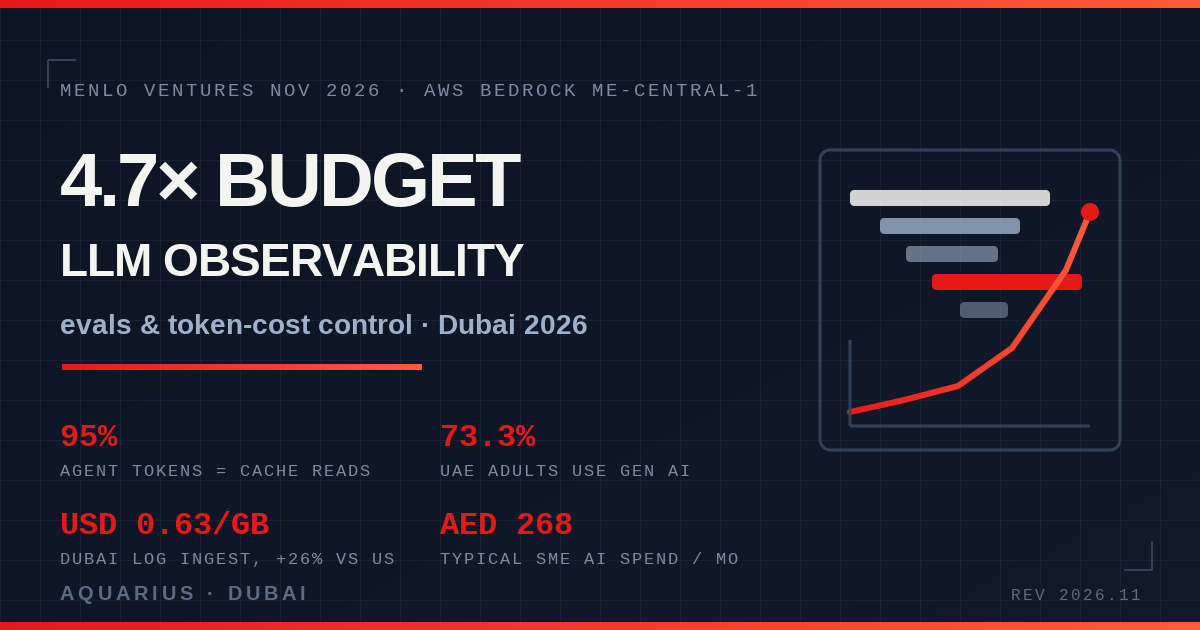
LLM observability is the practice of recording every prompt, response, token count and latency figure your AI feature produces, scoring those traces against a fixed test set, and attributing cost per request — and in 2026 it is the single highest-leverage engineering spend a Dubai product team can make. Enterprises worldwide spent 4.7× their 2025 AI budgets against a plan of 1.9× — roughly 2.5 times what they budgeted, according to Menlo Ventures' 2026: The State of Enterprise AI (3 November 2026). You do not fix that with a cheaper model. You fix it by measuring where the tokens go.
The stakes: UAE AI usage is far ahead of UAE AI discipline
Three numbers set the scene, and they do not point in the same direction.
- 73.3% of UAE residents aged 15–64 used generative AI in Q2 2026, per Microsoft's AI Diffusion research — against a global average of 17.8% and 64.3% in Singapore. UAE adoption climbed 59.4% → 64.0% → 70.1% → 73.3% across four consecutive half-year and quarterly readings.
- Only 29% of UAE businesses actually paid for AI tools in Q3 2026 (up from 12% in early 2026), and the typical SME spends just AED 268 per month, according to Pemo's spend data. Technology firms spend the most at around AED 880/month; construction sits at 17% adoption and hospitality 16%.
- About 95% of enterprise generative-AI pilots delivered no measurable P&L impact, MIT's Project NANDA found — with purchased solutions succeeding roughly twice as often as internal builds.
Read those together and the Dubai pattern is obvious. Usage is near-universal, paid deployment is rare, spend per company is tiny — and when companies do commit real budget, it blows past plan and still fails to show up in the accounts. The missing layer is not a better model. It is instrumentation: traces, evals and cost attribution. Most Dubai teams ship an AI feature with no idea what a single request costs or whether last Thursday's prompt edit made the output worse.
Why the bill explodes: three line items nobody models
1. Context bloat and cache misses
Menlo's 2026 data contains the most important operational fact in agentic AI: cache reads can make up 95% or more of an agent's tokens. On a frontier model like Opus 5.5 those reads cost $0.20 per million, against $4 for fresh input and $20 for output — so at a realistic mix of 3% fresh input and 2% output, an agent session lands around $0.70 per million tokens. Get the cache wrong and the same workload bills at fresh-input rates: a 10× to 20× swing on identical functionality.
Caching is not automatic. It depends on a stable prefix — system prompt, tool definitions, retrieved documents in a fixed order. Inject a timestamp or a shuffled retrieval set at the top of your prompt and every request is a cache miss. Nobody notices, because the feature still works. It just costs an order of magnitude more.
2. Retries, loops and agent fan-out
Agent traffic is growing far faster than human traffic — OpenRouter's agent volume rose 37× in the months after it overtook human traffic in February 2026. Agents call tools, re-read context and retry on malformed output. One user action can become fifteen model calls. Without a trace tree you will see a bigger invoice and have no idea which step multiplied.
3. Logging your prompts (the line item specific to Dubai)
Here is where most Dubai builds get caught, and it is a regional cost, not a global one. CloudWatch Logs ingestion in me-central-1 (UAE) costs $0.63 per GB against $0.50 in us-east-1 — a 26% premium. Infrequent Access class is $0.315/GB versus $0.25. Storage is $0.033/GB-month versus $0.030. Logs Insights queries add $0.0063 per GB scanned.
Full prompt-and-response logging is verbose — a chatty RAG feature can emit several kilobytes per request. At 2 million requests a month and 3 KB per trace, that is roughly 6 GB, or AED 14 per month in raw ingest. Trivial. But the same instinct applied to an agent with fifteen spans per action and 40 KB of context per span puts you near 1.2 TB, which is about AED 2,800 per month in log ingest alone — frequently more than the inference it is describing. That is the myth-bust: for instrumented agents in the UAE, observability often costs more than the model.
What LLM observability actually means (and what it is not)
Classic APM tells you a request took 4.2 seconds and returned HTTP 200. For an AI feature that is almost useless, because the failure mode is a 200 response containing a confidently wrong answer. You need three distinct capabilities.
Traces and spans
One user action produces one trace. Inside it, a span per step: retrieval, prompt construction, each model call, each tool invocation, each retry. Every span carries input tokens, output tokens, cached tokens, latency, model ID and cost. OpenTelemetry's GenAI semantic conventions now cover this, so you can emit spans once and route them anywhere — the same vendor-neutral argument we make in our guide to OpenTelemetry instrumentation for Dubai teams.
Evals: golden datasets and LLM-as-a-judge
An eval is a fixed set of inputs with known-good outputs — a golden dataset — replayed on every prompt or model change. Fifty to two hundred real examples from your own traffic beats any public benchmark. Score each output: deterministic checks where you can (did it return valid JSON, did it cite a real document, is the AED figure correct), and LLM-as-a-judge where you cannot, where a second model grades tone, completeness or faithfulness against a written rubric.
This is the step that separates the 5% of AI projects that show P&L impact from the 95% that do not. Without evals, a prompt change is a vibe. With them, it is a measurement with a number attached, and you can refuse a change that drops accuracy two points to save a dirham.
Cost attribution per request, feature and customer
Token prices are collapsing — the blended closed-model token fell 24% to about $0.70 per million in 2026, while average open-source tokens run around $0.13 per million. Yet total spend rose to $177 billion by September 2026 from $33 billion. Unit prices down, volume up far more. The only defence is knowing cost per request and per customer, so you can price your product above it.
Tracing platforms compared: what a Dubai team should pay
You have three realistic options: a managed trace platform, self-hosted open source, or raw CloudWatch. Published rates as of November 2026 (AED at 3.6725):
| Option | Monthly | AED/month | Included volume | Retention | Overage |
|---|---|---|---|---|---|
| Langfuse Hobby | $0 | AED 0 | 50,000 units | 30 days | — |
| Langfuse Core | $29 | AED 107 | 100,000 units | 90 days | $8 / 100k (AED 29) |
| Langfuse Pro | $199 | AED 731 | 100,000 units | 3 years | $8 / 100k, graduated to $6 |
| Langfuse Enterprise | $2,499 | AED 9,177 | 100,000 units | 3 years | graduated |
| LangSmith Developer | $0 / seat | AED 0 | 5,000 base traces | 14 days | ~$2.50 / 1k (reported) |
| LangSmith Plus | $39 / seat | AED 143 / seat | 10,000 base traces | 14 days base | ~$5 / 1k for 400-day traces |
| Self-hosted Langfuse | infra only | ~AED 350–900 | unlimited | your call | — |
| CloudWatch + X-Ray (me-central-1) | usage | AED 2.31 / GB ingest | per GB | configurable | $0.0063 / GB scanned |
Langfuse's graduated overage drops to $7.00 per 100k units between 1M and 10M, $6.50 to 50M, and $6.00 above that. Self-hosting Langfuse is free under its open-source licence and runs fine on a single Dubai VPS with Postgres and ClickHouse — which also keeps every prompt inside the UAE, a point we return to below.
The practical Dubai answer: start on a free tier, move to self-hosted the moment trace volume makes managed overage exceed roughly AED 400 per month, and use CloudWatch only for infrastructure logs — not as a trace store, because at $0.63/GB in Dubai it is the most expensive place to keep verbose prompt data.
The token-cost levers that actually move the bill
Once you can see cost per span, the levers become obvious. These are current Amazon Bedrock rates in me-central-1 (UAE), per million tokens:
| Model | Input | AED in | Output | Cache read | Batch / Flex | Priority |
|---|---|---|---|---|---|---|
| Nova Micro | $0.035 | AED 0.13 | $0.14 | $0.00875 (−75%) | −50% | — |
| Nova Lite | $0.06 | AED 0.22 | $0.24 | $0.015 (−75%) | −50% | — |
| Nova Pro | $0.80 | AED 2.94 | $3.20 | $0.20 (−75%) | $0.40 / $1.60 | $1.40 / $5.60 |
| Grok 4.7 (in-region) | $2.20 | AED 8.08 | $6.60 | $0.55 (−75%) | $1.10 / $3.30 | $3.85 / $11.55 |
| Kimi K3 | $3.30 | AED 12.12 | $16.50 | $0.33 (−90%) | −50% | — |
Four things worth knowing before you refactor anything:
- Cache writes are free on the Nova family. There is no reason not to cache a stable system prompt. Kimi K3 is the opposite: its 30-minute cache write costs $4.125 per million, a 25% premium over fresh input — but its cache read is 90% off, the steepest discount on the menu. Cache economics differ per model, so model choice and caching strategy are one decision, not two.
- Batch and flex are both 50% off. Anything not user-facing — nightly summarisation, enrichment, eval runs, re-indexing — belongs on batch or the flex service tier. Teams routinely pay priority-tier rates (up to +75%) for work no human is waiting on.
- Global routing is cheaper but moves your data. Grok 4.7 costs about 9% less on cross-region global inference ($2.00/$6.00) than in-region, and the newest Nova 2.0 models are global-only. If your PDPL posture requires UAE residency, that discount and those models are off the table — a trade-off we cover in detail in our comparison of self-hosted LLMs versus Bedrock for Dubai workloads.
- Smaller models carry the boring work. Nova Lite input is AED 0.22 per million against Kimi K3 at AED 12.12 — a 55× gap. Classification, routing, extraction and tool-argument formatting rarely need a frontier model. Your evals tell you whether the swap holds; without them, you are guessing.
One structural note: open-source models now carry 19% of token usage but only 4% of spend, driven by a 3.3× collapse in average token prices. Open-source volume grew 22.5× to roughly 2.9 quadrillion tokens per month. Cheap tokens are abundant. Knowing which of your calls can use them is the scarce part.
PDPL: your trace store is now a personal-data store
The moment you log full prompts, you are storing whatever your users typed — names, Emirates ID numbers, trade licence details, medical complaints, salary figures. Under Federal Decree-Law No. 45 of 2021 that is personal data, and a trace database is a processing activity like any other: it needs a lawful basis, a retention limit, access control and a deletion path.
Three rules we apply on every build. Redact before you ship the span, not after — mask Emirates ID, IBAN, phone and email patterns in the SDK layer so raw identifiers never leave the application. Keep the trace store in the UAE if the prompts touch regulated data, which is a strong argument for self-hosted Langfuse over a US-hosted managed plan. Set retention deliberately — Langfuse Pro's three-year window is a compliance liability for prompt data, not a feature; 30 to 90 days is usually right, with aggregates kept longer. Our UAE PDPL compliance checklist for websites and apps covers the data-subject-request mechanics.
This matters more every quarter. The UAE federal government has committed to delivering 50% of government services through AI agents within two years, with 80,000 federal employees trained and Copilot rolled out to 35,000 public-sector staff across 27 entities. Abu Dhabi's Digital Strategy 2025–2027 commits AED 13 billion to 100% sovereign cloud and 200+ AI solutions, targeting AED 24 billion in GDP contribution by 2027. If you sell into that market, residency and auditability are procurement questions, not engineering preferences.
What this costs in Dubai, and how Aquarius does it
Instrumenting an existing AI feature is a small, bounded project. Typical ranges for Dubai engagements:
| Scope | AED | Timeline | What you get |
|---|---|---|---|
| Trace retrofit, one feature | 9,500–16,000 | 1–2 weeks | OTel GenAI spans, token & cost per request, dashboard, alerting |
| Eval harness + golden dataset | 14,000–26,000 | 2–3 weeks | 100–200 curated cases, deterministic + judge scoring, CI gate on regressions |
| Full observability & cost programme | 32,000–60,000 | 4–6 weeks | Self-hosted Langfuse in UAE, PDPL redaction layer, caching refactor, tier routing, per-customer cost attribution |
| Monthly operations retainer | 4,500–11,000 | ongoing | Eval runs on every release, cost review, model-swap testing, drift reports |
How we work: traces first, because you cannot improve what you cannot see; then a golden dataset built from your real traffic, not synthetic examples; then the caching and tier changes, with evals proving quality held; then cost attribution wired into whatever you bill. Fixed scope, fixed price, and if the first two weeks of trace data do not identify savings worth more than the retrofit fee, we say so and stop — we would rather lose a phase than bill for a programme that cannot pay for itself.
The conversion maths is uncomfortable but simple. Companies spent 2.5× their AI budget in 2026 while 95% of pilots showed no P&L impact, and in the UAE the median SME commits only AED 268 a month — which means the differentiator is not budget, it is discipline. A team that knows its cost per request and its eval score ships confidently on AED 268. A team that does not will spend AED 26,800 and still not know whether the feature works.
FAQ
How much does LLM observability cost a small Dubai product team?
Under AED 150 per month in tooling for most early-stage features. Langfuse Hobby covers 50,000 units free; Core is AED 107 per month for 100,000 units with 90-day retention. The real cost is the engineering week to emit good spans, which is where our AED 9,500–16,000 trace retrofit sits. Self-hosting removes the licence cost entirely and runs for roughly AED 350–900 per month in VPS and database infrastructure.
Should I use a managed platform or self-host?
Start managed on a free tier to prove the workflow. Switch to self-hosted Langfuse when either trace volume pushes managed overage past about AED 400 per month, or your prompts contain regulated personal data that should stay in the UAE. Langfuse self-hosting is free and deploys via Docker Compose or Kubernetes, so the migration is a configuration change rather than a rebuild.
Does logging prompts breach UAE PDPL?
Not inherently — but an unredacted, indefinitely retained prompt log almost certainly does. Treat the trace store as a processing activity under Federal Decree-Law No. 45 of 2021: redact identifiers in the SDK before the span leaves your app, set a 30–90 day retention window, restrict access, and make sure a deletion request can actually reach it.
What is the single fastest way to cut our token bill?
Verify your prompt cache is actually hitting. Cache reads can be 95% or more of an agent's tokens and cost 75–90% less than fresh input, so one unstable prefix — a timestamp, a reordered retrieval set, a per-user greeting at the top of the system prompt — can multiply your bill by ten while the feature looks fine. Check cached-token counts per span before you touch anything else.
Can I just use CloudWatch and X-Ray?
For infrastructure, yes. As a trace store for prompts, it is the wrong tool at the wrong price in Dubai: $0.63 per GB ingested in me-central-1 (26% above us-east-1) plus $0.0063 per GB scanned by Logs Insights, and no eval runner, dataset management or prompt-diff view. X-Ray indexed spans are cheap at $0.00000075 each, so a sensible split is CloudWatch and X-Ray for system telemetry, a purpose-built LLM platform for prompt-level traces and evals.
Instrument it before you optimise it
Every expensive AI mistake we have been called in to fix in Dubai this year came from the same root cause: the team changed the prompt, the model or the retrieval step with no trace data and no eval score, then argued about whether it got better. Observability ends that argument in an afternoon.
If you are running an AI feature in production and cannot state its cost per request and its eval score today, that is the gap. We can close it in two weeks — see what we build, review our pricing, or just send us your current setup and we will tell you where the tokens are going.