
Dubai Metro, Bus and Taxi Advertising Cost in 2026: Real AED Rates and the Tracking Gap
Dubai transit carried 802 million riders in 2025. Real 2026 AED rates for metro station branding, train wraps, bus wraps and taxi tops, the RTA permit fee, and the tracking gap that wastes the spend.
- PUBLISHED
- 07 OCT 2026
- READ TIME
- 11 MIN
- AUTHOR
- AQUARIUS · DUBAI
- UNIT
- REV 2026.09
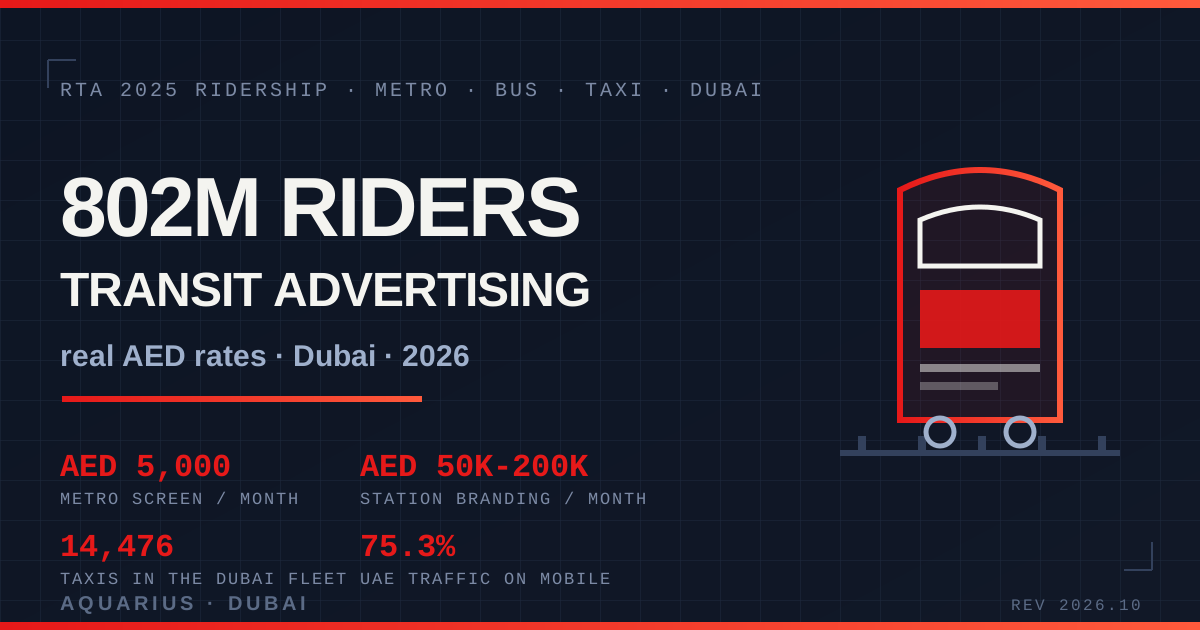
Short answer: transit advertising in Dubai in 2026 runs from AED 5,000 a month for a single Dubai Metro digital screen to AED 250,000 to 800,000 for a full train wrap. Platform media sits at AED 10,000 to 100,000 a month, full station branding at AED 50,000 to 200,000 a month, a full bus wrap at AED 15,000 to 25,000 per bus per month, and taxi media at roughly AED 800 to 1,500 per rooftop unit and AED 2,500 to 5,000 per full wrap, per taxi, per month. RTA permit fees add AED 1,000 to 2,500. The part almost nobody budgets is the landing page and tracking that turn those impressions into a measurable number.
The audience behind those rates is not an estimate. Dubai’s RTA recorded 802.1 million riders across public transport, shared mobility and taxis in 2025, up from 747.1 million in 2024 — 7.4% growth and an average of 2.2 million riders a day. Dubai Metro alone carried 294.7 million riders on the Red and Green lines, a 7% rise, making it the single largest share of city mobility at 37%. Taxis took 26% and public buses 25%. Station-level numbers matter when you are buying a specific site: BurJuman handled 17.8 million riders in 2025 and Al Rigga 13.8 million, the two busiest in the network.
Key takeaways
- Entry is cheaper than people assume. A metro digital screen from AED 5,000 a month is inside an SME budget; a train wrap at AED 250,000 to 800,000 is not.
- Taxi is the only format you can buy by the unit. Dubai’s registered taxi fleet is 14,476 vehicles serving 209 million passengers across 120.1 million trips — you pick 20 cars or 200.
- Every transit campaign needs RTA approval, and creative approval sits on top of the media buy. Permit fees are AED 1,000 to 2,500; the schedule risk is the approval cycle, not the fee.
- The UAE DOOH market is USD 62.61 million in 2026, growing at a 12.79% CAGR toward USD 114.30 million by 2031. Rates on premium sites are rising with it.
- Most Dubai businesses get this wrong: they spend AED 50,000 on a month of station branding and send every scan to an unoptimised homepage. 75.3% of UAE web traffic is mobile and 96% of UAE internet users reach the web by phone. The commuter is holding the device. Give them somewhere to land.
Why Dubai is an unusually good transit market
Three structural facts make transit work better here than in most cities its size. First, density of dwell time: a metro rider waits on a platform, rides several stops, and rides again that evening — the 294.7 million figure counts journeys, and a single commuter contributes hundreds a year. Second, captivity: the Dubai Metro runs driverless and air-conditioned with no competing outdoor distraction, so a platform lightbox or escalator panel owns the eyeline for the length of the wait. Third, connectivity: UAE internet penetration is 99.0% across 11.3 million users, so a QR code in a station is a working link, underground, on the first attempt.
Compare that with roadside out-of-home. A Sheikh Zayed Road unipole buys reach at speed, past a driver who cannot act. Transit buys reach at a standstill, past a passenger who can. That difference is why transit should be the cheapest conversion channel in a Dubai OOH plan and, in practice, usually is not — which is a measurement failure, not a media failure. Our guide to billboard and OOH advertising costs in Dubai covers the roadside side of the same budget.
Dubai transit advertising rates in 2026 (AED)
The ranges below are compiled from Dubai transit media sellers’ published 2026 guidance. Treat them as planning bands, not a rate card: final pricing moves with station tier, fleet volume, campaign length and season, and media owners quote against live availability.
| Format | Typical 2026 cost (AED) | Unit | Best for | Watch out for |
|---|---|---|---|---|
| Metro digital screen (DOOH) | from 5,000 | per screen / month | SME entry, short bursts, offer-led creative | Share of loop — ask how many advertisers rotate per minute |
| Platform media (lightbox, wall graphic, display panel) | 10,000 – 100,000 | per site / month | Dwell-time messaging, longer copy, QR response | Station tier drives the whole range |
| Escalator and walkway branding | 15,000 – 150,000 | per site / month | Unavoidable eyeline, sequential storytelling | Production and install are separate line items |
| Full station branding | 50,000 – 200,000 | per station / month | Launches, brand dominance near your venue | Price it against the station’s real rider count, not its name |
| Train wrap (exterior) | 250,000 – 800,000 | per train / campaign | Citywide fame, PR and social pickup | Longest approval and production lead time |
| Full bus wrap | 15,000 – 25,000 | per bus / month | Route-level coverage, suburb targeting | Buses are 25% of ridership — route choice is the targeting |
| Partial bus wrap (side or rear) | 8,000 – 12,000 | per bus / month | Fleet spread on a smaller budget | Rear-only loses pedestrian impressions |
| Taxi rooftop illuminated unit | 800 – 1,500 | per taxi / month | Night visibility, citywide drift, 20–50 car tests | Needs volume before it reads as coverage |
| Taxi full wrap | 2,500 – 5,000 | per taxi / month | High-impact mobile canvas | Quotes vary widely by operator — get two |
| Taxi partial wrap or door panel | 500 – 1,200 | per taxi / month | Cheapest route to fleet-level frequency | Creative must survive being read at two metres |
| RTA permit fee | 1,000 – 2,500 | per campaign | — | Mandatory. Budget approval time, not just cost |
Two planning rules fall straight out of that table. If your budget is under AED 20,000 a month, buy metro digital screens or taxi units — formats you can switch off. If you are above AED 50,000 a month, buy one station or one route properly rather than spreading thin; frequency against a defined commuter population beats scattered reach. Vehicle-level work follows the same economics as commercial branding, which we break down in vehicle branding and car wrap costs in Dubai.
The tracking gap: where most Dubai transit budgets leak
Here is the uncomfortable arithmetic. A mid-tier station branding package at AED 50,000 a month for three months is AED 150,000 of media. A dedicated, fast, bilingual landing page with QR routing, call and WhatsApp tracking and server-side analytics costs a fraction of one month of that spend. Skip it and the campaign produces a feeling rather than a number — and feelings do not get renewed at the next budget meeting.
The behavioural data says the bridge is a phone. 96% of UAE internet users access the internet via mobile, and 75.3% of all UAE web traffic is mobile — well above the roughly 64% global average. A commuter on a platform is one of the most phone-engaged audiences in the country. The failure modes we see on Dubai campaigns are consistent, and all of them are fixable:
- One QR code for every site. If the Al Rigga panel and the BurJuman panel share a code, you can never tell which station paid for itself. One code and one UTM per site, minimum.
- Scans landing on the homepage. The commuter saw a specific offer. Send them to a page repeating that offer, not to a navigation menu. Our landing page cost guide for Dubai covers what that build runs.
- No offline conversion capture. Most transit response in Dubai arrives as a phone call or a WhatsApp message, not a form fill. Untracked calls are invisible revenue.
- Client-side analytics only. Blocked scripts and mobile privacy defaults silently delete conversions. Server-side GA4 tracking is the fix, and it is a one-time build.
- Arabic creative, English-only landing page. The bilingual commuter base is the whole point of transit media in Dubai. Breaking the language chain at the click is a self-inflicted drop-off.
Context on where the money is going: the UAE DOOH market is worth USD 62.61 million in 2026 and is forecast to reach USD 114.30 million by 2031 at a 12.79% CAGR, while total UAE digital ad spend is projected at USD 2.64 billion in 2026, up 15.2% year on year. Programmatic DOOH is the fastest-moving slice of it. The practical consequence is that transit inventory is becoming biddable and measurable, and advertisers who already have clean landing pages and server-side measurement will buy it better than the ones who do not.
Permits, approvals and the one timeline that bites
Transit media in Dubai is a permissioned channel. The media owner handles inventory, but RTA approval is required for campaigns across metro, bus and taxi assets, with permit fees in the AED 1,000 to 2,500 band. Creative is reviewed, not rubber-stamped: regulated categories such as healthcare, financial services, education and real estate attract additional sector approvals, and every claim or price line needs to be defensible.
The number to protect is not the fee — it is the calendar. Approval plus production plus installation is where launch dates slip, and train wraps are the worst offender. Lock creative early, submit Arabic and English together, and never let the landing page be the last thing built; it should be live and tested before the first panel goes up. Commuter-facing apps follow the same approval logic — see our notes on Salik, Parkin and nol integration for Dubai apps.
How Aquarius does the measurable half
We do not sell metro inventory. We build the layer that makes it countable, which is usually the cheapest line in a transit plan and the only one that produces a report. A single-offer bilingual landing page with QR routing, call and WhatsApp tracking and conversion events runs AED 6,000 to 18,000. A multi-site campaign hub — one page per station or route, per-site QR codes, UTM discipline, server-side GA4 and a live dashboard mapping scans and calls back to each panel — runs AED 18,000 to 45,000. Add lead routing and CRM integration so sales sees the enquiry in seconds for AED 12,000 to 35,000. Full ranges sit on our pricing page, and the broader build capability under our services.
Against AED 150,000 of three-month station media, the measurement layer is roughly 4 to 12% of spend — the difference between renewing on evidence and renewing on hope. Risk reversal: fixed scope and fixed price, pages live and load-tested before your first panel installs, Arabic and English from the first release, per-site attribution agreed in writing before we build, and every analytics property configured in your own accounts so the data stays yours when the campaign ends.
FAQ
How much does Dubai Metro advertising cost in 2026?
Digital screen advertising starts from about AED 5,000 a month. Platform media such as lightboxes, wall graphics and display panels runs AED 10,000 to 100,000 a month depending on station traffic and placement, escalator and walkway branding AED 15,000 to 150,000, and full station branding AED 50,000 to 200,000 a month. Train wraps sit at AED 250,000 to 800,000. Premium business-district, mall and tourist stations command the top of each band.
What does taxi advertising cost in Dubai per month?
Published 2026 guidance puts rooftop illuminated units at roughly AED 800 to 1,500 per taxi per month, full wraps at AED 2,500 to 5,000, and partial wraps or door panels at AED 500 to 1,200. Quotes vary meaningfully between operators and fleet sizes, so get two. Scale matters: with 14,476 registered taxis in Dubai, a 20-car test is a sample, not coverage.
Is a bus wrap or a metro station better value in Dubai?
It depends whether you need geography or density. Buses carried 25% of Dubai’s 2025 ridership and move through residential catchments, so a full wrap at AED 15,000 to 25,000 per bus per month suits a business serving specific neighbourhoods. The Metro’s 294.7 million riders and 37% share concentrate at known nodes — BurJuman at 17.8 million, Al Rigga at 13.8 million — so station branding suits a venue, a launch, or a category you want to own in one catchment.
Do I need an RTA permit for transit advertising in Dubai?
Yes. Campaigns on metro, bus and taxi assets require RTA approval in addition to the media booking, with permit fees typically AED 1,000 to 2,500. Creative is reviewed, and regulated sectors such as healthcare, finance, education and real estate need additional category approvals. Confirm current requirements and lead times with RTA or your media owner before you commit to a launch date.
How do I measure a transit campaign in Dubai?
Per-site QR codes and short links, one UTM set per panel or route, a dedicated bilingual landing page repeating the exact offer on the creative, call and WhatsApp click tracking because that is how Dubai responds, and server-side GA4 so blocked scripts do not delete your conversions. Build it before installation, not after. The measurement layer typically costs 4 to 12% of a mid-sized media buy.
Bottom line: 802.1 million riders, 2.2 million a day, a Metro carrying 37% of them and a 14,476-vehicle taxi fleet make Dubai transit one of the best-value attention buys in the Gulf — with entry points as low as AED 5,000 a month. The spend that fails is the spend with nowhere to land. If you are planning a metro, bus or taxi campaign, send us the format, the sites and the launch date and we will build the pages and tracking that tell you which panel actually worked.