
Music School Software in Dubai: Published Academy Fees Show a 6.6x Gap in Revenue Per Teaching Hour (2027)
Published Dubai academy fees normalise to AED 44 to AED 396 per teaching hour. Here is how music school software should model rooms, instruments, prepaid packages and exam entries in 2027.
- PUBLISHED
- 24 NOV 2026
- READ TIME
- 12 MIN
- AUTHOR
- AQUARIUS · DUBAI
- UNIT
- REV 2026.09
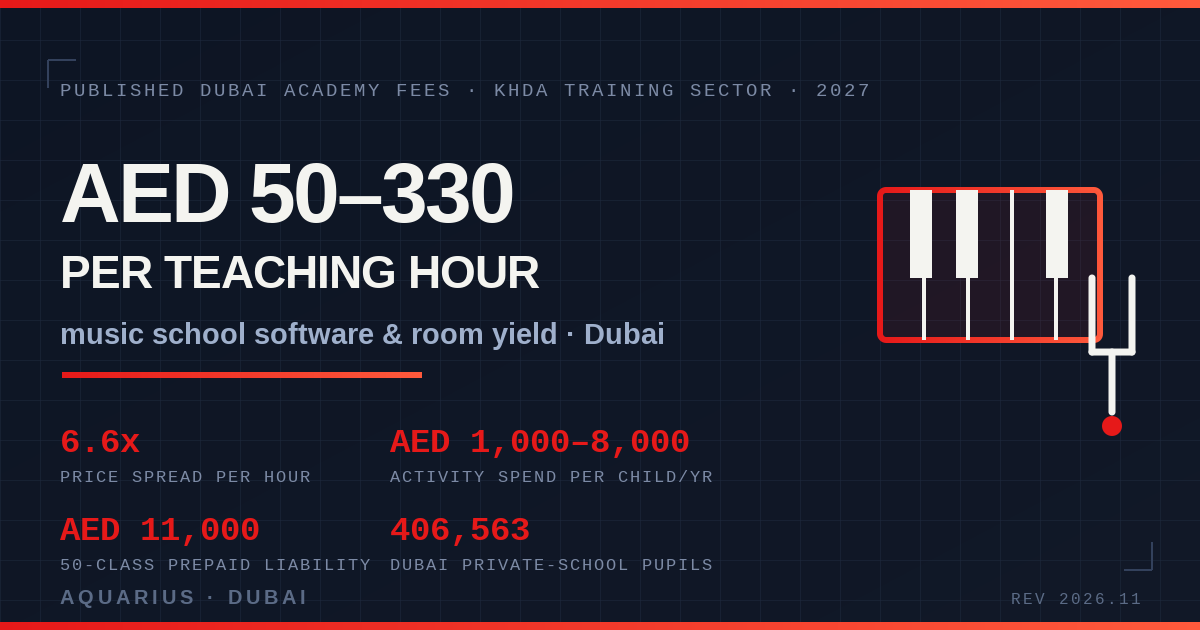
Short answer: Dubai music academies publish fees that work out to anywhere between AED 50 and AED 330 of revenue per teaching hour — a 6.6x spread for broadly the same instrument and the same city. The academies that survive 2027 are not the cheapest or the priciest; they are the ones whose software can tell them, per room and per teacher, which of those hours actually got taught.
Dubai’s music-lesson market, in real numbers
Private-sector demand is the whole story. KHDA recorded 406,563 pupils enrolled in Dubai private schools for 2026-27, up 4.6% on the roughly 388,731 counted in June 2026. Every one of those families is also budgeting for what happens after 3pm.
Khaleej Times’ back-to-school survey for 2026-27 put extracurricular activities at AED 1,000 to AED 8,000+ per child per year, inside a total “extras” bill of AED 2,000 to AED 10,000 per child on top of tuition. At the top end of co-curricular spend, the same paper found Dubai parents paying AED 10,000–12,000 a term for competitive rhythmic gymnastics, and AED 200–250 an hour for private piano lessons taken three times a week. One in-school ukulele programme — 30 minutes, twice a week — was billed at AED 1,000 per term above tuition.
Supply has kept pace: KHDA’s education directory lists well over a thousand approved training institutes in Dubai, and music academies sit in the same permit class as coding and tutoring centres. The result is a crowded, price-opaque market where two studios 10 minutes apart can differ by 6x on the only metric that matters to the P&L.
The number almost no academy tracks: revenue per teaching hour
Published Dubai price lists look like apples and oranges — monthly bundles, 10-class packs, 50-minute “terms”. Normalise them all to one teacher-hour and the market snaps into focus. Every figure below is taken from the academies’ own public fee pages in late 2026; the per-hour column is simple arithmetic on those numbers.
| Published Dubai offer | What you pay | Lesson length | Revenue per teaching hour |
|---|---|---|---|
| Dubai Music School — keyboard / guitar / ukulele, 8 classes a month | AED 350 / month | 60 min | AED 44 |
| Dubai Music School — piano / violin / drums, 8 classes a month | AED 400 / month | 60 min | AED 50 |
| Dubai Music School — electric guitar / singing, 8 classes a month | AED 500 / month | 60 min | AED 63 |
| Melodica — 10-class package, 45 minutes | AED 2,200 (AED 220 / class) | 45 min | AED 293 |
| Melodica — 10-class package, 30 minutes | AED 1,650 (AED 165 / class) | 30 min | AED 330 |
| Vocal Studio Orpheus — Term 1 beginner private track, 15 lessons + 10 enhancement sessions (VAT inclusive) | AED 4,949 / term | 50 min | AED 396 on lessons alone; AED 198 across all 25 contact sessions |
| Vocal Studio Orpheus — Term 1 group track | AED 2,811.50 / term | 50 min | Split across the group |
Two things fall out of that table, and both are counter-intuitive.
Shorter lessons earn more per hour. Melodica’s 30-minute package yields AED 330 per teacher-hour; its 45-minute package yields about AED 293. An academy that “upgraded” every beginner to 45 minutes to look premium just cut its own hourly rate by 11% — while adding 50% more teacher time per student.
Bundled extras quietly halve your rate. A term price that includes 10 “enhancement” sessions alongside 15 private lessons reads as AED 330 a lesson and behaves as AED 198 a contact hour. That is defensible as a retention play. It is indefensible if nobody in the office knows the number.
Why generic booking software breaks in a music academy
Salon and gym scheduling tools assume one resource: a staff member. A music school has at least three, and they collide.
Teacher + room + instrument is a triple constraint
A piano room cannot host a drum lesson. A drum room cannot host a vocal exam recording. A visiting violin teacher needs any room with a music stand and no kit in it. Generic software happily books a teacher into a room that physically cannot hold the lesson, and the clash surfaces when a parent is already standing in reception. Your booking engine needs rooms and instruments modelled as first-class bookable resources with capability tags, not as a free-text note on the appointment.
Make-up lessons are a balance-sheet item, not a courtesy
Most Dubai academies sell packages, not months — and the big ones go up to 50 classes. A 50-class, 45-minute Melodica package is AED 11,000 collected up front. Until those classes are taught, that money is deferred revenue and unclaimed make-up credits are a liability you have already spent. Published fee pages in Dubai routinely say nothing about expiry, cancellation notice or make-up eligibility, which means the policy is whatever the front desk improvises. Software should hold a per-student credit ledger with an issue date, an expiry, a reason code and the teacher who owes the hour.
The exam pipeline runs on someone else’s calendar
Graded-exam entries are the single most deadline-sensitive thing a music school does. ABRSM publishes its piano Practical Grades syllabus in multi-year cycles — the 2027 & 2028 piano syllabus is the current one teachers are preparing repertoire against — and Trinity College London’s UAE representatives run digital exam sessions on a monthly rhythm out of Dubai Knowledge Park. Entry windows, repertoire lists, accompanist bookings and parent consent all have to be tracked per candidate, per grade, per board. Spreadsheets lose candidates. A pipeline view with entry deadlines and a per-student repertoire checklist does not.
Recitals, media consent and home-visit routing
Two concerts a year generate seat allocations, piece ordering, rehearsal slots and a pile of photo and video permissions for minors — permissions that need to be recorded per child and honoured when the marketing team picks a highlight reel. Separately, home-visit teaching is a real Dubai segment at roughly AED 280–500 per 1:1 session versus AED 200–380 in-studio, and it only pays if travel time is routed sensibly instead of sending one teacher Jumeirah–Mirdif–Jumeirah in an afternoon.
One compliance note worth 30 seconds: zero-rated VAT is narrow. The FTA’s Education Sector guide (VATGED1, published 29 June 2026) ties zero-rating to a qualifying educational institution and a qualifying curriculum, and treats private tutoring and skills courses as standard-rated at 5%. That is why a Dubai vocal studio can state its term fees are “VAT inclusive” while a school next door charges nothing. We unpack the treatment table in our tuition and training centre software guide.
What the software costs in Dubai (2027)
There are three honest routes, and the right one depends on how many rooms you run.
| Route | Indicative cost | Fits | Where it hurts |
|---|---|---|---|
| Off-the-shelf music-teaching SaaS (studio-oriented, per-staff pricing) | From roughly AED 60–80 / month for a solo teacher, plus about AED 18 per extra staff member | 1–3 teachers, one room | No AED invoicing niceties, no TRN-ready tax invoice, no room/instrument resource model |
| Mid-market academy platforms | Roughly AED 360–1,200 / month by tier | 5–25 teachers, multi-room | Rigid package rules; make-up logic rarely matches a Dubai 50-class pack |
| Custom build (web + parent app + staff app) | AED 55,000–185,000 one-off, by scope | Multi-branch, exam-heavy, home-visit teaching | Needs real product decisions up front — which is the point |
Now the cost-of-inaction number, because it is bigger than any of the above. Take one 45-minute slot in one room that goes unsold six days a week at Melodica’s published AED 220 a class. Over a 48-week teaching year that single empty slot is AED 63,360 of lost revenue from one room. A four-room academy leaking one slot a day per room is leaking more than a quarter of a million dirhams a year — comfortably more than the top of the custom-build range, every year, forever.
How Aquarius builds it
We build the resource model first: teachers, rooms and instruments each with capability tags, so a booking is only valid when all three can physically happen. On top of that go the three ledgers a Dubai academy actually argues about — prepaid class credits, make-up entitlements with expiry, and teacher pay per taught hour rather than per scheduled hour.
Parents get a mobile-first portal, which is not a style choice: StatCounter put UAE mobile share at 67.8% versus 31.4% desktop in October 2026. Rebooking a missed lesson has to work with one thumb in a car park. Admin gets a room-yield dashboard that reports revenue per teaching hour by room, teacher and package — the number from the table above, live. Tax invoices carry your TRN and the correct 5% treatment. Exam entries get a pipeline with board deadlines, and recitals get consent tracking per child.
Risk reversal: we scope in a fixed-price discovery sprint, ship in two-week increments you can see running, and you own the code and the data outright — no per-seat ransom when you open branch three. If the first increment does not do what we said it would, you stop and keep what has shipped. Our pricing page shows the ranges; the sports academy software guide covers the same mechanics for coaching businesses with pitches instead of practice rooms.
FAQ
How much does music school management software cost in Dubai?
Entry-level studio SaaS starts around AED 60–80 a month for a single teacher with roughly AED 18 per additional staff member; mid-market academy platforms run roughly AED 360–1,200 a month depending on tier. A custom build with a parent app, package ledgers and exam pipeline is AED 55,000–185,000 one-off. The deciding factor is usually whether your package and make-up rules fit someone else’s product.
Are music lessons in Dubai subject to 5% VAT?
Usually yes. The FTA’s Education Sector VAT guide (VATGED1, 29 June 2026) restricts zero-rating to qualifying educational institutions delivering a qualifying curriculum, and treats private tutoring and skills-development courses as standard-rated at 5%. Several Dubai studios publish fees as “VAT inclusive” for exactly this reason. Confirm your own position with your tax adviser.
What should a music academy charge per lesson in Dubai?
Published rates cluster around AED 150–230 per class for in-studio 1:1 teaching, rising to AED 280–500 for home visits, with monthly group bundles as low as AED 350–500 for eight hour-long classes. Price your packages backwards from revenue per teaching hour, not from what the studio down the road charges per class — that is how the 6.6x spread happens in the first place.
Do we need a KHDA permit to run music classes in Dubai?
Teaching activity in Dubai’s training sector generally sits under KHDA permitting alongside your trade licence, with course and instructor approvals handled per offering and lead times measured in weeks, not days. Build the permit evidence — instructor approvals, course outlines, attendance records — into the system from day one rather than reconstructing it at renewal.
Can one system handle instruments, rooms and exam entries together?
Yes, and it should. Once instruments and rooms are bookable resources with capability tags, the exam pipeline becomes another view over the same data: candidate, grade, board, entry deadline, accompanist, consent. Running them in three separate tools is how academies lose exam entries.
Running a music school in Dubai and unsure what each teaching hour actually earns you? Tell us about your rooms and packages — we will run the yield numbers with you before anyone talks about building anything.