
Oracle Java Licensing Cost in Dubai 2026: Per Employee, Not Per Install
Oracle JDK 21 updates went commercial on 20 October 2026. What Java SE Universal Subscription really costs a Dubai business in AED, the 10x jump at 101 employees, and the free OpenJDK exits.
- PUBLISHED
- 22 NOV 2026
- READ TIME
- 12 MIN
- AUTHOR
- AQUARIUS · DUBAI
- UNIT
- REV 2026.09
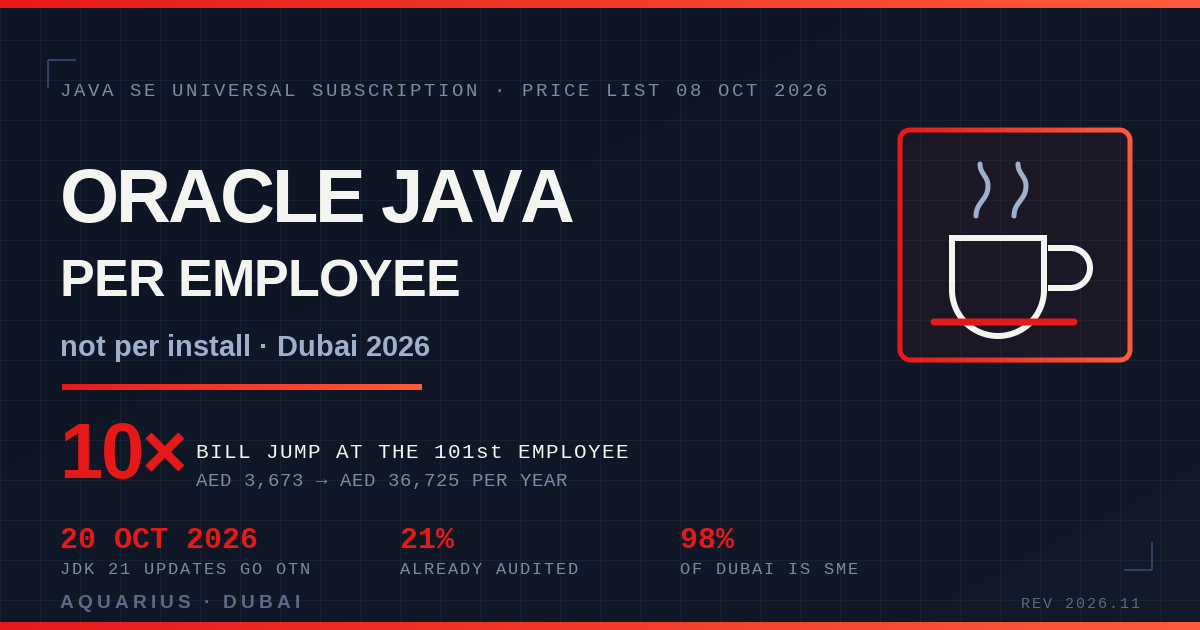
Short answer: Oracle stopped charging for Java by server, core or install. The Java SE Universal Subscription is priced per employee — every full-time, part-time and temporary employee, plus the staff of your agents, contractors and outsourcers, counted “without regard to the number of Employees that use the Programs.” For a Dubai company of 101 people that is USD 10,000 (AED 36,725) a year, whether one laptop runs Java or two hundred servers do. And on 20 October 2026 Oracle moved JDK 21 updates onto a licence that is no longer free for commercial production use.
The deadline most Dubai IT teams missed last month
Oracle’s own Java SE Support Roadmap is blunt about it: “Further update releases of Oracle JDK 17, released as of October 15, 2024, and Oracle JDK 21 releases as of October 20, 2026, are available under the Java SE OTN license, the same license under which we currently offer updates to Java 8 and 11.” The OTN licence is free for personal use, development, testing, prototyping and demos — not for running your business. Oracle’s advice in the same paragraph: “Users wanting to continue with permissively licensed versions of Java should move to Oracle JDK 25 or later.”
Two more dates matter. Premier Support for Java 17 ended in September 2026, and Java 17 is now in Extended Support (fee waived to September 2029). Java 21 Premier Support runs to September 2028. If your Dubai estate is sitting on an Oracle JDK 17 or 21 build and pulling quarterly security patches, you are either already licensable or already unpatched.
The scale of the problem is not theoretical. Azul’s 2026 State of Java Survey, run by Dimensional Research across 2,039 qualified respondents on five continents, found that 92% are concerned about Oracle Java pricing — only 7% are “not at all concerned,” roughly half last year’s level. 21% have already been through an Oracle Java audit. And 81% have migrated, are migrating, or plan to migrate at least part of their Oracle Java to a non-Oracle OpenJDK distribution, with 63% intending to move the entire estate.
Now put that against Dubai’s business shape. 98% of Dubai’s private sector is small and medium-sized enterprises, per Dubai Chambers — which is exactly the population Oracle’s SMB bands are designed to catch. 37,373 new companies joined the Dubai Chamber of Commerce in the first nine months of 2026 alone, with member exports and re-exports hitting AED 252 billion over the same period. Gartner puts MENA IT spending at USD 169.02 billion in 2026, up 8.9%, with software alone at USD 20.45 billion, up 13.9%. A lot of that software quietly runs on a JVM nobody has checked the licence on.
How Oracle counts: the employee metric, in full
This is the clause that surprises Dubai finance directors. Oracle’s price list defines an Employee for the Java SE Universal Subscription as “(i) all of Your full-time, part-time, temporary employees, and (ii) all of the full-time employees, part-time employees and temporary employees of Your agents, contractors, outsourcers, and consultants that support Your internal business operations. The number of Employees is determined without regard to the number of Employees that use the Programs.”
Read it twice. A 60-person Dubai trading company that outsources accounting, logistics support and a dev team to three vendors with 50 people between them is a 110-employee organisation for Java pricing. Oracle’s own worked example in the price list counts an organisation of 23,000 employees plus 5,000 agents, contractors and consultants as 28,000 — billed at USD 6.75 per employee per month, or USD 2,268,000 a year.
Four more mechanics worth knowing before you negotiate:
- Architecture does not help. Oracle’s subscription FAQ states plainly that “the underlying application architecture and deployment model does not affect pricing.” Containerising, consolidating onto fewer VMs or moving to the cloud changes nothing on the invoice.
- Bands do not stack. Pricing Note 7: each listed price “represents a quantity of one (1) entitlement covering usage up to the stated band limit … and may not be stacked, combined, or accumulated; requirements above the limit must be purchased at the next applicable band.”
- Your local reseller cannot sell you the cheap tier. The price list footnote is explicit: “SMB Pricing is only available for direct transactions at this time; resell is not available.” Up to 500 employees you self-serve at the Oracle Store; at 501+ you must go through Oracle sales.
- Minimum term is one year, and if you do not renew, “You must de-install” the subscription programs. There is no quiet lapse into free use.
What Oracle Java actually costs a Dubai business in 2026
These are the published bands from Oracle’s Java SE Universal Subscription Global Price List dated 8 October 2026, converted at the pegged rate of 1 USD = AED 3.6725. Processor caps are the ceiling each band includes.
| Employees | List price (USD) | Equivalent (AED) | Processors included |
|---|---|---|---|
| Up to 10 | 100 / year | 367 / year | 1,000 |
| Up to 100 | 1,000 / year | 3,673 / year | 10,000 |
| Up to 500 | 10,000 / year | 36,725 / year | 20,000 |
| 501 – 2,999 | 10,000 + 147.20 per employee above 500 | 36,725 + 540.59 each | 50,000 |
| 3,000 – 9,999 | 10.50 / employee / month | 38.56 / employee / month | 50,000 |
| 10,000 – 19,999 | 8.25 / employee / month | 30.30 / employee / month | 50,000 |
| 20,000 – 29,999 | 6.75 / employee / month | 24.79 / employee / month | 50,000 |
| 30,000 – 39,999 | 5.70 / employee / month | 20.93 / employee / month | 50,000 |
| 40,000 – 49,999 | 5.25 / employee / month | 19.28 / employee / month | 50,000 |
| 50,000+ | Contact Oracle | — | 50,000 |
The 101st employee costs you AED 33,052
Here is the myth-bust that most Dubai businesses get wrong: they assume per-employee pricing scales smoothly. It does not. Because bands cannot be stacked, a company at exactly 100 employees pays USD 1,000 (AED 3,673) a year. Hire one more person — or sign one more outsourcing contract — and you land in the “Up to 500” band at USD 10,000 (AED 36,725). That is a 10× increase, or AED 33,052 extra, for a single hire. The same cliff sits at the 11th employee: USD 100 becomes USD 1,000.
Above 500 the curve turns brutal rather than cliff-edged. Oracle’s own examples: 800 employees = USD 54,160 a year (AED 198,903). 2,000 employees = USD 230,800 (AED 847,613). At 2,999 it peaks at USD 377,852.80, then the enterprise metric kicks in and 3,000 employees = USD 378,000 a year (AED 1,388,205). For a mid-size Dubai group, that is a senior engineering team’s entire annual cost, spent on a runtime that has a free, TCK-certified, drop-in equivalent.
The free exits, and exactly how long each one lasts
Oracle itself points at the door. Its subscription FAQ advises: “We recommend transitioning your Java SE applications to OpenJDK binaries from Oracle (under a GPL license) before the end of your subscription.” The question is only which binary, and how long it is patched.
| Distribution | Licence | Cost | Security updates until |
|---|---|---|---|
| Oracle JDK 25 (LTS) | Oracle No-Fee Terms & Conditions (NFTC) — free for all users, including commercial production | Free | NFTC updates planned to September 2028, then OTN; Premier Support to Sep 2030 |
| Oracle JDK 21 / 17 / 11 / 8 | Oracle Technology Network (OTN) — free for personal, development and test use only | Subscription required for production | 21: Sep 2028 Premier · 17: Sep 2029 Extended · 11: Jan 2032 · 8: Dec 2030 |
| Eclipse Temurin (Adoptium) | GPLv2 + Classpath Exception | Free | 25: at least Sep 2031 · 21: at least Dec 2029 · 17 and 11: at least Oct 2027 · 8: at least Dec 2030 |
| Amazon Corretto | GPLv2 + Classpath Exception | Free, quarterly updates | 25: Oct 2032 · 21: Oct 2030 · 17: Oct 2029 · 11: Jan 2032 · 8: Dec 2030 |
| Oracle OpenJDK builds | GPLv2 + Classpath Exception | Free | Six months — one release cycle only |
Three practical notes from migrating these in the UAE. First, Oracle JDK 25 under NFTC is the cheapest compliance move if you are already on 21 and your code is modern — it permits free commercial and production use with no click-through licence, and non-LTS releases such as JDK 27 are NFTC for their whole six-month life. Second, if you want a support window past 2028 without a subscription, Temurin or Corretto 25 buys you to 2031–2032. Third, watch the edge cases: Amazon stops shipping JavaFX with Corretto 8 on 31 March 2026, and Oracle’s commercial Java 8 support, including Java Web Start, runs “through at least 2030.” Legacy Dubai desktop estates feel both of those.
What getting off Oracle Java costs in Dubai — and what it saves
A migration is a finite project with a fixed end. The subscription is a bill that renews every year and grows with your headcount, not your usage. These are the ranges we quote Dubai clients in 2026:
| Scope | Typical AED | Timeline |
|---|---|---|
| Java estate audit — inventory every JDK across servers, images and laptops, identify Oracle vs OpenJDK builds, count true employee number, model your band | 9,000 – 18,000 | 1 – 2 weeks |
| Like-for-like runtime swap — 3 to 8 services on Java 17/21 moved to Temurin or Corretto, CI/CD rebuilt, full regression pass | 25,000 – 70,000 | 3 – 6 weeks |
| Version jump out of Java 8 or 11 — removed APIs, javax to jakarta namespace, dependency uplift, performance re-baseline | 60,000 – 180,000 | 6 – 14 weeks |
| Ongoing patch governance — quarterly CPU tracking, CVE triage, build pipeline updates | From 2,500 / month | Continuous |
Run the arithmetic against the cost of doing nothing. A 300-person Dubai firm pays AED 36,725 every year, forever, for a runtime it could run free — a single runtime swap at the top of our range pays back in under two years and then saves in perpetuity. An 800-person group pays AED 198,903 a year; the same project pays for itself in under five months. And that is before audit risk, which 26% of the Azul respondents named as a migration driver in its own right.
How Aquarius does it
We start with the audit, never the migration. You get a one-page exposure model — your real employee count, your band, your annual AED figure, and which hosts are actually running an Oracle build — before anyone touches a Dockerfile. If the audit shows you are already clean, we say so and stop; you keep the report. If it shows exposure, the migration is quoted fixed-price off that inventory, with a regression suite agreed up front so “it still works” is a test result and not an opinion. Every build pipeline we hand back pins the JDK vendor and version explicitly, so the next engineer cannot accidentally reintroduce a licensable runtime.
If your estate is older than Java 11, the Java question is usually the smaller half of the problem — read our guide to legacy software modernisation in Dubai first, because the two projects should be scoped together. Our published rates are on the pricing page, and the engineering capability behind them is on services.
FAQ
Does Oracle only count the employees who actually use Java?
No. The price list defines the employee count as being determined “without regard to the number of Employees that use the Programs,” and it includes the staff of your agents, contractors, outsourcers and consultants who support your internal business operations. One Java application can make your entire Dubai headcount, plus your vendors’ headcount, the billing basis.
Is Oracle JDK 21 still free in 2026?
Public updates through September 2025 were permissively licensed and remain so. But Oracle JDK 21 releases issued from 20 October 2026 onward fall under the OTN licence, which is free only for personal, development, testing, prototyping and demonstration use. Patching a production Dubai system with those builds needs a subscription.
Can we stay on an Oracle JDK and pay nothing?
Yes — move to Oracle JDK 25. Since September 2025 Oracle has shipped it under the No-Fee Terms and Conditions, which permit free use for all users including commercial and production, with no click-through licence. Updates released after September 2028 are planned to move to OTN, so treat 2028 as your next decision point.
Do containers, VDI or cloud hosting reduce the bill?
No. Oracle’s own FAQ states that “the underlying application architecture and deployment model does not affect pricing.” Per-employee licensing is deliberately immune to the consolidation tricks that used to cut processor-based Java costs.
What happens if we just cancel the subscription?
Your right to use the subscription programs ends and Oracle’s terms require that you de-install them. That is why the sequence matters: migrate to a GPL-licensed OpenJDK build first, verify it in production, and only then let the subscription lapse. Oracle gives the same advice in its own FAQ.
If you are not sure whether a single Oracle JDK is sitting on a production box in your Dubai estate, that uncertainty is itself the finding. Book the audit — one week, a fixed fee, and a number you can take to your board.