
Penetration Testing Cost in Dubai 2026: VAPT Prices in AED
What a pentest really costs in Dubai in 2026 — AED ranges for web, mobile, API and cloud VAPT, plus the CBUAE and PCI DSS rules that now demand one.
- PUBLISHED
- 16 SEPT 2026
- READ TIME
- 10 MIN
- AUTHOR
- AQUARIUS · DUBAI
- UNIT
- REV 2026.09
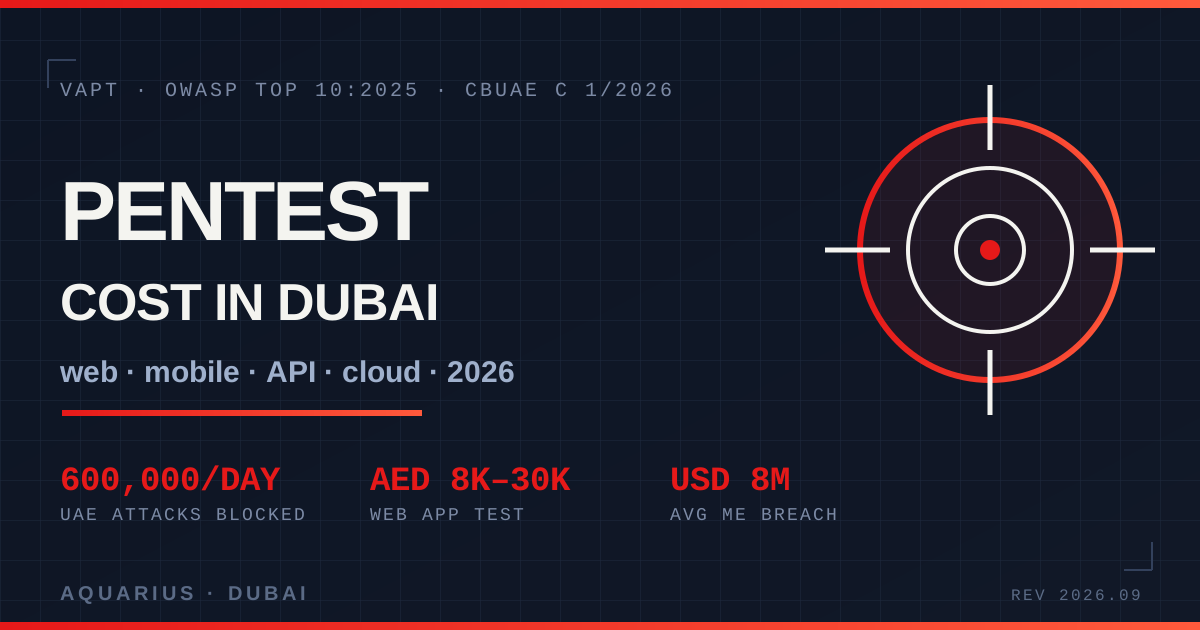
Short answer: A penetration test in Dubai costs roughly AED 8,000–30,000 for a single web application, AED 12,000–30,000 for one mobile app platform, and AED 35,000–90,000 for a mid-size VAPT covering a web app, API, cloud and external network together. Enterprise programmes and red-team exercises run AED 80,000–200,000+. The price is driven by scope — pages, endpoints, IPs, user roles — not by the name on the report.
That range matters because most Dubai businesses buy the wrong thing. An AED 3,000 “pentest” is usually an automated scanner export with a logo on it. It will not find the broken access control that lets one customer open another customer’s invoice — and that is exactly the flaw that ends up in a breach notice.
Key takeaways
- The UAE blocks around 600,000 cyberattacks a day. The threat is not theoretical for a Dubai SME with a login page.
- A scan is not a pentest. Automated scans find known CVEs; only manual testing finds business-logic and authorisation flaws.
- Regulators are tightening. The Central Bank’s new operational-risk regulation, in force since 14 September 2026, requires independent external penetration testing of critical functions.
- Scope is the price. A clear list of URLs, APIs, roles and environments cuts quotes and gets you a comparable number from every vendor.
Why penetration testing moved up the Dubai agenda in 2026
The awareness-stage numbers are blunt. In August 2026 Dr. Mohamed Al Kuwaiti, head of the UAE Cyber Security Council, said the country’s defences thwart about 600,000 cyberattacks every day — roughly 416 every second (Gulf News, August 2026). Earlier in the year, after regional tensions rose, reported daily volumes touched 800,000.
The attacks are also getting more expensive when they land. The Council’s State of the UAE Cybersecurity Report 2025 recorded a 32% year-on-year rise in ransomware attacks in 2024, with banking and financial services absorbing 21% of incidents. IBM’s 2026 Cost of a Data Breach research puts the Middle East average breach at about USD 8 million (roughly AED 29 million) — well above the global average of USD 4.99 million.
Spending is following the risk. Mordor Intelligence sizes the UAE cybersecurity market at USD 0.91 billion in 2026, growing to USD 1.51 billion by 2031 at a 10.66% CAGR. A growing slice of that is testing: proving controls work rather than assuming they do.
Myth-bust: “We ran a vulnerability scan, so we’re covered”
This is the mistake most Dubai businesses make, and vendors selling cheap reports are happy to let it stand. The three terms are not interchangeable:
- Vulnerability scan — automated. A tool checks your servers and app against a database of known weaknesses (outdated libraries, missing headers, exposed ports). Fast, cheap, noisy, and blind to logic.
- Penetration test — manual. A human tester tries to actually exploit weaknesses: escalating from a customer account to admin, tampering with prices in a checkout request, reading another tenant’s data through an API.
- VAPT (Vulnerability Assessment and Penetration Testing) — the combination most UAE tenders and auditors ask for: broad automated coverage plus manual exploitation of what matters.
The current OWASP Top 10:2025 shows why the manual part is non-negotiable. The number-one risk is A01 Broken Access Control, followed by Security Misconfiguration and the new A03 Software Supply Chain Failures. Scanners are decent at misconfiguration; they are close to useless at access control, because they do not understand that user 1042 should never see order 1043.
Black box, grey box or white box?
- Black box: the tester gets nothing but a URL. Realistic for an outside attacker, but much of the budget is spent on discovery.
- Grey box: the tester gets test accounts for each role and API docs. Best value for most Dubai web and mobile apps — it reaches the authenticated areas where real damage happens.
- White box: full source code and architecture access. Deepest coverage, highest cost; worth it for fintech, health data and platforms handling payments.
Penetration testing cost in Dubai by test type (2026)
These are published 2026 ranges from UAE security providers, cross-checked against each other. Treat them as market bands, not fixed prices — the scope section below explains where inside each band you will land.
| Test type | Typical 2026 Dubai range (AED) | What drives the price |
|---|---|---|
| Web application | 8,000–30,000 | Pages, user roles, forms, payment flows |
| API (REST/GraphQL) | 10,000–28,000 | Number of endpoints, auth model |
| Mobile app (one platform) | 12,000–30,000 | iOS or Android, MASVS depth, backend in scope |
| External network | 12,000–35,000 | Public IPs and exposed services |
| Internal network | 18,000–50,000 | Subnets, Active Directory, on-site vs VPN |
| Cloud (AWS / Azure / GCP) | 15,000–40,000 | Accounts, IAM complexity, services used |
| Mid-size VAPT bundle | 35,000–90,000 | Web + API + cloud + external combined |
| Red team exercise | 80,000–200,000+ | Duration, social engineering, physical scope |
Sources: eShield IT’s 2026 Dubai pricing guide and Wattlecorp/Qualysec UAE VAPT guides (2025–2026), which quote web-application tests at AED 15,000–30,000 and network tests at AED 20,000–50,000. Mobile tests are quoted per platform — testing both iOS and Android typically means paying for two builds, though the shared backend is only tested once.
How long it takes
A single web application usually needs 5–8 business days of testing plus 3–5 days of reporting; most UAE assessments complete within 1–3 weeks, and enterprise programmes run 3–6 weeks. Book around your release plan: testing a staging build that changes daily wastes the tester’s time and your money.
Retests are where cheap quotes get expensive
A good quote includes one free retest of Critical and High findings after you fix them. Where retests are extra, UAE providers typically charge another 20–30% of the original fee. Always ask before you sign: a report that says “12 findings” with no proof they were closed will not satisfy an auditor or a bank.
Worked example: what a Dubai SME actually pays
Take a typical Dubai services business: a customer portal with 25 screens and three roles (customer, staff, admin), a REST API with around 40 endpoints feeding an iOS and Android app, hosted on AWS, with an online payment flow.
| Scope item | Realistic band (AED) |
|---|---|
| Web portal, grey box, 3 roles | 15,000–22,000 |
| API, 40 endpoints | 12,000–18,000 |
| Mobile app (Android + iOS client-side) | 18,000–30,000 |
| AWS configuration review | 15,000–22,000 |
| Bundled as one VAPT engagement | 45,000–75,000 |
Buying the pieces separately lands near the top of each band; bundling them with one provider usually saves a meaningful share because recon, reporting and project management are shared. Dropping the cloud review and testing only the Android client is the fastest way to cut the bill — but only if iOS runs the same codebase.
Which UAE rules actually expect a penetration test?
No single UAE law says “every website must be pentested annually”. But several frameworks either require it outright or make it the only practical way to prove compliance:
- CBUAE Operational Risk Management Regulation (C 1/2026) — in force from 14 September 2026 for licensed financial institutions. Periodic testing of critical functions must include penetration testing by an independent external party, with results reported to the board. Significant incidents must be reported within 4 hours.
- PCI DSS v4.0.1 — any Dubai business storing, processing or transmitting card data in scope must run internal and external penetration tests at least every 12 months and after significant changes (requirements 11.4.2 and 11.4.3). Service providers must test segmentation every six months.
- UAE PDPL (Federal Decree-Law No. 45 of 2021) — requires “appropriate technical and organisational measures” to protect personal data. A recent pentest report is the clearest evidence that you took those measures. See our UAE PDPL compliance checklist.
- DIFC and ADGM data protection — DIFC fines run up to USD 100,000 per contravention; ADGM penalties can reach USD 28 million.
- ISO 27001:2022 — Annex A controls 8.8 (management of technical vulnerabilities) and 8.29 (security testing in development and acceptance) are typically evidenced with VAPT reports.
- Dubai government work — suppliers to Dubai government entities are increasingly asked to align with the Dubai Electronic Security Center (DESC) Information Security Regulation, and cloud providers need DESC CSP certification.
Healthcare providers licensed by the Abu Dhabi Department of Health must also comply with ADHICS, and enterprise buyers in every sector now send security questionnaires that ask for a pentest dated within the last 12 months. For many B2B software companies in Dubai, that questionnaire — not a regulator — is what triggers the first test.
How to get an accurate pentest quote in Dubai
Vendors price uncertainty. The less you tell them, the more padding goes into the number. Before you request quotes, write down:
- Every in-scope asset: URLs, API base paths, app store links, public IP ranges, cloud account count.
- User roles and whether you will provide test accounts (grey box) for each.
- Compliance driver: PCI DSS, CBUAE, ISO 27001, a client questionnaire — it changes the report format.
- Environment: production or a stable staging copy, and any testing windows.
- Report needs: executive summary, CVSS scoring, OWASP mapping, Arabic summary if a government client will read it.
- Retest terms: how many, within what window, and at what price.
Red flags in a pentest proposal
- A fixed low price with no questions about scope.
- Delivery in 24–48 hours for a full web application.
- A sample report that is pages of scanner output with no proof-of-exploit screenshots or reproduction steps.
- No mention of OWASP Top 10:2025 for web or OWASP MASVS for mobile.
- No retest included, or no named tester qualifications.
The cost of skipping it
Set the numbers side by side. A thorough VAPT for a typical Dubai SME platform costs AED 45,000–75,000. The Middle East average breach, per IBM’s 2026 research, costs about USD 8 million. Even a small, contained incident — a week of downtime, forensic investigators, customer notifications, legal advice and lost deals — routinely costs more than a decade of annual tests.
The cheaper win is earlier, though. Fixing an access-control flaw found in a pentest before launch is a few developer-days. Fixing the same flaw after it has leaked customer records is a board-level event.
How Aquarius handles security testing
Aquarius builds web apps, mobile apps and platforms for Dubai businesses, and security testing is part of delivery rather than an afterthought:
- Secure by design: role-based access control, input validation and dependency checks are built in and reviewed against OWASP Top 10:2025 before any external test.
- Test-ready handover: we prepare the scope pack — asset list, roles, test accounts, API docs — so independent testers quote accurately and spend their days testing, not discovering.
- Remediation included: when the report arrives, we fix the findings in the code we wrote and support the retest until Critical and High issues are closed.
- Independent where it counts: for CBUAE, PCI DSS or enterprise questionnaires, the test itself should be done by an independent provider — we coordinate it rather than mark our own homework.
Already have a platform and a pentest report full of findings nobody has fixed? That is a common starting point. See our services or pricing, and read what ongoing upkeep costs in our website maintenance cost guide.
Frequently asked questions
How much does penetration testing cost in Dubai in 2026?
A single web application test typically costs AED 8,000–30,000, a mobile app AED 12,000–30,000 per platform, and a combined mid-size VAPT AED 35,000–90,000. Red-team engagements start around AED 80,000. Scope — pages, endpoints, IPs and roles — sets where you land in each range.
What is the difference between VAPT and a penetration test?
A vulnerability assessment is largely automated scanning for known weaknesses. A penetration test is manual exploitation by a skilled tester. VAPT combines both, and is the term most UAE tenders, auditors and enterprise clients use.
How often should a Dubai business run a penetration test?
At least once a year and after any significant change, such as a new payment flow, major release or cloud migration. That matches PCI DSS requirements 11.4.2 and 11.4.3, and it is what enterprise security questionnaires usually expect.
Is penetration testing mandatory in the UAE?
It depends on your sector. CBUAE-licensed financial institutions must have critical functions tested by an independent external party under Regulation C 1/2026, and card-handling businesses must test under PCI DSS. Other businesses are not named in a blanket rule, but the UAE PDPL requires appropriate security measures, and a recent pentest is the strongest evidence you have them.
How long does a penetration test take?
A single web application usually takes 5–8 business days of testing and 3–5 days of reporting. Most UAE assessments finish within 1–3 weeks; larger enterprise programmes take 3–6 weeks.
Launching or scaling a platform in Dubai? Talk to Aquarius about building it secure from day one — and getting it pentest-ready before your first enterprise client asks.