
Online Pharmacy & Medicine Delivery App Development in Dubai (2026): DHA Licence, E-Prescription, NABIDH & Real Build Cost
How to build a compliant online pharmacy or medicine-delivery app in Dubai in 2026 — the DHA facility licence, e-prescription and NABIDH rules, cold-chain delivery, and real AED build cost.
- PUBLISHED
- 12 SEPT 2026
- READ TIME
- 12 MIN
- AUTHOR
- AQUARIUS · DUBAI
- UNIT
- REV 2026.09
Short answer: A compliant online pharmacy or medicine-delivery app in Dubai is not a "grocery app with medicines." It rides on a DHA-licensed physical retail pharmacy, dispenses prescription items only against a verifiable e-prescription, records every dispense in NABIDH (Dubai's health information exchange), keeps a documented cold chain for temperature-sensitive drugs, and never sells controlled substances online. Get the regulatory model right first; the software is the easy part. A login-and-catalogue MVP starts around AED 45,000–90,000; a full pharmacy platform with e-prescription, NABIDH integration, delivery dispatch and payments runs AED 120,000–260,000+.
Key takeaways
- Online-only is not allowed — you must first hold a DHA retail pharmacy facility licence, then get the digital platform approved.
- Prescription medicines require a valid, verifiable e-prescription on file; every dispense must be logged to NABIDH.
- Controlled substances (Schedules 1–4) cannot be dispensed online under any circumstances.
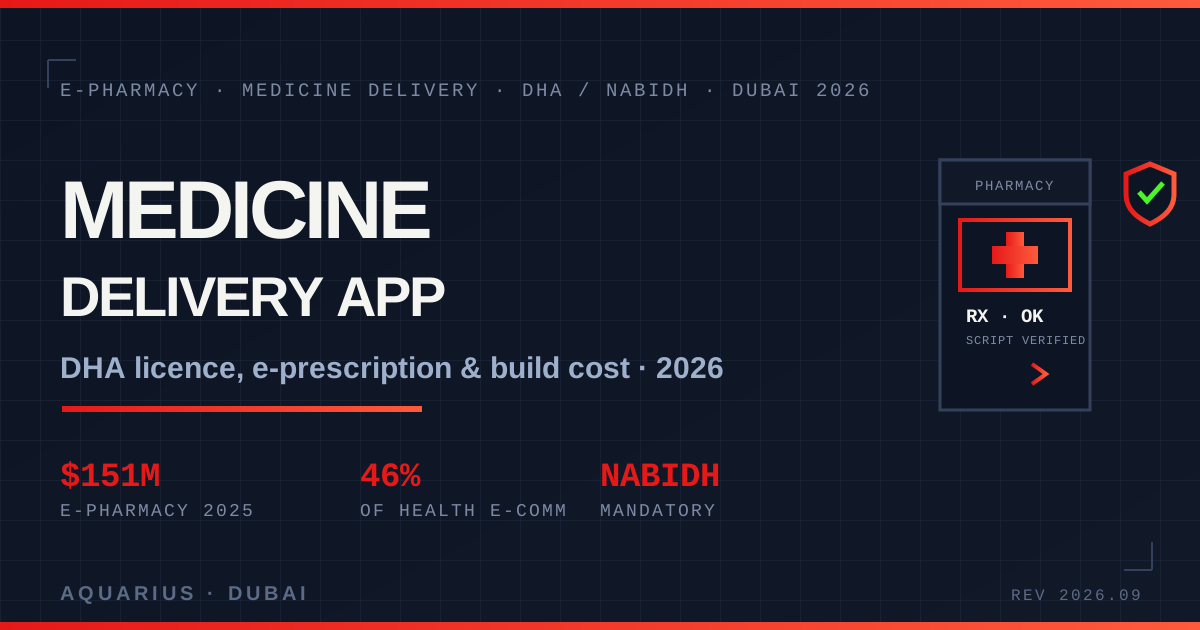
- The UAE online-pharmacy market was roughly US$151M in 2025 and growing double digits — pharmaceuticals are the largest health e-commerce category (~46%).
- Real Dubai build cost: AED 45K–90K for an MVP, AED 120K–260K+ for a full compliant platform.
The Dubai online-pharmacy opportunity in 2026
Medicine delivery has moved from convenience to expectation. UAE residents already manage banking, government services and groceries from a phone; refilling a chronic prescription is the obvious next habit. The numbers back it up: the UAE online-pharmacy market generated roughly US$151 million in revenue in 2025, with analysts projecting double-digit growth into 2026, and pharmaceuticals are the single largest category in UAE health e-commerce at around 46% of revenue. Chronic-disease management, e-prescriptions and telemedicine integration are the structural drivers — patients on long-term medication want scheduled, doorstep refills, not a queue.
The catch: pharmacy is one of the most tightly regulated verticals in the Emirate. A generic delivery app cloned from a food-ordering template will fail DHA review, get delisted, or expose the licence holder to penalties. The winners treat compliance as the architecture, not a checkbox.
What the law actually requires (DHA, MOHAP & NABIDH)
Before a line of code, understand the regulatory frame. In Dubai, pharmacy sits under the Dubai Health Authority (DHA), with MOHAP retaining jurisdiction over specific narcotic and community-pharmacy controls. The non-negotiables for a digital pharmacy in 2026:
- Physical licence first. You must hold a standard DHA retail pharmacy facility licence — online-only operations are not permitted. The website or app is a separate digital channel that DHA must additionally approve.
- Verifiable e-prescription. Prescription medicines can only be dispensed and delivered against a valid, verifiable prescription on file — no "upload a photo, we'll sort it out."
- NABIDH connectivity is mandatory. All dispensing must be recorded in Dubai's health information exchange. Your platform has to write dispense records to NABIDH, not just to your own database.
- Cold-chain documentation. Temperature-sensitive medicines (insulin, certain biologics) require a documented, temperature-controlled delivery process.
- No controlled substances online. Controlled drugs (Schedules 1–4 under UAE narcotics law) cannot be dispensed online under any circumstances — your catalogue logic must hard-block them.
- Licensed pharmacist in the loop. A DHA-licensed pharmacist must review and authorise dispensing; the app supports that workflow, it does not replace it.
Practically, this means your build needs a prescription-verification workflow, a pharmacist review queue, a NABIDH integration layer, and drug-classification rules baked into the catalogue — none of which exist in an off-the-shelf e-commerce kit.
What a compliant medicine-delivery platform is actually made of
Here's how the funnel maps to features. A serious 2026 build has four surfaces — customer app, pharmacist console, rider/dispatch, and admin — sitting on a compliance core.
| Module | What it does | Why it's non-optional |
|---|---|---|
| Catalogue + drug classification | OTC vs prescription vs blocked (controlled) logic | Prevents illegal online dispensing at the data layer |
| E-prescription capture & verification | Upload, e-Rx pull, pharmacist validation | Legal precondition for dispensing Rx items |
| Pharmacist review console | Queue, approve/reject, substitution, notes | Keeps a licensed pharmacist in the loop |
| NABIDH integration | Writes dispense records to the health exchange | Mandatory regulatory reporting |
| Cold-chain delivery tracking | Temperature-aware routing & proof of delivery | Compliance for sensitive medicines |
| Payments (AED) | Cards, Apple/Google Pay, insurance co-pay where applicable | Conversion + reconciliation |
| Refill & subscription engine | Scheduled chronic-med reorders, reminders | The retention flywheel for pharmacy |
The refill/subscription engine is where the business case lives. One-off orders are low margin; a patient on three chronic medications who auto-refills every 30 days is a predictable, high-lifetime-value relationship. Build for retention, not just checkout.
What it costs to build in Dubai (real 2026 AED ranges)
These are agency build estimates for the Dubai market in 2026 — not regulatory fees, and not market-research figures. Licensing, pharmacist staffing and DHA/DET fees are separate and depend on your facility. Software ballpark:
- MVP — catalogue + OTC ordering + delivery (no e-Rx): AED 45,000–90,000 · 5–8 weeks. Good for an OTC/wellness storefront tied to an existing pharmacy.
- Standard — + e-prescription, pharmacist console, payments: AED 90,000–160,000 · 8–12 weeks. The realistic minimum to legally dispense prescription medicines online.
- Full platform — + NABIDH integration, cold-chain, refill subscriptions, insurance co-pay, iOS + Android + web: AED 120,000–260,000+ · 12–20 weeks.
- Ongoing: budget 15–20% of build per year for maintenance, regulatory updates, and NABIDH/API changes.
Why the spread? A photo-upload "prescription" flow is cheap; a verifiable e-prescription + NABIDH write-back + pharmacist audit trail is real integration work with a regulated third party. The gap between those two is the gap between "will get shut down" and "will pass DHA review."
How Aquarius builds pharmacy platforms
We start with the compliance model, not the UI. That means: confirming your DHA facility licence status, scoping the NABIDH integration early (it's the long pole), designing the drug-classification rules so controlled items are blocked at the data layer, and building the pharmacist review workflow before the customer-facing polish. We ship on a modern React Native + Node stack so iOS, Android and web share one codebase, and we hand over documented, DHA-review-ready software — not a demo that breaks at audit. The cost of getting this wrong isn't a redesign; it's a delisted app and a licence at risk.
Frequently asked questions
Can I run an online-only pharmacy in Dubai without a physical shop?
No. DHA requires a licensed physical retail pharmacy facility first; the online platform is an additional approved channel on top of it.
Can the app sell any medicine?
No. OTC and standard prescription medicines are allowed (Rx items only against a verified prescription). Controlled substances (Schedules 1–4) cannot be dispensed online at all — your catalogue must block them.
What is NABIDH and why does it matter?
NABIDH is Dubai's health information exchange. Dispensing records must be written to it — so your platform needs a live integration, not just internal order records.
How long does a compliant build take?
A legally-dispensing standard build is typically 8–12 weeks; a full platform with NABIDH, cold-chain and subscriptions is 12–20 weeks, with the NABIDH integration usually the critical path.
Do I need my own delivery fleet?
Not necessarily, but temperature-sensitive medicines need documented cold-chain handling — so your delivery partner and app must support temperature-aware routing and proof of delivery.
The bottom line
Dubai's medicine-delivery market is large, growing and under-served by compliant, well-built apps — most attempts fail because they treat pharmacy like retail. Anchor the build on the DHA licence, e-prescription verification and NABIDH from day one, block controlled substances at the data layer, and design for chronic-refill retention. Do that and you have a defensible, high-lifetime-value healthcare business. Talk to Aquarius about scoping yours, or see our development services and other Dubai build guides.