
PHP 8.2 dies on 31 December 2026: the Dubai website checklist
PHP 8.2 stops getting security patches on 31 December 2026. We fingerprinted 120 UAE domains to see who is exposed, then priced the upgrade in AED. Dates, compatibility table and a 40-day plan.
- PUBLISHED
- 21 NOV 2026
- READ TIME
- 11 MIN
- AUTHOR
- AQUARIUS · DUBAI
- UNIT
- REV 2026.09
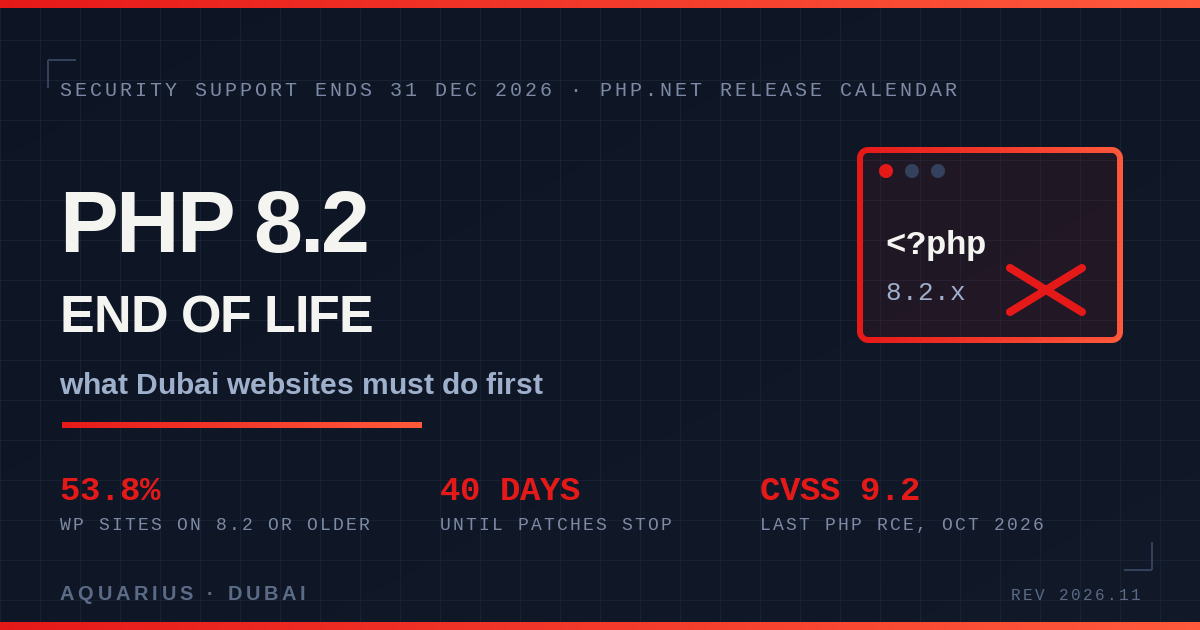
PHP 8.2 receives its final security patch on 31 December 2026. Nothing breaks on 1 January: your Dubai website loads exactly as it did the day before, which is precisely the trap — the code keeps running while every PHP vulnerability found after that date stays permanently unpatched on your server. Globally, 53.8% of all WordPress installations still run PHP 8.2 or older, and in our own fingerprint of 120 UAE domains on 21 November 2026, three of the five sites that disclosed a PHP version were already sitting on a dead or dying branch.
The deadline in hard numbers
These are not vendor opinions. They come straight off the php.net release calendar: PHP 8.2 was released on 8 December 2022, left active support on 31 December 2024, and leaves security support on 31 December 2026 — 40 days from the date this was published. PHP 8.1 died on 31 December 2025. PHP 7.4, still the single most common legacy branch in the wild, died on 28 November 2022, four years ago.
- 22.3% of all WordPress sites run PHP 8.2 and become unsupported overnight on 1 January 2027 (wordpress.org public PHP stats, retrieved 21 November 2026).
- 31.5% are already unsupported today — 14.1% on PHP 7.4, 8.9% on 8.1, the remainder on 8.0, 7.3 and older.
- 23 of the 42 UAE stacks we could fingerprint were PHP-based — 19 WordPress, 3 Magento, 1 Drupal. PHP is not a legacy curiosity in this market; it is the majority runtime.
- The UAE had 347,000 registered .ae domains across 26 accredited registrars as of 11 November 2024 (TDRA). Apply the same two-thirds PHP share and the exposed population is six figures.
Which PHP version is still safe to be on
| PHP branch | Released | Active support ends | Security support ends | Verdict for a Dubai site |
|---|---|---|---|---|
| 7.4 | Nov 2019 | Nov 2021 | 28 Nov 2022 | Dead 4 years. Migrate now. |
| 8.0 | Nov 2020 | Nov 2022 | 26 Nov 2023 | Dead. Migrate now. |
| 8.1 | Nov 2021 | Nov 2023 | 31 Dec 2025 | Dead since last December. |
| 8.2 | Dec 2022 | Dec 2024 | 31 Dec 2026 | 40 days left. Plan this quarter. |
| 8.3 | Nov 2023 | Dec 2025 | 31 Dec 2027 | Buys 12 months. A stopgap, not a destination. |
| 8.4 | Nov 2024 | 31 Dec 2026 | 31 Dec 2028 | Safe, conservative target. |
| 8.5 | Nov 2025 | Dec 2027 | 31 Dec 2029 | Best target for new builds. |
| 8.6 | 19 Nov 2026 | Dec 2028 | Dec 2030 | Too fresh for production this month. |
Note the overlap people miss: PHP 8.4 leaves active support on the same day 8.2 dies. Upgrading to 8.4 is still correct — it keeps getting security patches until 31 December 2028 — but it means you are landing on a branch that no longer gets bug fixes, only security ones. If your stack tolerates it, go to 8.5.
The myth that is costing Dubai businesses the most
Your WordPress updates itself. Your PHP never does. This is the single most common misunderstanding we hear on discovery calls, and our UAE scan quantifies it neatly. Of the 19 WordPress sites in our sample, 13 disclosed a core version — and 11 of those 13 were on the current 7.1.x line (nine on 7.1.5, two on 7.1.2). That is an 85% current-core rate, genuinely good hygiene.
Yet one of those sites runs that fully patched, up-to-the-minute WordPress core on PHP 7.4.33, a runtime that stopped receiving security fixes in November 2022. WordPress core auto-updates. Plugins auto-update. The interpreter underneath them is a hosting-panel setting that changes only when a human changes it. Nobody emails you about it, no dashboard badge appears, and the site does not slow down.
What we found probing 120 UAE domains
On 21 November 2026 we ran a first-hand audit so this article would rest on local evidence rather than global averages. The method is reproducible in an afternoon: pull a list of UAE business, retail, education and government domains, request headers with curl -sI, read X-Powered-By and Server, then fetch each homepage and fingerprint the CMS from markup signatures (wp-content, cdn.shopify, Magento, drupal-settings-json, _next/static). We are reporting the findings aggregated and anonymised, by stack rather than by company.
- 77 of 120 domains answered cleanly; 31 failed to resolve or timed out; 12 returned a 4xx/5xx block.
- 20 of 77 still leak an
X-Powered-Byheader at all. Only 5 leak a full PHP version string. - Those five versions: 8.5.13, 8.3.36, 8.2.36, 8.2.36, 7.4.33. Three are on branches that are dead or expire within 13 months.
- 43 of 120 sit behind a CDN that strips origin headers entirely.
That last line is the uncomfortable one. A CDN hides your runtime from attackers, but it hides it from you too — and from every free external scanner you might rely on for a warning. If your site is behind Cloudflare and nobody on your team has logged into the hosting panel this year, you do not currently know what PHP version your business runs on.
Why "it still works" is not the same as "it is safe"
The cost of an unsupported runtime is not theoretical, and it is not annual. The most recent proof arrived on 21 October 2026, when PHP shipped emergency releases for the pair of bugs tracked as CVE-2026-109618 and CVE-2026-109619 — a CVSS v4.0 9.2 unauthenticated remote code execution chain, nicknamed PHP2Shell. Patched builds went out as 8.5.12, 8.4.27, 8.3.36 and 8.2.35. PHP 8.1, 8.0 and 7.4 received source-only backports that most shared hosts never applied. PHP 7.3 and earlier received nothing at all.
Today, 8.2 users got a fix. After 31 December 2026, the next PHP2Shell-class bug produces a patch for 8.4, 8.5 and 8.6 — and a blog post for everyone else. The exposure window stops being "until my host updates" and becomes permanent.
Check your own version in sixty seconds
If you run WordPress
Tools → Site Health → Info → Server. The PHP version is the second row. WordPress 7.1 requires PHP 7.4 as a floor but recommends 8.4 or 8.5 — the floor exists for compatibility, not safety.
If you have cPanel or Plesk
cPanel: MultiPHP Manager, or PHP Selector under CloudLinux. Plesk: Websites & Domains → PHP Settings. Both let you switch branch per domain in one click, which is exactly why the switch rarely gets audited.
If you have SSH
Run php -v for the CLI binary and check your pool with php-fpm -v. They frequently differ, and the web-facing one is the one that matters.
From outside
curl -sI https://yourdomain.ae | grep -i "x-powered-by|server". If nothing comes back, that is good hardening (expose_php = Off) but tells you nothing about the version — go check the panel.
Your CMS may force the decision before the deadline does
Upgrading PHP is rarely the whole job, because the applications on top have their own matrices. Adobe Commerce 2.4.9 drops support for PHP 8.2 and 8.3 entirely, lists 8.5 as fully supported and 8.4 as upgrade-only — so a Dubai Magento store cannot stay on 8.2 and keep receiving Commerce updates. Laravel 13 requires PHP 8.3 to 8.5, with Symfony 8 underneath pushing hard toward 8.4. If you are weighing a runtime bump against a broader rebuild, our notes on legacy software modernisation in Dubai cover how to decide.
What actually breaks on the way up
Jumping 8.2 to 8.4 or 8.5 is usually a quiet upgrade, but it is not a no-op. The backward-incompatible changes that bite real sites:
exit()anddie()became true functions in 8.4 — passing them the wrong argument type now throws aTypeErrorinstead of being quietly coerced.E_STRICTwas removed. Any error handler orerror_reportingline referencing it needs editing.- JIT now defaults to
disable. If you measured a speed win from JIT, you must re-enable it explicitly. - A batch of
MYSQLI_*constants were removed, PDOATTR_*flags became strict booleans, and the DBA, ODBC and SOAP extensions migrated from resources to objects — the classic break in older in-house ERP and booking integrations. - Abandoned plugins and custom themes, not core, cause the overwhelming majority of real failures. Audit them on a staging clone first.
Compliance makes this mandatory, not optional
If your UAE site takes card payments, PCI DSS v4.0.1 has been fully mandatory since 31 March 2025, and two requirements settle the argument. Requirement 6.3.3 states that critical and high-security patches must be "installed within one month of release" — impossible to satisfy on a branch where no patches are released. Requirement 12.3.4 demands an annual review of technologies in use, explicitly including "documentation of any industry announcements or trends related to a technology, such as when a vendor has announced 'end of life' plans," plus "documentation of a plan, approved by senior management, to remediate outdated technologies."
In other words: your assessor is entitled to ask for a board-approved PHP migration plan dated before 31 December 2026. Separately, the UAE PDPL requires appropriate technical measures to protect personal data — and running an interpreter with known unpatched RCEs is difficult to defend as appropriate.
What the upgrade costs in Dubai
| Scope | What it covers | Typical timeline | Aquarius price |
|---|---|---|---|
| PHP compatibility audit | Version probe across CLI and FPM, plugin and theme compatibility matrix, staging clone, written remediation plan | 3–5 days | from AED 500 |
| Rebuild on a supported stack | Up to 8 pages, CMS, EN/AR, AI chat, shipped on PHP 8.5 or a Node runtime with no PHP at all | ~2 weeks | from AED 2,500 |
| Custom app, Magento or Laravel upgrade | Framework major-version jump, auth and payments retested, 30 days post-launch support | 4–8 weeks | from AED 10,000 |
Compare that against the cost of inaction: a CVSS 9.2 unauthenticated RCE means full server takeover without credentials, and a failed PCI assessment can suspend your ability to take cards at all. The audit is the cheapest line on that table and the only one that tells you whether you need the others.
Our approach is deliberately unglamorous. We probe the real runtime rather than trusting the panel label, clone to staging, run the plugin matrix, fix what breaks, then cut over with a tested rollback. Where a site is held together by three abandoned plugins, we say so and quote the rebuild instead of billing you to nurse it. See what we build, check transparent AED pricing, or send us your domain and we will tell you what PHP version you are actually running before you commit to anything.
FAQ
What exactly happens to my Dubai website on 1 January 2027?
Nothing visible. The site loads, forms submit, orders process. The only change is that the PHP project stops publishing security fixes for 8.2, so any vulnerability discovered from that day forward remains open on your server indefinitely unless your host backports it privately.
My host says they will keep PHP 8.2 secure. Is that true?
Sometimes, partially. CloudLinux HardenedPHP backports security fixes to old branches — currently covering 5.6 through 8.1 — and some managed hosts do similar work. Ask for the specific product name and the branches covered in writing. "We handle security" is not an answer; HardenedPHP coverage of your exact branch is.
Should I go to PHP 8.3 since it is a smaller jump?
Only as a stopgap. PHP 8.3 security support ends 31 December 2027, so you would repeat the whole exercise in twelve months, and Adobe Commerce 2.4.9 has already dropped it. Go to 8.4 if your extensions are conservative, 8.5 if they are not.
How do I know whether my plugins will survive?
Clone to staging, switch the branch there, and run with display_errors on and full logging. Deprecation notices appear immediately; fatal errors appear on the pages that use the broken code. Never test this on production, and never test it during a Dubai retail peak.
Can I avoid this problem permanently?
Not permanently, but you can stretch the cycle. Every runtime has a lifecycle — PHP ships one branch a year with roughly four years of support each. The fix is operational, not technical: put the EOL date of every runtime you depend on in a calendar, review it annually as PCI DSS 12.3.4 already requires, and budget one upgrade window every two to three years instead of discovering the deadline with 40 days left.