
Predictive Maintenance Software in Dubai (2026): What IIoT Condition Monitoring Really Costs
DEWA lost 49 seconds of supply per customer in 2025. Most plants lose four hours a month. Real AED costs for an IIoT predictive maintenance build, and the payback maths.
- PUBLISHED
- 03 NOV 2026
- READ TIME
- 11 MIN
- AUTHOR
- AQUARIUS · DUBAI
- UNIT
- REV 2026.09
Short answer: A predictive maintenance platform for a Dubai plant, cooling network or facilities portfolio costs AED 55,000–120,000 for a 10–20 asset pilot and AED 180,000–420,000 for a full single-site build covering 50–150 assets (before 5% VAT). The money is not in the sensors. It is in the data pipeline, the anomaly models and the work-order handoff that actually makes a technician move.
This is the 2026 guide for UAE manufacturers, district cooling operators, FM contractors and logistics fleets who are tired of fixing machines after they break. Real figures, real Dubai deployments, and the payback maths. Updated November 2026.
Key takeaways
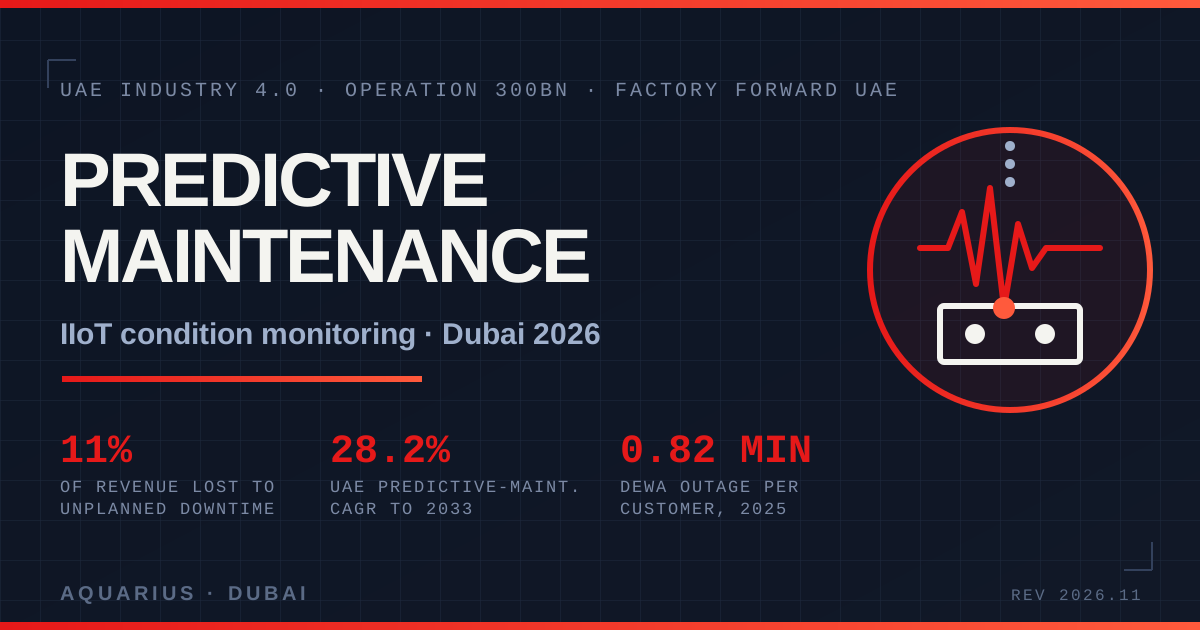
- Unplanned downtime now costs Fortune Global 500 companies about USD 1.4 trillion a year — roughly 11% of revenue, up from 8% in 2019 (Siemens/Senseye, The True Cost of Downtime 2024).
- The UAE predictive maintenance market was USD 336.2m in 2025 and is forecast to hit USD 2,364.4m by 2033 — a 28.2% CAGR (Grand View Research).
- DEWA recorded 0.82 minutes of outage per customer in 2025 — about 49 seconds, against roughly 15 minutes for leading EU utilities. Dubai’s infrastructure benchmark is brutally high.
- Budget AED 55,000–900,000 depending on asset count. Payback usually lands on a single avoided failure.
- Most Dubai businesses get this wrong by buying sensors first. Sensors are the cheapest part of the project.
Why Dubai plants are buying this in 2026, not 2029
Three numbers explain the shift.
First, downtime got more expensive. The Siemens and Senseye True Cost of Downtime 2024 study put unplanned equipment downtime at USD 1.4 trillion a year across the Fortune Global 500 — 11% of their combined revenue, up from 8% in 2019. Incidents are less frequent than they were, but each one costs far more: hidden costs such as idle labour, air-freighted emergency parts and contractual penalties pushed the total up 62% since 2019. Of the companies that actually tracked outages, 82% reported events averaging four hours and roughly USD 2m per incident. In automotive, an idle line runs at about USD 2.3m per hour.
Second, the UAE put money behind it. The UAE Industry 4.0 programme targets a 30% increase in industrial productivity, and in September 2026 MoIAT launched Factory Forward UAE, folding the national technology-transformation programmes into one track that has already supported more than 700 UAE factories, with over 620 assessed under the Industrial Technology Transformation Index. At Make it in the Emirates 2026, MoIAT secured AED 18bn in industrial financing commitments, with Emirates Development Bank committing AED 6bn of it — explicitly including finance for upgrading machinery with Industry 4.0 technology.
Third, the market is compounding. Grand View Research sizes the UAE predictive maintenance market at USD 336.2m in 2025, heading to USD 2,364.4m by 2033 at a 28.2% CAGR — the UAE alone was 2.4% of the global market in 2025. Dubai’s manufacturing sector, roughly 11% of national GDP, is targeted to reach AED 350bn by 2030. Capacity is being added fast, and new capacity is exactly what breaks unexpectedly.
Reactive, preventive, condition-based, predictive — the only comparison that matters
Most Dubai operators sit in the first two rows of this table and believe they are on the fourth.
| Strategy | Trigger | What it costs you | Software needed |
|---|---|---|---|
| Reactive (“run to failure”) | It stopped | Full four-hour-class outage, premium spares, overtime | None, or a spreadsheet |
| Preventive (calendar) | Every 3 or 6 months | Over-servicing healthy machines; still misses random failures | CMMS or the maintenance module in your ERP |
| Condition-based | A reading crosses a threshold | Catches obvious faults; threshold tuning never ends | Sensors + gateway + alerting rules |
| Predictive | A model says failure is likely in N days | Planned intervention inside a shift window | Sensors + time-series store + anomaly models + work orders |
The jump that pays is from row two to row four. And it is a software jump: the hardware on rows three and four is nearly identical.
What Dubai operators already run
This is not pilot-stage technology in the emirate.
Empower, the district cooling utility, had around 1.7 million refrigeration tons connected across roughly 1,750 buildings by end-2025 and expects contracted capacity near 2.08 million RT by the end of 2026. It runs an AI-driven Command Control Centre across about 90 plants on an integrated AI, big-data and IoT platform, with predictive maintenance built in to catch faults before they become failures, and reports 99.99% network reliability.
DEWA operates a Distribution Network Smart Centre that analyses more than 15 million units of data per day from the distribution network, plus an Asset Health Centre doing risk-based replacement planning. An AI “virtual engineer” for generation assets — predictive failure alerts, root-cause analysis, plant optimisation — was slated to start work in June 2026. The output of that stack is the 0.82 minutes per customer outage record in 2025, down from 6.88 minutes in 2012, with network losses at 2%.
Emicool moved in January 2025 with Quant Gulf, deploying smart vibration and temperature sensors for predictive maintenance across its cooling assets.
If you supply, service or compete with any of these organisations, the benchmark for normal asset reliability in Dubai has already moved.
What you are actually buying: the five layers
1. Sensing
Triaxial vibration plus surface temperature covers most rotating-equipment failure modes — motors, pumps, fans, chillers, compressors, gearboxes, conveyors. Current signature analysis helps on motors. Pressure and flow matter on pumping systems. For most Dubai plants this is the smallest line item in the budget.
2. Connectivity and edge
Wireless sensors to a gateway, then an edge device that buffers data when the link drops. The edge layer matters more in the UAE than people expect: Al Quoz and Jebel Ali industrial sheds eat signal, and summer rooftop temperatures punish cheap gateways. Plan on IP66/67 enclosures and local buffering.
3. Time-series storage
High-frequency sensor data is not a job for your transactional database. A purpose-built time-series store with downsampling and retention policies is the difference between a platform that still works in year three and one that falls over. If you are weighing where that data should live, see our guide to IoT smart building software development in Dubai.
4. Models and alerting
Start with statistical baselining and ISO 10816-style vibration severity bands, then layer anomaly detection once you hold a few months of healthy-state data. Anyone promising a trained failure-prediction model on day one, without your historical data, is selling you thresholds with a nicer dashboard.
5. Work-order handoff
The layer almost everyone skips. An alert that does not become an assigned, scheduled, parts-checked work order changes nothing. This is where predictive maintenance has to meet your CMMS or ERP — the same integration discipline we cover in manufacturing MRP and shop-floor software in Dubai.
What predictive maintenance software costs in Dubai (2026)
These are our build ranges for custom platforms, excluding 5% VAT.
| Scope | Assets covered | What you get | AED (ex VAT) | Timeline |
|---|---|---|---|---|
| Proof-of-value pilot | 10–20 | Sensor onboarding, live dashboard, threshold alerts, one month of baselining | 55,000–120,000 | 4–6 weeks |
| Single-site platform | 50–150 | Edge buffering, time-series store, anomaly models, asset health scores, CMMS work orders, roles | 180,000–420,000 | 10–16 weeks |
| Multi-site portfolio | 300+ | Multi-tenant, SCADA/OPC-UA integration, SLA and uptime reporting, mobile technician app, API | 450,000–900,000 | 16–28 weeks |
| Sensor hardware (indicative) | per point | Wireless triaxial vibration and temperature node, mounting, commissioning | 700–2,400 | with install |
| Run and improve | any | Hosting, model retraining, new asset classes, support | 4,500–18,000 / month | ongoing |
Off-the-shelf SaaS is a legitimate alternative and often the right first step. The reason Dubai operators come to us for a custom build is usually one of three: they need it wired into an existing ERP or SCADA estate, they need data to stay in-country, or they are a service provider who wants to resell asset monitoring to their own clients under their own brand. Full ranges sit on our pricing page.
The payback maths, done honestly
Do not model percentage uplifts. Model one avoided failure.
Take a mid-size Dubai plant with a critical chiller or compressor. One unplanned stoppage costs a shift of lost output, emergency call-out rates, air-freighted spares and — if you supply a hotel group or a hospital — an SLA penalty. Across the companies Siemens surveyed that actually measured it, the average tracked outage ran four hours at roughly USD 2m. Those are large-enterprise numbers, but the structure holds at any scale: if one avoided failure on your site is worth AED 150,000 and the platform cost AED 300,000, you need two catches to break even. On a 100-asset estate with no condition monitoring today, that is not an ambitious target.
The second return is quieter and larger: you stop over-servicing healthy machines. A calendar-based regime on 100 assets burns technician hours on equipment that was fine. Reallocating that labour is a permanent operating saving, and it is the mechanism behind the 30% productivity goal in the UAE Industry 4.0 programme.
Five mistakes we see on Dubai sites
- Instrumenting everything at once. Rank assets by criticality and failure cost, then instrument the top 10%. The rest can wait for the business case to prove itself.
- No healthy-state baseline. Models learn from months of normal operation. Start collecting before you expect predictions.
- Alerts to an email inbox. If it does not create a work order with an owner, it is noise, and within three weeks everyone mutes the thread.
- Ignoring summer. Dubai ambient conditions shift vibration and thermal baselines seasonally. A model trained in February will cry wolf in July unless it is seasonally aware.
- Buying a dashboard instead of a decision. The deliverable is “replace the bearing on Pump 4 during Thursday’s planned stop”, not a line chart.
How Aquarius builds it
We start with an asset-criticality workshop and a connectivity survey, not a software demo. Then a 4–6 week pilot on your 10–20 highest-cost assets, with a success test agreed up front — usually “detect a developing fault the current regime would have missed, and prove it on teardown.” If the pilot misses its test, you do not proceed to the platform build, and you still own everything the pilot produced: code, dashboards and your data. Hosting can sit in-country where data residency is a requirement.
Fixed scope, fixed price, source code handed over. Send us your asset list and site and you will get a scoped number, not a discovery invoice.
FAQ
How much does predictive maintenance software cost in Dubai?
A 10–20 asset pilot runs AED 55,000–120,000. A full single-site platform covering 50–150 assets runs AED 180,000–420,000, and a multi-site portfolio build AED 450,000–900,000, all before 5% VAT. Wireless vibration and temperature sensor nodes add roughly AED 700–2,400 per monitored point including commissioning.
How long before it predicts anything useful?
Threshold-based alerting is useful from week one. Genuine anomaly detection needs two to three months of healthy-state data per asset class, and seasonal robustness in the UAE realistically needs a summer and a winter in the dataset.
Is there UAE funding for this kind of upgrade?
Yes. MoIAT secured AED 18bn in industrial financing commitments at Make it in the Emirates 2026, including AED 6bn from Emirates Development Bank, with Industry 4.0 machinery upgrades explicitly in scope. Factory Forward UAE, launched in September 2026, is the single entry point — it has already supported over 700 factories and assessed more than 620 under the Industrial Technology Transformation Index.
Should we buy a SaaS product or build custom?
Buy SaaS if you have one site, standard rotating equipment and no integration requirement. Build custom when you need SCADA or ERP integration, in-country data residency, or you intend to offer monitoring to your own customers as a service.
Does this work for fleets and buildings, not just factories?
Yes. The same architecture covers logistics fleets, chiller plants, lifts, generators and pumping stations — which is precisely why Dubai’s cooling utilities and FM contractors were early adopters. Only the sensing layer and the failure modes change.
The one-line version
Dubai’s utilities have driven unplanned outage down to 49 seconds per customer per year. If your plant still loses four hours a month and finds out when a machine stops, the gap is not budget — it is the software layer between your sensors and your technicians. Start with the pilot.