
Ride-Hailing & Taxi App Development in Dubai (2026): Build Cost, RTA E-Hail Licensing & the Careem/Uber-Style Stack
What a Careem/Uber-style ride-hailing app costs to build in Dubai in 2026 — real AED tiers for rider, driver and admin apps, the RTA e-hail licensing to clear, and why 45% of taxi trips are now app-booked.
- PUBLISHED
- 11 SEPT 2026
- READ TIME
- 11 MIN
- AUTHOR
- AQUARIUS · DUBAI
- UNIT
- REV 2026.09
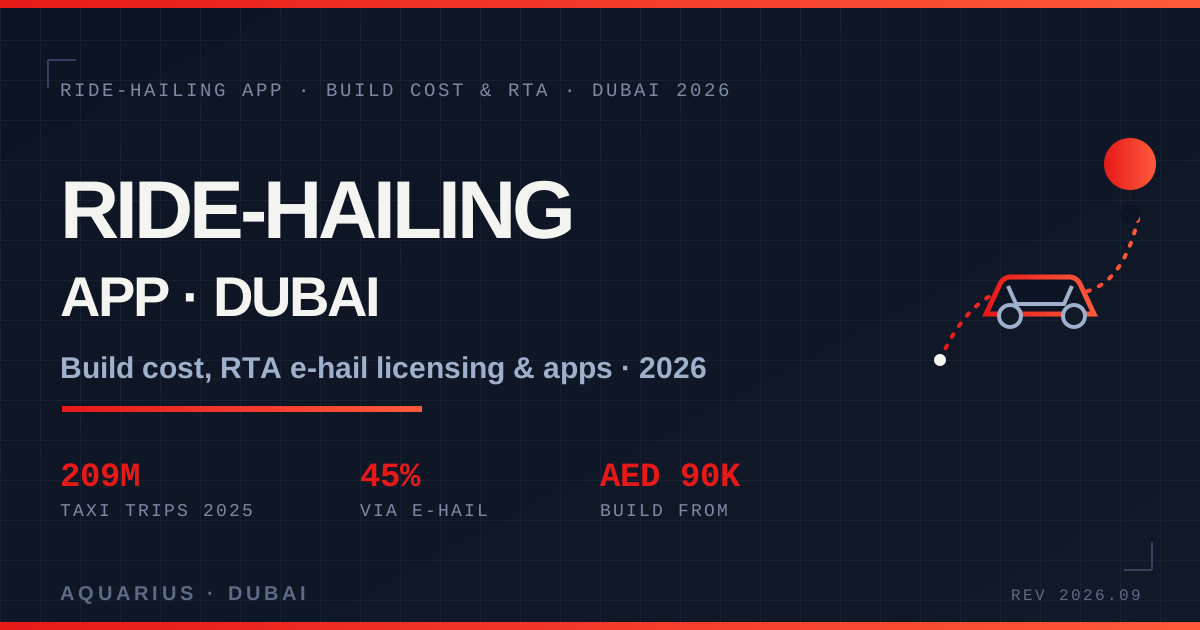
Short answer: a ride-hailing app in Dubai costs roughly AED 90,000–200,000 for a launch-ready MVP (rider app + driver app + admin dashboard, live GPS tracking, RTA-aligned fare engine, card + wallet payments), AED 200,000–450,000 for a custom production platform (surge pricing, corporate accounts, in-app wallet, ratings, fraud checks, scheduled rides), and AED 450,000–1,000,000+ for an enterprise super-app build with AI dispatch, multi-city support, analytics and a public API (before 5% VAT). A white-label clone gets you live in ~6–8 weeks from AED 55,000–185,000 — fastest to market, but you inherit someone else's architecture.
This is the 2026 build guide for Dubai mobility founders, limousine-company owners and fleet operators deciding what a Careem/Uber/Bolt-style e-hail app really costs — and what the RTA will actually let you operate. Updated September 2026.
Key takeaways
- Dubai taxis carried 209.02 million passengers in 2025, up 4.2% on 2024 — and 45% of all taxi trips were booked through e-hail apps, up 13% year on year.
- You cannot just "launch an app": e-hail operators run as booked limousine services needing a DET commercial licence + an RTA operational permit, and every driver needs an RTA Professional Driver Permit.
- MVP build: AED 90K–200K. Custom production platform: AED 200K–450K. Enterprise super-app: AED 450K–1M+. White-label clone: AED 55K–185K.
- The RTA sets and revises the core fare structure for app-booked rides — your surge and pricing logic must be built to stay inside regulated limits, not around them.
Why Dubai mobility is going app-first (the market)
Dubai's taxi and e-hail sector is both huge and accelerating. In 2025 Dubai taxis served 209.02 million passengers (up from 200.65 million in 2024, a 4.2% rise), from a registered fleet of 14,476 vehicles — of which around 90% are now hybrid or electric. The headline for anyone building software: 45% of every taxi trip in 2025 was completed through an e-hail platform, a 13% jump on the year before. App-booked mobility is no longer the challenger channel — it is nearly half the market and climbing.
Zoom out and the demand is even larger. Dubai's public transport, shared and taxi network moved 802.1 million riders in 2025, up 7.4% on 2024's 747.1 million. RTA reporting into early 2026 showed taxi and limousine ridership still growing at double-digit rates. Hala — the RTA–Careem joint venture that lets riders book official RTA taxis inside the Careem app — grew its share of total taxi trips to 41.3% in 2025. That single data point tells you the model that works here: not a rogue disruptor, but an app tightly integrated with the regulator.
Three realities are pushing operators to build in 2026:
- Riders now expect an app, not a phone line. With 45% of trips already e-hailed, a limousine or fleet company without a booking app is invisible to nearly half the demand — and pays a commission to whichever platform owns the rider relationship.
- The regulator is the partner, not the enemy. Uber, Careem, Bolt and Yango all operate legally as booked e-hail/limousine services under RTA permits. The winning play is compliance-first software, wired to RTA fare and permit rules from day one.
- Margins live in the software. Dispatch efficiency, driver utilisation, fraud prevention and retention are all software problems. Owning the stack — instead of renting a platform per-trip — is how operators stop leaking commission on every ride.
What you're actually building — the three-app stack & build tiers
A ride-hailing "app" is really three connected products plus a backend: a rider app (booking, live tracking, fare estimate, payment, rating), a driver app (trip offers, navigation, earnings, availability), and an admin/dispatch dashboard (fleet, drivers, pricing, disputes, analytics), all fed by a real-time backend handling matching, GPS, payments and notifications. What you spend depends on how many features you switch on and how much you build from scratch. Here's how the tiers map to real AED budgets for 2026:
| Build tier | What you get | AED (excl. VAT) |
|---|---|---|
| White-label clone | Rebranded rider + driver + admin apps, standard GPS/dispatch/payments, source code owned, ~6–8 weeks live | 55,000–185,000 |
| MVP (custom) | Rider + driver apps + admin dashboard, live tracking, RTA-aligned fare engine, card + wallet payments, ratings, OTP auth | 90,000–200,000 |
| Production platform | Everything in MVP + surge pricing, in-app wallet, corporate/business accounts, scheduled rides, promo engine, fraud checks, driver payouts | 200,000–450,000 |
| Enterprise super-app | AI dispatch & demand prediction, multi-city/multi-service, BI dashboards, public API, dynamic ETA/routing, high-availability infra | 450,000–1,000,000+ |
Feature priority order for a Dubai launch — build in this sequence and you have a licensable product fastest:
- Real-time GPS & matching — driver location, rider pickup, nearest-driver dispatch, live trip tracking.
- RTA-aligned fare engine — base fare, per-km, waiting, tolls (Salik), airport surcharge, computed inside regulated limits.
- Payments — card, Apple/Google Pay and in-app wallet through a UAE gateway; see our payment gateway integration cost guide.
- Driver onboarding & KYC — Professional Driver Permit, Emirates ID, licence and vehicle documents captured and verified in-app.
- Ratings, support & dispute handling, then surge, wallet, corporate accounts and promos as you scale.
The part founders underestimate: RTA & DET licensing
The software is the easy half. In Dubai you cannot operate a ride-hailing service off a street-hail model — that is reserved for RTA taxis. App-based operators run as booked limousine / e-hail services, which means two licence layers plus driver permits:
- DET commercial licence — a licensed UAE company with the correct transport/limousine activity from Dubai's Department of Economy and Tourism.
- RTA operational permit — approval to operate limousine/e-hail transport, which governs vehicles, fares and how bookings may be taken.
- RTA Professional Driver Permit — every driver needs one (Administrative Resolution No. 516 of 2022): typically age 21–65, a valid licence, medical certificate, clean record and UAE residency.
The commercial catch that shapes your software: the RTA sets and revises the core fare structure for app-booked rides. Operators do not have a free hand on pricing the way a global app might elsewhere. Your fare and surge logic must be engineered to stay inside regulated bands — which is exactly why a compliance-aware fare engine, not a generic clone's pricing module, is worth building properly. This is also where a Dubai-based build team earns its fee: scoping the app around what the permit actually allows.
What it costs to run — and the ROI math
Budget beyond the build. For a production e-hail platform in Dubai, plan for:
- Cloud & real-time infrastructure — roughly AED 3,000–20,000/month depending on trip volume (real-time GPS and matching are the cost driver).
- Maps & routing APIs — usage-based; a material line item at scale, so cache and optimise calls.
- Payment gateway fees — per-transaction on every ride; wallet top-ups reduce this.
- SMS/OTP, push, support and QA — QA alone typically runs 15–20% of development.
- Maintenance & iteration — budget ~15–20% of build cost per year.
The ROI case is commission. Every trip booked on a third-party platform pays that platform a cut; every trip on your app keeps it. For a fleet running even a few hundred trips a day, an owned platform's build cost is typically recovered inside 12–24 months against commission saved — after which the software is a margin engine, not a cost. The cost of waiting is the mirror image: with e-hail already at 45% of trips and rising 13% a year, every quarter without your own app is demand routed through — and monetised by — a competitor's platform.
Weighing a white-label clone against a full custom platform? The same build-vs-buy trade-off we cover for car-rental booking apps applies here: clone to test the market fast and cheap, build custom when compliance depth, surge logic and fleet scale start deciding your margins. See our pricing for indicative Dubai build bands, or talk to us to scope your permit path and feature set.
Frequently asked questions
How much does it cost to build a ride-hailing app like Careem in Dubai?
A launch-ready MVP (rider + driver + admin apps, live tracking, RTA-aligned fares, payments) runs AED 90,000–200,000. A full production platform with surge, wallet and corporate accounts is AED 200,000–450,000, and an enterprise super-app with AI dispatch is AED 450,000–1,000,000+. A white-label clone starts around AED 55,000.
Do I need an RTA licence to launch a taxi app in Dubai?
Yes. App-based operators run as booked limousine/e-hail services requiring a DET commercial licence and an RTA operational permit, and every driver needs an RTA Professional Driver Permit (Administrative Resolution No. 516 of 2022). Street-hailing is reserved for RTA taxis.
Can I set my own fares?
Not freely. The RTA sets and revises the core fare structure for app-booked rides, so your fare and surge engine must be built to stay within regulated limits rather than pricing at will.
Should I build custom or buy a white-label clone?
A white-label clone gets you live in ~6–8 weeks from AED 55K–185K and is ideal for testing demand. Build custom when compliance depth, surge logic, fraud prevention and fleet scale start driving your margins — typically past a few hundred trips a day.
How long does it take to build?
A white-label launch is ~6–8 weeks; a custom MVP is ~3–5 months; a full production platform is ~6–10 months including RTA integration, testing and app-store review.
The bottom line
With 45% of Dubai's 209 million annual taxi trips now booked through apps, e-hail is the market, not a slice of it. Budget AED 90K–200K for a compliant MVP and AED 200K–450K for a production platform — but treat the RTA operational permit, DET licence and driver-permit path as first-class scope, not an afterthought. The operators who win in 2026 are the ones whose software was built around what the regulator allows, and who stopped paying commission on every ride.