
We Read the Robots Directives on 504 .ae Homepages: 1 in 5 Does Nothing
We checked meta robots and X-Robots-Tag on 504 live .ae homepages in November 2026: 19.6% ship a directive that does literally nothing, and only 1.4% use the HTTP header at all.
- PUBLISHED
- 29 NOV 2026
- READ TIME
- 11 MIN
- AUTHOR
- AQUARIUS · DUBAI
- UNIT
- REV 2026.09
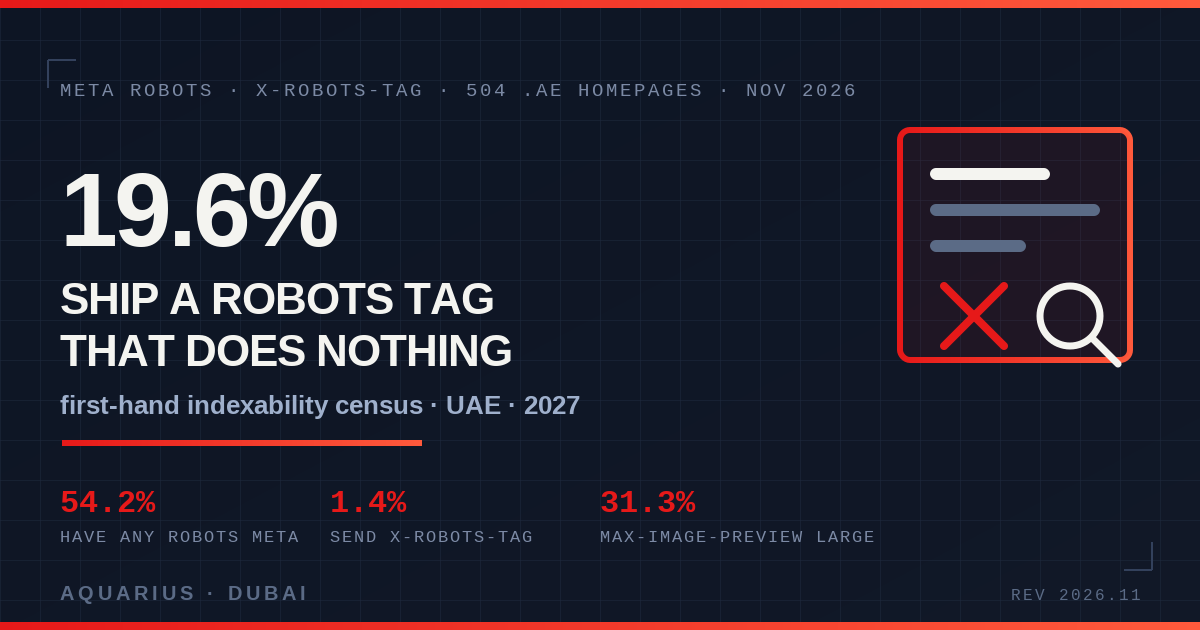
We read the indexing directives on 504 live .ae homepages in November 2026. 273 of them (54.2%) ship a robots meta tag — but 99 of those tags are a pure no-op, telling Google something it already assumed. Only 7 homepages (1.4%) send an X-Robots-Tag HTTP header, the one place a directive can be applied to PDFs, images and files that have no HTML at all. The directives that actually change how a Dubai site appears in search — max-image-preview, max-snippet, nosnippet — are either absent or arrived by accident with an SEO plugin.
Three things make this worth your twenty minutes if you own a UAE website:
- Google holds 95.42% of UAE search in October 2026, against 2.71% for Bing and 1.33% for Yandex (StatCounter). There is no second channel to fall back on if your own markup is throttling you.
- AI Overviews now appear for over 50% of queries tracked in Semrush Sensor as of 28 August 2026 — and a single
nosnippetdirective removes your page from the pool Google uses as direct input for AI Overviews and AI Mode. - UAE e-commerce is a AED 42.2bn market in 2025, heading for AED 67.2bn by 2030 (EZDubai/Euromonitor). A homepage that quietly suppresses its own image preview is competing for that with one hand tied.
The measurement: 504 homepages, two layers, one control pass
This is first-party data. We took a Tranco-ranked list of 787 .ae hostnames, fetched each homepage with a desktop Chrome user agent following redirects, and recorded two layers independently: every <meta> tag in the robots family (robots, googlebot, bingbot, and the rest) and the X-Robots-Tag header on every hop of the redirect chain.
690 hosts answered. 572 returned an HTML 200. We then filtered to homepages with at least 500 characters of extracted text, which removes bot walls and WAF interstitials that would otherwise poison the numbers — 504 real homepages. 102 returned 403 to a normal browser and were dropped. Every host was also re-fetched with the Googlebot user-agent string as a control, so we could tell a genuine directive apart from a page that only misbehaves for crawlers.
One worked example of why the filter matters: gvs-trading.ae returns noindex, nofollow, which looks like a catastrophic own goal. Its title is “Security check”. That is a WAF challenge page, not the company's homepage, so it is excluded from the self-noindex count below rather than reported as a finding.
Finding 1: a fifth of .ae homepages ship a directive that does nothing
Of the 504, 273 (54.2%) ship a robots meta, 229 ship neither a meta nor a header, and 5 ship both. The interesting number is inside the 273: 99 homepages — 19.6% of the whole set — ship a robots tag whose entire content is index, follow, all or long-dead directives.
Google's own documentation is blunt about this: all is the default value and “has no effect if explicitly listed”. index and follow are the same — they restate the default. A homepage with <meta name="robots" content="index, follow"> has the identical crawl and index outcome as a homepage with no tag at all. It is a comfort blanket, and in 99 cases it is the only robots directive on the page.
| Directive token | Homepages (of 504) | Does it change anything? |
|---|---|---|
index | 247 | No — restates the default |
follow | 244 | No — restates the default |
max-image-preview:large | 165 | Yes — unlocks large images in Discover |
max-snippet:-1 | 94 | Yes — removes the snippet length cap |
max-video-preview:-1 | 93 | Yes — only if you publish video |
nofollow | 7 | Yes — and almost never intentional on a homepage |
noodp | 7 | No — dead since 2017 |
notranslate | 7 | Yes — suppresses translated results |
noindex | 5 | Yes — removes the page from search |
all | 5 | No — explicitly the default |
noydir | 3 | No — Yahoo directory closed |
noimageindex | 2 | Yes — drops your images from image search |
noodp is the clearest fossil. Google's Search Central blog said in June 2017, in Gary Illyes's words, that with DMOZ closed “we stopped relying on its data and thus the NOODP rule is already no-op” — DMOZ was switched off on 17 March 2017. Seven UAE homepages are still sending it in late 2026, which dates the last serious head-tag review on those sites to roughly a decade ago.
Finding 2: only 1.4% use the header — and one of them contradicts itself
Seven homepages out of 504 send an X-Robots-Tag. That matters more than it sounds, because the header is the only way to set a directive on something that has no HTML head: a price-list PDF, a brochure, a generated image, a staging directory. If your Dubai site has a /downloads folder full of PDFs you would rather not rank above your service pages, a meta tag cannot help you. Almost nobody in the .ae top tier has that control wired up.
The one deployment we found that is actively doing damage is clean.ae. Its HTML says index, follow. Its HTTP response says X-Robots-Tag: noindex, nofollow. Google resolves conflicts by favouring the most restrictive rule, so the header wins and the homepage is asking to be dropped from search while the markup in the page insists otherwise. This is the exact failure mode that only shows up in a header-level audit — view-source looks perfectly healthy.
Finding 3: two homepages are telling Google to leave
After excluding the WAF page, two homepages carry a genuine self-inflicted noindex: inhealth.ae with noindex, nofollow and jasani.ae with noindex. Both are real, text-bearing commercial homepages. Add clean.ae's header and three of the 504 most-visited .ae sites are currently instructing the search engine that owns 95.42% of UAE queries not to list their front door.
This is almost always a staging artefact. A noindex is added to protect a pre-launch site, launch happens, and nobody removes it. It costs nothing to check and it is the single highest-severity technical SEO defect that exists.
A softer version of the same problem sits with the e& domain storefronts: etisalatdomains.ae, uaenic.ae and nic.ae all ship index, nofollow, noodp. That nofollow on a homepage tells Google to ignore every internal link on the page — the exact links that are supposed to distribute authority into the rest of the site.
Finding 4: large image previews in the UAE are a plugin side effect
158 homepages (31.3%) carry max-image-preview:large. 68.7% do not. Google's Discover documentation is explicit that a large image is “enabled by the max-image-preview:large setting, or by using AMP”, with the image itself needing to be at least 1200px wide, over 300,000 pixels in area, and ideally 16x9. Without the directive you get a thumbnail, in a market where mobile is 67.8% of UAE traffic (StatCounter) and the visual slot is most of the click decision.
Here is the part that should bother anyone paying for SEO: 86 of those 158 arrived as part of the Yoast/Rank Math triple — max-snippet:-1, max-image-preview:large, max-video-preview:-1 emitted verbatim by the plugin. That is 17.1% of all 504. Large-preview eligibility in the UAE is overwhelmingly something that happened to a site, not something a site chose. Two homepages went the other way deliberately: jafza.ae and cyber50.ae both ship max-image-preview:none together with noimageindex, which is a defensible choice for a free-zone authority and a very expensive one for anyone selling a product.
Government portals are the weakest group
37 .gov.ae homepages passed the text filter. Only 17 (45.9%) ship a robots meta at all, just 4 have max-image-preview:large, and 12 of the 17 are no-op-only tags. Public-sector UAE sites are the ones most likely to be surfaced in an AI Overview answering a residency, licensing or fee question, and they are the least likely to have told Google how much of themselves to show.
One of them is sending a directive that cannot work. ajmanpolice.gov.ae emits max-image-preview:large — the colon HTML-escaped by a template that over-sanitised its own output. Google parses that as an unknown token and silently ignores it. The tag is there, the effect is not, and nothing in Search Console will ever flag it.
Nine homepages ship two robots metas on the same page. tax.gov.ae emits index, follow twice, which is harmless. edenred.ae emits one modern tag plus a second containing noodp, noydir — two generations of SEO advice stacked in the same head, with the risk that the next directive someone adds lands in the wrong one.
The control pass: 12.3% refuse the Googlebot user agent
Re-fetching all 504 with the Googlebot UA string changed the robots directive on only 4 of 442 comparable hosts. Directives in the .ae field are honest — sites are not cloaking one answer to users and another to crawlers.
What did change is access. 62 of 504 homepages (12.3%) returned a non-200 or an outright error to the Googlebot UA string while serving a browser normally. Be careful with that number: a forged UA header is not Googlebot, and a WAF treating an unverified claim with suspicion is behaving correctly. It is not proof that real, IP-verified Googlebot is being blocked. It is a strong signal that one in eight of these sites has edge rules nobody has tested against the reverse-DNS verification path, which is exactly how a site discovers a crawl collapse six weeks after the fact. The server mix behind the 504 explains where those rules live: 241 Cloudflare, 102 with no server header, 53 nginx, 32 Apache, 16 IIS, 14 LiteSpeed, 9 Vercel.
What to publish instead (BOFU)
For most Dubai businesses the correct homepage robots tag is either nothing at all or one line that does real work. Delete the comfort blanket, keep the controls.
| Work | What it fixes | Typical AED | Timeline |
|---|---|---|---|
| Indexability audit (meta + header + robots.txt + canonical) | Finds every noindex, header conflict, dead token and escaped directive across the site | AED 2,500 – 5,500 | 3 – 5 days |
Directive clean-up and X-Robots-Tag rollout | Removes no-ops, sets max-image-preview:large, applies headers to PDFs and non-HTML assets | AED 3,000 – 7,500 | 1 week |
| Crawler access review at the edge | Verifies Googlebot and Bingbot by reverse DNS instead of UA string, fixes WAF rules | AED 4,000 – 9,000 | 1 – 2 weeks |
| Monitoring and regression alerts | Catches a noindex the day it ships, not the quarter it ships | AED 1,200 – 2,800 / month | Ongoing |
Our full engagement ranges are on the pricing page. For the neighbouring gaps in the same dataset, see our JSON-LD structured-data census and the .ae sitemap discovery scan — robots directives, structured data and sitemaps are the three signals that decide whether a crawl turns into a listing.
How Aquarius does it
We measure before we advise, because every number above came from a probe rather than an opinion. Against your domain we check the meta layer and the header layer separately on every redirect hop, test apex and www, re-run with verified crawler identity instead of a spoofed UA, check your PDFs and uploads directories for directives you cannot set in HTML, and diff the result against your last snapshot so a regression surfaces in days.
The risk-reversal is simple: this is a fixed-scope audit with a written finding list, and if we find nothing wrong with your directives you get the report and we tell you to spend the budget elsewhere. Against a market where a single stale noindex can remove you from 95.42% of UAE search while the page looks perfect in a browser, it is the cheapest insurance on the technical backlog.
FAQ
Should my homepage have <meta name="robots" content="index, follow">?
It does nothing. Google treats indexing and link-following as the default and documents that all — the combined form — has no effect when explicitly listed. Keeping it is harmless; believing it is doing something is not. Replace it with max-image-preview:large, max-snippet:-1 if you want a tag that actually changes your result.
What is the difference between the robots meta tag and X-Robots-Tag?
Same directives, different delivery. The meta tag only works on HTML pages. The X-Robots-Tag HTTP header works on anything your server returns — PDFs, images, feeds, ZIPs — and is the only option for files with no head section. If the two disagree, Google applies the more restrictive one, which is how clean.ae ends up noindex despite markup that says otherwise.
Will nosnippet keep my site out of AI Overviews?
Yes, and that is the trade-off. Google states that nosnippet content is not used as direct input for AI Overviews or AI Mode. With AI Overviews showing on over half of tracked queries as of August 2026, a blanket nosnippet is a decision to be absent from the answer layer. Use data-nosnippet on specific elements instead — only 4 homepages in our 504 did.
How do I know if my Dubai site is blocking Googlebot at the firewall?
Not by changing your user agent — a WAF should distrust a forged header, which is why 12.3% of our set returned errors to a Googlebot UA string that proves nothing. Use the crawl stats and URL Inspection live test in Search Console, and have whoever owns your edge configuration verify crawlers by reverse DNS lookup rather than by the UA they claim.
If you want to know which of these your own site is doing right now — including the PDFs and subdomains you have forgotten about — send us the domain and we will run the same two-layer probe we ran on all 787.