
SaaS MVP Development in Dubai (2026): Real Build Cost, Tech Stack, Timeline & How Founders Ship Fast
What it really costs and takes to build a SaaS MVP in Dubai in 2026 — realistic AED budgets, the right tech stack, a ship-fast timeline, and the mistakes that burn founder runway.
- PUBLISHED
- 12 SEPT 2026
- READ TIME
- 12 MIN
- AUTHOR
- AQUARIUS · DUBAI
- UNIT
- REV 2026.09
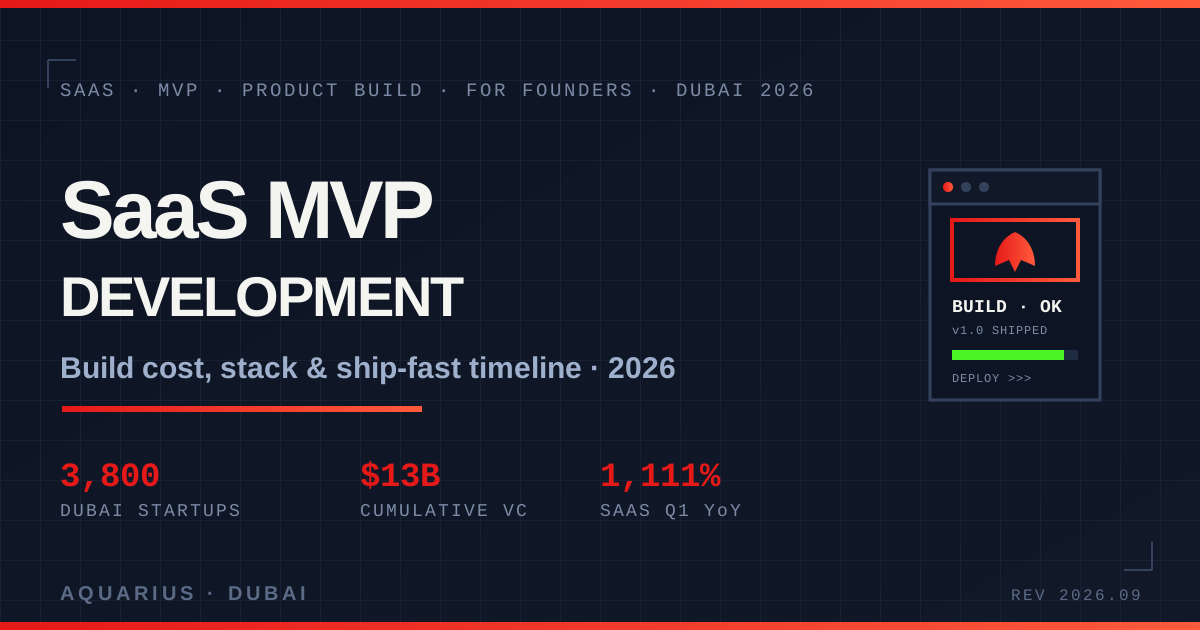
Short answer: A focused SaaS MVP in Dubai in 2026 typically costs AED 90,000–250,000 and ships in 8–16 weeks — if you scope it to one core workflow, one payment flow and one user type. Anything priced far below that is a prototype that won't survive real users; anything far above usually means you're building v2 features before proving v1. Build the smallest thing a paying customer will actually pay for, launch, then let usage — not opinion — decide what's next.
Key takeaways
- Dubai hosts 3,500–3,800 active startups and captures nearly half of all MENA venture capital — the demand for shipped product is real.
- The UAE attracted $3.5B+ in VC in 2026 and is MENA's most-funded ecosystem for the fourth year running; Dubai alone holds $13B+ in cumulative startup investment.
- SaaS is the hottest category — enterprise/SaaS models pulled AED 2.53B in Q1 2026, a 1,111% year-on-year jump.
- Realistic MVP build cost: AED 90K–250K, shipped in 8–16 weeks.
- The #1 runway killer is scope: building for imagined users instead of one real, paying workflow.
Why Dubai is the place to ship a SaaS MVP in 2026
Founders aren't imagining the momentum. Dubai is now home to between 3,500 and 3,800 active startups and captures close to half of all venture capital deployed across MENA, accounting for roughly 35–40% of regional deal volume. The UAE pulled in more than $3.5 billion in VC during 2026 — its fourth consecutive year as MENA's most-funded ecosystem — and Dubai has attracted over $13 billion in cumulative startup investment.
And the money is flowing to exactly this category: SaaS and asset-light enterprise models secured AED 2.53 billion in Q1 2026 alone — a 1,111% year-on-year increase. Add 30+ free zones offering 100% foreign ownership and full profit repatriation, and the maths is simple: capital, customers and licensing all favour founders who can put a working product in front of users fast. The bottleneck isn't opportunity — it's shipping.
What actually belongs in an MVP (and what doesn't)
The word "minimum" does the heavy lifting. An MVP is not a smaller version of your dream product — it's the single workflow that proves someone will pay. Everything else is a distraction that eats runway.
In the MVP: one core job-to-be-done, sign-up/auth, one payment or subscription flow (AED via Stripe/Telr/Network International), the primary dashboard, and basic admin. Not in the MVP: multi-role permissions, a second language, native mobile apps, an analytics suite, integrations you "might need", and a settings page with 40 toggles. You add those once real usage tells you they matter — not before.
The discipline is brutal but it's the whole game: every feature you cut is a week of runway you keep and a week sooner you learn whether the core idea holds.
The right 2026 tech stack for a Dubai SaaS MVP
Pick boring, proven, hire-able technology — not whatever trended last month. The goal is speed to first customer and easy handover, not architecture-astronaut points.
| Layer | Sensible 2026 default | Why |
|---|---|---|
| Frontend | Next.js (React) + TypeScript | Fast to build, SEO-ready, huge talent pool in the UAE |
| Backend/API | Node (NestJS) or a serverless API | One language across the stack; scales without a rewrite |
| Database | PostgreSQL (managed) | Reliable, relational, cheap to run at MVP scale |
| Auth | Clerk / Auth0 / Supabase Auth | Don't hand-roll auth — buy it, ship weeks faster |
| Payments | Stripe / Telr / Network International | AED billing, cards, Apple/Google Pay, recurring |
| Hosting | Vercel + managed DB, or a UAE VPS if data residency matters | Cheap, fast; go local only when compliance requires it |
| AI features | Claude / LLM API where it adds real value | A genuine AI copilot can be the wedge — if it solves a real job |
One rule that saves the most money: buy the commodity, build the differentiator. Auth, payments, email and file storage are solved problems — use managed services. Spend your build hours only on the thing customers can't get anywhere else. If PDPL data-protection rules apply to your users, factor data residency into the hosting choice early.
What a SaaS MVP costs to build in Dubai (real 2026 AED ranges)
These are agency build estimates for the Dubai market in 2026 — not licensing or free-zone fees, which are separate. The spread comes almost entirely from scope and how much custom logic sits behind the core workflow:
- Lean MVP — one workflow, auth, payments, basic dashboard: AED 90,000–150,000 · 8–12 weeks. Enough to launch and win first paying users.
- Standard MVP — + admin panel, subscription tiers, one integration, basic analytics: AED 150,000–250,000 · 12–16 weeks. The realistic target for a fundable, demo-ready product.
- AI-native MVP — + a genuine LLM copilot/agent as the core wedge: AED 200,000–350,000+ · 14–20 weeks. Worth it only when the AI is the product, not a bolt-on.
- Ongoing: budget 15–20% of build per year for hosting, maintenance and iteration once you have users.
For comparison, a full custom product build runs far higher — see our cost to build a website or app in Dubai guide. The reason MVPs stay in the AED 90K–250K band is discipline: you're buying speed to a paying customer, not a finished company.
How Aquarius ships SaaS MVPs
We start by cutting scope, not adding it. In week one we pin down the single workflow worth paying for, choose managed services for everything commodity, and lock a fixed feature list so the budget can't drift. Then we ship in tight iterations on a Next.js + Node + Postgres stack you can hand to any UAE developer later. You get a working, deployable product — not a slide deck — and the code, so you're never hostage to an agency. The cost of getting this wrong isn't a bad app; it's spending your entire runway before you ever learn whether customers care.
Frequently asked questions
How long does a SaaS MVP take to build in Dubai?
A lean MVP ships in 8–12 weeks; a fundable, demo-ready standard MVP in 12–16 weeks. AI-native builds add a few weeks for model integration and evaluation.
How much should I budget?
AED 90,000–150,000 for a lean MVP, AED 150,000–250,000 for a standard one, and AED 200,000+ if a real AI copilot is the core of the product. Licensing and free-zone fees are separate.
Do I need a UAE trade licence before building?
You can build in parallel, but you'll need a licence to invoice UAE customers, open a corporate bank account, and take payments. Dubai's 30+ free zones offer 100% foreign ownership — pick one that fits your sector.
Should my MVP include AI?
Only if AI solves the core job better than anything else. A genuine LLM copilot can be your wedge; AI sprinkled on for marketing just adds cost and complexity.
Who owns the code?
You should. Insist on full source-code ownership and a documented handover so you're never locked to one vendor.
The bottom line
Dubai has the capital, the customers and the licensing to make 2026 a great year to launch a SaaS product — but only founders who actually ship get to play. Scope to one paying workflow, buy the commodity and build the differentiator, budget AED 90K–250K, and launch in 8–16 weeks. Then let real usage guide v2. Talk to Aquarius about scoping your MVP, or explore our development services and other Dubai build guides.