
SaaS Sprawl in Dubai (2026): The AED You Are Burning on Unused Licences and the Audit That Finds It
UAE companies waste about 32% of their SaaS budget and 37% of licences sit unused. How to audit a Dubai software stack in AED, plus the VAT, PDPL and e-invoicing traps.
- PUBLISHED
- 29 OCT 2026
- READ TIME
- 12 MIN
- AUTHOR
- AQUARIUS · DUBAI
- UNIT
- REV 2026.09
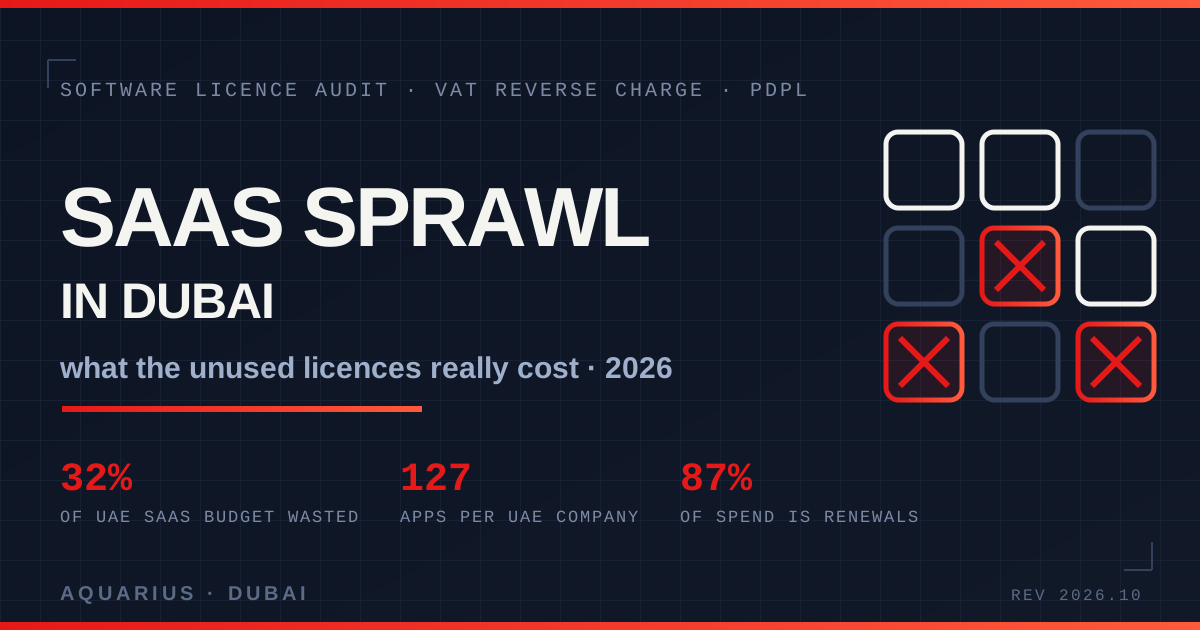
Short answer: the average UAE company now runs 127 SaaS applications and wastes roughly 32% of its software budget on duplicate tools, orphaned accounts and licences nobody opens. On a 60-person Dubai team paying the UAE average of AED 12,800 per employee per year, that is about AED 246,000 a year leaving the business through the company card — and because most of it is billed by foreign vendors, it also drags 5% VAT reverse-charge and PDPL cross-border exposure behind it.
The numbers behind the sprawl
Software is now the fastest-growing line in every IT budget on earth. Gartner's July 2026 forecast puts worldwide software spending at USD 1,468 billion in 2026, up 15.5%, outpacing hardware, IT services and communications inside a total IT spend that crosses USD 6 trillion for the first time.
The UAE is riding the same curve harder than most. The UAE cloud services market is valued at roughly USD 6.15 billion in 2026, heading to USD 9.34 billion by 2032 at a 7.21% CAGR, with SaaS alone accounting for about half of it (MarkNtel Advisors). UAE enterprises put over USD 3.2 billion into SaaS applications in 2024, growing at a projected 28% a year through 2027.
Here is the part nobody puts in a board pack. CloudNuro's analysis of UAE enterprise SaaS usage found that UAE companies waste an average of 32% of their SaaS budgets on redundant subscriptions, orphaned accounts and overlapping tools, and that 37% of paid licences sit unused or underutilised. The average UAE portfolio has gone from 47 applications three years ago to 127 today. Per-employee spend averages AED 12,800 a year — against a global average of about USD 2,900 — and Dubai financial services firms routinely clear AED 18,000 per head.
Zylo's 2026 SaaS Management Index, built on real spend data rather than survey recall, shows the same shape at a bigger scale: an average of 305 applications per company, licence utilisation of just 54% (improved from 47% the year before), 46% of applications underutilised or unused outright, and USD 19.8 million of annual waste in the measured cohort. Application counts were essentially flat year over year at −0.07% — yet spend still rose 8%. Nobody bought more tools. The same tools simply cost more.
Most Dubai businesses get this wrong: they treat SaaS sprawl as a tidiness problem for the IT guy. It is a cash-flow problem with a tax and data-protection tail. Every undocumented foreign subscription is an unreported reverse-charge transaction and an unassessed cross-border transfer of personal data at the same time.
Where the money actually leaks
Sprawl is not one problem. It is six, and they need different detection methods. The recovery percentages below are what we typically see on a first pass through a Dubai SME stack; the AED column models them against a modest AED 1,000,000 annual software spend, which is roughly where a 70–90 person Dubai company lands at UAE averages.
| Leak | How you find it | Typical recovery | On AED 1m of spend |
|---|---|---|---|
| Orphaned accounts — leavers still licensed | Reconcile HR leaver list against every admin console and SSO directory | 3–8% | AED 30,000–80,000 |
| Inactive licences — paid seats, no logins in 60–90 days | Per-app last-login export; SSO sign-in logs | 8–15% | AED 80,000–150,000 |
| Duplicate categories — three tools, one job | Map every app to one business capability; flag any capability with 2+ paid tools | 4–10% | AED 40,000–100,000 |
| Over-tiered plans — Enterprise bought for one feature | Feature-usage reports vs the tier you pay for | 3–7% | AED 30,000–70,000 |
| Silent auto-renewals | Contract register with notice-period dates, 90 days ahead | 5–17% | AED 50,000–170,000 |
| Shadow IT and shadow AI — card-paid tools IT never saw | Card and bank statement sweep + OAuth grant audit in Microsoft 365 or Google Workspace | 2–6% | AED 20,000–60,000 |
Two of those deserve a closer look, because 2026 changed them both.
Renewals are where the budget is decided, not procurement
Zylo's index found that renewals account for 87% of total software spend, with an average of 211 renewals per organisation per year — roughly four every week. That is the single most under-managed number in most Dubai finance functions, and vendors know it. In the same research, 79% of IT leaders hit a price increase at renewal, 77% encountered unexpected costs after signing, and 78% reported surprise charges tied to consumption-based or AI features. The consequence is not abstract: 61% of organisations were forced to cut projects or initiatives because of unplanned SaaS cost increases.
Renegotiation works when it is scheduled rather than reactive — Zylo reports an average of 17% saved at renewal by customers who manage the date instead of discovering it on a card statement.
Seat counting no longer tells you what you will pay
The pricing model moved underneath everyone. By Q2 2026, usage-based pricing had become the single most common SaaS model at 36.5% of vendors, passing per-user pricing at 32.4%. Pure per-seat pricing has fallen to around 15% of vendors, with hybrid models climbing from 27% to 41% adoption in twelve months. Consumption lines are harder to forecast and much harder to cap — which is why a licence audit that only counts seats now misses a growing share of the bill.
AI is the sharp end of that. Cledara's March 2026 benchmark across companies of 30–500 employees found 79% now pay for at least one AI tool, averaging USD 15,300 a year across 3.7 subscriptions (median closer to USD 3,900). AI is about 5.6% of total SaaS spend on average and over 10% for heavy adopters, growing more than 100% year over year — Zylo clocked AI-native application spend up 108%. And it mostly arrives unsanctioned: 59% of employees use unapproved AI tools, and shadow AI adds an estimated 20–30% on top of known AI costs. BetterCloud's July 2026 survey of 525 IT and security professionals found only 56% of applications in use are IT-approved, with new unsanctioned tools discovered at 21% of organisations and data leaks from AI tools at 18%. Most of that traffic rides on unmanaged accounts and unmanaged devices — the same gap we cover in our Dubai BYOD and device management guide.
The UAE layer: VAT, e-invoicing and PDPL
This is where Dubai differs from a generic cost-cutting article, and where sprawl stops being just expensive.
5% VAT by reverse charge. Software licences, SaaS platforms, cloud hosting, online advertising and remote IT support bought from a supplier with no UAE establishment are imported services. Under Article 48 of the VAT law the UAE recipient self-accounts for 5% VAT on them, regardless of the vendor's home rate. From 1 January 2026 the amended rules removed the requirement to issue a self-invoice for reverse-charge transactions — but the VAT still has to be calculated and reported, and you must retain the foreign supplier's invoice and supporting records. A subscription paid on a personal card and reimbursed through petty cash produces neither. Multiply that by the 40-odd shadow subscriptions a mid-sized Dubai company typically carries and you have a reconciliation problem at the next FTA review.
E-invoicing makes your vendor register mandatory. The UAE e-invoicing regime opened its voluntary pilot on 1 July 2026. Businesses with annual revenue of AED 50 million or more had to appoint an Accredited Service Provider by 30 October 2026, with mandatory exchange from 1 January 2027; smaller businesses follow from 1 July 2027 and government entities from 1 October 2027. The Ministry of Finance published Version 1.1 of its guidelines in June 2026. A decentralised model reporting to the FTA in near real time rewards companies that already know exactly who they buy from — and punishes the ones discovering vendors on a card statement.
PDPL and the transfers you never assessed. Federal Decree-Law No. 45 of 2021 restricts moving personal data outside the UAE unless the destination offers adequate protection, appropriate safeguards are in place, or a narrow exemption applies — and the UAE Data Office has still not published an adequacy list or issued standard contractual clauses. A documented transfer risk assessment is expected before data leaves. Penalties run from AED 50,000 to AED 5 million. Every shadow SaaS tool holding a customer list is an undocumented cross-border transfer. Note too that a jurisdiction treated as adequate under DIFC's data protection law is not automatically adequate under the federal PDPL, so multi-entity Dubai groups need both analyses.
And the plain tax point: with UAE corporate tax at 9% on taxable income above AED 375,000, a software cost you cannot evidence is a deduction you may not keep.
What an audit costs in Dubai, and when to build instead
Our engagement ranges below exclude 5% VAT. Scope is driven by headcount and the number of apps discovered, not by a percentage of your spend — we do not take a cut of savings, because that incentive quietly pushes consultants toward cancelling tools your team actually needs.
| Engagement | Scope | AED |
|---|---|---|
| Discovery sprint | Full app inventory from 14 sources, owner map, spend baseline, quick-win list | 8,000–18,000 |
| Full licence and renewal audit | Discovery plus per-app utilisation pull, overlap matrix, renewal calendar, negotiation brief per vendor | 20,000–55,000 |
| Compliance overlay | Reverse-charge reconciliation pack, vendor data-transfer register, PDPL assessment per processor | 15,000–40,000 |
| Consolidation build | Replacing 3–6 overlapping subscriptions with one internal tool you own | 60,000–180,000 |
| Ongoing governance | Renewal watch, monthly spend review, new-app intake workflow | 2,500–9,000 / month |
Consolidation is the part worth doing arithmetic on. Four overlapping tools at AED 4,500 a month combined is AED 54,000 a year, or AED 270,000 over five years with no asset at the end and a renewal price you do not control. A focused internal replacement at AED 95,000 plus AED 3,500 a month of care totals about AED 305,000 over the same five years — close to a wash on cash, but you own the code, the data sits where you chose, and the cross-border transfer disappears. That maths only works for a stable, core workflow. For anything the market innovates on faster than you can — email, accounting, design, model APIs — subscribe and negotiate. Deciding which backbone system to own first is a related question we work through in CRM vs ERP for Dubai SMEs.
Note that none of this touches your infrastructure bill. SaaS sprawl is subscriptions; cloud waste is metered compute and egress, with its own levers — that is the subject of our Dubai cloud cost optimisation and FinOps guide. Most Dubai companies have both problems and only ever look at one.
How Aquarius runs it, in three weeks
- Week 1 — discovery. Card and bank statements, AP ledger, VAT reverse-charge records, SSO directory, Microsoft 365 or Google Workspace OAuth grants, browser-extension inventory, and a five-minute survey of every department head. Output: one register with app, owner, cost, renewal date, data classification and vendor jurisdiction.
- Week 2 — evidence. Per-app utilisation exports, orphaned-account reconciliation against the HR leaver list, a capability overlap matrix, and a tier-versus-feature-usage check on your five biggest contracts.
- Week 3 — decisions. A ranked cut, keep, downgrade or renegotiate list with AED attached to each line, vendor negotiation briefs with your renewal dates and alternatives, a PDPL transfer register, and an intake workflow so the sprawl does not return by Q2.
The recovery is usually faster than the engagement. CloudNuro's UAE data suggests organisations typically recover 15–25% of SaaS spend within the first quarter through licence optimisation alone — on an AED 3 million stack, AED 450,000 to AED 750,000. Against an audit priced in the tens of thousands, the cost of inaction is the only expensive option on the table.
Frequently asked questions
How do I find every SaaS subscription we are paying for?
No single source has all of them, which is why sprawl survives. Use six in parallel: twelve months of company card and bank statements (search for the usual billing descriptors), the AP ledger, your VAT reverse-charge records for imported services, your SSO or identity provider sign-in logs, the third-party app and OAuth grant list in Microsoft 365 or Google Workspace, and a direct question to every department head. Expect the final count to exceed IT's list by 30–50%; BetterCloud's 2026 data puts roughly half of all tools in use outside IT oversight.
Is SaaS sprawl really a compliance problem in the UAE, or just a cost one?
Both, and the compliance half is the one with a fine attached. Each foreign subscription is an imported service requiring 5% VAT self-accounting under the reverse charge, and each tool holding customer or employee personal data is a cross-border transfer under PDPL that should have a documented risk assessment behind it, with penalties from AED 50,000 to AED 5 million. The e-invoicing rollout from 2027 makes a clean, complete vendor register operationally necessary rather than merely good practice.
Should we build our own tool instead of subscribing?
Only for stable, core workflows that are specific to how your business runs — the ones where you are paying for three tools and a staff member's manual workaround to simulate one missing feature. Four overlapping subscriptions at AED 4,500 a month run to AED 270,000 over five years, which is comparable to a focused internal build you own outright. For commodity categories that improve faster than you could maintain them, subscribing and negotiating is the cheaper answer by a wide margin.
What does a SaaS audit cost in Dubai?
A discovery sprint runs AED 8,000 to 18,000; a full licence and renewal audit AED 20,000 to 55,000, depending on headcount and how many applications surface. Avoid success-fee models that pay a percentage of savings — the incentive is to cut, not to right-size, and you will pay for the same tool twice when a team quietly re-subscribes.
How do we stop sprawl from coming back?
Three mechanisms, all boring. One named owner per application, with cost attached to their budget line. A new-app intake request that takes five minutes and asks what it replaces. And a renewal calendar reviewed monthly, 90 days ahead of each notice period — because renewals are 87% of your spend and roughly four of them land every week.
Want to know what your real number is? Send us your headcount and twelve months of card statements and we will return a first-pass app count with an AED waste estimate — free, before you commit to anything. Our standard engagement ranges are on the pricing page.