
Sales Commission Software in Dubai (2026): Splits, Clawbacks and the AED 13.59 Billion Payout Problem
Dubai brokers were paid AED 13.59 billion in commission in 2025 and most of it was calculated in a spreadsheet. Real AED costs for a commission engine that survives an audit.
- PUBLISHED
- 08 NOV 2026
- READ TIME
- 12 MIN
- AUTHOR
- AQUARIUS · DUBAI
- UNIT
- REV 2026.09
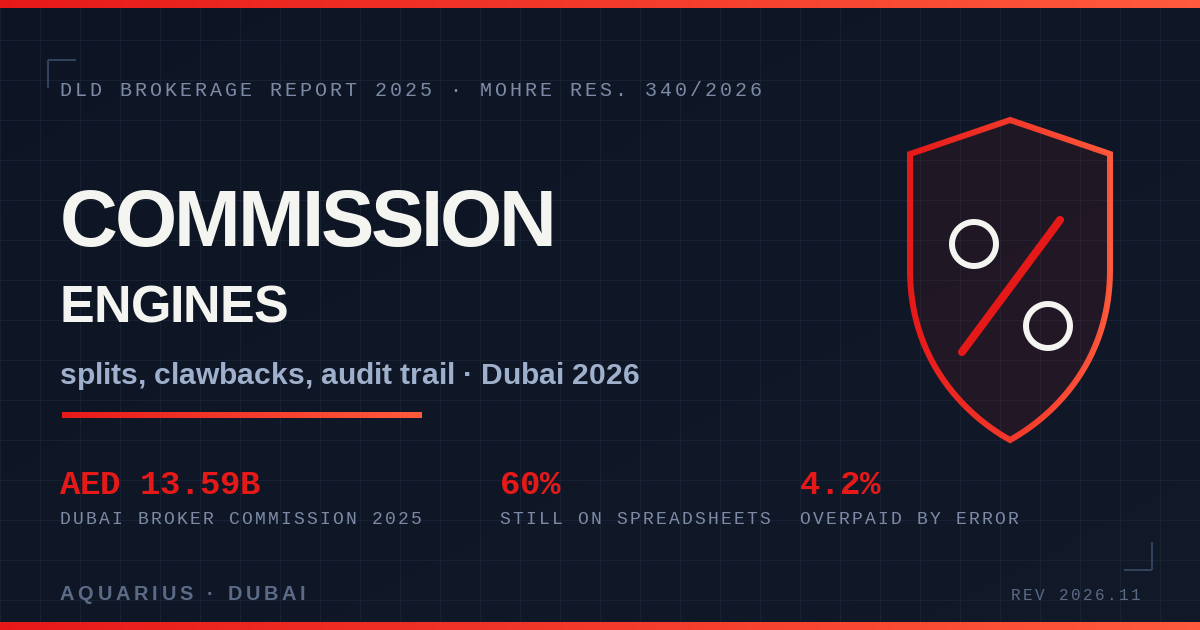
Short answer: commission software in Dubai is not a payroll add-on, it is a calculation ledger. Dubai brokers alone were paid AED 13.59 billion in commission in 2025, yet roughly 60% of organisations still run commissions primarily in spreadsheets, where measured overpayment runs about 4.2% against 0.5–1% on a proper engine. Expect AED 35,000–75,000 for a commission engine bolted onto an existing CRM, AED 90,000–210,000 for a custom calculation and payout portal, and AED 210,000–450,000 for a multi-entity platform that covers several commission lines with Arabic approvals and a full audit trail.
Most Dubai businesses get this wrong in the same way: they buy a CRM to capture the deal, an accounting package to book the invoice, and then calculate the money that sits between them by hand, every month, in a file that only one person understands.
The commission pool nobody reconciles
Dubai Land Department data put real estate brokerage commissions at AED 13.59 billion in 2025, up 31% on 2024, with broker-executed transactions rising 54% to 96,440. The broker population itself grew by 13,083 people in a single year — a 38% jump — to 32,294 registered brokers across 9,785 registered brokerage offices. Women in the sector executed 28,909 transactions and earned AED 2.98 billion in commission, up 83%.
That is the headline number, but it is not the whole exposure. The UAE insurance market wrote around AED 75.2 billion in gross written premium in 2025, up 15.5%, with another 15.1% year-on-year rise in Q1 2026 and 17.8 million policies in force. Roughly 161 CBUAE-registered brokers intermediate about 67% of health and 60% of motor business, earning an estimated USD 590 million in commission, remuneration and servicing fees. Add distribution, travel, education agents and B2B software resellers and variable pay is one of the largest controllable cash outflows in the emirate.
Every dirham of it is calculated by somebody. In most Dubai companies that somebody is a finance analyst with a 40-tab workbook and three days before payday.
The shareable version: a brokerage paying AED 20 million a year in commission and running it on spreadsheets is statistically leaking around AED 840,000 a year in overpayment alone — before a single underpaid agent files a dispute.
Why spreadsheets fail at this specific job
Commission is the worst possible workload for a spreadsheet, because it combines high volume, frequent rule changes and personal money. The research is unambiguous:
- More than 80% of non-trivial spreadsheets contain at least one error. Commission workbooks are about as non-trivial as business spreadsheets get.
- Manual commission processes carry a 3–8% error rate. Benchmarks put spreadsheet overpayment at roughly 4.2%, against 0.5–1% for teams on a calculation engine.
- 60% of organisations still rely primarily on spreadsheets for commission management, according to a 2026 survey of 424 sales and commercial operations leaders.
- Errors do not stay hidden. Underpaid reps keep shadow spreadsheets, and commission disputes are associated with a 9% quit rate among sales professionals. In a market adding dozens of new brokers a day, your best producer is the one with the most options.
Overpayment is the quieter problem. Nobody reports a commission that came in too high, so the error compounds silently until an auditor or a corporate tax review finds it. By then it is a recovery conversation with a person who has already spent the money.
Four rules that make Dubai commission different
Generic commission platforms are built for US and European pay structures. Four UAE-specific rules routinely break them.
1. Gratuity runs on basic wage, not total earnings
Article 51 of Federal Decree-Law No. 33 of 2021 calculates end-of-service gratuity on basic wage only — 21 days per year for the first five years, 30 days a year after that, capped at two years' basic wage. Commission, bonus, housing and transport are all excluded. If your system stores one blended "earnings" figure per employee, you cannot calculate gratuity correctly, and a commission-heavy pay structure quietly suppresses the end-of-service accrual. That is legal, but it needs to be deliberate and documented. Our end-of-service and savings scheme breakdown covers the payroll data model in detail.
2. WPS tightened in June 2026
MOHRE Ministerial Resolution No. 340 of 2026 took effect on 1 June 2026, repealing Resolution No. 598 of 2022. It raises the Wage Protection System compliance threshold from 80% to 85% of total wages transferred on time, and fixes a single deadline: wages for the preceding Gregorian month are due on the first day of the month. Enforcement escalates fast — warning by day 2, work permit suspension by day 5, administrative fines possible by day 11, and severe measures including travel bans by day 21.
Commission is typically paid outside the WPS salary file, but it still has to be documented and reconcilable. A commission cycle that routinely closes on the 12th is an operational risk, not just an inconvenience.
3. VAT depends on agent versus principal
Brokerage, agency, conveyancing, valuation and property management services are taxable supplies at 5%. The critical distinction is capacity: an agent accounts for VAT on its commission only, while a principal accounts for VAT on the full customer price. The mandatory registration threshold is AED 375,000 of taxable turnover. If your commission engine cannot tag each transaction with the capacity in which you acted, your VAT return is a guess.
4. Insurance remuneration is defined very broadly
The CBUAE Insurance Brokers' Regulation, issued 25 July 2024 and in force from 15 February 2025, defines "Remuneration" as any commission, fee, charge or other payment, including an economic benefit of any kind or any other financial or non-financial advantage or incentive given in respect of brokerage activities. Life insurance first-year commission is capped at 10%. That definition sweeps in trips, sponsored events, vouchers and soft-dollar incentives that most commission systems never record at all.
What a commission engine actually has to store
The reason this cannot be a spreadsheet is the data model. A working engine needs, at minimum:
- Versioned plans. Every plan has an effective-from and effective-to date. Changing a rate must never silently restate last quarter.
- Attribution and splits. Listing agent, closing agent, referrer, team lead, manager override — stored as percentages that must sum to 100% and fail loudly when they do not.
- Trigger events. Dubai brokerages commonly pay on commission received, not on deal signed. Insurance pays on premium collected, often instalment by instalment. The engine needs the cash event, not just the sale.
- Clawback rules. Cancelled bookings, policy lapses inside the first year, refunded deposits. A clawback is a negative accrual with its own approval trail, not a manual deduction typed into next month's file.
- Capacity and tax tags. Agent or principal, VAT treatment, TRN of the paying entity.
- An immutable audit log. Who changed which rate, when, and on whose approval. This is the single feature that turns a commission dispute from a two-week argument into a two-minute answer.
- Statement delivery. Per-person, per-period, bilingual, downloadable, with a dispute button that creates a ticket rather than an email.
Buy or build: what the platforms actually cost
The incentive compensation management market was worth roughly USD 3.43 billion in 2026 and is forecast to reach USD 7.09 billion by 2035. Published pricing is scarce — most vendors quote. At the pegged rate of USD 1 = AED 3.6725, third-party benchmarks land here:
| Platform | Benchmark list price | Approx. AED equivalent | Note |
|---|---|---|---|
| QuotaPath Growth | USD 35/user/month + USD 525/month platform fee | AED 129/user + AED 1,930/month | Only major vendor publishing per-user pricing |
| Xactly SimplyComp | ~USD 40/user/month | ~AED 147/user/month | Benchmarked for teams up to 25 reps |
| CaptivateIQ | ~USD 55/user/month list; median deal ~USD 35,160/year | ~AED 202/user/month; ~AED 129,000/year | Implementation charged separately |
| Varicent | ~USD 56/user/month | ~AED 206/user/month | Third-party benchmark, enterprise positioning |
| Everstage | ~USD 75/user/month; median ACV ~USD 41,000 | ~AED 275/user/month; ~AED 150,500/year | Implementation charged separately |
| Enterprise implementation | USD 50,000–150,000+ one-off | AED 184,000–551,000+ | On top of licence, before any UAE-specific work |
Those licence numbers are defensible for a 40-person enterprise sales team on standardised quota plans. They are hard to justify for a Dubai brokerage with 300 agents on five split structures, because you pay per seat for a product that still will not model commission-received triggers, Arabic statements, or the agent-versus-principal VAT tag — and the implementation partner bills the gap.
What it costs to build in Dubai
Custom is the right answer when your split logic is a competitive asset or your trigger event is cash, not signature — which describes most Dubai brokerages, agencies and distributors. Our 2026 bands:
| Scope | AED | Typical timeline |
|---|---|---|
| Commission engine bolted onto existing CRM or ERP | 35,000–75,000 | 4–6 weeks |
| Custom calculation engine + agent payout portal + statements | 90,000–210,000 | 8–14 weeks |
| Multi-entity, multi-line platform (brokerage + insurance + distribution, Arabic, approval chains) | 210,000–450,000 | 4–7 months |
| Data plumbing only: CRM-to-ledger reconciliation and historical clean-up | 25,000–60,000 | 2–4 weeks |
| Ongoing care, rule changes and reconciliation support | 3,500–14,000/month | Retained |
For context on how these bands sit against our other builds, see pricing and services.
How Aquarius builds commission systems
We start with the workbook you already have, because it is the real specification. Week one is a rule extraction: every split, bonus tier, accelerator, clawback and exception that exists in practice rather than in the policy PDF. We then rebuild it as versioned, testable rules and run a parallel period — your spreadsheet and the engine calculate the same month side by side until the variance is zero and every difference is explained. Nobody switches off the old file on faith.
From there it is the audit trail, the bilingual statements, the dispute workflow and the finance exports that match your TRN and VAT capacity tags. Most engagements land in the 90,000–210,000 band and reach parallel-run inside eight weeks.
The payback arithmetic is unusually clean. At the benchmarked 4.2% spreadsheet overpayment rate, a company paying AED 20 million a year in commission is losing roughly AED 840,000 annually. A 210,000 build pays for itself in under four months on error reduction alone, before counting the finance days recovered each cycle or the producers who stop leaving over disputed statements. If commission is a lead-generation problem rather than a calculation problem, start with our real estate CRM guide instead.
Frequently asked questions
Does commission count towards end-of-service gratuity in the UAE?
No. Article 51 of Federal Decree-Law No. 33 of 2021 bases gratuity on basic wage only. Commission, bonuses, housing and transport allowances are all excluded. A commission-heavy structure therefore produces a smaller gratuity accrual than a salary-heavy one at the same total cost.
Can commission be paid outside the WPS?
Commission and variable pay are commonly paid outside the WPS salary file, but the underlying wage obligation still has to meet Resolution No. 340 of 2026 — at least 85% of total wages transferred on time, with the preceding month due on the first day of the month. Keep commission documented and reconcilable against the same period.
Is VAT charged on commission in the UAE?
Yes, at 5% where the place of supply is the UAE. The amount depends on capacity: as an agent you account for VAT on your commission only; as a principal you account for VAT on the full customer price. The registration threshold is AED 375,000 of taxable turnover.
How long does a commission system take to build?
A bolt-on engine on top of an existing CRM takes four to six weeks. A full calculation engine with an agent portal and statements takes eight to fourteen weeks, including a parallel run against your current spreadsheet. Multi-entity platforms run four to seven months.
Should a Dubai brokerage buy a platform or build one?
Buy if your plans are simple, quota-based and paid on invoice. Build if you pay on commission received, run multiple split structures, need Arabic statements, or treat your split model as a recruiting advantage. Most Dubai brokerages and insurance intermediaries fall into the second group, which is why per-seat licences plus a UAE implementation often cost more than a custom engine.
Bottom line: the AED 13.59 billion that moved through Dubai brokerage commissions in 2025 was overwhelmingly calculated by hand, and the measured cost of doing that is around 4.2% of every payout. A commission engine is the rare build with a number attached to the decision. Talk to Aquarius about auditing your commission workbook before the next cycle closes.