
Session Cookie Theft Walks Past Your MFA: Device Bound Sessions for Dubai Apps (2026)
Attackers stole 8.6 billion session cookies in 2025, and a stolen cookie ignores MFA entirely. What Device Bound Session Credentials change for Dubai web apps in 2026.
- PUBLISHED
- 05 NOV 2026
- READ TIME
- 12 MIN
- AUTHOR
- AQUARIUS · DUBAI
- UNIT
- REV 2026.09
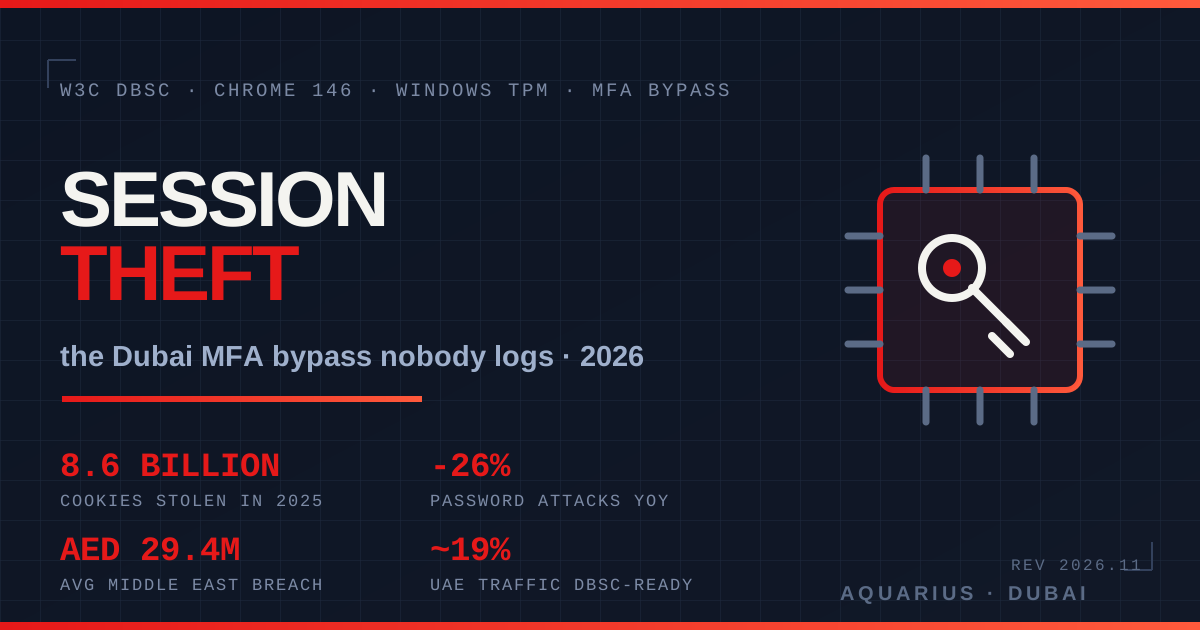
Short answer: Multi-factor authentication protects the login, not the session it hands out. Attackers now skip the password entirely, lift the session cookie off an infected laptop and replay it — SpyCloud counted 8.6 billion stolen cookies and session artefacts in 2025. Device Bound Session Credentials (DBSC) fix the replay: Chrome generates a key pair at sign-in, seals the private key in the machine’s TPM, and refreshes short-lived cookies only when the browser can prove it still holds that key. A copied cookie on another device is dead weight.
DBSC reached general availability on Windows in Chrome 146 in April 2026, and Google switched it on for all Workspace and personal Google accounts from 1 June 2026. If your Dubai product still issues a one-year session cookie and calls that “logged in”, you are now behind the browser.
The stake: attackers stopped guessing passwords because they no longer need to
Microsoft’s Digital Defense Report 2026 (July 2025 to June 2026) is blunt about the shift. Password attacks fell 26% year on year, while the share of adversary-in-the-middle phishing and token-theft attacks more than doubled in the first six months of 2026. URL and AiTM phishing now accounts for 45% of identified phishing techniques, and valid accounts were the initial access vector in 20% of incidents seen by Microsoft Defender Experts. Nobody is brute-forcing your login form. They are buying a working session.
The supply is industrial. SpyCloud’s 2026 Identity Exposure Report recorded 13.2 million infostealer infections in 2025 — Lumma, Vidar and Atomic being the familiar names — averaging roughly 50 credentials per infected device, alongside 18.1 million exposed API keys and tokens. Cookies are the premium product in those logs precisely because they arrive post-MFA.
For the UAE the exposure is not theoretical. Dr Mohamed Al Kuwaiti, head of the UAE Cybersecurity Council, put the country at 90,000 to 200,000 breach attempts every day in February 2026. And when one lands, IBM’s Cost of a Data Breach 2026 puts the Middle East average at USD 8 million, roughly AED 29.4 million per breach — the second-highest region in the study. Where phishing was the initial vector, the average climbed to USD 10.41 million (about AED 38.2 million).
Most Dubai businesses get this wrong in the same way: they spend the security budget hardening authentication and leave the session — the thing that actually grants access for the next 30 days — as a bearer token any machine can present.
What DBSC does, in plain terms
DBSC is a W3C Web Application Security working group proposal that Google, Microsoft and Okta have all worked on. The flow is deliberately boring:
- Sign-in. Your server returns a
Secure-Session-Registrationheader. Chrome generates a key pair and stores the private key in the TPM, where software cannot export it. - Registration. The browser posts proof of possession to a
/StartSessionendpoint you add. You bind that public key to the session. - Refresh. The long-lived cookie is replaced by a short-lived one. When it expires, Chrome calls your refresh endpoint, receives a
Secure-Session-Challenge, signs it with the TPM key and returns aSecure-Session-ResponseJWT. Valid proof, new short cookie. - Theft. A stolen short-lived cookie dies within minutes and cannot be refreshed, because the thief’s machine has no matching private key.
Google’s own framing of the design goal: “This design allows large and small websites to upgrade to secure, hardware-bound sessions by adding dedicated registration and refresh endpoints to their backends, while maintaining complete compatibility with their existing front-end.” Google reports a significant reduction in session theft since launch, though it has not published figures — treat the mechanism as proven and the magnitude as unquantified.
Coverage reality check for a UAE audience
DBSC needs hardware key storage, so platform support is uneven. Here is where it stands in November 2026, mapped against Statcounter’s October 2026 UAE share data.
| Platform | DBSC status, Nov 2026 | UAE desktop share (Oct 2026) |
|---|---|---|
| Chrome on Windows (TPM) | Generally available since Chrome 146 | Windows 76.8% of desktop OS; Chrome 79.4% of desktop browsers |
| Chrome on macOS (Secure Enclave) | Rolling out from Chrome 147; still limited | macOS 7.5% plus OS X 6.4% |
| Edge on Windows | Microsoft co-authored the standard; not shipped as GA | Edge 8.3% of desktop browsers |
| Safari / iOS / Android / Linux | No implementation | Safari 5.2% desktop; mobile is 67.8% of all UAE traffic |
Run those numbers and the honest estimate is that roughly 19% of UAE web traffic can be hardware-bound today (31.4% desktop, of which 79.4% is Chrome, of which 76.8% runs Windows — assuming those splits are independent). That is not a reason to skip it. It is a reason to build DBSC as an upgrade path rather than a gate: the spec is explicitly skipped on network errors, on machines with no TPM, and under some third-party-cookie restrictions, so you keep both the long-lived and short-lived cookie and let capable devices harden themselves. The 19% also happens to be where your admin consoles and finance dashboards are used.
What it costs to do properly in Dubai
DBSC is a backend change, not a product rewrite — but it only pays off if the session layer underneath it is sane. Typical scopes we quote in the UAE:
| Scope | What you get | Indicative AED |
|---|---|---|
| Session security audit | Cookie flags, token lifetimes, rotation, logout and revocation review, written findings | 6,000 – 12,000 |
| Session hardening sprint | Short-lived access tokens, refresh rotation with reuse detection, server-side revocation, device and IP anomaly logging | 18,000 – 35,000 |
| DBSC implementation | Registration and refresh endpoints, TPM key binding, graceful fallback, staged rollout behind a flag | 22,000 – 45,000 |
| Passkey migration alongside | WebAuthn sign-in and recovery flows, so the login is phishing-resistant too | 25,000 – 60,000 |
Set that against the cost of inaction: AED 29.4 million average Middle East breach, AED 38.2 million when phishing started it. IBM also found that organisations using AI-driven security tooling and strong governance reported costs more than USD 3 million lower than those without — the gap is operational, not magical. Its named cost amplifiers are mismanaged secrets and keys, excessive privileges, and an inability to prioritise threats. All three are session problems wearing different hats.
If you are regulated, the clock sharpens the maths. CBUAE Regulation C 1/2026, effective 14 September 2026, gives licensed financial institutions four hours to assess a material incident, 24 hours for a brief report and 72 hours for high-severity reporting. You cannot report what you cannot detect, and a replayed session cookie from a legitimate-looking account is the hardest thing in your logs to see.
How Aquarius does it
We start with the audit, because half the time the quick win is not DBSC at all — it is a refresh token that never rotates or a logout that only clears the client. Then we ship in this order: shorten sessions and add rotation with reuse detection, add server-side revocation so you can actually kill a session, add device-binding telemetry, then layer DBSC on top for Windows Chrome users behind a feature flag. Fallback paths stay live throughout, so nobody gets locked out because their laptop has no TPM. We pair it with passkeys and WebAuthn where the login itself is the weak point, and with bot and account-takeover protection where credential stuffing is the volume problem. Fixed scope, fixed price, staged rollout — see pricing or send us your auth stack and we will tell you in one call whether DBSC is worth your quarter.
FAQ
Does MFA stop session cookie theft?
No. MFA is evaluated once, at sign-in. The session cookie issued afterwards is a bearer token: whoever holds it is treated as you, on any device, until it expires. That is exactly why token theft and adversary-in-the-middle phishing more than doubled in the first half of 2026 while password attacks fell 26%.
Do I need DBSC if I already use passkeys?
Passkeys and DBSC solve different halves. Passkeys make the login phishing-resistant; DBSC makes the session theft-resistant. An attacker who cannot phish your passkey can still steal the cookie your passkey login created. The strongest posture in 2026 is both.
Will DBSC break users on iPhones or Android?
It should not, if you implement the fallback correctly. There is no Android, iOS or Linux implementation, and mobile is 67.8% of UAE traffic, so DBSC must be an opportunistic upgrade. The spec itself allows the browser to skip binding on network errors or missing hardware, which means your long-lived cookie path has to keep working.
How long does a DBSC rollout take for a Dubai SaaS product?
Two to five weeks of engineering for most mid-sized apps: a few days for the registration and refresh endpoints, most of the time for session-store changes, revocation and staged testing. Products that still store sessions as opaque long-lived cookies with no server-side record take longer, because that record has to exist before anything can be bound to it.
Is this relevant if we are not a bank?
Yes. Infostealers do not target by sector, they target by device. SpyCloud found 6.2 million credentials and authentication cookies tied to AI tools alone, and 28.6 million phished identities in 2025 — nearly half of them corporate. Any admin panel that can export customer data is worth a session cookie to somebody.
Sources: SpyCloud 2026 Identity Exposure Report; Microsoft Digital Defense Report 2026; IBM Cost of a Data Breach Report 2026 (Middle East findings); Google Chrome and Google Workspace release announcements, April–June 2026; W3C Web Application Security WG DBSC explainer; Statcounter UAE, October 2026; UAE Cybersecurity Council statements, February 2026; CBUAE Regulation C 1/2026.