
Software Developer Salaries in Dubai 2026: Real AED Ranges and the Loaded Cost of a Hire
Dubai software engineers earn a median AED 22,000 a month in 2026, but salary is only 60-70% of what a hire costs you. Real AED ranges by role, visa and Emiratisation maths.
- PUBLISHED
- 10 OCT 2026
- READ TIME
- 13 MIN
- AUTHOR
- AQUARIUS · DUBAI
- UNIT
- REV 2026.09
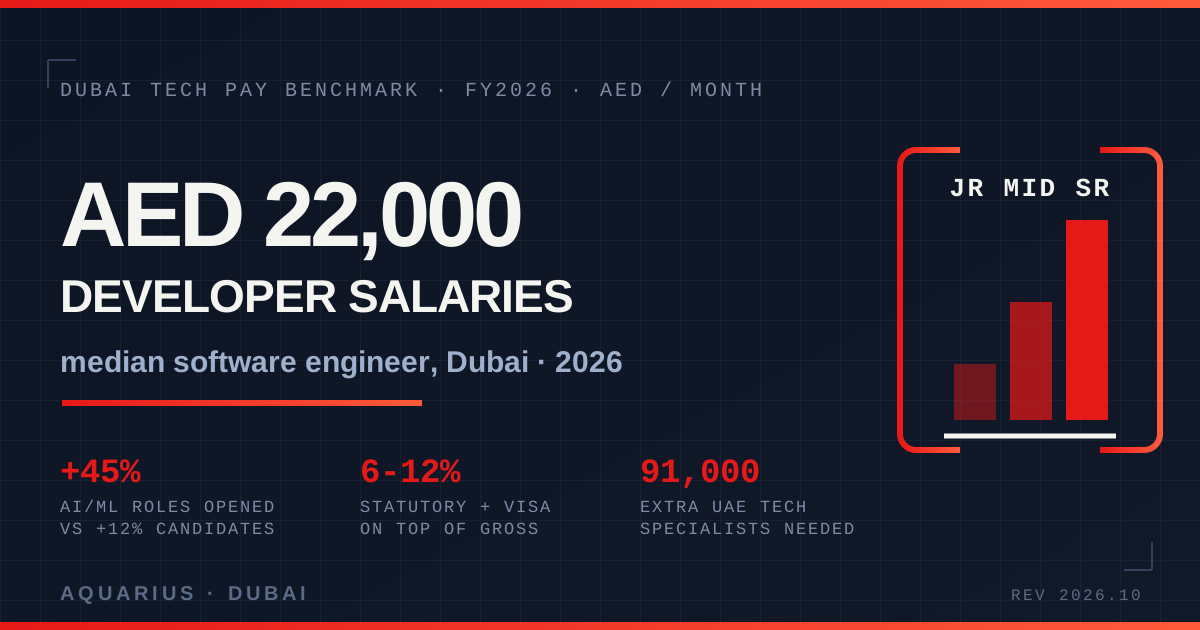
Short answer: A software engineer in Dubai earns a median of about AED 22,000 a month (AED 264,000 a year) in 2026 — juniors from around AED 8,000, mid-level engineers AED 18,000–28,000, and seniors or leads AED 30,000–45,000 where the stack is scarce. AI and machine-learning specialists sit 30–40% above those benchmarks. But the salary is not the cost. Statutory and visa obligations add 6–12% on top of gross, and on SME mainland maths an AED 8,000 offer lands near AED 13,200 a month all-in. Budget the loaded number, not the offer letter.
Key takeaways
- Demand is outrunning supply, and only in the specialised roles. UAE open AI/ML positions grew 45% from 2025 to 2026 while the qualified candidate pool grew 12%. General salary growth is 4.1%, but AI, finance and tech specialists are seeing jumps above 10%.
- Headline increments are modest. Cooper Fitch expects average UAE salaries to rise just 1.6% in 2026, with most adjustments between 0% and 5%. The market is paying up for scarce skills, not across the board.
- Salary is 60–70% of the real cost on a mainland SME licence. A two-year employment visa runs AED 3,000–8,000 per employee all-in, gratuity accrues at roughly 5.8% of salary from day one, and health cover must be active before stamping.
- Emiratisation is now a line item in your dev-team budget. Firms with 50+ skilled staff must add 2 percentage points of Emirati representation a year to hit 10% of skilled roles by end-2026. Each unfilled Emirati role costs AED 9,000 a month — about AED 108,000 a year.
- The hiring market is not loosening. Around 80% of UAE businesses expect to maintain or increase hiring in the second half of 2026, and the country needs over 91,000 additional technology specialists. If you are waiting for cheaper engineers, you are waiting for the wrong thing.
What Dubai actually pays developers in 2026
The sanest way to read the Dubai market is as two markets stacked on top of each other. There is a broad, competitive pool of generalist web and mobile developers where pay has been roughly flat in real terms — Cooper Fitch forecasts a 1.6% average UAE salary rise for 2026, with most adjustments landing between zero and five per cent. Then there is a narrow band of scarce specialists where the numbers behave completely differently: average UAE salary growth of 4.1% hides double-digit jumps for AI, cloud, security and data talent.
That split is a supply story, not a sentiment story. Open AI/ML roles in the UAE grew 45% between 2025 and 2026 while the qualified candidate pool grew only 12%. Recruiters report the hardest roles to fill are AI and ML engineers, cloud architects and certified DevOps engineers — the same roles most Dubai SMEs now want because they have an AI project on the 2026 plan. Nationally, the UAE is short more than 91,000 technology specialists across software engineering, cloud architecture and systems analysis.
Against that backdrop, the median for a software engineer in Dubai in 2026 is roughly AED 22,000 a month, or AED 264,000 a year. Juniors start near AED 8,000 and typically land in the AED 144,000–192,000 annual band; mid-level engineers run AED 216,000–336,000; seniors reach AED 360,000–540,000. Remember all of it is personal-income-tax-free, which is exactly why a Dubai offer competes with a materially higher gross number in Europe.
Dubai tech salary table, 2026 (AED per month)
Reported 2026 ranges by role and seniority. Treat these as negotiation brackets, not single points — the same job title swings 40% depending on whether the employer is a funded startup, a family group or a bank.
| Role | Junior (0–2 yrs) | Mid (3–5 yrs) | Senior / lead |
|---|---|---|---|
| Software / full-stack engineer | AED 8,000–14,000 | AED 18,000–28,000 | AED 30,000–45,000 |
| DevOps / platform engineer | AED 10,000–16,000 | AED 16,000–28,000 | AED 28,000–42,000 |
| Data engineer | AED 10,000–17,000 | AED 18,000–26,000 | AED 28,000–40,000 |
| Mobile developer (iOS / Android / RN) | AED 8,000–14,000 | AED 14,000–22,000 | AED 22,000–33,000 |
| QA / test automation engineer | AED 7,000–12,000 | AED 10,000–18,000 | AED 30,000–40,000 (automation architect) |
| UI/UX designer | AED 8,000–14,000 | AED 15,000–25,000 | AED 20,000–35,000 (avg ~AED 27,500) |
| Product manager | — | AED 14,000–22,000 | AED 25,000–40,000 (avg ~AED 32,500) |
| AI / ML engineer | Roughly 30–40% above the equivalent software-engineering band; AI product managers reported at AED 30,000–45,000 | ||
Two cautions on reading any Dubai salary dataset. First, self-reported aggregators are badly skewed by job title: the same source that puts mid-level mobile developers at AED 14,000–22,000 also reports a Dubai "iOS developer" average near AED 5,745, because the sample is full of agency juniors and non-Dubai submissions. Second, the quoted figure is usually total package in UAE practice — basic salary plus housing and transport allowances. That matters, because gratuity and several statutory calculations run off basic salary, so a package split 60/40 basic-to-allowances carries a different liability than the same number split 100/0.
The part most Dubai employers get wrong: loaded cost
Here is the single most common budgeting mistake we see in Dubai founder conversations. A company approves "AED 22,000 a month for a mid-level developer", then discovers the finance line is closer to AED 25,000–27,000 once the visa cycle and statutory obligations are in. The true cost of a UAE employee is gross salary plus 6–12% in statutory and visa-related costs — and on SME mainland maths, salary is only 60–70% of the all-in monthly cost: an AED 8,000 offer equals about AED 13,200 a month actual.
| Cost component | 2026 AED range | Cadence |
|---|---|---|
| Two-year employment visa, all-in | AED 3,000–8,000 | Every 2 years |
| MoHRE work permit | AED 250–3,450 | Per permit cycle, varies by employer classification |
| Entry permit (overseas hire) | AED 200–440 | Once |
| Status change / stamping (in-country hire) | AED 640–1,360 | Once |
| Medical fitness test | AED 320–750 | Per cycle (standard vs express) |
| Emirates ID (2–3 year) | AED 100–370 | Per cycle |
| Mandatory health insurance | AED 320 (basic scheme) to AED 10,000+ (comprehensive) | Annual, must be active before stamping |
| End-of-service gratuity accrual | ~5.8% of salary | Accrues from day one |
| Emiratisation shortfall contribution | AED 9,000 per unfilled role (~AED 108,000/yr) | Monthly, if you are below quota |
That last row is the one that has changed the arithmetic of building an in-house engineering team in Dubai. The 2026 Emiratisation target is 10% of skilled roles, reached by adding 2 percentage points a year for companies with 50 or more skilled workers, with a separate rule catching firms of 20–49 employees across 14 targeted sectors. MoHRE counts a role as skilled where it sits in a qualifying occupational category, the worker holds a recognised qualification, and pay is at least AED 4,000 a month — which is every developer you will ever hire. Scale your dev team past the threshold without a Nafis plan and each missing Emirati role bills you AED 9,000 every month.
Hire, contract, or build with an agency? The honest comparison
Once loaded cost is on the table, the build-vs-hire question gets much easier to answer, because you are comparing like with like for the first time.
- Hire in-house when the work is permanent and you know what to build. One mid-level engineer at AED 22,000 a month is roughly AED 280,000–300,000 a year loaded, plus the visa cycle. That is excellent value for ongoing product work — and terrible value for a three-month project, because you cannot unwind it in three months.
- Use freelancers for bounded, well-specified scope. Rates and the contracting mechanics are their own topic — see our breakdown of freelance developer rates in Dubai for 2026.
- Use an agency when you need a whole team for a defined outcome. You are buying a designer, a backend engineer, a mobile engineer, QA and a project lead for the window you need them, with no visa, no gratuity accrual, no Emiratisation headcount effect and no hiring lag in a market where qualified AI/ML supply is growing at a quarter of the rate demand is.
- Hybrid is what most Dubai SMEs end up doing. One or two strong in-house engineers who own the domain, an agency for surge capacity and specialist skills. Our longer comparison of in-house vs freelancer vs agency in Dubai walks through the decision in detail.
The cost-of-inaction number worth keeping in front of you: roughly 80% of UAE businesses expect to maintain or increase hiring through the second half of 2026. You are competing for the same scarce engineers as every funded startup, bank and government entity in the country, in a market short 91,000+ specialists. Every month a build waits on a hire is a month of revenue your competitor collects. For many Dubai SMEs the right answer is to ship the product with an external team now and hire the permanent engineer around a working codebase later — which is also a far easier role to recruit for, because you are offering a real system instead of a blank repository.
Myth-bust: "offshore is a third of the price, so it is a third of the cost"
It is a third of the rate. Cost includes the hours your side spends specifying, reviewing and re-reviewing, the timezone latency on every decision, and the rework when PDPL, UAE Pass, VAT invoicing, Arabic RTL or a Tap or Network International integration gets built by someone who has never shipped into this market. We rescue those builds regularly. The honest framing: offshore wins on commodity throughput against a precise spec; local wins when the requirements are still moving and the compliance surface is UAE-specific. Price both as loaded cost over the life of the product, not as an hourly rate.
How Aquarius does it
We are a Dubai team that builds web apps, mobile apps and AI automation for UAE businesses — so the comparison is direct: a fixed, scoped engagement against the loaded cost of a permanent hire. You get a full team (design, backend, mobile, QA, delivery lead) for the window the project needs, with UAE specifics handled as standard: 5% VAT-compliant invoicing, PDPL-aware data handling, Arabic/RTL where you need it, and local payment-gateway integration. No visa cycle, no gratuity accrual, no Emiratisation headcount exposure, no 60–90 day time-to-hire before a line of code exists.
Scope is fixed in writing before we start, you own the code and the repository from day one, and we hand over cleanly if you later build the team in-house — that is the point. See transparent AED pricing, or tell us what you are building and we will tell you honestly whether to hire, contract, or let us build it: get in touch.
FAQ
What is a good salary for a software developer in Dubai in 2026?
For a mid-level developer with 3–5 years of experience, AED 18,000–28,000 a month is the competitive band, against a market median of about AED 22,000. Below AED 15,000 you are recruiting from the junior pool; above AED 30,000 you should be getting senior or lead capability, or a scarce specialisation such as AI/ML, cloud architecture or security.
Are Dubai developer salaries tax-free?
There is no personal income tax on salaries in the UAE, so the gross figure is effectively take-home. That is why AED 22,000 a month competes with substantially higher gross packages in Europe or India. Corporate tax and VAT apply to the business, not to the employee's salary.
How much does it really cost my company to employ a developer in Dubai?
Budget gross salary plus 6–12% for statutory and visa-related costs: the two-year visa cycle at AED 3,000–8,000, mandatory health insurance from AED 320 a year upward, and gratuity accruing at roughly 5.8% of salary from day one. On SME mainland maths, salary works out to only 60–70% of the all-in monthly cost.
Do developers count toward Emiratisation quotas?
Yes. MoHRE counts a role as skilled when it falls in a qualifying occupational category, the worker holds a recognised qualification and earns at least AED 4,000 a month — developers always qualify. Companies with 50 or more skilled staff must raise Emirati representation by 2 percentage points a year to 10% by the end of 2026, and each unfilled role costs AED 9,000 a month.
Are Dubai tech salaries going up in 2026?
Selectively. Cooper Fitch forecasts an average UAE rise of just 1.6% with most adjustments between 0% and 5%, and overall salary growth around 4.1%. But AI, cloud, data and security specialists are seeing increases above 10%, because open AI/ML roles grew 45% year on year while the qualified candidate pool grew 12%. Generalist pay is flat; scarce pay is rising fast.
Is it cheaper to hire a developer or use an agency in Dubai?
For permanent, ongoing product work, in-house is usually cheaper per unit of output. For a defined project, an agency is almost always cheaper in total, because you pay only for the window you need, you get a full multi-disciplinary team instead of one person, and you avoid the visa cycle, gratuity accrual, Emiratisation exposure and the 60–90 days of time-to-hire in a market short 91,000+ specialists. Many Dubai SMEs run both: a small in-house core plus an agency for surge and specialist work. If you are picking a stack at the same time, start with our guide to the best tech stack for a Dubai startup in 2026.
Figures in this article are 2026 reported market ranges compiled from UAE salary surveys and recruitment-market reporting (including Cooper Fitch, Michael Page and Hays commentary, PwC's 2026 AI Jobs Barometer UAE analysis, and UAE employer-cost and MoHRE guidance). Salary data varies by sample; treat ranges as negotiation brackets and confirm statutory fees against current MoHRE, GDRFA and Dubai Health Authority schedules before budgeting.