
Tracking AI Search Traffic in Dubai (2026): The GA4 Setup, Real Benchmarks and What Google Will Not Show You
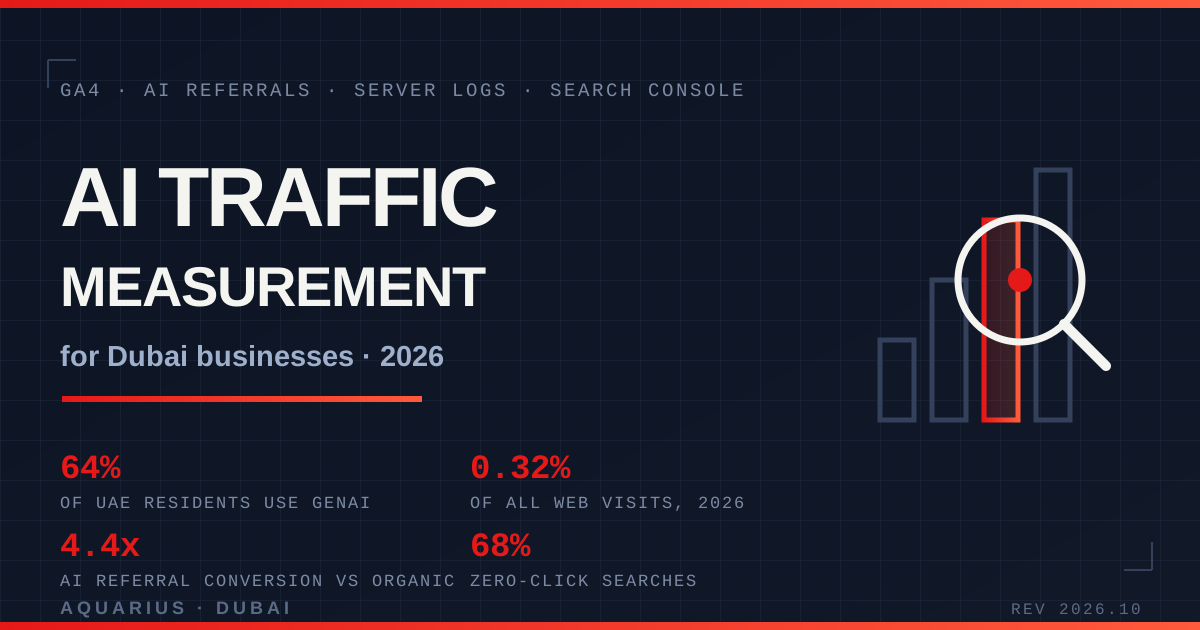
UAE generative AI use hit 64% while AI platforms drive 0.32% of web traffic and convert 4.4x organic. How to measure AI search traffic in GA4 from Dubai.
- PUBLISHED
- 04 OCT 2026
- READ TIME
- 11 MIN
- AUTHOR
- AQUARIUS · DUBAI
- UNIT
- REV 2026.09
Short answer: most Dubai businesses already get traffic from ChatGPT, Gemini, Copilot and Perplexity - they just cannot see it, because GA4 files those sessions under Referral, Direct or Unassigned by default. Fix it in an afternoon: add an "AI Assistants" custom channel group in GA4 (it applies retroactively), then layer server-log crawler data and Search Console generative AI reports on top. Expect AI to be well under 1% of your sessions today - and to convert several times better than non-branded organic.
That last sentence is the whole reason to bother. AI referrals are a rounding error in volume and a disproportionate share of revenue, and if they land in Direct you will underfund the one acquisition channel still growing in 2026.
Why UAE businesses feel this before everyone else (awareness)
The UAE is not an average market for this. Microsoft's Global AI Adoption study, reported in January 2026, put 64% of UAE residents using generative AI - one of only two countries above 60%, alongside Singapore. A Google/Ipsos survey across 21 countries in late 2025 found past-year generative AI use highest in the UAE at 85%. Against that, generative AI had reached just 17.8% of the world's working-age population by Q1 2026, while the UAE sat at 70.1% of 15-to-64-year-olds in Q1 2026, rising to 73.3% in Q2. Your customers in Dubai adopted the assistant years before your analytics did.
The traffic side is growing fast from a small base. Semrush's April 2026 study found outbound referral traffic from ChatGPT grew 206% during 2025, and chatgpt.com drew roughly 1.09 billion visits in July 2026, up 48% year on year, with ChatGPT past 1.1 billion monthly active users by June 2026. Yet measured across the whole web, AI platforms accounted for about 0.32% of all website traffic in 2026, up from 0.02% in 2024 - roughly one visit in every 312.
Meanwhile the old channel is leaking. SparkToro put zero-click searches at 68% of US Google queries in early 2026, up from 60.45% two years earlier. Ahrefs measured AI Overviews cutting the top organic result's click-through rate by 58%, and Pew Research found users click a cited source only about 1% of the time when an AI summary is shown.
Most Dubai businesses get this wrong: they panic that AI is eating their traffic while running a dashboard that cannot even name the AI traffic they already have. The 2026 problem is not that the robots took your clicks. It is that nobody in the building can answer "how many leads came from ChatGPT last month" with a number.
The four layers that actually answer the question (consideration)
There is no single report. AI visibility splits into four separate data sources, each answering a different question. You need at least the first two.
1. GA4: the clicks you already receive
When an assistant sends a user to you, it arrives as an ordinary referral with a hostname like chatgpt.com or perplexity.ai. GA4's default channel grouping has no AI channel, so it scatters these across Referral and - whenever the referrer is stripped, which happens constantly from desktop and mobile apps - Direct.
Create a custom channel group called AI Assistants with a condition on Session source matching this regex:
.*chatgpt.*|.*openai.*|.*perplexity.*|.*copilot.*|.*gemini.*|.*bard.*|.*claude.*|.*anthropic.*|.*mistral.*|.*deepseek.*|.*grok.*|.*you.com.*|.*phind.*|.*edgeservices.*
Two details decide whether this is useful. First, GA4 evaluates custom channel groups at query time, so the rules apply retroactively across your data retention window - you can see last year, not just next month. Second, that window is the catch: GA4's standard event data retention defaults to 2 months, and most UAE properties we audit have never been switched to the 14-month maximum. Change that setting first, or your retroactive view is eight weeks deep.
2. Server logs: the robots that never reach GA4
GA4 only records humans who run JavaScript. Crawlers and retrieval fetchers never appear - and they are the mechanism by which you get cited at all. HUMAN Security recorded a 6,900% increase in requests from AI agents and agentic browsers since July 2025. In your access logs, separate three different animals:
- Training crawlers - GPTBot, ClaudeBot, Google-Extended, Applebot-Extended. Blocking these costs you nothing today and may cost you citations later.
- Retrieval fetchers - OAI-SearchBot, PerplexityBot, Bingbot feeding Copilot. Block these and you remove yourself from the answer entirely.
- User-triggered agents - ChatGPT-User and its equivalents, firing because a human asked right now. This is the closest thing to a warm lead in a log file.
Plenty of Dubai sites behind aggressive WAF or bot-management rules are silently returning 403 to the second group. Grep your logs for those user agents and their status codes before you spend a dirham on content.
3. Search Console: impressions, and only impressions
Google launched Search generative AI performance reports on 3 June 2026, which finally isolate how often your pages surface in AI Overviews and AI Mode. Read the fine print: the dedicated view reports impressions with no clicks, no CTR and no query data, while the clicks stay folded into aggregate Web performance. It tells you that you appeared. It will not tell you what appearing was worth.
4. Citation monitoring: the share of voice you cannot log
Most AI answers never produce a click at all, so the only way to know whether you are named is to ask the models on a schedule - a fixed panel of 30 to 60 real buying prompts in English and Arabic, run weekly against ChatGPT, Gemini, Perplexity and Copilot, logging whether your brand, a competitor or a directory gets cited. This is the metric that behaves like a ranking. Our guide to getting cited by AI search covers the content work that moves it.
| Layer | Question it answers | Where the data lives | Dubai setup cost (AED) |
|---|---|---|---|
| GA4 AI channel group | How many sessions, leads and sales came from assistants | GA4 custom channel group plus a saved exploration | 2,500 - 6,000 |
| Server-log AI crawler report | Which bots fetch you, how often, and what status code they get | Nginx or CloudFront logs into a small warehouse and dashboard | 9,000 - 25,000 |
| Search Console generative AI view | Whether you appear in AI Overviews and AI Mode at all | Search Console, exported to BigQuery for history | 1,500 - 4,000 |
| Citation monitoring panel | Share of voice against competitors on real buying prompts | Scheduled prompt panel, EN and AR, logged weekly | 6,000 - 18,000 setup, then 1,500 - 4,500 / month |
| Full AI visibility dashboard | All four in one view, with lead and revenue attribution | Looker Studio or a custom BI layer | 18,000 - 45,000 |
What the numbers justify spending (decision)
Here is the conversion case, and it is not about volume. Semrush found AI-referred traffic converting at roughly 4.4 times the rate of traditional organic search, and ecommerce traffic from ChatGPT converting 31% better than non-branded organic in 2025. A channel worth 0.3% of your sessions can plausibly carry a few percent of your pipeline - and in a market where 64% of residents use these tools, that ratio moves in one direction only.
The cost of not measuring is specific, not vague. You cannot prove the channel exists, so it never gets budget. Your AI referrals sit inside Direct, which makes Direct look healthy and your SEO look worse than it is. And you have no baseline, so when assistant traffic doubles or halves - plausible either way, given that over 30% of ChatGPT's outbound clicks go to just ten domains, with Google alone taking more than 20% - you will not notice for a quarter.
One more reason to build this on data you own rather than any single vendor's product: ChatGPT Atlas, OpenAI's own browser, launched on 21 October 2025 and shut down on 9 August 2026 - 292 days - with its agentic browsing folded back into the ChatGPT app and a Chrome extension. Tools in this category will keep appearing and vanishing. Your access logs, your GA4 property and your own prompt panel will not.
How Aquarius sets this up
We are a Dubai web, app and AI studio, so we run this as a short fixed-price engagement rather than a retainer you cannot exit. A typical first pass is one week: fix GA4 retention and ship the AI channel group, grep 90 days of access logs for the 14 AI user agents and flag anything returning 403, connect the Search Console generative AI view, and stand up a 40-prompt bilingual citation panel with a baseline reading. You get the dashboard, the queries and the documentation, and you own all three. If your tagging is already fragile, read our note on server-side tracking costs in Dubai first, because measuring AI traffic through a broken container only moves the problem. For the wider budget picture, see our Dubai SEO cost breakdown, and our pricing for the fixed-price blocks.
FAQ
How do I see ChatGPT traffic in GA4?
Create a custom channel group called AI Assistants with a Session source condition matching chatgpt, openai, perplexity, copilot, gemini, claude and the other assistant hostnames. GA4 applies custom channel groups at query time, so the classification is retroactive across your data retention window - but check that window first, because the standard default is 2 months, not 14.
How much AI traffic should a Dubai website expect in 2026?
Benchmarks put AI platforms at about 0.32% of all website traffic in 2026, up from 0.02% in 2024 - around one visit in 312. Expect more if you publish genuine reference content, less if your site is thin or blocks retrieval crawlers. Judge the channel on conversion rate and assisted revenue, not on session share.
Does Google Search Console show AI Mode and AI Overviews data?
Partly. Since 3 June 2026 Search Console has had dedicated Search generative AI performance reports showing where your pages appear in generative AI features, but with no clicks, CTR or query breakdown; those clicks remain aggregated into overall Web performance.
Should I block AI crawlers on my UAE website?
Separate the two cases. Blocking training crawlers such as GPTBot or Google-Extended is a defensible content decision. Blocking retrieval fetchers such as OAI-SearchBot and PerplexityBot removes you from the answers your buyers are reading. Many Dubai sites block the second group by accident through a WAF rule - check your logs for 403 responses to those user agents.
Why does AI traffic show up as Direct in GA4?
Assistants running inside desktop or mobile apps, and links opened from a copied answer, frequently arrive with no referrer at all, so GA4 has nothing to classify. Referral-based reporting is therefore a floor, not a total - which is exactly why the server-log layer and a citation panel matter alongside it.
Is AI traffic measurement worth the setup cost?
If AI referrals convert anywhere near the 4.4x of organic that Semrush measured, a few hundred sessions a month is already material to a Dubai services business. The honest test is cheap: spend AED 2,500 - 6,000 on the GA4 layer, look at 90 days of retroactive data, then decide on real numbers whether the rest is justified.
Next step
If nobody in your business can currently say how many enquiries came from an AI assistant last month, the useful first move is small. Give us read access to GA4 and 90 days of access logs, and we will send back the retroactive AI channel report, the list of AI bots your server is blocking, and a fixed AED price to make it permanent. Talk to Aquarius and ask for the measurement checklist with it.