
UAE KYC Digital Platform: What Dubai Apps Must Change in 2026
Cabinet Resolutions 55 and 56 of 2026 switched on the UAE national KYC platform. The 31 violations, the AED 100,000 data-outside-the-UAE rule, and what it costs to comply.
- PUBLISHED
- 21 NOV 2026
- READ TIME
- 11 MIN
- AUTHOR
- AQUARIUS · DUBAI
- UNIT
- REV 2026.09
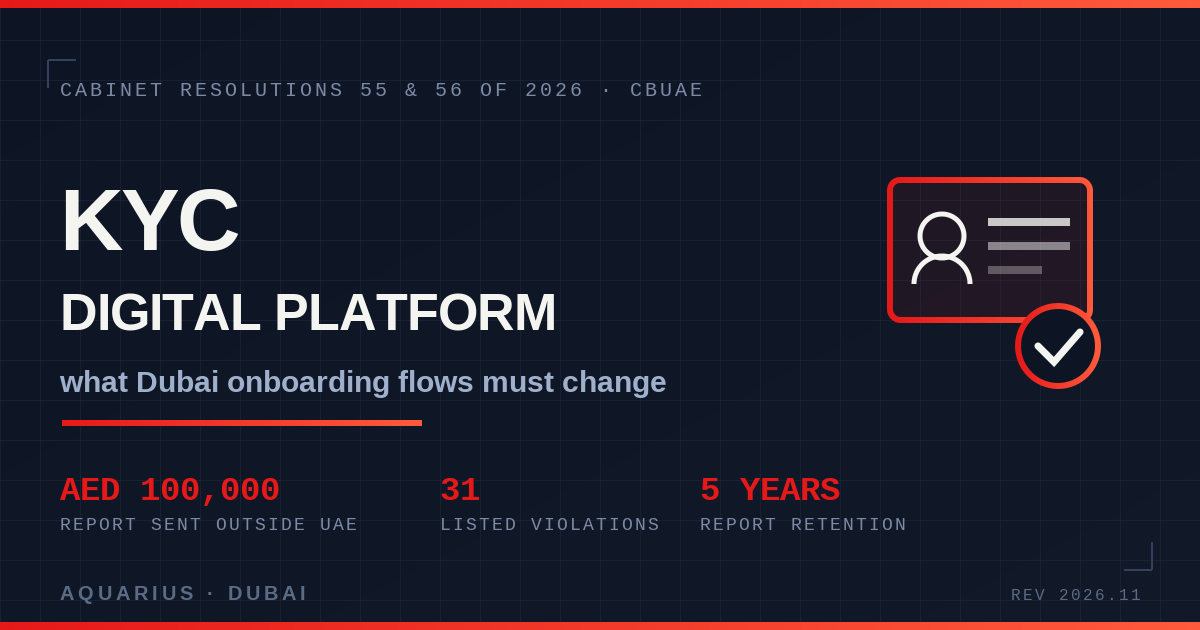
Short answer: The UAE now has a single national Know Your Customer platform, created by Federal Decree-Law No. 30 of 2024 and switched on commercially by Cabinet Resolutions 55 and 56 of 2026. Any Dubai business that pulls a KYC report from it becomes a regulated “User” with hard engineering duties: record the customer’s consent, use the report only for the purpose you declared, keep it for at least five years — and keep it inside the UAE. Sending a KYC report or any data in it outside the country is a listed violation carrying a fine of AED 100,000.
Key takeaways
- Decree-Law 30/2024 created the platform; Cabinet Resolution 56 of 2026 published the enforcement schedule — 31 violations, most at AED 50,000, seven at AED 100,000.
- Criminal exposure sits on top: imprisonment of not less than two years and/or a fine of not less than AED 50,000 for unauthorised disclosure or obtaining a report without approval.
- Item 22 of the schedule bans transferring a report or its data outside the UAE. That makes your identity-verification vendor’s hosting region a compliance decision, not a procurement one.
- The Central Bank is the regulator and may suspend dealings with a violating entity — a far bigger cost than the fine.
Most Dubai businesses are reading this as a banking story. It is an onboarding-flow story. If your app, portal or CRM will ever display a national KYC report, the rules land on your database schema, your consent screen, your audit log and your cloud region — not on your compliance officer’s PDF folder.
What the UAE KYC Digital Platform actually is
Three dates matter.
- 1 October 2024 — Federal Decree-Law No. 30 of 2024 established a company to build and operate the national “Know Your Client” digital platform, chaired by an assistant to the Central Bank Governor, with a board of seven to eleven members.
- 15 April 2026 — the Central Bank of the UAE signed a technical partnership with Swedish firm Norbloc AB to deliver the unified e-KYC platform, covering KYC and KYB with automated workflows drawn from trusted government data sources. It is in early development and onboarding.
- 20 April 2026 — Cabinet Resolution No. 56 of 2026 issued the regulations on administrative violations and sanctions, alongside Cabinet Resolution No. 55 of 2026, the executive regulations covering how reports are requested, issued, corrected, protected and retained.
The architecture is simple and that is what makes it demanding. Providers — federal and local government bodies, licensed financial institutions, insurers, and private companies including free-zone entities — feed verified customer data into the platform, and under Article 8 they must do so without imposing any financial burden on the operating company. Users are the entities entitled to pull a report. Under Article 10, a User must obtain the client’s prior approval before requesting one; the only carve-out is an order from the judge of urgent matters in respect of a debtor.
The demand side is not small. DIFC alone closed H1 2026 with 10,018 active registered companies and 1,134 regulated financial services firms, up 16% year on year, plus 1,933 AI, FinTech and innovation companies — a 39% jump. Every one of those that onboards UAE customers is a candidate User of the platform. Meanwhile the Central Bank has shown it will write cheques: on 24 June 2026 it fined a foreign bank branch AED 20 million for repeated AML/CFT and sanctions-framework failures, and AED 300,000 on its head of compliance personally.
The 31 violations, and the seven that cost AED 100,000
Cabinet Resolution 56 of 2026 annexes a schedule of 31 violations. The default fine is AED 50,000. Seven rows are set at AED 100,000, and one row is a range. These are the ones that map directly onto software decisions.
| Violation (Cabinet Resolution 56 of 2026) | Who it hits | Fine (AED) |
|---|---|---|
| Transferring a KYC report or any of its data outside the State, or sharing its contents with any entity outside the State | User | 100,000 |
| Using the report for a purpose other than the one stated in the request | User | 100,000 |
| Failing to keep the report’s data confidential | User | 100,000 |
| Issuing a report without verifying the consent of the customer, heir or representative, or in breach of the data-provider agreement | Company | 100,000 |
| Using or circulating KYC data for other purposes | Company | 100,000 |
| Failure to link the KYC database with the Central Bank | Company | 100,000 |
| A data provider refusing to supply requested data | Provider | 100,000 |
| Any breach of Central Bank codes of conduct or controls | Any party | 10,000 – 100,000 |
| Retaining copies of reports for less than five years; not informing the customer of the purpose; not notifying unlawful use; refusing an audit; breaching UAE data-protection law | User | 50,000 each |
Two mechanics in the same Resolution change how you should plan remediation. Article 4 lets the Central Bank issue a written notice to rectify within 30 days — but rectifying does not cancel the sanction. Article 5 gives you 15 days to be notified, 30 days to lodge a grievance and 30 days for a decision, with silence treated as rejection and the decision final. And Article 3 is the one that should reach your board: the Central Bank may suspend dealings with a violating person or entity entirely.
The item-22 trap: your IDV vendor is now an architecture decision
Here is where most Dubai product teams are quietly non-compliant-by-default. A typical UAE app does identity verification with an offshore SaaS vendor on a US or EU region, because that is what the pricing page offers and what the SDK defaults to. The moment a national KYC report, or any field extracted from it, flows into that pipeline, item 22 applies — AED 100,000, per the schedule, for data leaving the State.
Offshore verification is cheap, which is exactly why the trap is attractive. Sumsub publishes USD 1.35 per verification on its Basic plan with a USD 149 monthly minimum, and USD 1.85 on Compliance with a USD 299 minimum — roughly AED 4.96 and AED 6.79 per check at the 3.6725 peg, on AED 547 and AED 1,098 monthly floors. Onfido and Persona publish no comparable public per-check rate for the region. None of those prices include the thing Resolution 56 now charges you for: the report never leaving the UAE.
The fix is boring and permanent. Split the flow. Offshore vendors keep doing document OCR and liveness on the customer’s own uploads if your contract and your PDPL transfer basis allow it. The national KYC report itself — request, response, cached fields, screenshots, support-ticket attachments, analytics events, log lines — terminates inside a UAE region. In practice that means a UAE-hosted service of your own in front of the platform, with its own storage, its own audit trail and its own retention clock.
What a compliant onboarding flow has to do
Read the User duties in the schedule as a requirements list and six features fall out:
1. Consent capture, stored as evidence
Article 10 requires the client’s prior approval, and the definition allows written, digital or other legally acceptable means. “The customer ticked a box” is not evidence. Store the consent record with timestamp, version of the text shown, channel, and the identity of the staff member or system that requested it.
2. Purpose binding on every request
Two separate rows punish purpose drift: using the report for a purpose other than the one in the request, and failing to inform the customer of the purpose. That means purpose is a required field on the request, stored with the response, and checked again at read time — not a free-text note.
3. In-country storage, enforced in code
Region pinning at the account level, no cross-region replication on KYC buckets, no offshore analytics or error-tracking capturing report payloads, and no third-party support tool receiving them. The quiet leaks are logs and screenshots, not databases.
4. A five-year retention clock and a disposal job
The schedule requires Users to retain copies of all reports for not less than five years, and to dispose of them in line with the executive regulations. Both halves need code: a retention field per report and a scheduled, logged deletion.
5. Incident and audit paths
Users must immediately notify the operating company, the competent authorities and the customer of unlawful use, provide copies to competent authorities on request, and submit to audits by the company. Build the export, not the promise.
6. PDPL on top, not instead
Row 31 of the schedule makes breaching UAE personal-data-protection legislation its own KYC-platform violation. Your PDPL work and your KYC-platform work are now the same programme — which is also how the goAML and AML/KYC software stack should be planned.
What this costs in Dubai, and how we build it
Budget in three layers rather than one line item.
| Layer | What you get | Typical Dubai cost (AED) |
|---|---|---|
| Readiness audit | Data-flow map of every place a KYC field lands today: app, DB, logs, analytics, support tools, backups. Gap list against the 31 rows. | From 2,500 |
| Compliant onboarding module | UAE-hosted KYC service, consent + purpose capture, encrypted report store, retention clock, audit log, authority export | From 10,000 |
| Per-verification running cost | Offshore document/liveness checks where still permitted | From ~5 per check |
Compare that with the downside: a single item-22 finding is AED 100,000, the Central Bank’s June 2026 action shows personal fines on compliance leadership, and Article 3 allows suspension of dealings — which for a fintech is not a fine, it is a closed business. Against a build that starts near AED 10,000, the cost-of-inaction ratio is the easiest case in UAE compliance right now.
Aquarius builds the UAE-side layer: a thin in-country service in front of the platform, consent and purpose stored as first-class records, report storage encrypted and region-pinned, retention and disposal automated, and an audit export a regulator can actually read. We start with the audit so you see the gap list before you commit to the build, and we scope the module on fixed deliverables rather than open-ended hours. Our pricing is published.
FAQ
Is the UAE KYC Digital Platform live yet?
The legal framework is in force — Decree-Law 30/2024, plus Cabinet Resolutions 55 and 56 of 2026. The platform itself, built with Norbloc under an agreement signed on 15 April 2026, is in early development and onboarding. The build window is now; the enforcement schedule already exists.
Does this apply to my business if I am not a bank?
The definitions are deliberately broad. Providers include federal and local government bodies, private companies in-state and in free zones, financial institutions and insurers. Users are whoever is entitled to obtain a report. If you request or display a report, the User duties and the AED 50,000–100,000 schedule apply to you.
Can I still use an offshore identity-verification vendor?
For your own document and liveness checks, subject to your PDPL transfer basis and contracts, yes. For the national KYC report and the data inside it, item 22 of the schedule fines transferring it outside the State AED 100,000 — so that leg terminates in the UAE.
What is the criminal exposure, as opposed to the fines?
Article 14 of Decree-Law 30/2024 sets imprisonment of not less than two years and/or a fine of not less than AED 50,000 for unauthorised disclosure, obtaining a report or access without approval or by fraud, breaching confidentiality, or wilful misrepresentation — aggravated where the offender is a public employee or an employee of the operating company.
How long do we have to keep KYC reports?
Not less than five years, per the User duties in the annexed schedule, with disposal to follow the executive regulations. Keeping them longer than your stated purpose justifies creates PDPL exposure instead, which row 31 also penalises — so retention needs a defined end, not an indefinite archive.
If you are shipping onboarding in the UAE in the next two quarters, the cheapest version of this work is the version you do before the platform opens to your sector. Send us your onboarding flow and we will come back with the gap list.