
Web Bot Auth in 2027: How Dubai Websites Verify AI Agents Instead of Blocking Them
AI agent requests to websites grew over 1,700% in a year and 51% of UAE shoppers now use AI chat tools. How Web Bot Auth signatures let Dubai sites allow buyers and block scrapers.
- PUBLISHED
- 22 NOV 2026
- READ TIME
- 13 MIN
- AUTHOR
- AQUARIUS · DUBAI
- UNIT
- REV 2026.09
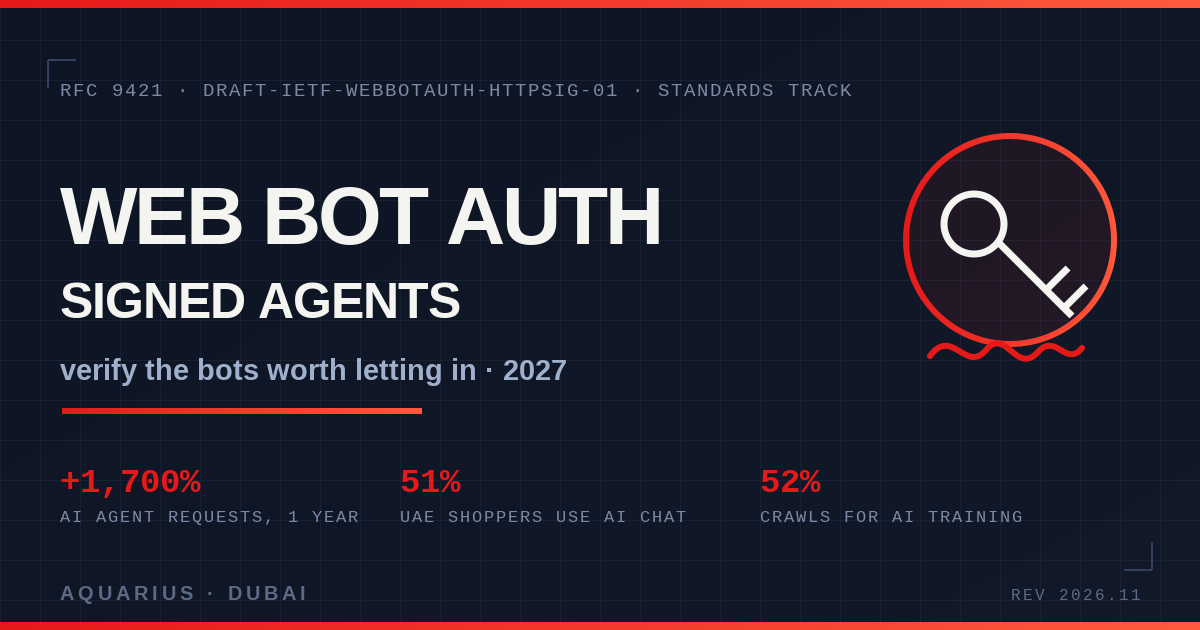
Web Bot Auth lets an AI agent prove who it is by cryptographically signing every HTTP request, so your Dubai website can allow the agents that bring buyers and block the ones that only take. It replaces guesswork based on IP ranges and user-agent strings with a signature you can verify against a public key the operator publishes at /.well-known/http-message-signatures-directory. As of 29 October 2026 it is an IETF Standards Track working-group draft (draft-ietf-webbotauth-httpsig-protocol-01, Web Bot Auth WG), and Cloudflare has been enforcing it at the edge since 2025.
The traffic your firewall is now quietly deciding about
Three numbers explain why agent identity stopped being a theoretical problem in 2026. First, daily requests from AI agents on Cloudflare’s network grew by more than 1,700% in a single year, and for the first time more than half of internet traffic was not human. Second, the purpose of that crawling shifted hard: in spring 2025, 22% of crawler requests were for AI training; by June 2026 it was 52%. Third, the volume is not marginal — Cloudflare now handles roughly 115 million HTTP requests per second (up from 63 million at the end of 2024, with peaks above 150 million) and sees more than 500 billion verified bot requests every week.
The commercial consequence is already visible. In the most heavily crawled categories — Retail, Computer Software, IT & Services and Financial Services — human traffic has fallen by as much as 40% in less than a year. Meanwhile the exchange rate stayed bad: Cloudflare Radar put Anthropic at 1,917 pages crawled per referral in July 2026 and OpenAI at 251:1, against roughly 4.7:1 for Google. Those ratios are improving fast (Anthropic was 38,744:1 in July 2025), but they still describe a supply agreement most site owners never signed.
So Dubai businesses reach for the firewall. And here is the part almost everyone gets wrong.
The myth: blocking every bot protects revenue
It no longer does, because a growing share of machine traffic is a customer with a wallet. The DHL eCommerce Trends Report 2026 (published 24 June 2026; 29,000 shoppers and 5,800 e-commerce businesses across 29 countries) found that 51% of UAE shoppers use AI-powered chat tools when shopping online, that 91% of UAE e-commerce businesses have already integrated AI into operations, and that 59% expect more customer activity to arrive through AI chat or virtual assistants. Checkout.com’s MENA Digital Commerce 2026 report (13 May 2026) found 54% of UAE shoppers are comfortable letting an AI assistant complete a purchase for them — rising to 79% among high-income earners versus 50% in lower-income groups.
That is the UAE’s highest-value customer segment arriving through an automated client. Set against a market running at roughly USD 12.3 billion (about AED 45 billion) in 2026, with 11 million-plus online shoppers across 45,000+ active stores and 78.67% of orders placed on mobile, a blanket bot block is not a security posture. It is a silent conversion leak that never appears in your analytics, because a blocked agent does not fire your tags.
Note also what the rest of the web actually does: on Cloudflare, fewer than 1% of sites block search crawlers while 17% block training crawlers. The sophisticated move is not block-everything or allow-everything. It is telling them apart — which until 2025 was impossible to do reliably.
How Web Bot Auth works, in plain terms
Web Bot Auth is a thin profile on top of RFC 9421 HTTP Message Signatures. The agent holds a private key, signs each outbound request, and tells you where to find the matching public key. Nothing about the page changes; the proof travels in headers.
The three headers
Signature— the cryptographic signature value covering the specified request components.Signature-Input— what was signed and under which parameters, includingkeyid,created,expiresand the identifyingtag="web-bot-auth".Signature-Agent— a structured dictionary of absolute HTTPS URLs where verification keys can be found. The spec requires that dictionary members carry no parameters, and Revision 02 of the protocol draft made this header mandatory on every signed request.
Where the keys live
The protocol registers a well-known URI: /.well-known/http-message-signatures-directory, serving a JSON Web Key Set in the RFC 7517 format. So chatgpt.com/.well-known/http-message-signatures-directory is the authoritative place to check a key for an OpenAI agent — no reverse DNS, no IP allowlist to maintain, nothing that breaks when the operator adds capacity.
Discovery on top of that is a flat registry. Cloudflare publishes one of the first instances as a plain-text list of directory URLs at assets.radar.cloudflare.com/bots/signature-agent-registry.txt, with each entry backed by a “signature-agent card” extending JWKS with operational metadata: client_name, client_uri, logo_uri, contacts, expected-user-agent, rfc9309-product-token, purpose, trigger and rate-expectation. That last trio is the interesting one for a Dubai retailer: it tells you why the agent came, what triggered it, and how much traffic to expect.
The timeline, so you can size the urgency
Cloudflare announced Web Bot Auth in May 2025 and folded Message Signatures into its Verified Bots Program on 1 July 2025, starting with Free and Pro plans. On 28 August 2025 it launched Signed Agents — a separate class for user-directed agents — with ChatGPT agent, Block’s Goose, Browserbase, Anchor Browser and Cloudflare’s own Browser Rendering in the first cohort. The IETF chartered a Web Bot Auth working group and the protocol is now draft-ietf-webbotauth-httpsig-protocol-01, dated 29 October 2026, on Standards Track. Operators are shipping against it now; the gap is on the receiving side.
Four postures, and which fits which Dubai business
Verification is only useful once you decide what to do with the answer. The honest framing is a per-class policy, not a single switch.
| Traffic class | How you identify it | Recommended posture | Best fit |
|---|---|---|---|
| Search crawlers | Verified bot, product token in robots.txt | Allow, serve fast and clean | Every site |
| Signed user-directed agents (shopping, booking, research on a human’s behalf) | Valid Signature + Signature-Agent, tag web-bot-auth | Allow, and instrument as a revenue channel | E-commerce, travel, real estate, clinics |
| Training crawlers | Verified identity, declared purpose | Explicit decision: refuse, licence or charge | Publishers, data-heavy B2B |
| Unsigned, unverifiable automation | No signature, spoofable user-agent | Challenge or rate-limit, never silently trust | Logins, rate pages, availability APIs |
The fourth row is where the money leaks in both directions. Unsigned traffic is where scrapers and credential-stuffing bots live — see our guide to bot traffic, scraping and account-takeover protection in Dubai — but it is also where a legitimate agent lands if the operator has not adopted signing yet. Treat it as “challenge”, not “ban”.
What agent-readiness costs in Dubai
This is cheap infrastructure work with an expensive failure mode. Typical UAE ranges for 2027 engagements:
| Workstream | AED range | Timeline | What you get |
|---|---|---|---|
| Agent traffic audit (logs, CDN, WAF event review) | 3,500 – 9,000 | 3 – 5 days | Which agents hit you, what gets challenged, what gets wrongly blocked |
Signature verification at the edge + Signature-Agent allowlist | 7,000 – 22,000 | 1 – 2 weeks | RFC 9421 validation, per-class rules, verified agents exempt from challenges |
| Agent-facing surface hardening (robots tokens, rate limits, API quotas) | 9,000 – 28,000 | 2 – 3 weeks | Scrapers throttled without touching verified traffic |
| Agent-channel analytics and attribution | 12,000 – 40,000 | 2 – 4 weeks | Agent sessions, conversions and your own crawl-to-refer ratio per platform |
| Checkout and booking flows made agent-completable | 20,000 – 85,000 | 3 – 8 weeks | Deterministic forms, stable selectors, structured data, no CAPTCHA dead ends |
Now the cost of inaction, in the same currency. Checkout.com found 39% of UAE shoppers would switch to a competitor after a falsely declined payment and 32% abandon carts over payment-security friction, while 96% say they want “invisible” payments. A false block on a verified shopping agent is the same event as a false decline: the customer does not file a complaint, they just leave. On a store doing AED 2 million a year, losing one in twenty-five high-intent sessions to a firewall rule is AED 80,000 of annual revenue sitting in a log file nobody reads. The UAE market is forecast to reach AED 67.2 billion by 2030 at a 9.9% CAGR — the agent share of that is going up, not down.
How Aquarius does it
We start with evidence, not opinion: a week of origin and CDN logs tells us which agents actually reach your Dubai site, which ones already sign their requests, and how many verified agents your current rules are challenging or dropping. Most clients have never seen that number, and in most audits the biggest single win is a firewall rule rather than a rebuild.
Then we implement verification per class — signatures validated at the edge, signed user-directed agents allowed and measured as a channel, training crawlers given an explicit documented decision, and unsigned automation challenged rather than trusted. We pair it with the crawler policy layer from our guide to AI crawler control and pay-per-crawl for Dubai websites, and with the conversion side covered in agentic commerce and AI shopping agents for Dubai stores. Scope and fixed-price bands are on our pricing page.
Risk reversal is simple: the audit is a fixed fee and it either finds verified agent traffic you are mishandling or it does not. If it does not, you have a documented clean bill of health for a 2027 compliance file. If it does, the fix is usually measured in days.
FAQ
Is Web Bot Auth an official standard yet?
It is an IETF Standards Track working-group draft, not a published RFC. The current document is draft-ietf-webbotauth-httpsig-protocol-01 dated 29 October 2026, produced by the Web Bot Auth working group, and it builds on the already-published RFC 9421 for HTTP Message Signatures. Earlier individual drafts (draft-meunier-*) have been replaced by the working-group version.
Do I need Cloudflare to use it?
No. Cloudflare validates signatures automatically at its edge and surfaces the result for WAF and bot rules, which is the least-effort path. But because verification is just RFC 9421 signature checking against a key fetched from a published directory, it can be implemented in Nginx, an API gateway or application middleware on any stack.
Does this replace robots.txt?
No — it makes robots.txt enforceable. robots.txt states a policy by product token; Web Bot Auth proves the client claiming that token really is that client. Policy and identity are two different layers, and you need both.
What if a shopping agent is not signed?
Challenge it, do not ban it. Adoption is partial: the first Signed Agents cohort was four operators plus Cloudflare’s own browser-rendering product, and more are onboarding through 2027. A rate limit plus a solvable challenge keeps the door open for a genuine customer-directed agent while still costing a scraper real money.
How do I know if I am already blocking agents?
Filter your WAF or CDN event log for requests carrying a Signature-Input header with tag="web-bot-auth", then check how many ended in a challenge or block. If that number is above zero, you are turning away verifiable, named, user-directed traffic.
The agentic web is not a forecast in the UAE — half of UAE shoppers are already using AI tools to shop and the majority are willing to let one buy. The sites that win the next two years are the ones that can tell a customer’s agent apart from a scraper, at the edge, in milliseconds. Talk to Aquarius and we will tell you which one your firewall thinks it is talking to.