
Aani and Jaywan Integration in Dubai (2026): The National Payment Rails That Cut Card Fees
Aani has 12.5 million users and 774,000 UAE merchants; Jaywan card issuance began July 2026. What the national rails cost, what they save, and how to add them to a Dubai checkout.
- PUBLISHED
- 15 SEPT 2026
- READ TIME
- 10 MIN
- AUTHOR
- AQUARIUS · DUBAI
- UNIT
- REV 2026.09
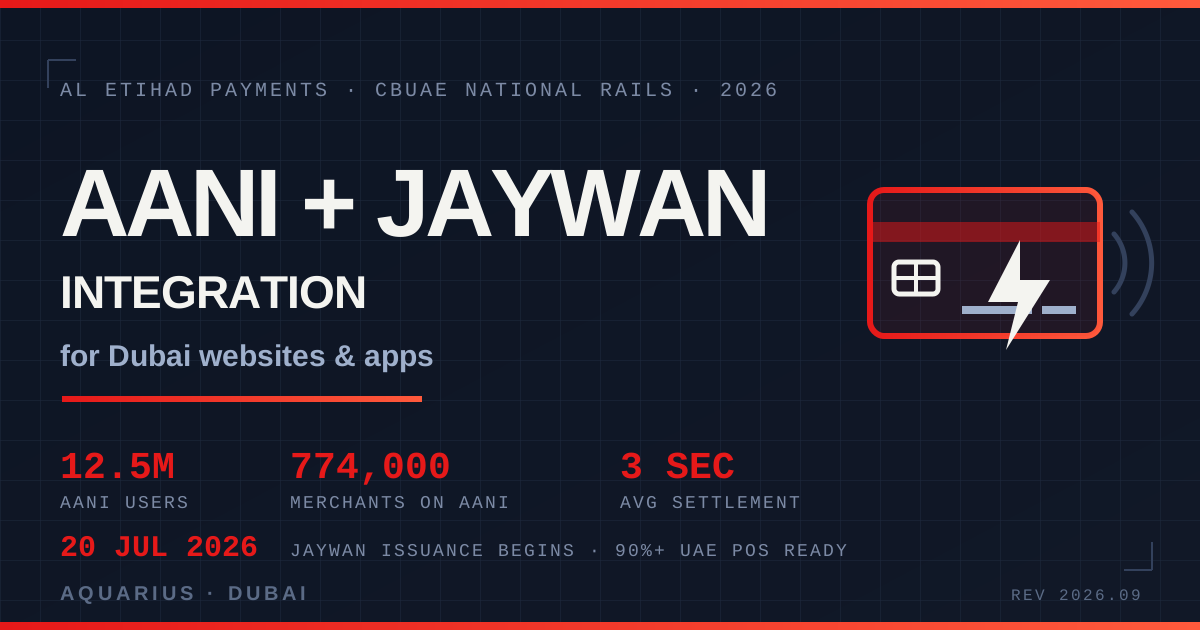
Short answer: Aani is the UAE’s national instant account-to-account payment platform — 12.5 million users, 774,000 merchants, 74 licensed financial institutions, and an average settlement time of three seconds. Jaywan is the UAE’s national card scheme, and consumer issuance through banks and exchange houses began on 20 July 2026, on a terminal estate where more than 90% of UAE point-of-sale devices already accept it. For a Dubai business, adding both to an existing checkout is a AED 2,000–6,000 job for Jaywan acceptance, AED 8,000–20,000 for a proper Aani account-to-account flow, and AED 25,000–60,000 for a multi-rail checkout that routes intelligently between cards, national rails, wallets, BNPL and cash on delivery.
Key takeaways
- The cost gap is the whole story. Visa and Mastercard MDR in the UAE typically runs 1.8%–3.5%, with new merchants usually quoted 2.2%–2.9% plus about AED 1 per transaction. Account-to-account rails carry no card interchange at all.
- Jaywan acceptance is close to free to switch on. Network International has stated merchants face no additional fees for Jaywan transactions processed through its gateway. Most Dubai stores simply have not enabled it.
- Aani settles in about three seconds, versus T+1 to T+3 for card settlement — a working-capital difference, not just a fee difference.
- There are no chargebacks on instant rails. That removes AED 75–150 dispute fees, and it also removes the buyer protection your refund policy now has to replace. Build for it.
- Budget AED 2,000–60,000 depending on how far you go — acceptance toggle, true A2A checkout, or a routed multi-rail payments layer.
Why this changed in 2026, and why most Dubai businesses missed it
The UAE spent three years building its own payment infrastructure, and 2026 is the year it arrived in public. In April 2026, Al Etihad Payments — the Central Bank of the UAE subsidiary that operates both systems — reported that Aani had passed 12.5 million users and 774,000 merchants, with transfer volumes up sixfold year on year and roughly 10% average monthly growth through 2025. It is connected to 74 licensed financial institutions, covering 85% of banks. Then on 20 July 2026, Jaywan was formally inaugurated and banks, licensed financial institutions and exchange houses began issuing cards to customers, with First Abu Dhabi Bank and Commercial Bank of Dubai among the first.
The demand side was already there. Visa reported in January 2026 that 80% of UAE payments are now digital. Dubai’s Cashless Strategy, launched in October 2024, targets 90% of all transactions cashless by 2026 and estimates the shift is worth more than AED 8 billion a year to the emirate’s economy; 97% of Dubai government payments are already digital. The UAE e-commerce market sits at about USD 12.42 billion in 2026 across 11 million-plus online shoppers and more than 45,000 active stores, and Dubai accounts for roughly 60% of it. Cash on delivery, meanwhile, has fallen to 25%–30% of transactions in 2026, down from 40% in 2022.
Here is the part most Dubai businesses get wrong: they treat Jaywan as a press release rather than a settings change. Their gateway already supports it, their terminal already accepts it, and the acceptance toggle is switched off in a dashboard nobody has opened since launch week.
Aani and Jaywan are not the same product
They are both operated by Al Etihad Payments under CBUAE supervision, and they solve different problems. Confusing them is the fastest way to scope an integration wrong.
| Dimension | Aani | Jaywan |
|---|---|---|
| What it is | Instant account-to-account payments (UAE Instant Payment Platform) | National domestic card scheme, established 2024 |
| How the customer pays | Mobile number, Emirates ID, email, QR code or IBAN | Debit, prepaid and co-badged credit cards |
| Speed | About 3 seconds, 24/7 | Card-standard authorisation, acquirer settlement |
| Transaction cap | AED 50,000 per transaction | Card and account limits set by the issuer |
| Merchant cost | No card interchange; pricing set by your bank or PSP | No additional fee via Network International’s gateway |
| Reach today | 12.5M users, 774,000 merchants, 74 institutions | 90%+ of UAE POS terminals; issuance from 20 July 2026 |
| Chargebacks | None — push payment, effectively final | Standard card dispute rules apply |
| Best for | High-value invoices, B2B, recurring bills, low-margin baskets | Everyday retail and e-commerce card acceptance |
Jaywan also went international this year: Al Etihad Payments and Mastercard announced the world’s first Jaywan co-badged credit card in July 2026, and an MoU with UnionPay International on 11 August 2026 opens acceptance of mono-badged Jaywan cards across a network spanning 183+ countries, 100 million-plus points of sale and 1.8 million ATMs. If your objection to a domestic scheme was “my customers travel”, that objection has a date on it now.
What you are actually paying today
Run your own numbers before anyone sells you an integration. UAE merchant pricing in 2026 looks like this, and the fee line is where the money is — not the setup cost.
| Cost line | Typical 2026 UAE figure | What it means for you |
|---|---|---|
| Visa/Mastercard MDR | 1.8% – 3.5% | New merchants are usually quoted 2.2%–2.9% plus about AED 1 per transaction |
| Domestic debit interchange cap | 0.75% in person / 1.00% online | The floor under your rate — if your quote is far above it, ask why |
| International card surcharge | 1.5% – 3.9% | Tourist-heavy Dubai baskets sit at the top of your blended rate |
| Setup / integration fee | AED 0 – 2,000+ | Negotiable, and the least important number on this table |
| Chargeback fee | AED 75 – 150 per dispute | Disappears entirely on Aani — along with the buyer protection |
| Settlement timing | T+1 to T+3 business days | Aani settles in seconds; that is cash flow, not just cost |
Do the arithmetic on a real store. At AED 1,000,000 a year in online sales and a blended 2.5% rate, you hand over AED 25,000 a year in processing. Move a quarter of that volume onto account-to-account rails and roughly AED 6,250 a year stops leaving the business — more if your basket sizes are large, because percentage fees punish high-value orders hardest. A single AED 40,000 invoice costs about AED 1,000 to collect on a card and settles days later; on Aani it is under the AED 50,000 cap and lands in seconds.
One honest caveat, because the internet is full of confident numbers here: Aani merchant pricing is set by your bank or payment service provider, not published centrally. Get it in writing before you plan the saving. What is not in doubt is that there is no card interchange in the middle.
How the integration actually works
Ninety percent of this job is not code. It is finding out what your acquirer already supports and then designing a checkout that does not confuse anyone.
1. Jaywan acceptance: start with a phone call, not a sprint
Ask your acquirer whether Jaywan is enabled on your merchant ID for both POS and online. Network International has rolled out Jaywan acceptance for online payments, Telr supports it for UAE merchants, and the early adopter list already includes Etihad Airways for flight bookings and Majid Al Futtaim across 200-plus destinations. If your gateway supports it, the work on your side is card-scheme detection, BIN range handling, a Jaywan logo at checkout, and regression testing your card form. That is the AED 2,000–6,000 band.
2. Aani: a different payment model, not a different card
Aani is a push payment. The customer approves it in their banking app; you do not hold their credentials. That changes your architecture in four places:
- Initiation. Request-to-pay or a dynamic QR generated per order, through your bank or PSP’s Aani API. Static QR codes work for a counter; dynamic per-order codes are what an e-commerce checkout needs.
- Confirmation. Webhooks, not redirects. Your order state machine needs a pending state that resolves on an inbound notification, plus a polling fallback and an idempotency key so a retried webhook does not ship the order twice.
- Reconciliation. Match by payment reference, not by amount — two customers will pay the same figure within the same minute eventually. Store the Aani reference against the order at creation.
- Refunds. There is no chargeback mechanism and no reversal on the rail. Refunds are outbound transfers you initiate, so your finance workflow needs an approval step and your terms need a written refund SLA. Skip this and you have moved a card problem into your inbox.
That is the AED 8,000–20,000 band, and the refund and reconciliation work is most of it.
3. Multi-rail routing: the version that actually pays back
The end state is a checkout that offers cards, Jaywan, Aani, Apple Pay and Google Pay, BNPL and cash on delivery, and routes by context: national rails surfaced first on high-value baskets where the fee saving is largest, cards first where speed of habit wins, BNPL where basket value justifies it. Pair it with a reconciliation dashboard that shows blended cost per rail, because the only way to keep the saving is to measure it monthly. Our guides to payment gateway integration cost in Dubai and Tabby and Tamara BNPL integration cover the other rails in the same detail.
What it costs, what it saves, and when to do it
| Scope | AED (ex 5% VAT) | Timeline |
|---|---|---|
| Jaywan acceptance on an existing gateway | 2,000 – 6,000 | 3 – 7 days |
| Aani A2A checkout: request-to-pay, dynamic QR, webhooks, reconciliation | 8,000 – 20,000 | 2 – 4 weeks |
| Multi-rail checkout with routing rules and cost dashboard | 25,000 – 60,000 | 4 – 8 weeks |
| B2B invoice collection portal on Aani | 18,000 – 45,000 | 3 – 6 weeks |
The payback test is blunt: if your annual card volume is above roughly AED 600,000, a Jaywan-plus-Aani integration at the low end of these bands returns its cost inside the first year on fee savings alone, before you count the settlement-timing benefit. Below that, enable Jaywan acceptance, skip the custom Aani build, and revisit when volume justifies it. We would rather tell you that now than invoice you for it.
There is also a compliance-shaped reason to move. In August 2026 the Ministry of Finance became the first federal entity to adopt Aani and Jaywan for federal service fees and fines, under Cabinet Resolution No. 176M/4M of 2026, explicitly paving the way for other federal entities and collection banks. When government collection standardises on a rail, business-to-government and supplier payment expectations follow.
How we build it at Aquarius: we start with your last three gateway statements, not a proposal. We establish your real blended rate, confirm what your acquirer already supports, and quote only the gap. Fixed price, tested against your acquirer’s sandbox, with reconciliation and refund workflows included rather than billed as a change request — see our Dubai development pricing and what we build.
Frequently asked questions
What is the difference between Aani and Jaywan?
Aani is the UAE’s instant account-to-account payment platform — the customer pays from their bank account using a mobile number, Emirates ID, email, QR code or IBAN, and it settles in about three seconds. Jaywan is the UAE’s national card scheme, issued as debit, prepaid and co-badged credit cards. Both are operated by Al Etihad Payments under the Central Bank of the UAE.
Does accepting Jaywan cost merchants extra?
Network International has stated that merchants face no additional fees for Jaywan transactions processed through its gateway. Your overall acquiring agreement still applies, so confirm the specific rate for Jaywan transactions with your acquirer in writing.
What is the maximum Aani transaction amount?
AED 50,000 per transaction. For higher-value collections you either split the payment or stay on card and bank transfer rails, which is why Aani suits mid-value invoices and everyday baskets rather than property-scale transactions.
Can I add Aani and Jaywan to a Shopify or WooCommerce store?
Jaywan acceptance typically arrives through your existing UAE gateway, so on Shopify or WooCommerce it is a configuration and testing task. Aani needs a bank or PSP API, which means a custom payment method plugin plus webhook handling — roughly two to four weeks of work on a standard store.
How do refunds work on Aani if there are no chargebacks?
You initiate an outbound transfer back to the customer. There is no scheme-level dispute process, so your refund policy, approval workflow and response SLA become the customer protection. Build the refund path at the same time as the payment path, not after your first complaint.
Should a Dubai business drop card payments entirely?
No. With 80% of UAE payments already digital and tourists carrying international cards, cards remain essential. The gain is in routing: offer national rails prominently where they save you the most, keep cards for everyone else, and measure the blended cost monthly.
Paying 2.5% on every dirham you collect is a choice you renew every month by not looking at it. Send us your gateway statement and we will tell you, in one page, exactly what Jaywan and Aani would change for your business — including the honest answer if it is nothing yet.