
Tabby & Tamara BNPL Integration for Dubai Stores (2026): Cost, Setup & the Real Conversion Uplift
What it costs to add Tabby and Tamara to a UAE store in 2026 — real merchant fees, the conversion and AOV uplift, CBUAE rules and a plain AED integration budget.
- PUBLISHED
- 09 SEPT 2026
- READ TIME
- 09 MIN
- AUTHOR
- AQUARIUS · DUBAI
- UNIT
- REV 2026.09
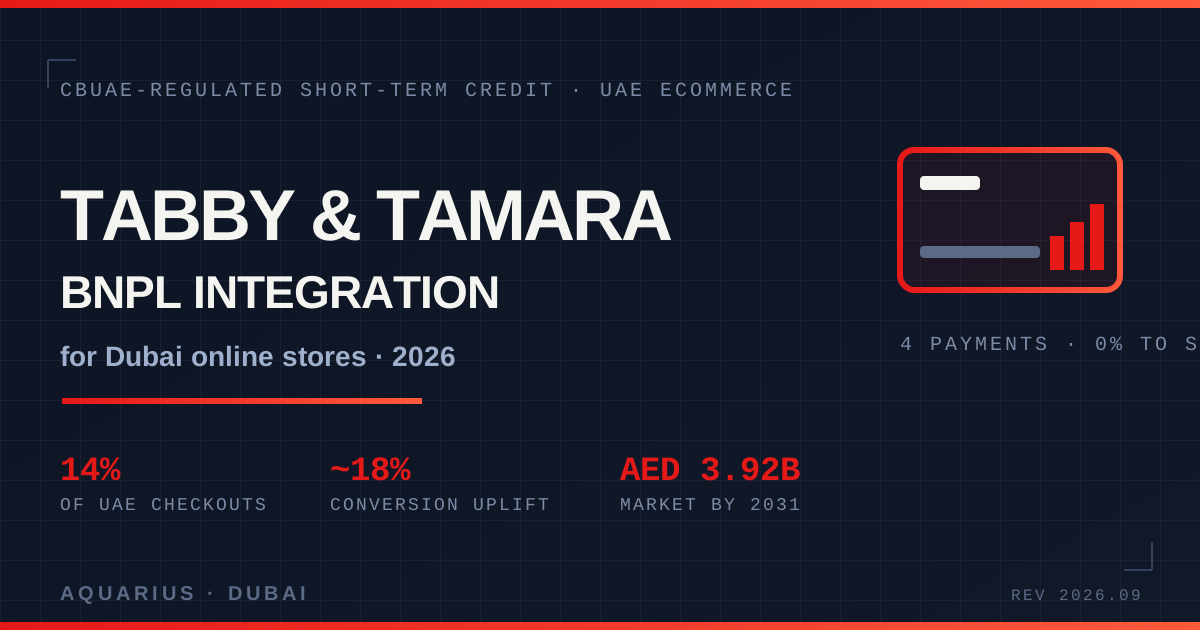
Short answer: adding Tabby and Tamara to a Dubai store in 2026 costs almost nothing to switch on — an official Shopify or WooCommerce plugin plus a few hours of developer time (AED 1,000–6,000), or AED 8,000–25,000 to wire the APIs into a custom checkout. The real cost is the merchant fee of roughly 3–4% of order value plus AED 1–2 per order, which you deduct from a discount rate — not add on top. In return, merchants typically see a ~18% lift in checkout conversion and a 20–40% higher average order value on BNPL orders. For most UAE stores selling above AED 200, that trade is strongly positive.
Why BNPL is no longer optional in the UAE (TOFU)
Buy-now-pay-later has quietly become a default expectation at UAE checkout, not a novelty. Three numbers set the stakes for any Dubai store owner in 2026:
- The UAE BNPL market was worth about USD 1.17 billion in 2025 and is forecast to reach USD 3.92 billion by 2031 — a compound growth rate north of 20% a year (GlobeNewswire / Research and Markets, Feb 2026).
- By the start of 2026, BNPL accounted for roughly 14% of checkout volume across major UAE Shopify stores, and UAE BNPL transaction volume grew more than 40% year-on-year through 2025.
- Tabby now carries a USD 4.5 billion valuation with 15 million+ users and 40,000+ merchants across the UAE, Saudi Arabia and Kuwait — the highest-valued consumer fintech ever to come out of the Arab world. Tamara secured a USD 2.4 billion Shariah-compliant financing package to fund its own growth.
Translation for a Dubai merchant: a meaningful slice of your would-be buyers now expect to see "4 payments" at checkout. If it isn't there, a share of them abandon the cart — and often finish the purchase at a competitor who offers it.
How Tabby and Tamara actually work (MOFU)
Both are "pay-in-4" or "pay-later" providers. The shopper splits an order into interest-free instalments (or defers payment 14–30 days); you, the merchant, get paid the full amount up front, minus the provider's fee. The BNPL company carries the credit risk and chases the shopper — you are not lending anything. That is the key point most store owners miss: your cash flow is unchanged, you are simply buying conversion.
They are close competitors with real differences. Here is how they compare for a UAE store in 2026:
| Factor | Tabby | Tamara |
|---|---|---|
| UAE checkout share | Larger; strong Noon & mall-operator tie-ins | Growing; strong with larger retail chains |
| Merchant fee (MDR) | ~3–4% + AED 1–2/order (negotiable by volume) | Similar 3–4% + per-order fee |
| Settlement to merchant | T+1 on most plans (fast) | Typically a little slower |
| Shariah-compliant option | Yes | Yes — core positioning |
| Integration | Official Shopify app, WooCommerce/Magento plugins, REST API | Official Shopify app, WooCommerce plugin, REST API |
Most serious UAE stores run both. They cover overlapping-but-different shopper bases, the plugins co-exist happily at checkout, and offering the pair rather than one visibly lifts the "eligible" share of your traffic. The AOV sweet spot is orders between AED 200 and AED 800 in beauty, fashion, electronics and home — exactly where UAE Shopify stores cluster — and that is precisely where conversion uplift is highest.
The numbers that decide it (do this before you install)
BNPL is not free — the fee is real — so run the trade. Independent merchant data and Tabby's own materials put the conversion uplift at roughly 10–25% (Tabby cites ~18%) and the AOV uplift at 20–40% on BNPL orders. Model it against the fee:
| Line | Without BNPL | With BNPL |
|---|---|---|
| Monthly checkout sessions that add to cart | 1,000 | 1,000 |
| Conversion rate | 2.5% | 2.95% (+18%) |
| Orders | 25 | ≈ 30 |
| Average order value | AED 350 | AED 420 (BNPL orders +20%) |
| Monthly revenue | AED 8,750 | ≈ AED 12,400 |
| Less ~3.5% BNPL fee on BNPL orders | — | ≈ −AED 250 |
| Net monthly gain | — | ≈ +AED 3,400 |
Even on modest traffic, the added conversion and basket size dwarf the merchant fee. The fee only stings if your margins are razor-thin or your typical order is very small — see "when to skip it" below.
What the CBUAE rules mean for you (they are simpler than they sound)
BNPL is now regulated in the UAE. Under the Central Bank's Finance Companies Regulation (Circular 3/2023, effective 27 December 2023), BNPL is formally treated as a form of consumer short-term credit, and this was reinforced by Federal Decree-Law No. 6 of 2025 (effective 16 September 2025). Providers must hold a CBUAE licence or partner with a licensed financial institution, and short-term credit to a single borrower is capped at AED 20,000 or three months' verified net income, whichever is lower.
The good news for merchants: the licensing burden sits with Tabby and Tamara, not with you. Because they are CBUAE-regulated, you inherit compliant consumer-credit disclosures out of the box. Your only real obligations are the ones you already have — accurate pricing, clear refund terms, and PDPL-compliant handling of the customer data that passes through checkout.
VAT and refunds — the two things stores get wrong
VAT: the 5% UAE VAT applies to the full sale price at the point of sale, regardless of how the shopper pays. You issue a normal tax invoice for the whole order the moment it is placed — you do not spread VAT across the instalments, and the BNPL fee does not change the VAT you owe. If you are unsure how your invoicing module should record this, our guide to VAT-compliant ecommerce invoicing covers the field-level detail.
Refunds: returns are the messy part of BNPL. When a shopper returns an item, the provider must unwind the remaining instalment plan while you process the refund, and disputes can add days. Build your returns workflow to trigger the refund through the provider's API (not just your gateway) so the customer's plan is cancelled correctly — otherwise you get support tickets and chargebacks.
What integration actually costs to build (BOFU)
This is where store owners over-estimate. Switching BNPL on is cheap; the cost scales only with how custom your checkout is.
| Store type | Typical AED range | What's involved |
|---|---|---|
| Shopify | 1,000 – 4,000 | Install official Tabby & Tamara apps, configure merchant account, test checkout, set eligibility thresholds |
| WooCommerce / Magento | 2,000 – 6,000 | Official plugin, gateway config, tax & refund testing, checkout placement of BNPL widgets |
| Custom / headless checkout | 8,000 – 25,000 | REST API integration, order-status webhooks, refund automation, promo widgets on product & cart pages |
Two things drive the custom number up: refund/webhook automation (so plans unwind cleanly) and putting the BNPL "split into 4 payments of AED X" widget on product and cart pages, not just the final checkout — that early visibility is where much of the AOV uplift comes from. Ongoing, you pay the per-transaction fee and effectively nothing else; there is no monthly platform charge to speak of.
One more decision stat for the sceptics: with BNPL adoption already at ~14% of UAE checkouts and growing 40% a year, the cost of not offering it is a rising share of abandoned high-value carts — orders a competitor happily catches.
When you should NOT bother
Skip BNPL, or add it later, if your average order is under ~AED 100 (the fee eats too much and shoppers rarely instalment small baskets), if you sell very low-margin commodities where 3–4% erases your profit, or if you are a pure B2B store with invoice terms already. For everyone else selling to UAE consumers above AED 150–200, it pays for itself quickly.
How Aquarius does it
We add Tabby and Tamara to Dubai stores — Shopify, WooCommerce or custom — with the parts that actually move revenue done properly: product- and cart-page widgets, clean refund/webhook automation, correct 5% VAT invoicing, and PDPL-safe data handling. It is quoted in fixed AED against a clear scope, and we'll model the conversion and AOV uplift on your numbers before you commit a dirham.
Ready to add BNPL the right way? See our pricing, explore what we build, or tell us your store's numbers and we'll send a fixed AED quote with a projected uplift.
FAQ
How much does it cost to add Tabby and Tamara to a Dubai store in 2026?
On Shopify, roughly AED 1,000–4,000 of developer time to install and configure the official apps; on WooCommerce or Magento, AED 2,000–6,000; on a custom or headless checkout, AED 8,000–25,000 for full API, webhook and refund integration. Ongoing, you pay a merchant fee of about 3–4% of order value plus AED 1–2 per order, with no meaningful monthly platform charge.
What are Tabby and Tamara's merchant fees in the UAE?
Both charge a merchant discount rate of roughly 3–4% of transaction value plus a small per-order fee (AED 1–2). Rates are negotiable by volume and category, and are deducted from your settlement — you are not adding a surcharge on top of the customer's price.
Does BNPL actually increase sales?
For most UAE consumer stores, yes. Merchants typically report a conversion uplift of 10–25% (Tabby cites about 18%) and a 20–40% higher average order value on BNPL orders, which comfortably outweighs the 3–4% fee for baskets above roughly AED 200.
Do I need a licence to offer BNPL on my store?
No. Under the CBUAE Finance Companies Regulation, the licensing sits with the BNPL provider. Because Tabby and Tamara are CBUAE-regulated, you offer compliant consumer credit simply by using them — your obligations remain accurate pricing, clear refund terms and PDPL-compliant data handling.
How is VAT handled with BNPL orders?
The 5% UAE VAT applies to the full sale price at the point of sale, not per instalment. You issue a standard tax invoice for the whole order when it is placed; the BNPL fee does not change the VAT you charge or reclaim.