
A/B Testing in Dubai (2026): The Sample-Size Math Most Stores Fail
Detecting a 10% lift on a 2.5% conversion rate needs 61,152 visitors per variant. Most Dubai stores do not have that traffic. Here is the math and what to run instead.
- PUBLISHED
- 12 NOV 2026
- READ TIME
- 12 MIN
- AUTHOR
- AQUARIUS · DUBAI
- UNIT
- REV 2026.09
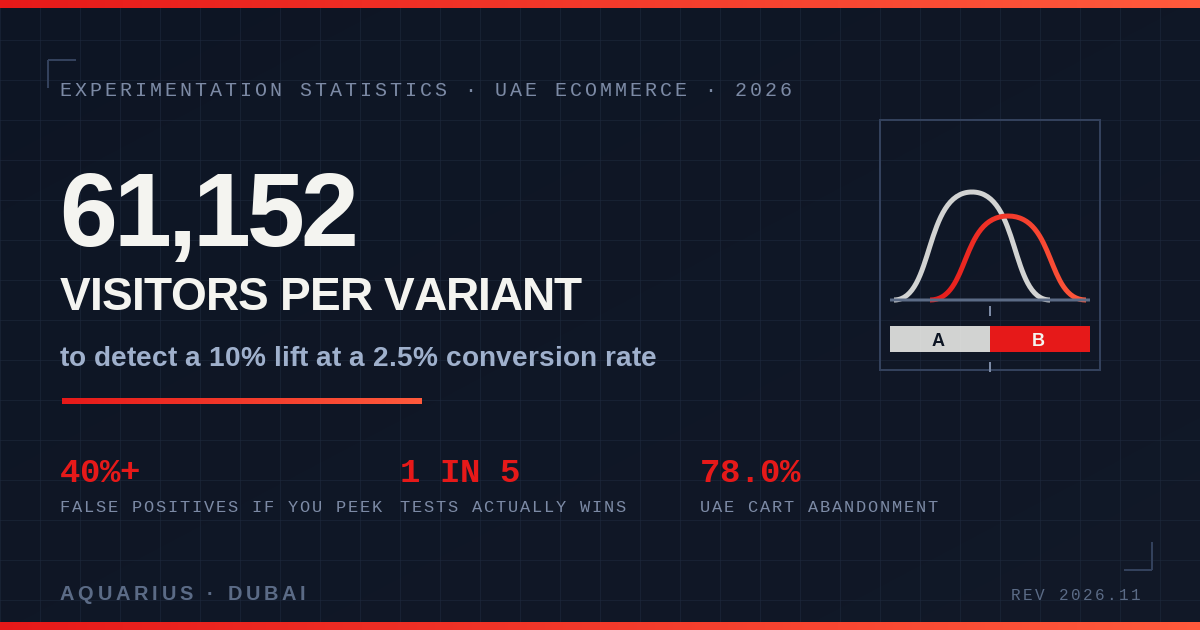
To detect a 10% relative lift on a 2.5% conversion rate at 95% confidence and 80% power you need 61,152 visitors per variant — 122,304 sessions for a simple A/B. A Dubai store doing 10,000 sessions a month needs just over 12 months to finish that one test. Most experimentation programmes in the UAE do not fail on creative ideas. They fail on arithmetic: the test was never going to resolve inside the window anyone was willing to wait.
This is the sample-size math, the three statistical traps that make past "winners" fake, what to run instead when your traffic is normal, and what an experimentation setup actually costs in Dubai in 2026.
The UAE numbers that decide whether you can test at all
UAE ecommerce is worth roughly USD 12.3bn (about AED 45.1bn) in 2026 across 11.04 million online shoppers — a big market made of mostly mid-sized stores. The behavioural baselines matter more than the headline:
- Add-to-cart rate: 11.5–12.0% of UAE ecommerce sessions (ECDB market data).
- Cart abandonment: 78.0–78.5% — above the global average.
- Purchase conversion rate: around 2.5%, with plenty of UAE and wider MENA stores sitting at 1–2%.
- Average order value: USD 111 in H1 2026, up from USD 97 — roughly AED 400–410.
That 2.5% is the number that sets your testing budget, because sample size scales with 1/p. A 2.5% baseline costs you roughly five times the traffic of an 11.5% baseline to detect the same relative change.
Most Dubai businesses do not have an A/B testing problem. They have a sample-size problem wearing an A/B testing costume.
The sample-size table nobody puts in the pitch deck
For a two-sided test at alpha 0.05 with 80% power, required visitors per variant is approximately n = 15.68 × p(1 - p) / delta², where p is your baseline conversion rate and delta is the absolute lift you want to detect. At the UAE baseline of 2.5%:
| Lift you want to detect | Visitors per variant | Total sessions | Months at 10,000 sessions/mo |
|---|---|---|---|
| 5% relative (2.5% to 2.63%) | 244,608 | 489,216 | 48.9 |
| 10% relative (2.5% to 2.75%) | 61,152 | 122,304 | 12.2 |
| 15% relative (2.5% to 2.88%) | 27,179 | 54,358 | 5.4 |
| 20% relative (2.5% to 3.0%) | 15,288 | 30,576 | 3.1 |
| 30% relative (2.5% to 3.25%) | 6,795 | 13,590 | 1.4 |
Read that bottom-up. At 10,000 sessions a month, only a 20–30% swing is testable in a quarter. The same 10% test takes 24.5 months at 5,000 sessions/mo, 12.2 months at 10,000, 4.9 months at 25,000, 2.4 months at 50,000 and 1.2 months at 100,000. If your button-colour test needed two years, running it for two weeks did not shorten it — it just made the result noise.
Three reasons your past "winners" were not real
1. Peeking
A fixed-horizon test is only valid if you look once, at the end. Check the dashboard daily over a two-week test and your false-positive rate climbs from the stated 5% to roughly 25–40%. Looking every 1,000 visitors lands near 20%, every 500 visitors near 26%, and watching a live dashboard continuously pushes past 40%. Two out of five "significant wins" in a peeked programme are nothing.
2. Sample Ratio Mismatch
A 50/50 split that arrives as 52/48 is usually a broken assignment, not luck. SRM shows up in 5–10% of tests even in mature programmes — Microsoft reports about 6%, LinkedIn about 10% — and exceeds 20% in poorly instrumented client-side ecommerce setups, where flicker, ad blockers and slow tag managers eat one arm's traffic. An SRM alarm is the single highest-value check you can add on day one.
3. The win rate is low by design
Only about 17.4% of experiments reach significance with a winner; roughly 1 in 5 industry-wide, and one audit of 2,288 tests found about 19%. A programme reporting a 60% win rate is not better at ideas — it is peeking, or calling tests on segments it did not pre-register.
What to run when you do not have 122,000 sessions
You do not need enterprise traffic. You need to stop asking an underpowered test a question it cannot answer. Four moves, in order of leverage:
- Move the metric up the funnel. Testing add-to-cart (11.5% baseline) instead of purchase (2.5%) needs 12,067 visitors per variant for the same 10% lift — 5.1x less traffic. Validate the step you are actually changing, then confirm revenue over a longer holdout.
- Only test big swings. Below roughly 25,000 sessions a month, restrict yourself to 20%+ MDE changes: whole page layouts, pricing presentation, checkout steps removed. Micro-copy tests are unaffordable at that traffic.
- Use CUPED. Pre-experiment covariate adjustment cuts variance 5–40%, which translates to a 20–50% smaller sample (Etsy reports about 7% on average and up to 30%; Bing about 50% on query share; Netflix 30–60% on engagement metrics) and up to 65% faster runtime — often a decision a full day earlier.
- Switch to sequential testing. Alpha-spending or always-valid sequential designs let you look whenever you like and stop early, without the peeking penalty. If your team will watch the dashboard anyway — and they will — pick the method that survives it.
Two more hard rules: never split traffic four ways at Dubai mid-market volumes (each arm needs the full per-variant sample), and run experiments server-side or at the edge rather than in a client-side visual editor, which is where most SRM and flicker damage originates. The same assignment layer that powers your tests should power your rollouts — see our guide to feature flags and canary releases in Dubai.
The 2026 platform landscape, and what it costs
2026 was the year the experimentation tool market consolidated. OpenAI acquired Statsig for USD 1.1bn in an all-stock deal (founder Vijaye Raji became CTO of Applications), and in May 2026 Amplitude took over the Statsig brand, platform and customers while the team stayed at OpenAI. Datadog bought Eppo for about USD 220m, retired the original product and shipped Datadog Feature Flags and Experiments. VWO and AB Tasty merged into a group with over USD 100m ARR and 4,000+ enterprise customers, after Everstone took a USD 200m stake in VWO; Monetate and SiteSpect sold for about USD 75m. VWO's founder put it plainly: the web-experimentation TAM is largely tapped.
Translation for a Dubai buyer: pick tools on data model and exit cost, not on a roadmap promise.
| Platform | 2026 entry price | Best fit |
|---|---|---|
| GrowthBook (self-hosted, MIT core) | AED 0 — unlimited users, warehouse-native | Teams with a data warehouse and an engineer |
| GrowthBook Cloud | Free Starter (3 users, 1 project); Pro from USD 40/seat/mo | Small Dubai product teams |
| Statsig / Amplitude Experiment | Free tier 2M events/mo; Pro from USD 150/mo | Flags plus experiments plus session replay in one |
| Datadog Experiments | Add-on to existing Datadog spend | Shops already on Datadog APM |
| VWO | From about USD 299/mo, scales with traffic | Marketing-led visual testing |
| Optimizely | No public price; web experimentation around USD 36,000/yr, enterprise USD 50,000–200,000/yr | Large enterprises with a procurement team |
One compliance note specific to the UAE: experiment assignment logs tie a persistent identifier to behaviour, which makes them personal data under the PDPL. Keep them inside your retention policy and your privacy notice — our UAE PDPL compliance checklist covers how. Your metric definitions should come from the same source as your product analytics stack, not a second parallel tracking setup.
What experimentation costs to stand up in Dubai (2026 AED)
Freelancers in Dubai bill AED 100–600/hr and mid-market studios AED 250–700/hr, which puts a credible setup in these bands:
| Work item | Dubai 2026 range (AED) | Timeline |
|---|---|---|
| Server-side SDK plus assignment layer (one app) | 9,000 – 22,000 | 1–2 weeks |
| Event tracking and metric definition audit | 6,000 – 15,000 | 1 week |
| Sample-size and MDE model for your real traffic | 3,500 – 7,500 | 2–3 days |
| Experiment QA harness (SRM alarm, assignment logs, flicker check) | 5,000 – 12,000 | 3–5 days |
| Managed experimentation retainer (2–3 tests/mo) | 12,000 – 30,000/mo | ongoing |
| Platform licence | 0 – 12,000/mo | — |
The payoff math is as unglamorous as the sample-size math. A store at 10,000 sessions/mo, 2.5% conversion and AED 408 AOV books about AED 101,900 a month. A real 10% lift is AED 10,190/mo — about AED 122,300 a year from one winning test. That pays for the setup, which is exactly why it is worth refusing to run tests that cannot conclude.
How Aquarius does it
We start with your analytics, not your ideas: actual sessions, actual conversion rate, then the table above for your numbers. If the honest answer is "your traffic supports two tests a quarter at 20% MDE," you get that in writing before anyone buys a licence. Then we wire assignment server-side, add an SRM alarm and a pre-registered metric per test, and run sequential analysis so looking at the dashboard is safe. Where traffic genuinely cannot support a test, we say so and fix the known conversion leaks instead — the work covered in our Dubai CRO cost guide. Scope and bands live on our pricing page.
FAQ
How much traffic do I need to A/B test in Dubai?
For a 2.5% conversion rate, about 15,300 visitors per variant to detect a 20% lift and 61,152 per variant for a 10% lift. Practically: under about 25,000 sessions a month, only test large changes, and measure an upper-funnel metric like add-to-cart where the baseline is 11.5%.
How long should I run an A/B test?
Until the pre-computed sample size is reached, and never fewer than two full weeks so every weekday and weekend pattern is covered. In the UAE also account for Ramadan, Dubai Shopping Festival and summer travel — a test spanning those periods is measuring the calendar, not your change.
Is it safe to check results every day?
Not with a standard fixed-horizon test: daily peeking over two weeks pushes the false-positive rate to roughly 25–40%. It is safe with sequential testing or alpha spending, which is why we default to those.
Do I need a paid experimentation platform?
No. GrowthBook's MIT-licensed self-hosted core is free with unlimited users, and Statsig's free tier covers 2M events a month. At Dubai mid-market traffic the licence is rarely the constraint — the statistics and the instrumentation are.
Most Dubai stores are not running bad experiments. They are running experiments that mathematically could not have answered the question. Work out your testable MDE first, and the rest of the programme becomes honest.