
Product Analytics for Dubai Apps and SaaS (2026): Mixpanel vs Amplitude vs PostHog, Tracking Plans and AED Costs
GA4 caps event data at 14 months and samples your funnels. Compare Mixpanel, Amplitude and PostHog 2026 pricing for UAE products, with tracking-plan rules, PDPL transfer rules and AED build costs.
- PUBLISHED
- 11 NOV 2026
- READ TIME
- 10 MIN
- AUTHOR
- AQUARIUS · DUBAI
- UNIT
- REV 2026.09
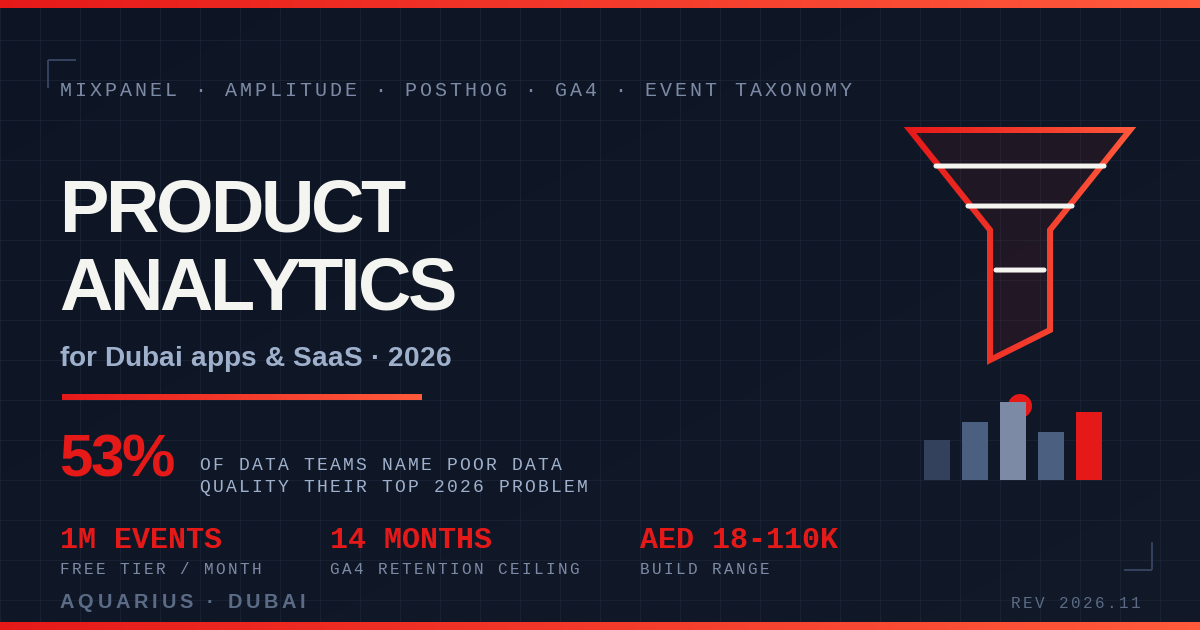
Short answer: Google Analytics 4 tells a Dubai business how people found you. Product analytics tells you what they did next, who came back and where the revenue leaked — and in 2026 the tooling is close to free. PostHog and Mixpanel both give you the first 1 million events a month at no cost, Amplitude gives 2 million. A UAE product firing 5 million events a month pays about AED 562 a month on PostHog or AED 1,609 on Mixpanel Growth billed annually. The tool is never the expensive part. The tracking plan is — and 53% of data teams named poor data quality their top problem in 2026, which is precisely what an unplanned event schema produces.
Why UAE product teams are flying blind in 2026
The money has moved into the product. Mordor Intelligence sizes the UAE e-commerce market at USD 12.30 billion in 2026, heading to USD 21.01 billion by 2031 at an 11.29% compound rate, and 78.7% of UAE e-commerce orders in 2025 were placed on a smartphone — the fastest-growing channel in the market at a 16.24% compound rate. The UAE digital economy is projected to pass AED 100 billion of GDP contribution by the end of 2026. If your product is the storefront, the product is the business.
The instrumentation has not kept up. dbt Labs’ 2026 State of Analytics Engineering survey found 53% of respondents cite poor data quality as their top challenge, 71% worry about incorrect data reaching stakeholders, and 41% report ambiguous data ownership. The share who rated increasing trust in data as important jumped from 66% in 2025 to 83% in 2026. Translated to a Dubai product team: the dashboard exists, nobody believes it, and decisions get made on opinion anyway.
Scale matters here too. Mixpanel’s 2026 State of Digital Analytics analysed 577 billion events across 3.8 billion devices, up 27% year on year. In that dataset EMEA acquisition grew 32% year on year against 6% for North America, while North America posted the weakest one-week retention at 5.0% versus 8.3% in APAC. Regional growth is being handed to teams who cannot yet tell an activated user from a bounce.
Product analytics vs GA4: what the free tool will not tell you
Almost every Dubai site already has GA4, so the first honest question is why pay for anything else. GA4 is an acquisition and campaign tool wearing a behavioural costume, and its published limits are where UAE product questions go to die:
- 14 months of retention, 2 months by default. On a standard property, user-level and event-level data maxes out at 14 months. Ramadan-over-Ramadan or year-two cohort retention is simply not in the box.
- Sampling above 10 million events. Explorations — funnel, path and user exploration, the reports you actually want — sample once a query needs more events than the property’s quota allows.
- Cardinality collapse into “(other)”. Any dimension with more than 500 values is treated as high-cardinality. Product SKUs, listing IDs, Arabic search terms and user identifiers are exactly that, and they get swept into a single useless bucket.
- Hard caps on the modelling layer. 30 key events, 100 audiences, and a 1 million event per day ceiling on the free BigQuery export.
Product analytics tools invert the design: every event keeps its properties, every user keeps a stable identity across web and app, and funnels, cohorts and retention curves are computed on the raw event stream rather than a pre-aggregated report. Keep GA4 for channel reporting — see our GA4 server-side tracking setup guide — and add product analytics for behaviour. They answer different questions and they belong side by side.
Most Dubai businesses do not have an analytics problem. They have four tools reporting four different signup numbers because nobody ever wrote down what “signup” means.
Mixpanel vs Amplitude vs PostHog: real 2026 pricing for a UAE product
All three are usage-priced on events, and all three are cheap at the volume a typical UAE SME product generates. Figures below are November 2026 list prices converted at AED 3.6725 to the dollar.
| Tool | Free tier / month | Paid model | 5M events/month | 20M events/month | Best for |
|---|---|---|---|---|---|
| PostHog | First 1M analytics events | $0.00005/event 1–2M, $0.0000343 2–15M, $0.0000295 15–50M, down to $0.000009 above 250M | ~$153 (AED 562) | ~$643 (AED 2,363) | Teams who want analytics, session replay, feature flags and experiments in one bill, or self-hosting for data control |
| Mixpanel Growth | First 1M events (Free plan up to 1M) | Volume tiers to 20M events; annual billing discounts heavily | $438/mo annual or $613 monthly (AED 1,609–2,251) | $2,289/mo monthly billing (AED 8,407) | Product and growth teams who want the fastest funnel and retention reporting with minimal setup |
| Amplitude Plus | 2M events plus 10,000 session replays | Event-based, scales to 70M events; Growth and Enterprise quoted by sales | Quoted (free allowance covers small products) | Quoted | Larger UAE products wanting experiments, guides and surveys bundled with unlimited seats |
| GA4 (standard) | Unlimited collection, capped reporting | Free | AED 0 | AED 0 | Channel and campaign reporting only — not behavioural depth |
Two add-ons change PostHog maths if you need them: group analytics (tying events to a company rather than a person — essential for B2B SaaS) runs $0.000071 per event, and data pipelines that forward raw events to your warehouse cost $0.000062 per event. At 5 million events that pipeline add-on is about AED 1,139 a month, which is still cheaper than most managed ETL. If you are already building a warehouse, read our UAE data warehouse cost breakdown before you duplicate the pipeline.
The tracking plan is the deliverable, not the dashboard
Every failed analytics project in Dubai we have been called in to rescue failed the same way: the SDK went in during week one, 300 auto-captured events piled up, and six months later nobody could define activation. The fix is boring and it is the whole job.
- 20 to 40 named events, not 300. Object-action naming (
checkout_started,quote_requested,booking_confirmed), snake_case, past tense, documented in one spreadsheet with an owner per event. - Properties carry the Dubai context. Emirate, language (
aroren), payment method (card, Tabby, Tamara, cash on delivery), free-zone vs mainland account type. Without these you cannot see that your Arabic funnel converts 30% worse. - One identity across web, iOS and Android. Alias the anonymous device ID to the authenticated user ID at login, and keep that mapping stable. This is the single most common break and it silently doubles your user count.
- Server-side events for anything that touches money. Payment success, refunds and subscription renewals must be fired from your backend, never the client, or ad blockers and dropped connections will quietly understate revenue.
- One North Star and three input metrics. Pick the activation event, define it in writing, and hold the team to the cohort curve rather than vanity totals.
Hold yourself to published benchmarks once the data is trustworthy. AppsFlyer’s Q3 2026 data puts median Day 30 retention at 5.3% on iOS and 3.8% on Android; subscription apps retain 14% against 5.4% for ad-supported. Mixpanel’s 2026 regional cut shows 33% stickiness (DAU over MAU) at the APAC top end against 44.6% weekly retention in North America. If your numbers look wildly better than these, your tracking is double-counting; if they look wildly worse, you are measuring the wrong event.
PDPL: where your event data lives and what consent you need
This is the part Dubai teams skip and later pay for. Product analytics is personal data processing, and under Federal Decree-Law No. 45 of 2021 there is no general legitimate-interest basis to lean on the way GDPR allows. Non-essential analytics therefore rides on consent — collected separately from your terms acceptance, logged with a timestamp, and withdrawable. Build the withdrawal path on day one; retrofitting it across three SDKs costs more than the tools do.
Residency is the second trap. Mixpanel persists customer data in one of three regions — US (GCP us-central1, Iowa), EU (GCP europe-west4, Netherlands) or India (GCP asia-south1, Mumbai) — and the choice is made when the project is created, not later. Amplitude offers an EU residency option. Neither offers a UAE region. That makes every event a cross-border transfer under PDPL Articles 22 and 23: permitted to an adequate jurisdiction, or on appropriate safeguards such as standard contractual clauses. As of late 2026 the Executive Regulations have still not been published in the Official Gazette and no federal-level standard contractual clauses have been issued, so UAE controllers are relying on contractual safeguards modelled on international templates plus a documented transfer risk assessment. The UAE Cabinet established the Federal Authority for Artificial Intelligence and Data on 14 June 2026, absorbing the Emirates Data Office, and it is expected to finalise the regulations and own enforcement.
Practical consequences for a UAE build: pick EU residency over US where the vendor offers it, pseudonymise identifiers before they leave your infrastructure, keep personal data out of event property names, and consider self-hosted PostHog when a government, healthcare or banking client writes residency into the contract. Our CDP guide for Dubai businesses covers the consent-propagation layer that sits underneath all of this.
What a product analytics build costs in Dubai in 2026
Subscription and licence fees are the small line. Below are the ranges Aquarius quotes for the implementation work, which is where the value and the risk both sit.
| Scope | What you get | Timeline | Aquarius range (AED) |
|---|---|---|---|
| Tracking plan + instrumentation foundation | Event taxonomy workshop, 20–40 documented events, SDK install on one platform, identity aliasing, consent gating, three core funnels | 2–3 weeks | 18,000 – 40,000 |
| Full product analytics layer | Web + iOS + Android instrumentation, server-side ingest for revenue events, cohort and retention dashboards, QA harness, PDPL transfer documentation, team training | 4–7 weeks | 45,000 – 110,000 |
| Warehouse-native or self-hosted | Self-hosted PostHog or warehouse-first stack, pipeline to BigQuery/Snowflake, reverse sync to marketing tools, experimentation and feature-flag integration, residency controls | 8–14 weeks | 90,000 – 220,000 |
| Ongoing analytics care | Schema governance, new-feature instrumentation, monthly insight review, dashboard upkeep, tool-cost tuning | Monthly | 3,000 – 9,000 / month |
The payback case is not abstract. Sensor Tower and Bidease’s 2026 Middle East report shows GCC in-app purchase revenue grew 41% between Q1 2024 and Q1 2026 against a 21% global benchmark, with the UAE leading the region at 46% revenue growth while downloads grew only 9%. Revenue is growing more than four times faster than installs, which means the money is in what existing users do next — retention, upgrade, repeat purchase. Those are exactly the questions GA4 cannot answer. A single recovered drop-off step in a checkout or onboarding flow typically repays an AED 40,000 instrumentation project inside a quarter, and the same event stream then powers your push and engagement triggers and paywall experiments for free.
How Aquarius instruments UAE products
We start with the decision, not the tool: name the three questions the business will act on this quarter, then design the smallest event set that answers them. Taxonomy is agreed in a one-session workshop and shipped as a living document with an owner per event. Instrumentation goes in behind a consent gate with Arabic and English property coverage from the first commit, revenue events fire server-side, and every release runs through an event-QA checklist so the schema does not rot. Residency and the PDPL transfer file are produced as deliverables, not afterthoughts. You own the project, the plan and the data; we are not a dependency. See our pricing for how this packages, or the full services list if the analytics work sits inside a bigger build.
FAQ
What is the difference between GA4 and product analytics?
GA4 answers acquisition questions — which channel, campaign and landing page brought traffic. Product analytics answers behavioural questions — which step of onboarding loses users, whether the Arabic funnel converts worse than the English one, and what a cohort looks like 90 days after signup. GA4 caps event-level retention at 14 months, samples explorations above 10 million events and buckets any dimension with over 500 values into “(other)”, so it cannot do the second job. Run both.
How much does product analytics cost for a Dubai app in 2026?
Tooling is often free: PostHog and Mixpanel include the first 1 million monthly events, Amplitude includes 2 million. At 5 million events a month expect roughly AED 562 on PostHog or AED 1,609 on Mixpanel Growth billed annually. Implementation is the real budget: AED 18,000–40,000 for a tracking plan and single-platform instrumentation, AED 45,000–110,000 for a full web and mobile layer with server-side revenue events.
Does UAE PDPL allow Mixpanel or Amplitude if the data leaves the UAE?
Yes, with conditions. Neither vendor offers a UAE region, so every event is a cross-border transfer governed by PDPL Articles 22 and 23 — lawful to an adequate jurisdiction, or on appropriate safeguards such as standard contractual clauses plus a documented transfer risk assessment. Because no federal SCCs have been issued yet, UAE controllers use international templates. Choose EU residency where offered, pseudonymise identifiers, collect separate consent for non-essential analytics, and self-host when a client contract demands UAE residency.
How many events should a tracking plan have?
Twenty to forty named events covers almost every UAE SME product. Auto-capture everything and you get 300 events nobody can define, which is how 53% of data teams end up calling data quality their biggest problem. Use object-action snake_case names, put the variation in properties rather than in new event names, and assign each event an owner.
Instrumenting a UAE product properly, or rescuing a tracking setup nobody trusts? Talk to Aquarius — we will audit what you have, show you the gaps in one session, and quote the fix in AED.