
Accepting Crypto Payments in Dubai (2026): The Dirham Stablecoin Rule, Real AED Costs and the USDT Trap
One in seven UAE SMEs now accepts crypto, but USDT at checkout is not legal on the mainland. What Dubai businesses may actually accept in 2026, the fee maths and real AED build costs.
- PUBLISHED
- 10 OCT 2026
- READ TIME
- 12 MIN
- AUTHOR
- AQUARIUS · DUBAI
- UNIT
- REV 2026.09
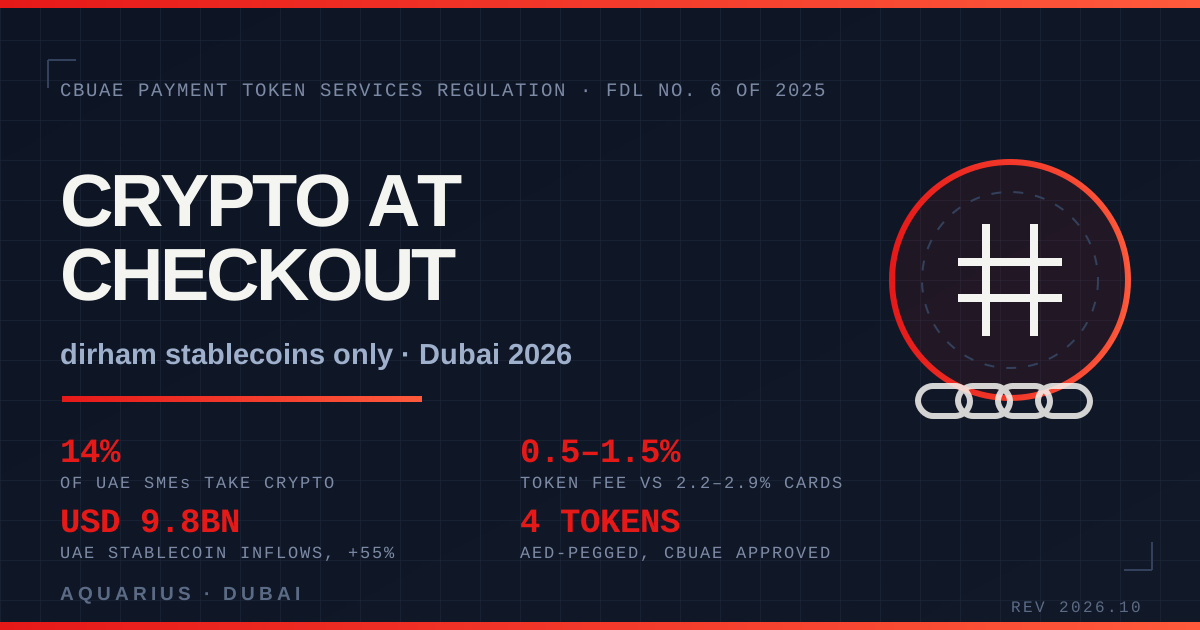
Short answer: A Dubai business can legally accept crypto at checkout in 2026, but only in one form: a Dirham Payment Token issued by a CBUAE-licensed issuer — AE Coin, Zand AED, DDSC or the in-principle-approved RAKBANK dirham token. Bitcoin, Ether and unregistered dollar stablecoins such as USDT cannot be accepted as payment for goods and services on the UAE mainland, and the one-year grace period that allowed it lapsed in 2025. The upside is real: regulated token settlement runs 0.5–1.5% against 2.2–2.9% plus AED 1 on cards, and integrating through your existing acquirer costs AED 18,000–45,000 rather than a new licence.
Key takeaways
- Demand already exists. 14% of UAE SMEs — one in seven — accept cryptocurrency as payment and 10% pay business expenses in stablecoins, per Mastercard’s 2026 Dreamonomics research. UAE SMEs rank among the world’s most active users of digital assets for business payments.
- Stablecoins are the main event, not Bitcoin. Stablecoins account for 51% of UAE crypto activity versus 19% for Bitcoin and 9% for Ether, with more than USD 9.8 billion received by UAE services in a year — up 55%. And 93% of UAE stablecoin transfer volume is retail-sized.
- The legal rule is narrow and most merchants get it backwards. You may accept a CBUAE-licensed dirham token for any lawful purchase, or a registered Foreign Payment Token only where the customer is buying a virtual asset or derivative. General checkout in USDT is not permitted on the mainland.
- Fees are the actual business case. New UAE merchants typically pay 2.2–2.9% + AED 1 per card transaction and 3.2–3.9% on internationally issued cards. Regulated token rails run 0.5–1.5% — a 50–75% cut in cost of acceptance.
- The rails went mainstream in 2026. Network International became the first UAE payments platform to power regulated stablecoin acceptance at scale through AE Coin on 6 January 2026, and the country’s first in-store AED-stablecoin pilot now runs on existing POS hardware at selected Marks & Spencer and LuLu stores.
Why this suddenly matters to ordinary Dubai businesses
The UAE has quietly become one of the most digital payment markets on earth. Eight in ten payments in the UAE are now digital, per Visa reporting in January 2026, and digital wallets alone carry more than 53% of transactions after the rollout of Aani instant payments and UAE Pass. The e-commerce market sits at roughly USD 12.30 billion in 2026, heading for USD 21.01 billion by 2031 at an 11.29% CAGR, and 78.67% of 2025 e-commerce ran through a smartphone.
Into that market, regulated digital money arrived faster than most merchants noticed. Stablecoins are now the single largest slice of UAE crypto activity at 51%, ahead of Bitcoin at 19% and Ether at 9%, and value received by UAE services passed USD 9.8 billion — a 55% jump year on year. Crucially for retailers, 93% of that stablecoin transfer volume is retail-sized, not whale-sized. These are people paying for things.
Businesses have already moved. Mastercard’s 2026 research found 14% of UAE SMEs accept cryptocurrency and 10% already settle business expenses in stablecoins. Looking forward, tokenised deposits are projected to rise from 1.2% to 6.2% of payment volumes and CBDCs from 0.6% to 4.1%, with new forms of money reaching about 20.7% of payment volumes by 2035 against 3.4% in 2025.
So the question for a Dubai merchant in 2026 is no longer whether crypto is a gimmick. It is which token you are allowed to take, and what it costs you to take it.
The rule most Dubai businesses get wrong
Here is the myth: that because Dubai is a crypto hub, a shop can stick a USDT QR code next to the card terminal. It cannot. Under the CBUAE Payment Token Services Regulation, a business selling goods or services in the course of business in the UAE may accept only two categories of token:
- A Dirham Payment Token issued by a CBUAE-licensed issuer, backed one-to-one by dirhams in segregated, audited reserves. Usable for any lawful purchase.
- A Foreign Payment Token from a CBUAE-registered foreign issuer — but only where the customer is buying a virtual asset or a virtual asset derivative. Not for your coffee, your consultancy invoice or your online order.
Everything else sits outside that permission: Bitcoin, Ether, and dollar stablecoins that are not registered with the Central Bank. The regulation commenced on 31 August 2024 with a one-calendar-year carve-out on the merchant restriction, and that grace expired in 2025 — the restriction has been live ever since. Layered on top, Federal Decree-Law No. 6 of 2025 consolidated the UAE financial framework, repealing the 2018 Central Bank Law and pulling payment tokens, virtual asset payment services and DeFi inside the CBUAE perimeter, with a transitional period running to 16 September 2026.
One geography note that catches people out: the merchant restriction does not apply inside DIFC and ADGM, which answer to the DFSA and FSRA. It does apply in commercial free zones such as DMCC, JAFZA and RAKEZ, and across mainland Dubai. Being in a free zone is not a defence unless it is a financial free zone.
| At your Dubai checkout | Mainland / DMCC / JAFZA | DIFC / ADGM |
|---|---|---|
| CBUAE-licensed dirham token (AE Coin, Zand AED, DDSC) | Permitted for any lawful purchase | Permitted under DFSA / FSRA rules |
| Registered Foreign Payment Token (e.g. USDU) | Only to buy a virtual asset or derivative | Per DFSA / FSRA regime |
| USDT / USDC, unregistered | Not permitted at general checkout | Per DFSA / FSRA regime |
| Bitcoin, Ether, other volatile assets | Not permitted for goods and services | Per DFSA / FSRA regime |
| Crypto-funded, dirham-settled platform | Permitted via a CBUAE-licensed platform | Permitted |
The practical compliance step is boring and cheap: before accepting any token, check it against the Central Bank’s public register. A restaurant needs no financial licence to accept a licensed dirham stablecoin. It does need to know which token it is holding.
Which dirham tokens are actually live in 2026
Four AED-pegged tokens hold CBUAE approval at different stages, and the ecosystem moved fast through 2026:
| Token | Status | Milestone |
|---|---|---|
| AE Coin | Full licence | Approved December 2024 as the UAE’s first fully licensed dirham-backed stablecoin; now integrated into Network International POS and e-commerce |
| Zand AED | Full approval | Bank-issued dirham payment token |
| DDSC | Approved, live | CBUAE approval February 2026; carried an AED 110 million transaction in May 2026; retail access widened July 2026 |
| RAKBANK AED | In-principle approval | Granted 7 January 2026, subject to completing regulatory and operational conditions |
| USDU | Registered Foreign Payment Token | Registered 29 January 2026 — virtual asset purchases only, not general checkout |
That AED 110 million DDSC settlement is the signal worth noting: regulated dirham tokens are no longer a retail novelty, they clear institutional-scale value. On the consumer side, DDSC and Network International launched the UAE’s first in-store pilot for a Central Bank-licensed AED-backed stablecoin at selected Marks & Spencer and LuLu locations — the customer scans a QR code in a supported wallet, and the merchant chooses whether to settle in the token or in dirhams.
Three ways to accept it, and what each one costs
1. Through your existing acquirer or PSP — the lazy, correct route
On 6 January 2026, Network International became the first UAE payments platform to power regulated stablecoin payments at scale, integrating AE Coin into its POS and e-commerce systems following an MoU with Al Maryah Community Bank. For most Dubai merchants this is the whole answer: the token shows up as another payment method, the acquirer handles conversion, and you elect dirham settlement so nothing about your bank reconciliation changes. It also keeps you outside the licensing perimeter, which matters more than the fee saving.
2. Direct wallet-to-wallet
Cheaper on paper — a direct transfer carries only the network fee, a fraction of a fils on a layer-2 chain — and genuinely useful for B2B invoices, which is why 10% of UAE SMEs already pay expenses this way. AE Coin’s first professional-services adopter, Nephos Group, settles client invoices in seconds through a wallet rather than bank rails.
This is also where merchants wander into regulated territory. You trigger licensing requirements if you convert tokens to dirhams for others, hold customer assets, control private keys on their behalf, operate wallets, use pooled or omnibus wallets before settlement, or earn a spread or fee on conversion. Taking a token in payment is a sale. Doing any of that around it is a financial service, and the CBUAE splits it into three licence types — Issuance, Conversion, and Custody & Transfer — each with its own capital, safeguarding and AML conditions.
3. Crypto-funded, dirham-settled platforms
On 11 May 2026, Crypto.com became the first virtual asset service provider to receive a CBUAE Stored Value Facilities licence, letting users fund payments with digital assets while settlement happens in dirhams or in CBUAE-approved dirham stablecoins. It launched pointed at Dubai government fees — visas, fines, utility bills — with Emirates and Dubai Duty Free integrations flagged as subject to further approval. For merchants this is the model to watch: the customer holds the volatile asset, you receive dirhams, and the licensed platform absorbs the conversion.
The fee maths, in AED
This is the part that gets a CFO’s attention. New businesses in the UAE typically see merchant discount rates of 2.2–2.9% plus a fixed AED 1 per transaction; domestic debit lands near 1.5–2.5%, while internationally issued Visa and Mastercard credit runs 3.2–3.9% plus a fixed fee — painful in a city where a large share of cards are issued abroad. Stablecoin payment processors charge 0.5–1.5%, and direct wallet settlement carries only network cost.
| Rail | Typical UAE cost | Cost on AED 5,000,000 annual volume |
|---|---|---|
| Domestic debit card | 1.5–2.5% | AED 75,000–125,000 |
| Domestic credit card (new merchant) | 2.2–2.9% + AED 1 | AED 110,000–145,000 plus per-transaction fees |
| Internationally issued credit card | 3.2–3.9% + fee | AED 160,000–195,000 plus per-transaction fees |
| Dirham stablecoin via PSP | 0.5–1.5% | AED 25,000–75,000 |
| Direct wallet-to-wallet (B2B) | Network fee only | Effectively negligible on layer-2 |
Shift 20% of an AED 5 million card book onto a regulated dirham token at 1.0% instead of 2.6% and you keep roughly AED 16,000 a year. Shift half of it and you keep about AED 40,000 — the whole integration budget inside year one. Then add the second-order wins: no chargeback window on a settled token transfer, and same-day value instead of T+2 on cards, which is working capital you currently lend your acquirer for free.
The licence tripwire, and what it costs to get wrong
Accepting a permitted token needs no financial licence. Building a little conversion business around it does — and the penalties are not symbolic. Unlicensed activity is a criminal offence under Federal Decree-Law No. 6 of 2025, with imprisonment and fines available. Administrative fines reach up to AED 1 billion for licensed institutions, and promoting a regulated activity without authorisation carries a minimum fine of AED 1 million. Enforcement is already visible: in October 2025, VARA fined 19 firms between AED 100,000 and AED 600,000 each for unlicensed virtual asset activity and marketing breaches.
Note also that Article 62 of the new law makes the licensing trigger technology-neutral — it applies regardless of the medium, technology or form used. Dressing a conversion service up as an app feature changes nothing. AML obligations apply whether or not you hold a licence, so build source-of-funds screening into the payment flow rather than into a policy document nobody opens.
Tax and bookkeeping: simpler than you expect
Cabinet Decision No. 100 of 2024 made transfers and conversions of virtual assets — stablecoins included — largely VAT-exempt, treating them closer to financial services such as currency exchange and removing the ambiguity that had some providers charging 5% output tax on basic wallet settlement. FTA clarifications VATP039 and VATP040 set out the detail.
That does not exempt your sale. Accepting crypto for goods or services is treated like receiving cash: value the transaction at the market rate at the time of receipt and account for 5% VAT on the taxable supply exactly as you would on a dirham sale. Corporate tax is unchanged at 0% up to AED 375,000 of taxable income and 9% above it. The real work is engineering, not tax: your system has to stamp the AED value at receipt, carry it into the tax invoice, and reconcile the on-chain reference against the ledger entry. Get that wrong and it is your auditor, not the Central Bank, who stops you.
What it costs to build, in real AED
Indicative Dubai ranges for adding regulated token acceptance to an existing store or app, assuming you use a licensed issuer or PSP rather than becoming one:
| Workstream | AED range | What you get |
|---|---|---|
| Checkout integration (single token, web or app) | 18,000–45,000 | Token as a payment method, QR or wallet flow, webhook confirmation, AED-stamped order record |
| Full omnichannel (POS + e-commerce + invoices) | 45,000–120,000 | In-store QR on existing terminals, online checkout, B2B invoice links, unified reporting |
| Reconciliation and ERP / accounting bridge | 25,000–65,000 | On-chain reference to journal entry, valuation-at-receipt logic, VAT-ready tax invoices |
| Compliance layer (register checks, AML screening, policy) | 12,000–30,000 | Token allowlist against the CBUAE register, source-of-funds prompts, audit log, staff runbook |
| Ongoing care and monitoring | 2,500–9,000 / month | Issuer and regulation change monitoring, failed-settlement alerts, quarterly reconciliation review |
A typical Dubai SME rollout — one licensed dirham token, online plus in-store, reconciled into the accounting system — lands between AED 55,000 and AED 110,000 and takes four to eight weeks. See our pricing for how we scope it, or the full services list if token work is part of a bigger build.
How Aquarius does it
We treat token acceptance as a payments-engineering problem, not a crypto project. The sequence: confirm your zone and licence position, pick the issuer or PSP route that keeps you outside the licensing perimeter, add the token behind a feature flag alongside cards so nothing breaks at launch, and only then wire reconciliation and AML screening into the flow. We do not touch custody, we do not hold keys, and we do not build conversion logic that would make you a financial institution by accident.
If you already run cards through an acquirer, the honest advice is usually to start there and keep the stack boring. If your volume is B2B invoices, wallet-to-wallet with a clean reconciliation bridge pays for itself faster. Related reading: payment gateway integration costs in Dubai, the Digital Dirham CBDC picture, and Aani and Jaywan integration for the domestic instant-payment rails.
FAQ
Can a Dubai shop accept USDT in 2026?
Not for goods and services on the mainland. USDT is a foreign payment token and, where registered with the CBUAE, may only be accepted when the customer is buying a virtual asset or a virtual asset derivative. General merchant checkout is restricted to CBUAE-licensed dirham payment tokens.
Do I need a licence to accept a dirham stablecoin?
No. Accepting a permitted token in payment for your own goods or services is a sale, not a regulated activity. You need a licence if you convert tokens for others, hold customer assets, control private keys, operate wallets, pool funds before settlement, or earn a spread on conversion.
Is accepting crypto subject to VAT in the UAE?
The transfer or conversion of the virtual asset itself is largely VAT-exempt under Cabinet Decision No. 100 of 2024. Your underlying sale is not: value it at the market rate at the time of receipt and account for 5% VAT as normal.
How long does integration take?
Four to eight weeks for a typical SME rollout covering one licensed token online and in store, including reconciliation. A single-channel checkout integration can ship in two to three weeks if your PSP already supports the token.
Will accepting tokens actually increase sales?
Treat it as cost reduction first, reach second. The measurable win is a 0.5–1.5% rail against 2.2–3.9% on cards, plus faster settlement. The reach argument is real but smaller today: 14% of UAE SMEs accept crypto and stablecoins are 51% of UAE crypto activity, so the audience exists and is growing — but it is not replacing your card book this year.
Where to start
Three things this month. Check whether you sit in DIFC or ADGM (different rules) or on the mainland or a commercial free zone (the merchant restriction applies). Ask your acquirer whether they support a CBUAE-licensed dirham token yet — after January 2026, many can. Then run one quarter of card statements through the fee table above and see what the rail change is worth to you.
If the number is worth having, talk to us. We will tell you honestly whether it is a four-week integration or a project worth waiting another year to run.