
AI Agent Security in Dubai (2026): Prompt Injection, OWASP LLM01 and Real AED Costs
Prompt injection attempts rose 340% and OWASP ranks it the #1 LLM risk. With 72% of UAE firms using AI, here is what breaks agents and the real 2026 AED cost to secure them.
- PUBLISHED
- 22 OCT 2026
- READ TIME
- 12 MIN
- AUTHOR
- AQUARIUS · DUBAI
- UNIT
- REV 2026.09
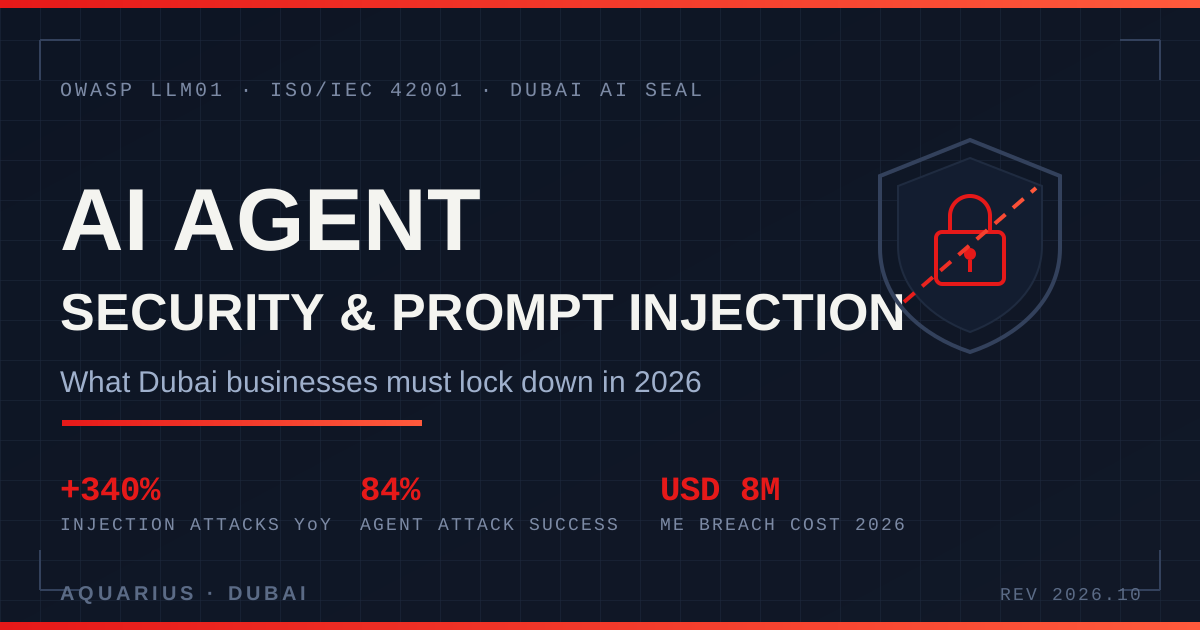
Prompt injection is the number-one security risk in AI applications — OWASP ranks it LLM01 — and attempts rose 340% year on year. For Dubai businesses the exposure is unusually sharp: 72% of UAE companies now use AI, up from 53% a year earlier, and research across 78 studies found agent systems that auto-execute tool calls are compromised 66.9%–84.1% of the time. If your AI agent can read email, query a database or call an API, an attacker does not need your password — they need your agent to read one sentence.
The Dubai gap: adoption raced ahead of AI security
The UAE is now one of the most AI-saturated economies on earth. Business adoption hit 72% in 2026, up 19 percentage points from 53% the year before, according to the Strand Partners study published with the UAE AI Office and AWS. 70.1% of the working-age population uses AI — first globally as of Q1 2026. The UAE AI market is worth roughly USD 8.3 billion in 2026, Dubai AI Campus has passed 400 companies, and AI firms at Dtec grew 95% year on year in the first half of 2026.
The attack surface grew with it. The UAE blocks around 800,000 cyberattacks a day, four times prewar volumes, and the UAE Cyber Security Council logged 128 confirmed cyber threat incidents in early 2026 across three distinct waves of AI-assisted attacks, with government, financial services and banking the most targeted sectors. Google measured a 32% increase in malicious injection payloads embedded in web content between November 2025 and February 2026 — content your agent fetches and reads as if it were data.
Most Dubai businesses secured the model and left the agent wide open. The model was never the attack surface — the tool call is.
Three numbers that make the point concrete:
- 1.8 million injection attempts — a single public red-team competition produced over 60,000 successful policy violations.
- ~50% — attackers bypass even the best-defended frontier models within ten attempts.
- 40% — the share of agent frameworks found to carry exploitable flaws in their tool-execution logic, with API-calling autonomous agents running up to 2.5x the risk exposure of a plain chatbot.
What prompt injection actually is (and why filters do not stop it)
A large language model cannot tell instructions from data. Everything in the context window is one stream of text. Prompt injection exploits that: a sentence placed anywhere the model reads — a document, a web page, a CRM field, an email signature, an image’s alt text — can override your system prompt. OWASP is explicit that the input need not be human-visible; white text on white, a hidden HTML comment or a zero-width character works fine.
Direct vs indirect injection
Direct injection is a user typing an override into the chat box: the classic jailbreak. Annoying, usually bounded by what that user is already allowed to do. Indirect injection is the one that costs money. The payload sits in third-party content your agent ingests, and it executes with your agent’s privileges, not the attacker’s. Web-based indirect injection accounts for roughly 40% of all LLM security incidents, and more than 50% of indirect injections evade standard prompt filters — because by the time the text reaches the model it looks exactly like legitimate retrieved context.
The OWASP Top 10 for LLM Applications 2025
This is the list your build should be audited against. It is the de facto baseline every serious reviewer in Dubai now uses:
- LLM01 Prompt Injection — instructions smuggled into any ingested content.
- LLM02 Sensitive Information Disclosure — the model surfaces PII, keys or internal data it should not.
- LLM03 Supply Chain — poisoned models, adapters, plugins and packages.
- LLM04 Data and Model Poisoning — tainted training or fine-tuning data.
- LLM05 Improper Output Handling — model output passed unsanitised into SQL, a shell, a browser or a payment call.
- Excessive Agency, System Prompt Leakage, Vector and Embedding Weaknesses, Misinformation, Unbounded Consumption — the remaining five, and Excessive Agency is where most Dubai pilots fail.
Four production systems broken in 2025 — all by text
These are not lab demos. Each was a shipped, enterprise-grade product:
- EchoLeak (CVE-2025-32711) — Microsoft 365 Copilot, disclosed by Aim Security in June 2025. A single crafted email exfiltrated data with zero user interaction. Patched server-side; Microsoft reported no in-the-wild exploitation.
- ForcedLeak — Salesforce Agentforce, CVSS 9.4, late September 2025. The payload went into a Web-to-Lead description field, and the data left via an expired allowlisted domain an attacker re-registered for about USD 5.
- CamoLeak — GitHub Copilot Chat, private source code leaked through rendered content.
- ShadowLeak — ChatGPT Deep Research, exfiltration from the agent’s own browsing step.
The pattern is identical in all four: untrusted content reaches a privileged agent, and the agent has an outbound channel. CrowdStrike’s 2026 reporting documented attacks of this class against 90+ organisations.
What AI agent security costs in Dubai in 2026 (AED)
Converted at USD 1 = AED 3.6725. Ranges reflect 2026 market pricing for AI red teaming and AI governance certification work:
| Engagement | 2026 range (AED) | Timeline / notes |
|---|---|---|
| One-time AI security audit | 29,000 – 92,000 | 1–2 weeks; posture review, no sustained red team |
| Simple chatbot red team | 29,000 – 55,000 | No tools, no retrieval — cheapest tier |
| RAG application red team | 55,000 – 129,000 | Adds retrieval poisoning and vector-store attacks |
| Tool-using single agent | 92,000 – 220,000 | 2–4 weeks; tool-call abuse, excessive agency |
| Multi-agent or MCP architecture | 184,000 – 551,000+ | 4–8 weeks; cross-agent trust, delegated privilege |
| ISO/IEC 42001 certification, small org | 29,000 – 74,000 | 6–12 months; plus annual surveillance |
| ISO/IEC 42001 certification, mid org | 51,000 – 129,000 | Wider scope, multiple AI systems |
| Continuous guardrail monitoring | From ~5,000 / month | Injection detection, output filtering, audit logging |
For scale: the global AI red teaming market is growing from USD 1.75 billion to USD 2.26 billion, up 28.8% — which is why specialist capacity in the region is tight and lead times are real.
The seven controls that actually work
There is no filter that reliably detects injection. Defence is architectural: assume the prompt will be injected and make it not matter.
1. Least privilege on tools, not on users
Scope every tool the agent can call to the narrowest action that completes the job. A support agent that reads orders should not hold a write token. Most Dubai pilots we review hand the agent a service account with full table access because it was faster in week one.
2. Human approval on anything irreversible
Payments, refunds, deletions, outbound email, contract generation, permission changes. One confirmation step turns a successful injection into a logged attempt.
3. Egress allowlisting — and domain-expiry monitoring
ForcedLeak worked because an allowlisted domain had lapsed. Allowlist outbound destinations, then monitor that the allowlist entries still belong to who you think they do.
4. Treat model output as untrusted input
LLM05 in one line. Never interpolate model output into SQL, a shell command, HTML or an API payload without the same validation you would apply to a form field from the open internet.
5. Separate trust tiers in the context window
Retrieved documents, web content and user-submitted fields are data. Tag them, delimit them, and never let them reach the same privilege level as your system prompt. In MCP server architectures this means per-server scopes rather than one shared credential.
6. Immutable audit logging of every tool call
Prompt, retrieved context, tool invoked, arguments, result. Without this you cannot answer a regulator’s question about what the agent did, and under PDPL you will be asked.
7. Adversarial testing before launch and after every model swap
A model upgrade changes the attack surface. Red team the agent, not the model — this is a different exercise from the web and mobile VAPT you already run.
What it costs to skip this
IBM’s Cost of a Data Breach 2026 puts the Middle East average breach at USD 8 million — roughly AED 29.4 million — the costliest region tracked. The AI-specific findings are starker: 26% of malicious breaches were AI-enabled, AI-involved breaches average USD 6 million versus USD 4.99 million globally, and shadow-AI incidents doubled to 43% of breached organisations (from 20%), with average cost climbing from USD 4.63 million to USD 5.39 million. Of those shadow-AI breaches, 49% involved data loss, 42% operational disruption and 21% a regulatory fine. Organisations using AI and automation extensively in defence saved over USD 3 million per breach.
Then the regulatory layer. UAE PDPL (Federal Decree-Law 45/2021) carries fines of AED 50,000 to AED 5,000,000: up to AED 5m for processing sensitive data without lawful basis, AED 3m for breaching data-subject rights, missing the 72-hour notification window, unlawful cross-border transfers or skipping a DPIA, and AED 1m for inadequate technical security measures or missing records of processing. The Data Office can also order processing to stop. An agent that leaks customer data through an injected prompt is an inadequate-technical-measures finding, not an act of God. Full detail is in our PDPL compliance checklist.
And there is now a commercial gate. The Dubai AI Seal, run by the Dubai Centre for AI, has drawn applications from 325 Dubai companies across 77 international offices, grading suppliers across six tiers (E to S) on security protocols, governance, ethics and AI maturity — e& and IBM were the first at Tier S. Since the Dubai Department of Finance directive of October 2025, Dubai government bodies work only with certified AI suppliers. If you sell AI to the public sector here, your security posture is now a procurement requirement, not a differentiator.
How Aquarius secures AI agents
We start with the privilege map, because it decides everything downstream: every tool the agent can reach, the exact scope of each credential, and which actions are irreversible. Then trust-tier separation in the context window, egress allowlisting with expiry monitoring, output handling treated as hostile, and immutable tool-call logging you can hand to an auditor. Then we red team it — indirect injection through every ingestion path, not just the chat box — and we re-run that suite on every model version change.
We build on UAE-region infrastructure by default, which keeps the data residency question answered before it is asked, and we map controls to OWASP LLM01–LLM10, PDPL and ISO/IEC 42001 so the evidence exists when you need it. Fixed scope, fixed price, a findings report with a reproducible proof-of-concept for every issue — not a severity table you cannot verify. Ranges are on our pricing page, and the broader regulatory picture is in our Dubai AI compliance guide.
FAQ
Can prompt injection be fully prevented?
No. There is no known complete fix, because the model cannot distinguish instructions from data in a single context window. Attackers bypass the best-defended models about 50% of the time within ten attempts, and over half of indirect injections slip past standard filters. The goal is containment: least-privilege tools, human approval on irreversible actions, egress allowlisting and full audit logging, so a successful injection achieves nothing worth having.
Is my chatbot at risk, or only autonomous agents?
Both, at very different magnitudes. A chatbot with no tools risks reputational damage and system-prompt leakage. An agent that calls APIs carries up to 2.5x the risk exposure, and auto-executing agent systems were compromised in 66.9%–84.1% of tested cases. Risk scales with what the agent is allowed to do, not with how clever the model is.
Does UAE PDPL apply to AI agents?
Yes, whenever the agent processes personal data — which covers nearly every customer-facing deployment. Fines run from AED 50,000 to AED 5,000,000, including up to AED 1,000,000 for inadequate technical security measures, and the 72-hour breach-notification clock applies. The Executive Regulations are still unissued, so the operative standard is the law itself plus sector guidance.
Do I need ISO/IEC 42001 to sell AI in Dubai?
Not legally, but it is becoming the practical bar. Certification runs roughly AED 29,000–74,000 for a small organisation and AED 51,000–129,000 mid-market, over 6–12 months with annual surveillance. Separately, the Dubai AI Seal matters for public-sector sales: since the October 2025 Department of Finance directive, Dubai government bodies only engage certified AI suppliers.
How is AI red teaming different from a normal penetration test?
A penetration test attacks code, infrastructure and APIs. AI red teaming attacks behaviour — it feeds adversarial content through every path the agent ingests and tries to make the agent misuse its own legitimate permissions. Different skillset, different findings, and you need both. Expect AED 29,000–55,000 for a simple chatbot and AED 184,000–551,000+ for a multi-agent architecture.
Next step
If your AI agent holds a credential that can write, delete or pay, that is the thing to fix before you add another use case. Tell us what your agent can reach today and we will map it against OWASP LLM01–LLM10 and PDPL — and send the 2026 AI agent security checklist either way.
Figures and regulatory positions as of October 2026. Costs vary with scope and provider; confirm compliance obligations with a UAE legal adviser before relying on them.