
AI Coding Assistants for Dubai Dev Teams: Real ROI Math for 2026
AI coding seats cost a Dubai team from AED 70 per developer per month - under 28 minutes of median dev time. The licence fee is not the risk. Here is the real 2026 ROI math, seat pricing and PDPL catch.
- PUBLISHED
- 20 NOV 2026
- READ TIME
- 10 MIN
- AUTHOR
- AQUARIUS · DUBAI
- UNIT
- REV 2026.09
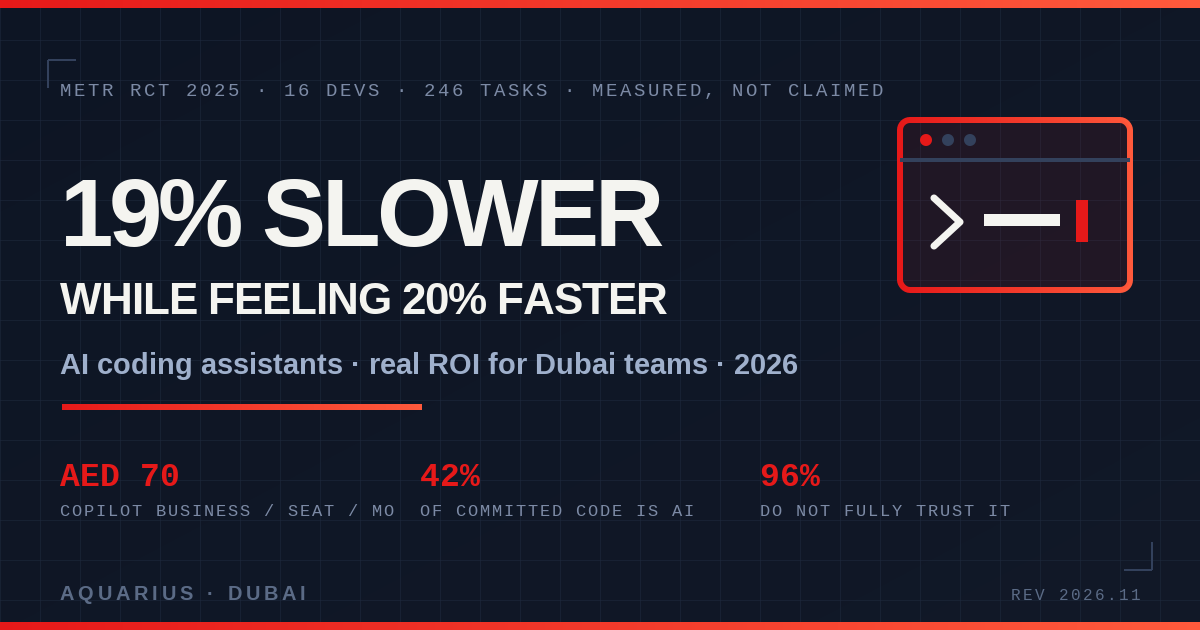
AI coding assistants are cheap and the licence fee is not the decision. A GitHub Copilot Business seat runs AED 70 per developer per month, a Claude Team seat AED 73, a Cursor Teams seat AED 110 - together under AED 255 a seat, or roughly 100 minutes of a median Dubai developer's time. The decision that actually costs money is how you govern the output: the only controlled trial on the subject found experienced developers worked 19% slower with AI on codebases they knew well, while believing they had been 20% faster.
That gap between measured and felt productivity is where most Dubai engineering budgets quietly leak in 2026. Below is the real seat pricing in AED, the review tax nobody models, the PDPL exposure hiding in personal ChatGPT accounts, and the break-even arithmetic for a Dubai team.
The Dubai numbers that set the stakes
Three figures explain why UAE engineering leaders are buying AI seats faster than they are writing policies for them.
- Developer scarcity is the binding constraint. Quantalent's 2026 UAE tech talent analysis counts roughly 23,500 open technology roles against a shortfall of about 10,500 qualified candidates, with an average time-to-fill of 48 days. Every unfilled seat is a quarter of lost roadmap.
- Dubai developer time is expensive. Levels.fyi reports a median total compensation of AED 316,000 per year for software engineers in Dubai (25th percentile AED 215,998, 75th percentile AED 420,057, from 199 reported salaries as of 18 November 2026). That is about AED 152 an hour, or AED 2.53 a minute. Guildhall's 2026 Dubai salary guide puts front-end developers at AED 24,000 to AED 34,000 a month, which lands in the same band.
- AI is already in your repository whether you approved it or not. Sonar's State of Code Developer Survey 2026 (n=1,149, fieldwork October 2025) finds AI-generated code went from 6% of committed code in 2023 to 19% in 2024 to 42% today, with developers forecasting 55% next year. 58% say AI-written code is already running in mission-critical services.
Put those together and the question is not whether to pay for AI seats. At AED 152 an hour for human output and AED 70 a month for a licence, the seat is a rounding error. The question is what the output costs you downstream.
The myth-bust: measured productivity is not felt productivity
Most Dubai businesses get this wrong because they buy on self-reported numbers. Self-reported numbers are excellent: Sonar found developers claim an average 35% productivity boost, 82% say they code faster, and Google's 2025 DORA report (around 5,000 respondents) found 90% of developers using AI and more than 80% reporting productivity gains.
Then METR ran a randomised controlled trial. Sixteen experienced open-source developers completed 246 real issues on repositories averaging 22,000+ stars and over a million lines of code - projects they had maintained for years. Before starting, they forecast AI would make them 24% faster. Measured outcome: 19% slower. Afterwards, they still believed they had been sped up by 20%.
A 43-point gap between expected speedup and measured slowdown, on mature codebases, with experienced engineers. If your business case rests on how fast your team feels, your business case is unfalsifiable.
The nuance matters: METR tested senior maintainers on code they already knew intimately - the condition where AI has least context advantage and most review cost. On greenfield work, unfamiliar stacks and boilerplate, the gains are real. DORA's framing is the honest one: AI is an amplifier. It raised throughput and raised instability at the same time. It makes a disciplined team faster and an undisciplined team faster at shipping defects.
What AI coding assistants actually cost a Dubai team in 2026
Here is the live per-seat pricing converted at AED 3.6725 to the US dollar. Figures are vendor list prices as published in November 2026 and exclude UAE VAT, which applies at 5% on most digital services supplied to a UAE business.
| Tool / tier | USD per seat / month | AED per seat / month | AED per seat / year |
|---|---|---|---|
| GitHub Copilot Pro (individual) | $10 | AED 37 | AED 441 |
| GitHub Copilot Business | $19 | AED 70 | AED 837 |
| GitHub Copilot Enterprise | $39 | AED 143 | AED 1,719 |
| Claude Team (standard seat, annual) | $20 | AED 73 | AED 881 |
| Claude Team (premium seat, annual) | $100 | AED 367 | AED 4,407 |
| Cursor Teams | $30 | AED 110 | AED 1,322 |
| Cursor Ultra (heavy agent use) | $200 | AED 735 | AED 8,814 |
Two things to read off that table. First, the entry ticket is trivial: AED 70 a month buys a Copilot Business seat, which is under 28 minutes of a median Dubai developer's time. Second, nobody buys one tool. Sonar found the average development team juggles four different AI tools, and the realistic Dubai stack - Copilot Business plus a Claude Team seat plus Cursor Teams - lands at about AED 253 a seat per month. For a ten-developer team that is AED 30,400 a year, still less than two months of one mid-level developer's salary.
Budget two further line items that invoices hide: metered usage above the included allowance (Copilot now bills overage in AI credits at $0.01 each, and Cursor charges separately for some third-party model usage), and the review time below.
The review tax: where the saved hours go back
AI shifts work from writing to verifying, and verification is the part nobody budgets. Sonar's 2026 data is blunt about it:
- 96% of developers do not fully trust that AI-generated code is functionally correct, and 61% report code that looks correct but is not reliable.
- 95% spend review effort specifically on AI output; 59% call that effort moderate or substantial.
- 38% say reviewing AI-generated code takes more effort than reviewing human code, against 27% who say less.
- Only 48% always check AI-generated code before committing it.
- Developers rank perceived positive impact at 89% for personal productivity but only 47% for technical debt, 39% for defect rates and 24% for outage severity.
That last line is the whole story. The benefit is felt at the individual commit; the cost shows up at the system level, one quarter later, in maintenance and incidents. It is also why the single most-cited skill for the AI era in Sonar's survey is not prompting - 47% named the ability to review and validate AI-generated code. We see the end state of ignoring this constantly: see our teardown of rescuing a vibe-coded app in Dubai for what unverified AI output looks like six months in.
Shadow AI is a PDPL problem, not an IT preference
Across the top ten AI coding tools, Sonar found 35% of developers access them through personal accounts rather than work-sanctioned ones. For ChatGPT that rises to 52% of its users; for Perplexity, 63%. Copilot and Amazon Q are the outliers at 17%, because they were rolled out top-down.
In the UAE that is not a licensing footnote. Under Federal Decree-Law No. 45 of 2021 (the PDPL), a Dubai company is the controller of its customers' personal data, and pasting that data into a consumer AI account - with consumer retention terms and no data-residency commitment - is a processing and cross-border transfer decision made by an individual developer with no contract behind it. Add the DIFC and ADGM regimes if you operate there. The fix is boring and cheap: buy business-tier seats with zero-retention terms, name the approved tools, and block the rest. A business seat at AED 70 is materially cheaper than a data incident. If you are shipping AI features and not just using AI to code, read our notes on AI agent security and prompt injection next.
Where agents earn their seat, and where they do not
64% of developers have started using AI agents - 25% regularly, 39% experimenting. Adoption clusters exactly where measured effectiveness is highest, which is a healthy sign:
- Documentation - 68% adoption, 70% rate it effective. Best first deployment, lowest blast radius.
- Test generation and execution - 61% adoption, 59% effective.
- Automated code review - 57% adoption, 52% effective. Useful as a first pass, not as the only pass.
- Security vulnerability patching - only 28% adoption. Developers are right to be cautious here.
For Dubai SMEs there is a genuine edge: 67% of developers at small and mid-sized businesses rated agents effective for conversational app building, against 52% at enterprises, plus 63% for project planning and task breakdown. Small teams with short decision chains extract more from agents than large ones. That is the opposite of the usual enterprise-advantage story.
The break-even math for a Dubai team
At AED 152 an hour, a Copilot Business seat at AED 837 a year pays for itself if it saves 5.5 hours per developer per year - about 28 minutes a quarter. The full AED 3,041-a-year three-tool stack breaks even at 20 hours a year, roughly 24 minutes a month. Any plausible reading of the evidence clears that bar. Buy the seats.
The downside is asymmetric, and that is the number to put in front of your CFO. If AI makes your senior engineers 19% slower on your mature codebase the way METR measured, that is about 395 hours a year per developer, or roughly AED 60,000 of lost output per head - twenty times the entire tool spend. The licence is not the risk. Ungoverned adoption is.
So the rollout that actually pays:
- Baseline before you buy. Capture lead time for change, change failure rate, deploy frequency and review turnaround for one month. Without a baseline you will be left with self-reported feelings, and you now know what those are worth.
- Target greenfield, boilerplate, tests and docs first. Keep agents off the legacy core where review cost exceeds writing cost.
- Make review the paid-for step. Mandate human review of AI output, and treat the 48%-always-check figure as the behaviour to fix.
- Gate quality in CI, not in opinion. Static analysis, coverage thresholds and a technical-debt budget, so AI volume cannot outrun your ability to maintain it.
- Standardise the stack and kill the shadow accounts. Four tools per team is sprawl; two business-tier tools with the right terms is a policy.
How Aquarius does it
We build web, mobile and custom software for UAE businesses, and we use AI assistants on client work daily - under rules. Every AI-touched line goes through human review before merge, static analysis and test gates run in CI on every pull request, and we use business-tier seats with zero-retention terms so UAE client data never lands in a consumer account. Fixed-scope quotes, documented architecture you own outright, no lock-in to our team. If you want the comparison with ground-up build cost, see our 2026 Dubai custom software cost guide and our pricing page.
FAQ
How much do AI coding assistants cost per developer in Dubai?
From AED 37 a month for GitHub Copilot Pro to AED 70 for Copilot Business, AED 73 for a Claude Team seat and AED 110 for Cursor Teams, at AED 3.6725 to the dollar and excluding 5% UAE VAT. A realistic three-tool stack is about AED 253 a seat per month, or AED 30,400 a year for a ten-developer team.
Do AI coding assistants actually make developers faster?
Conditionally. Developers self-report about a 35% boost and over 80% of DORA respondents report productivity gains, but METR's randomised trial measured experienced maintainers working 19% slower on codebases they knew well while believing they were 20% faster. Gains are strongest on new code, tests and documentation; weakest on mature, complex systems.
Is it safe under UAE PDPL to use ChatGPT or Copilot on client code?
Only on business or enterprise tiers with zero-retention and clear processing terms, with a named approved-tools policy. Sonar found 35% of developers use AI tools through personal accounts, and 52% of ChatGPT users do - which puts controller obligations under Federal Decree-Law No. 45 of 2021 in the hands of an individual developer with no contract behind the transfer.
What should a Dubai engineering team measure to prove ROI?
Lead time for change, deploy frequency, change failure rate, review turnaround and defect escape rate - baselined for a month before rollout. DORA's 2025 finding was that AI raised throughput and instability together, so measuring speed alone will show a win even when the net result is negative.
Will AI coding assistants replace developers in the UAE?
Not against a shortfall of roughly 10,500 qualified candidates and a 48-day average time-to-fill. The job is shifting: 47% of developers name reviewing and validating AI-generated code as the key skill of the AI era, and AI already accounts for 42% of committed code. The scarce person is the one who can tell good AI output from plausible AI output.
Rolling out AI assistants across a Dubai dev team, or cleaning up after one that was never governed? Talk to Aquarius - we will review your stack, quality gates and PDPL exposure, and tell you plainly which seats are worth paying for.