
We Sent ChatGPT's Shopping Agent to 137 UAE Stores: 13 Slammed the Door
We probed 787 .ae domains as Chrome and as ChatGPT-User on 29 Nov 2026. 13 of 137 UAE stores block the shopping agent at the edge, none disallow it in robots.txt, and only 20.4% expose a readable price.
- PUBLISHED
- 29 NOV 2026
- READ TIME
- 12 MIN
- AUTHOR
- AQUARIUS · DUBAI
- UNIT
- REV 2026.09
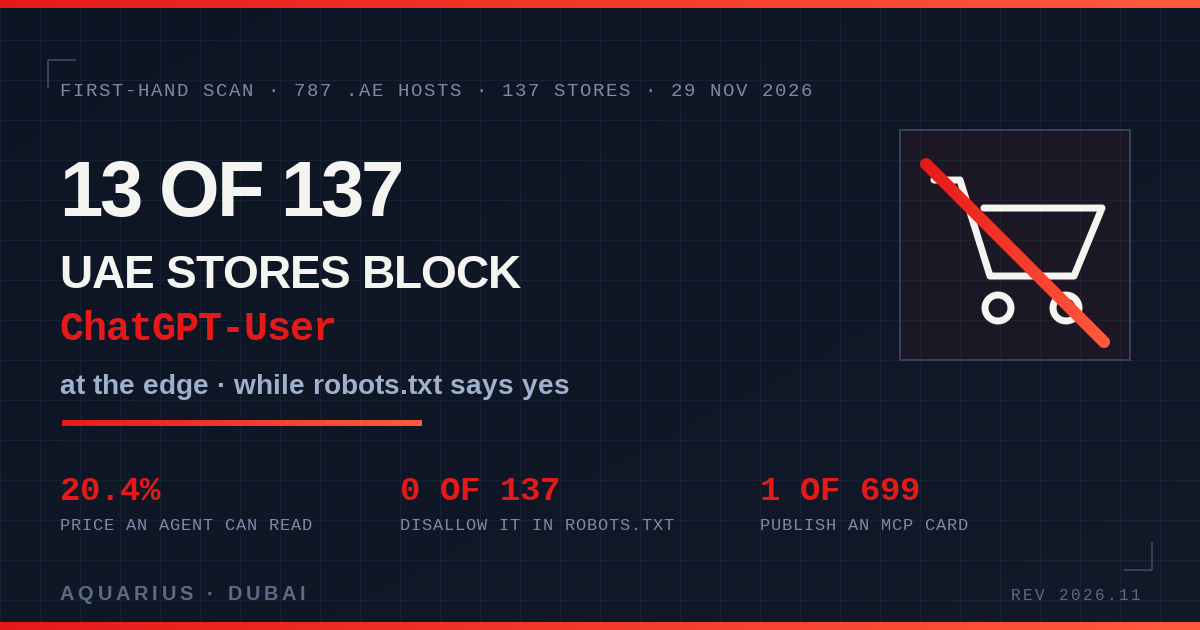
Short answer: on 29 November 2026 we fetched 787 UAE .ae homepages twice — once as a normal mobile Chrome browser, once as ChatGPT's shopping agent. 568 answered with live HTML and 137 of those are real online stores. 13 of the 137 refuse ChatGPT-User at the edge while serving the identical page to Chrome, only 28 (20.4%) expose a product price an agent can actually read, and across all 699 hosts that answered anything at all, exactly one publishes an MCP server card.
That is the gap in one line: UAE shoppers are ready to let an agent buy, and UAE stores are configured to stop it. Not by policy — not one of those 137 stores disallows ChatGPT-User in robots.txt. By accident, in a bot-management rule nobody has looked at since it was switched on.
Three numbers that set the stakes
First, demand. Visa's 2026 Global Digital Shopping Index found 82% of UAE consumers would let an AI agent complete a purchase autonomously if they could set a price cap, and 71% expect to be using an AI shopping agent within two years. More striking: 64% said they would trust an AI shopping agent's recommendation more than a family member's — against 27% in the US and 25% in the UK. The UAE is not a late market for agentic commerce. It is the forward market.
Second, the merchants agree. 74% of UAE merchants expect AI agents to drive at least 5% of sales within two years and 42% expect at least 16%. That is being bet against a market worth roughly AED 45.1 billion in 2026, on its way to about AED 67 billion by 2030 at a 9.9% CAGR.
Third, the readiness. Visa's own merchant survey found only 19% of UAE merchants have product data structured for an agent to read. We measured the same thing independently, from the outside, on live .ae stores, and got 20.4%. Two different methods, one answer: four out of five UAE stores are invisible to the thing their customers are about to start shopping with.
How we measured it
We took 787 .ae hosts from the Tranco top-sites list and requested each homepage twice from the same machine, seconds apart, with identical Accept and Accept-Language headers. The only difference was the user-agent: a current Android Chrome string, then the same string carrying ChatGPT-User/1.0. 699 hosts answered something; 568 returned a 200 with real HTML (at least 500 characters of text after stripping tags). We classified a host as a store only when at least two independent signals agreed — a cart or checkout path, a known commerce platform, product schema, or price attributes alongside AED — which gave 137 stores across Shopify (38), WooCommerce (34), Magento (23), OpenCart, Odoo, PrestaShop and others.
Every host we name below was then re-tested on both the apex and the www hostname with four different agent user-agents: ChatGPT-User, Claude-User, Perplexity-User and OAI-SearchBot. One site from the first pass (a pet retailer) served normally on re-test and was dropped. The 13 named here failed twice, on both hostnames.
Finding 1: 13 stores block the shopper and let the browser in
Of the 137 stores, 123 (89.8%) served the agent the same page they served Chrome. The remaining 14 (10.2%) did not: nine hard 403s, three 405s, one 404 and one connection failure. After apex-and-www re-verification, 13 are reproducible edge blocks.
The interesting part is that most of them are not blocking agents as a category. They are blocking one agent, inconsistently:
| Store | Mobile Chrome | ChatGPT-User | Other agent UAs |
|---|---|---|---|
| binsina.ae | 200 (1.64 MB) | 405 (424 bytes) | Claude-User and Perplexity-User served in full |
| grandstores.ae | 200 (1.63 MB) | 404 (614 bytes) | All three others served in full |
| sharkninja.ae | 200 | 405 | Perplexity-User served; Claude-User also 405 |
| hollandandbarrett.ae | 200 | 405 | Claude-User served |
| egolfmegastore.ae | 200 | 403 | At least one rival agent served |
| elpadel.ae / engagestores.ae | 200 | 403 | Claude-User served; Perplexity-User blocked |
| proshop.ae / ptcdxb.ae / bdc.ae | 200 | 403 | At least one rival agent served |
| airbnb.ae / solomia-home.ae / policybazaar.ae | 200 | 403 | All four agent UAs blocked |
10 of the 13 serve at least one competing AI agent while refusing ChatGPT's. Only three block agents across the board. That is not a decision — a decision would be consistent. It is a WAF signature list that happens to contain one string and not the others. The 424-byte 405 responses cluster across three unrelated stores on the same pattern: a bot-manager rule rejecting the request method before the application ever sees it.
If you have ever wondered why your store does not appear when a customer asks ChatGPT "where can I buy this in Dubai", this is the first place to look — before content, before schema, before anything. A 403 is not a ranking problem. It is a locked door.
Finding 2: robots.txt says yes, the edge says no
We then read the robots.txt of all 137 stores (128 had one) and parsed the user-agent groups properly rather than grepping for strings. The result is almost comic:
- Zero of 137 stores disallow
ChatGPT-User. Five explicitly allow it; nine have partial rules; the rest never mention it. - Zero disallow
OAI-SearchBoteither. - But 11 block
GPTBot, 10 blockApplebot-Extendedand 8 blockGoogle-Extended— the training crawlers.
So the stated policy across the UAE's commerce web is coherent and, frankly, correct: do not train on my catalogue, but do let the shopping agent read it. The edge configuration then does the exact opposite. Of our 13 edge blockers, none disallows ChatGPT-User in robots.txt; three have no robots.txt at all; and policybazaar.ae publishes an explicit Allow for GPTBot while 403-ing every agent user-agent we sent. Eleven of the 137 have gone as far as adopting Cloudflare's Content-Signal syntax — a policy layer stacked on top of an infrastructure that contradicts it.
Nobody is lying. Two teams simply own the two halves of the answer, and nobody has tested the result end to end. We wrote about the signing standards meant to fix this in Web Bot Auth and signed agents; none of it helps while a legacy rule is returning 403 before the signature is checked.
Finding 3: only 20.4% expose a price an agent can read
Being reachable is table stakes. The agent then has to find a product and a price. So for each of the 137 stores we followed up to three product, collection or category links from the homepage and parsed JSON-LD and microdata on the destination.
- 49 of 137 exposed no product or collection link in their raw HTML at all. A browser renders those menus with JavaScript; a plain fetcher sees nothing. Of the 88 we could reach, we got a product page on all of them.
- 28 stores publish Product or Offer schema on an inner page — 20.4% of all 137, or 31.8% of the 88 we could actually reach.
- Of those 28, 23 expose a machine-readable price value and 24 declare
priceCurrency: AED. Not one relied on Open Graphproduct:price:amountalone. - On homepages the picture is thinner still: 105 of 137 stores (76.6%) ship some JSON-LD, but only 14 (10.2%) carry strict Product or Offer markup.
Then the sting. Four of the 28 stores that did the schema work — sharkninja.ae, egolfmegastore.ae, engagestores.ae and elpadel.ae — block the agent that would have read it. They paid for the structured data and then firewalled the reader. Combine both requirements — machine-readable product data and an open door — and the UAE's agent-ready store count is 24 of 137. Measured at homepage level only, it is 12 (8.8%).
Finding 4: one MCP card in 699 hosts
The next layer of agentic commerce is discovery: a machine-readable card at a well-known path that tells an agent what your site can do. We requested /.well-known/ai-plugin.json, /.well-known/mcp.json and /.well-known/agent-card.json on every host — plus a random 18-character control path, which matters more than it sounds. 91 of 699 hosts return HTTP 200 for a .well-known path that does not exist. Skip the control and you would report a 91-fold overstatement of adoption.
After correcting for catch-alls: zero genuine ai-plugin.json files, zero agent-card.json files, and exactly one real MCP server card — wego.ae. It is the real thing: served on both apex and www, Content-Type: application/mcp-server-card+json, 543 bytes, naming a remote streamable-HTTP endpoint and four supported protocol versions back to 2024-11-05. One travel site, in a sample of 699, is currently addressable by an agent on purpose.
That is the opportunity, not the problem. Discovery files are hours of work, not quarters.
What this is worth, in AED
The conversion case is no longer speculative. Visibility Labs' 12-month study of 94 brands put ChatGPT referral conversion at 1.81% against 1.39% for non-branded organic — about 31% better, with 37% higher revenue per visit. By mid-2026 AI-referred retail visits in the US were converting roughly 60% better than the average visit. Ignore the "4x" headlines; the honest number is still a premium, on traffic that compounds while your competitors are 403-ing it.
Here is what the fix costs at Dubai rates, and roughly how long each piece takes:
| Work | What it fixes | Typical AED | Timeline |
|---|---|---|---|
| Agent access audit | Finds the 403 / 405 / 404 rule and the robots.txt contradiction | AED 3,500 – 6,000 | 3 – 5 days |
| WAF and bot-rule remediation | Allow-lists verified agent UAs; keeps trainers blocked | AED 4,000 – 9,000 | 1 week |
| Product and Offer schema on every SKU | Price, availability and AED currency an agent can parse | AED 9,000 – 22,000 | 2 – 4 weeks |
| Server-rendered product and category links | Removes the JavaScript wall that hid 49 of 137 catalogues | AED 12,000 – 35,000 | 3 – 6 weeks |
Discovery layer (mcp.json, feeds, Content-Signal) | Makes the store addressable on purpose, like wego.ae | AED 6,000 – 15,000 | 1 – 2 weeks |
Our full engagement ranges are on the pricing page, and the e-commerce build context is in what an online store actually costs in Dubai.
How Aquarius does it
We start with the measurement, because everything else is guessing. Same method as above, against your domain: two user-agents, apex and www, a real SKU, your robots.txt parsed as a machine would parse it. Then we fix in the order that pays — access first, because schema behind a 403 earns nothing; then product data; then discovery. We re-probe after every change and show you the raw status codes, not a score out of 100.
Risk reversal: if our probe finds no agent-blocking rule and no product-data gap on your store, the audit is free and we will tell you to spend the budget elsewhere. We would rather be the firm that said so. See the rest of what we build on our services page, or read the strategy piece behind this scan, agentic commerce in Dubai.
FAQ
Is blocking ChatGPT-User the same as blocking GPTBot?
No, and the difference is money. GPTBot collects data for training. ChatGPT-User and OAI-SearchBot fetch pages because a customer asked a question right now. Blocking the first is a defensible content decision. Blocking the second removes you from the answer. Across our 137 UAE stores, zero disallowed the shopper in robots.txt — 13 blocked it anyway at the edge.
How do I check my own store in five minutes?
Request your homepage twice with curl, once with a normal browser user-agent and once with a string containing ChatGPT-User/1.0, and compare the status code and the byte count. Do it on both the apex and the www hostname, because they frequently sit behind different rules. Anything other than a matching 200 with a similar size is a block or a degraded page.
Do I need ACP, AP2 or x402 to be agent-ready?
Not yet. OpenAI retired in-chat Instant Checkout in March 2026 and moved to discovery-and-redirect, so the thing that actually matters in 2027 is whether an agent can reach your page and read your price. The payment rails are consolidating meanwhile — x402 moved to the Linux Foundation in April 2026 with 22 founding members including Visa, Mastercard and Stripe, and Google's AP2 has 60-plus partners — but structured product data is the prerequisite for all of them.
Will allowing agents through cost me bandwidth or scraping risk?
Some, and it is manageable. Rate-limit by verified agent identity rather than blocking by user-agent string, keep training crawlers disallowed in robots.txt, and serve agents the same cached HTML you serve search engines. Eleven of the 137 stores we scanned are already using Content-Signal to state terms rather than slamming the door.
Our data for this piece is first-hand and reproducible: 787 hosts, 29 November 2026, both user-agents, apex and www re-verified, control path included. If you want the same numbers for your own domain before a competitor finds them, send us the URL and we will run it today.